
Renewable energy sector grows but barriers remain

Energy production must shift from fossil fuels to renewable sources within four decades to avoid the most damaging consequences of climate change, a government report has found. The Climate Commission’s report on the state of the sustainable energy market, titled The Critical Decade: Generating a renewable…

Xxqk34hg-1353890797
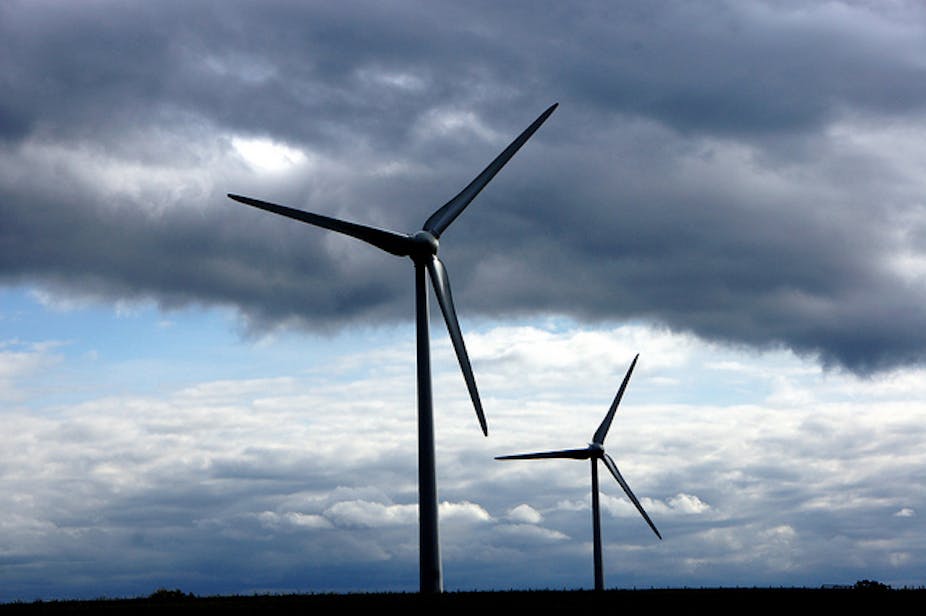
South Australia’s wind energy per capita is higher than any major country in the world, the report said. http://www.flickr.com/photos/twicepix/

Energy production must shift from fossil fuels to renewable sources within four decades to avoid the most damaging consequences of climate change, a government report has found.

The Climate Commission’s report on the state of the sustainable energy market, titled The Critical Decade: Generating a renewable Australia, was released as world leaders gathered for global climate talks in Doha this week.

“Australia has world-class solar and wind energy resources in many parts of the country,” said the report, adding that investment in solar photovoltaic (PV) and wind energy infrastructure could help create jobs, reduce air pollution and save consumers money.

“Solar PV and wind could be the cheapest forms of power in Australia for retail users by 2030, if not earlier, as carbon prices rise,” the report said.

While China has the most installed renewable energy infrastructure and is the sector’s biggest investor, “South Australia’s wind energy per capita is higher than any major country in the world and wind is now contributing approximately 26% of the state’s total electricity production,” the report said.

Report author and Climate Commissioner, the University of New South Wales' Professor Veena Sahajwalla, said that global investment in renewable energy reached almost $250 billion in 2011.

“A renewable energy future is inevitable and we are headed in that direction worldwide,” she said.

“With these renewable technologies, they are only going to get cheaper and cheaper.”

However, Mark Diesendorf, deputy director of the Institute of Environmental Studies at the University of New South Wales, said the report failed to discuss the barriers to renewable energy sector growth in Australia, which include fossil fuel subsidies to the tune of over $10 billion a year.

“Obviously, they are trying to put a rosy glow on the situation to avoid criticising federal and state governments,” he said.

While the federal government funds some demonstration solar projects, there were no real incentives to expand the solar market, he said. Only the ACT government funded medium scale solar power stations.

“At the state level, we have seen Victoria, NSW and Queensland putting in place policies to hold back renewable energy. In Victoria, it’s now almost impossible to build a new wind farm, so severe are the restrictions on siting,” he said.

“NSW has followed Victoria’s unfortunate lead to some degree and all three states have cut back on feed-in tariffs for residential renewable energy.”

Professor Diesedorf said UNSW research published inthe journal Energy Policy had found that 100% renewable energy systems (using wind, solar and biomass) could supply the national electricity market with the same reliability as the existing polluting system.

Andrew Blakers, Director of the Centre for Sustainable Energy Systems at the Australian National University, said that grid parity for rooftop-mounted photovoltaics has been reached already throughout Australia for both domestic and commercial retail consumers.

“We do not have to wait until 2030, as projected by the Climate Commission report. It is puzzling that the Climate Commission did not recognise this fact,” he said.

Photovoltaic and wind power are likely to be the main sources of new energy generation capacity for decades to come and parity with the cost of wholesale electricity from new gas or coal fired power stations is likely to be achieved by both wind and solar this decade, he said.

“The traditional Australian electricity industry is under severe pressure from PV and wind, the implementation of energy efficiency measures, and falling demand. The industry may choose to cope by attempting to keep PV out of the market place. Alternatively, it could embrace PV, wind and energy efficiency and rapidly transform itself.”

“Large changes are required in both infrastructure and tariff structures as the industry rapidly transforms to clean distributed generation from thousands of wind generators and millions of rooftop PV systems.”

Sign in to Favourite

Want to follow The Conversation?

Sign up to our free newsletter to get the day's top stories in your inbox each morning, with a special wrap on Saturday.

Spinner
Donate and become a friend of The Conversation

Join the conversation

61 Comments sorted by

  1. Sunanda Creagh

    Editor at The Conversation

    The topic of this article is not whether climate change exists; it's the renewable energy sector. Comments not on this topic will be deleted.

    report
    1. Mark Harrigan

      Dr

      In reply to Sunanda Creagh

      Hooray! :) My question to mark Diesendorf, whose published research is excellent (I think) is as follows:

      What percentage of gas is required to make your scenarios work and what are the emission levels associated with this use (including the life cycle of the fuel source or agricultural offset emissions if bio fuel) and what is the cost to implement such a scenario?

      report
    2. Peter Lang

      Retired geologist and engineer

      In reply to Sunanda Creagh

      Mark Harrigan,

      I can give you a preliminary response while waiting for Mark Diesendorf's answer. In the early work Ben Elliston did for his PhD, supervised by Mark Diesendorf, he modelled an NEM with 100% renewable energy to meet the 2010 demand profile (averaged to hourly demand demand, so lower peak than actual). That modelling required 13% of biofuels. It's important to note that this does not provide even close to the reliablity we demand, but Mark disputes that. Since biofuels are not…

      Read more
    3. Mark Harrigan

      Dr

      In reply to Sunanda Creagh

      Thank you for your reply Peter Lang. I am passingly familiar with your work on BNC and the criticisms of Mr Diesendorfs approach.

      I agree with your costs about the total system comment and would really like to see more public, civil discourse based on about this. I look forward to the forthcoming paper that Mark talks about and I hope we can have a good public discussion/debate about it.

      I'm not sure who would be a good authority to contribute to the discussion but I share your concerns about…

      Read more
  2. Tony Xiao

    retired teacher

    Professor Diesedorf's claim that renewables could supply 100 percent of the national electricity market with the same reliability as the existing system needs to be addressd by Power Engineers.
    With the existing technology it is impossibe to provide grid stability from large percentages of renewable energy on the Power Grid and there are reports out there from Europe, Asia and the US to verify this problem. .
    While decreases in load can be achieved with renewables, increases in load, cannot be achieved by renewables in the response time required to maintain grid stability (voltage and frequency control) in order to prevent damage to machinery and electrical equipment.
    Power Grid operators will not jeapardize Grid stability while they are legally liable for damages incurred to equipment caused by negligence..

    report
    1. Felix MacNeill

      Environmental Manager

      In reply to Tony Xiao

      What tends to get forgotten in discussions around intermittency of renewables and the need to maintain a stable grid is that generators and distributors are already pretty good at coping with less than fully predictable demand - they've simply had to be.

      Therefore, while adding the issue of intermittency of supply (though this can be hugely mitigated through developing a range of technologies across the whole country, supported by increasingly effective storage systems like molten salt) to unpredictability…

      Read more
    2. David Jones

      Engineer

      In reply to Tony Xiao

      Tony,

      biogas, geothermal, concentrating solar thermal with storage, conventional hydro and pumped storage hydro can all provide grid regulation functions in the same way as our existing grid generators. They are also arguably more flexible than our existing baseload generators.

      Even wind and PV can provide a limited amount of grid support services if appropriately specified.

      report
  3. Peter Bysouth

    Semi-Retired

    Dear Mark, Would you please supply a break up of the $10bn oft reported subsidy to the fossil fuel industry? it seems as though there is an inclusion of the diesel fuel rebate. However, the excise was always explained as a tax to pay for the national highways. If you operated off road e.g. farm tractors, stationary plant, generators etc you didn't have to pay excise. I also see that the excise rebate is also counted as a subsidy to the mining industry. How many times can a subsidy be counted. Please what are the facts?

    report
  4. John Newlands

    tree changer

    Several bald statements in this article are highly questionable. For starters some of the alleged 'subsidies' to fossil fuels are a matter of semantics. For example the diesel rebate is a discounted tax rate not what I'd call a subsidy. To be consistent the authors should renounce feed-in tariffs which to my thinking are unambiguous subsidies.

    High penetration renewables is a lofty sentiment but as Germany and our own South Australia illustrate it seems to be impossible without a lot of gas…

    Read more
    1. Mike Hansen

      Mr

      In reply to John Newlands

      John. I know you are not a climate science denier so I am totally baffled by your argument.

      "To be consistent the authors should renounce feed-in tariffs which to my thinking are unambiguous subsidies."

      What are you on about? Of course they are subsidies. That is the whole point. Because of global warming, we need to encourage the uptake of renewable energy and discourage the use of fossil fuels. Anything that encourages the use of fossil fuels - whether it is a diesel fuel rebate or a set of steak knives with every drum of diesel should be phased out.

      Renewables are not competing against fossil fuels.

      Renewables are competing against fossil fuels + the damage being done to environment by continuing to add CO2 to the atmosphere.

      report
    2. Mark Harrigan

      Dr

      In reply to John Newlands

      @ Mike and John - I think the whole "subsidy" debate is a bit of a furphy.

      First we have a real definitional problem of what is a subsidy and what is not. Then there is the question of whether we are comparing apples with oranges. For example - is the diesel fuel rebate a "subsidy" for the generation of electricity delivered to homes and business by poles and wires? Clearly the feed in tariff is a subsidy but is this a bad thing?

      Mark Diesendorf has cliamed the miners and farmers "don't need" the diesel fuel rebate - (I doubt you'd get many of them to agree!!) but I'm not sure it's relevant?

      Globally the best data I can find is in the link below (global not local alas)

      http://www.iisd.org/gsi/sites/default/files/relative_energy_subsidies.pdf

      have a look at Table 1 on page 3. It shows that on a per kWh basis fossil fuels enjoy the lower subsidies and renewables the highest - but then - isn't that what it SHOULD be?

      report
  5. Tom Keen

    BSc

    "grid parity for rooftop-mounted photovoltaics has been reached already throughout Australia for both domestic and commercial retail consumers."

    That statement is at odds with figures in the recent Australian Energy Technology Assessments (AETA) report http://www.bree.gov.au/publications/aeta.html - is there a reference for that? And what exactly does "grid parity" mean anyway? Even if the LCOE of rooftop PV was the same as coal (it's not), a direct comparison of a non-dispatchable energy technology…

    Read more
  6. John Newlands

    tree changer

    @Mike Hansen
    the switch to low carbon is the whole point of carbon pricing. It is double dipping to then give feed-in tariffs. In Europe it is getting to the absurd point of 'triple dipping' whereby gas fired generators want to be paid to remain on standby if preferentially treated wind and solar under perform.

    In my opinion low carbon and not preferred technology should be the brief of the Climate Commission. It's not their business and if the German experiment goes bad they will lose credibility. The CC will be just as relevant to the climate debate as Al Gore in the US ....you work out if that's a compliment.

    BTW my electricity bill has been up to $550 in credit and I've done 400 km trips entirely on home made biodiesel. I've disconnected my electric range and I've helped friends with microhydro projects. Yet it's obvious to me 99% of the population are not in that position. High penetration renewables is a fantasy of the already privileged.

    report
  7. Mark Diesendorf

    Associate Professor and Deputy Director, Institute of Environmental Studies, UNSW at University of New South Wales

    As Sunanda’s excellent article states, our initial study published in the journal Energy Policy found that 100% renewable energy systems (using wind, solar and biomass) could supply the National Electricity Market with the same reliability as the existing polluting system. The study simulated demand and supply using real hourly data on demand, wind power and sunshine and accurate models of real commercially available renewable energy technologies. The many simulations in that study explored different…

    Read more
    1. Peter Lang

      Retired geologist and engineer

      In reply to Mark Diesendorf

      Dr Diesendorf's comments about reliability of a system with only 7% of electricity supplied by back-up are not credible. Table 4 here http://bravenewclimate.com/2012/02/09/100-renewable-electricity-for-australia-the-cost/ suggest that 46% of electricity would need to be supplied by back up generators

      Regarding biofuels, Dr Diesendorf never did answer these questions posed to him on the thread where he replied to my critique:

      "1. Dr. Diesendorf says it is too early to focus on the costs of…

      Read more
  8. Mark Diesendorf

    Associate Professor and Deputy Director, Institute of Environmental Studies, UNSW at University of New South Wales

    Re subsidies to the production and use of fossil fuels in Australia, see Chris Riedy’s paper at www.isf.uts.edu.au. One of these subsidies, the diesel fuel rebate, flowed to miners and farmers, most of whom don't need it. The point is that subsidies to fossil fuels are big and are not decreasing, despite a long history of use, while subsidies to renewable energy are comparatively small and decreasing, depsite a short history.

    To Tony Xiao: two of the authors of the UNSW studies are electric power…

    Read more
    1. Mark Harrigan

      Dr

      In reply to Mark Diesendorf

      @ Mark Diesendorf - 1st thanks for taking the time to engage with some of the comments - not many writers do but those that do really add to the collective learning I feel.

      However I would like to challenge some of your statements about subsidies and Chris Reidy's work (and also seek your comment on broader matters)

      If you would care to comment that would be great?

      If I've read Chris's work correctly of the $10B in fossil subsidies (based on 2005-6 figures I believe) , over $7 Billion is…

      Read more
    2. David Arthur

      n/a

      In reply to Mark Diesendorf

      @ Mark Harrigan: regarding a possible role for nuclear power in Australia's future, we need to remember that nuclear power in Australia is can only be located near the coast due to the absolute lack of environmentally acceptable water supplies anywhere inland.

      So, what factors must then be considered? The factors I can think of include
      1. Geology/soils.
      2. Seismic risks.
      3. Environmental impact of warmed cooling water discharge; this will include the warmed deoxygenated hypersaline desalination…

      Read more
    3. Mark Harrigan

      Dr

      In reply to Mark Diesendorf

      @ David - yes some good points about siting issues. But 1 & 2 are pretty good in Aus and point 3 applies to pretty much any large scale thermal plant - coal, nuclear or CST. And yes Fukushima was poorly sited and not properly shielded - although it's interesting to note that Fukushima Daini (just 11 kilomteres away from Fukushima daichi) the shutdown for the tsunami was NOT a problem

      http://safetyfirst.nei.org/safety-and-security/fukushima-daini-model-of-a-safe-shutdown/

      Of course this gets no press because we don't focus on what doesn't happen.

      report
  9. Geoffrey Henley

    Research Associate

    Renewal energy advocates often gloss over some of the significant limitations of this technology.

    One problem is the incredible difficulty in maintaining a consistent supply of power to the grid when wildly fluctuating renewable output has to be balanced by input from conventional power stations. Also, to keep that back-up constantly available often requires fossil-fuel power plants to run much of time very inefficiently and expensively, frequently negating any supposed CO2 savings.

    Winds farms commonly produce only a fifth to a quarter of their rated capacity, so the usefulness of these farms is often exaggerrated. For example, last year Germany's wind turbines, despite having a capacity of 29 GW, had an average actual output of 5 GW with most of the rest coming from fossil fuel power stations.

    report
    1. Peter Lang

      Retired geologist and engineer

      In reply to Geoffrey Henley

      "One problem is the incredible difficulty in maintaining a consistent supply of power to the grid when wildly fluctuating renewable output has to be balanced by input from conventional power stations."

      This is an important point that most people do not appreciate. To provide some insight, I'll post a copy of an email I received today.

      "This is not a simple problem, as the outcome depends upon whether the OCGT is a single shaft unit or not and on the size of the frequency drop – which in turn…

      Read more
    2. Mike Hansen

      Mr

      In reply to Geoffrey Henley

      @Geoffrey Henley

      Geoffrey. You were bragging about your superior knowledge of the scientific method on a previous thread. Why is then that you always make claims that are never ever backed up with references so that your claims can be checked?

      Fortunately we have Google at out disposal.

      Here is a quote I found
      "One is that it becomes incredibly difficult to maintain a consistent supply of power to the grid, when that wildly fluctuating renewable output has to be balanced by input from conventional…

      Read more
    3. David Arthur

      n/a

      In reply to Geoffrey Henley

      Thanks for that information about intermittency of renewable energy generation, Geoff Henley & Peter Lang.

      It's true that solar thermal and solar PV are intermittent, but at least we know (millenia in advance) WHEN the sun is shining, and the maximum insolation that any particular installation will receive. We know with a day or two's notice, the amount of cloud cover that will restrict solar PV, and require solar thermal to resort to drawing down on its stored heat.

      Hmm ... matter of fact…

      Read more
    4. Geoffrey Henley

      Research Associate

      In reply to Geoffrey Henley

      @Mike Hansen.

      So I quoted from an article by Christopher Booker without attribution. Big deal. The problems with the fluctuating nature of renewable energy and it's affect on managing a power grid are well known and well documented. Same for the large differential between rated capacity and actual power generated. Nothing new there. Been said many times before. Your accusations of plagiarism are baseless because I'm not presenting new information and claiming it to be by own work.

      The Guardian ran stories on Lewandowsky's lamentable 'moon-landing' paper and Joelle Gergis's discredited and now retracted 'Australian hockey stick' paper, so their credibility in the area of climate science information is almost non-existent.

      BTW, I did mention my institution in a previous post. So you messed up there.

      report
  10. Neil Gibson

    Retired Electronics Design Engineer

    @Mike Hansen. You attack Geoff Henley for the source of his information while not debating it's truth. Geoff's post is right on the money regardless of source and Europe is starting to see Merkel's green energy dream turn into a nightmare. Wind farms are always fraudulently quoted as supplying so many thousand homes whereas the number they can supply reliably is close to zero - see http://windfarmperformance.info/documents/analysis/monthly/aemo_wind_201203_hhour.pdf
    Stating that solar panels are…

    Read more
  11. Peter Lang

    Retired geologist and engineer

    Many renewable energy advocates continually repeat the same nonsense about renewable energy can be made reliable if it is sufficiently widespread, if there are sufficient mix of technologies, and.or if there is sufficient energy storage. All this is theoretical. These people seldom estimate the costs for their schemes. Or when they do they grossly underestimate. Renewable energy is very costly, energy storage is very costly, and transmission is very costly. Also, renewable energy technologies…

    Read more
  12. Peter Lang

    Retired geologist and engineer

    Ivanpah CST, California

    Renewables require an order of magnitude more materials, per TWh of electricity supplied, than nuclear; that means renewables require more mining, processing, manufacturing, fabrication, construction, decommissioning and disposal, and transport between all stages, than with nuclear.

    Australia’s federal government has committed us to waste about $25-30 billion on subsidies for renewable energy by 2020. That is for a negligible amount of energy. It is an enormous waste…

    Read more
    1. Zvyozdochka

      logged in via Twitter

      In reply to Peter Lang

      30,000 tonnes! Is that a lot? How much does a nuclear reactor weigh and how much of it is recyclable?

      report
    2. David Jones

      Engineer

      In reply to Peter Lang

      Peter,

      you conveniently select the upfront materials usage and capital costs for comparison (also using the most expensive renewables you can find) while ignoring whole of life issues.

      Yes, renewables typically have high upfront costs and materials usage but they have little or no ongoing costs and materials usage, unlike nuclear and fossil alternatives.

      Nuclear proponents commonly crow about the negligible fuel usage of reactors but they neglect the actual mining required to acquire the…

      Read more
    3. Peter Lang

      Retired geologist and engineer

      In reply to Peter Lang

      David Jones,

      You said: "Peter, you conveniently select the upfront materials usage and capital costs for comparison (also using the most expensive renewables you can find) while ignoring whole of life issues."

      No this is wrong. You have a misunderstanding. Levelised Cost of Electricity" includes full life time costs. Everything is included.

      The rest of what you say is equally wrong. There is no point in just regurgitating the nonsense the anti-nukes have been dishing out for decades. If you are interested try doing some unbiased, impartial research. No point people like me trying to explain this to people who's minds are locked shut. If you are interested, you can do the research. The information is readily available.

      report
  13. Peter Lang

    Retired geologist and engineer

    I see the tired old anti-nuke talking points are being rolled out again by the usual nuke deniers. The one about water has been raised.

    Nuclear power uses slightly more cooling water than coal (about 10% more), but less in the rest of the process. It uses far less than geothermal or solar thermal (both of which are usually located in dry inland areas). Like all these, nuclear can also be air cooled. However, it makes more sense to locate nuclear plants on the coast and use sea water for cooling. This is practicable for nuclear but usually not for the other technologies. Australia's first plants might be located at existing coal fired power station sites and use the same water for cooling. Or we may go straight to the new small modular nuclear power plants (air cooled) like this: http://www.uxc.com/smr/Library/Design%20Specific/mPower/Presentations/2012%20-%20Reactor%20Design%20Overview.pdf

    report
  14. Peter Davies

    Bio-refinery technology developer

    Peter Lang,

    Thanks for the explanation for the gas turbine load following problem, I was aware there was an issue but hadn't had it described this way. We have done some desktop assessments of requirements for running low btu optimised gas turbines (in this case a 4MWe Typhoon) using RPS Biomass gasifiers supplying the fuel gas. Most of the problems seemed to relate to the compressor and start up. Our (theoretical) solution was to run the compressor separate to the turbine using a industrial spark…

    Read more
  15. Peter Bysouth

    Semi-Retired

    Further to the notes and comments re grid stability, I note that the "wunderkinda" of technology are having significant/expensive standby power solutions to overcome instability as renewables increase across their grid. If the Germans are having problems then it is something that will require our close attantion. See Der Spiegel 16 Aug 2012:

    http://www.spiegel.de/international/germany/instability-in-power-grid-comes-at-high-cost-for-german-industry-a-850419.html

    "...Even a millisecond in voltage fluctuation can cause major damage at large industrial firms.

    Sudden fluctuations in Germany's power grid are causing major damage to a number of industrial companies. While many of them have responded by getting their own power generators and regulators to help minimize the risks, they warn that companies might be forced to leave if the government doesn't deal with the issues fast. ..."

    report
    1. Mike Hansen

      Mr

      In reply to Peter Bysouth

      This particular Spiegel Online article was briefly top of the pops at climate science denial blogs in August.

      The fact that the data from the German Federal Regulator actually shows a decrease in System Average Interruption Duration Index (SAIDI) since 2006 was an inconvenient fact never mentioned.

      http://www.bundesnetzagentur.de/cln_1931/DE/Sachgebiete/ElektrizitaetGas/Sonderthemen/SAIDIWerteStrom/SAIDIWerteStrom_node.html

      (you will need to translate the link from German)

      report
    2. Peter Davies

      Bio-refinery technology developer

      In reply to Peter Bysouth

      If a millisecond in voltage fluctuation can cause major damage at large industrial firms this might explain the collapse of Australian manufacturing because the existing grid has these problems all the time, long before the first wind tower hooked in.

      We know of firms who have had $40,000/month repair bills fro electrical equipment from brief "brown outs", indeed it is an excellent reason to have some stable onsite power production from biomass for example.

      report
  16. Peter Lang

    Retired geologist and engineer

    Peter Davies,

    Thank you for your interesting and detailed comment. I am afraid I cannot assist you with the technical issue of the gas turbines load following. The details are outside my area of expertise. The email I copied is from an email circulation group so, unfortunately, I can’t give the email addresses.

    I am not persuaded your list of ‘the real barriers’ is correct. I think your barrier #4 is the most important and this would cause lack of financial support for proof of concept…

    Read more
    1. Peter Davies

      Bio-refinery technology developer

      In reply to Peter Lang

      Peter Lang,

      Thank you for your much more detailed response.

      No I stand by the order and importance of the barriers I listed, though I agree there are only a small number of sites where a 30MWe biomass plant would be appropriate. This scale seems to have come about by the "burn it and boil water" brigade who need this size to capture their own version of economies of scale.

      We did a market assessment way back in 2006 and whilst I don't have the original sources to hand, it showed from then…

      Read more
    2. Peter Lang

      Retired geologist and engineer

      In reply to Peter Lang

      Peter Davies,

      Thank you for further explanation of your concepts. My impression is that there is a very long way to go to develop your concept. The logistics will be a key. You can't just move around and plug into power lines. The issue of regional crop failures and long periods of droughts, biomass storage and/or biofuel storage will be huge cost items to provide reliable supply through seasonal events. The capital cost of everything has to be included in the fuel cost. I'd urge you to get an experienced engineer to review your concept at an early stage. I doubt you could get funding for a proof of concept at the moment. My impression is that the concept is nowhere near to being viable, especially if the idea is to provide backup for renewable energy as proposed in the Ben Elliston et al paper (back up is only required in winter and then up to 30 GW of back up power are required).

      report
  17. Peter Davies

    Bio-refinery technology developer

    Peter Lang,

    Thank you for your assessment and advice. I am pleased to see from your answer that whilst cautious you deem it worthy of proper consideration by qualified persons.

    Indeed you can move around and "plug in" to power lines, after a fashion. This part was suggested to us by a senior electrical utility engineer/manager after viewing our gasification system working on the back of a tandem axle trailer. The economics though are of course, apart from the added cost of associated mobile…

    Read more
  18. Zvyozdochka

    logged in via Twitter

    I see the usual renewable energy deniers commenting here.

    Their favourite talking point is the supposedly impossible and crushing difficulty of dealing with the variablity of supply when renewables are introduced.

    When you read that, just ask yourself what the variability of DEMAND looks like.

    The "grid" already deals with this moment by moment. It also deals with the not infrequent failure of whole plant or transmission.

    As another comment suggest highly inconveniently, the German grid has become MORE reliable with a greater pentration of renewable energy input.

    report
    1. Mark Harrigan

      Dr

      In reply to Zvyozdochka

      @ Zvyozdochka - I'm not sure you are helping. Claim and counter claim without substantiation, or acknoeldgement of the reality of the issue do not assist learning or the discussion.

      'Renewable Energy Deniers" as you call them overstate the case if they claim that varaibility of supply (a fact with renewables) makes their 100% deployment "impossible". But Renewable Energy Boosters are guilty of fanciful wishful thinking if they wish to claim, as you appear to, that is an issue of the same proportion…

      Read more
  19. Peter Lang

    Retired geologist and engineer

    If we were rational we wouldn't even consider renewable energy. Why would we consider renewable energy when there is a far better option in almost every way. Nuclear power is proven. It is reliable. It is safer [1]. It uses an order of magnitude less materials for the amount of energy generated. It is far cheaper. Comparing a mostly nuclear scenario with the mostly renewable energy scenario to power the NEM, nuclear is cheaper by a factor of 3 for capital cost, 2 for cost of electricity and…

    Read more
    1. Zvyozdochka

      logged in via Twitter

      In reply to Peter Lang

      "I now recognise it (nuclear) is not close to being competitive for Australia, and the denial of that fact by the nuclear supporters on this web site has reinforced for me that there is no hope of us tackling the underlying problems that make it too expensive."

      Peter Lang, http://bravenewclimate.com/2011/10/15/open-thread-19/#comment-138650

      "It is pretty clear that nuclear will not be an economically viable option in Australia for a very long time."

      Peter Lang, http://bravenewclimate.com/2011/10/15/open-thread-19/#comment-138651

      report
    2. Peter Lang

      Retired geologist and engineer

      In reply to Peter Lang

      Zvyozdochka,

      Thank you for linking to comments I posted on BNC in October 2011. However, you could have mentioned context, couldn’t you. If you’ve been following my comments and posts you’d know that I’ve been advocating that, if the world is serious about reducing global ACO2 emissions, nuclear power will be the least cost option by far for making substantial cuts.

      I also acknowledge that nuclear is uncompetitive with fossil fuels in Australia at the moment and will remain that way until…

      Read more
    3. Zvyozdochka

      logged in via Twitter

      In reply to Peter Lang

      The (partial) context of your comments is that without deconstructing the extensive safeguards in place in advanced countries (like Australia), nuclear isn't economic.

      Putting to one side the near hopeless economics of nuclear, it will not find social license in Australia and you wish to make that a more difficult hurdle by also weakening controls?

      Meantime, renewables are actually getting on with the job, albiet at a much slower pace than is required and with some real issues for sure.

      Australians like renewable energy, they support it, we could be doing MUCH more if it weren't for the misplaced efforts of people like Barry Brook, yourself Peter and a host of others trying to refloat the Titanic.

      Fossil and energy businesses hate renewables because it means the certain end of their business model. It's the one true indicator that it works. We renewable advocates call it the SQUEEL test.

      report
    4. Peter Lang

      Retired geologist and engineer

      In reply to Peter Lang

      Zvyozdochka,

      It seems you have misunderstood. Renewable are far more expensive than nuclear (see previous comment). Yes, nuclear is not economic compared with fossil fuels in Australia, but what does that say about renewables? They are far more expensive so far less economic. I didn't expect I'd have to explain that to someone who comments on The Conversation. But clearly, I do.

      Not only is nuclear much less costly than renewables, it is safer too. And requires and order of magnitude less material.

      Your only argument is that it doesn't have social licence. And that is thanks to irrational zealots like you. So called 'Progressives' have been blocking progress for 50 years.

      report
    5. Zvyozdochka

      logged in via Twitter

      In reply to Peter Lang

      "Renewable are far more expensive than nuclear"

      Except the bit about them driving down wholesale power prices where they are used, eating the lunch of the existing centralised generation interests. South Australia is an example.

      Germany has had 12 straight months of cheaper wholesale electricity pricing than France.

      http://www.renewablesinternational.net/german-baseload-power-cheaper-than-french-12-months-running/150/537/57302/

      Oh, an EON in Germany can't make money and has cancelled coal plant construction;

      http://www.businessweek.com/news/2012-11-13/eon-may-shut-plants-as-generation-unit-faces-huge-challenges

      report
    6. Mark Harrigan

      Dr

      In reply to Peter Lang

      @ Zvyozdocka - sorry but your point and your article about "baseload" prices is misleading - to the point of being a virtual falsehood

      1) The article refers to "spot prices" which it then claims are "baseload prices". But spot prices are, as you should know, an average of the price on the day for the different forms of power pricing - base, peak and off peak. In addition it can be driven highly by the "spare" power available to be dispatched to meet excess demand

      2) Industry does NOT as the…

      Read more
  20. Jon Petrie

    Human

    Question I asked myself:
    :
    How long before renewables will replace coal and other fossil fuels as the principal source of world electricity assuming the 2009-2010 changes in supply continue for the next x years.

    Answer: NEVER -- renewables share of electricity production is declining -- see below

    Electricity production totals and increases 2009-2010

    Hydro increase 119 TWh to 3448
    Solar increase 2009-2012 12 TWh to 33
    Wind…

    Read more
  21. Anton Lang

    Retired

    I'm a little late in joining this conversation, but I was just wondering here.

    Refer to the graph shown at the following link.

    http://windfarmperformance.info/documents/analysis/annual/2011/wind_power_demand_2011.pdf

    This shows total power consumption for the whole of 2011 across Qld, NSW, Vic, SA, and Tas.

    Now note the red line at the top and the black (average) line through that. That is the total power consumption for all those States. See how it is between the range of 22,000MW and…

    Read more
    1. Peter Lang

      Retired geologist and engineer

      In reply to Anton Lang

      Anton Lang,

      You asked:
      "Now, understanding that Wind and Solar currently generate 700MW, and with Wind so variable, running at around a 30% Capacity Factor, might someone here explain to me how, in the foreseeable future, say even out to 2025, 2030, how we can get that current 700MW up to even the Absolute requirement of 17,000MW to 18,000MW,"

      I think some readers may not realise from this comment, that the important issue is that at times the wind across that whole region generates no power…

      Read more
    2. Peter Lang

      Retired geologist and engineer

      In reply to Anton Lang

      Anton Lang,

      Another cost that is often omitted in comparing technologies are the grid-level system effects. I just saw this (released today):

      “Grid-level system costs are the costs above plant-level to supply electricity to the grid. Broadly these comprise costs for additional investments to extend and reinforce transport and distribution grids, as well as to connect new capacity; and the costs for short-term balancing and the maintenance of long-term secure electricity supplies.

      The study considers six technologies in detail: nuclear, coal, gas, onshore wind, offshore wind and solar. It finds that the so-called dispatchable technologies - coal, gas and nuclear - have system costs of less than $3 per MWh, while the system costs for renewables can reach up to $40 per MWh for onshore wind, $45 per MWh for offshore wind and $80 per MWh for solar.”

      http://www.world-nuclear-news.org/EE-Levelling_the_playing_field_of_grid_cost-2911128.html

      report
    3. Peter Lang

      Retired geologist and engineer

      In reply to Anton Lang

      I just checked the additional costs for transmission and distribution I calculated for a mostly renewable NEM and mostly nuclear NEM.

      The estimated additional costs for transmission and distribution are:

      – mostly nuclear system = $4/MWh (of which $2 is for nuclear and $2 for the already committed renewables) (Appendix 2)

      – mostly renewables system = $37/MWh to $58/MWh (Figure 7)

      http://oznucforum.customer.netspace.net.au/TP4PLang.pdf

      My estimates are remarkably close to these newly published figures. That's encouraging given the criticisms by Mark Diesendorf and others for most of this year.

      report
    4. Peter Davies

      Bio-refinery technology developer

      In reply to Anton Lang

      Anton,

      An excellent contribution to the discussion. I can't answer for the renewable s mentioned but in terms of distributed biomass (stored solar) approaches our own modelling suggests an upper limit contribution to the target of about 5 gigawatt by 2025 without radically altering current land use, or roughly 20% of the absolute generation required, and more importantly delivering this capacity in a daily weather independent dispatch-able form.

      Projected capital costs for this are in the order…

      Read more
    5. Zvyozdochka

      logged in via Twitter

      In reply to Anton Lang

      @ Anton Lang

      This is an excellent example of the baseloader/renewable-denier "limits analysis" straw man.

      How many monkeys on bicycle generators would be required to power the economy?

      The required anaylsis, after a mix of renewable technologies has been proposed, is the co-incidence of generation and demand. Then you have the top-up/backup amount required (probably gas of some sort) which, with further adaption (even demand control) and learning can be eliminated (more storage, geothermal).

      Anton Lang, any relation to Peter?

      report
    6. Peter Lang

      Retired geologist and engineer

      In reply to Anton Lang

      Peter Davies,

      I suggest what you have written is extremely misleading and I understand it is promoting your own commercial ideas. Biofuel electricity generation is not viable at the scale required. Not even close to being viable. See the explanation here:
      http://bravenewclimate.com/2012/02/09/100-renewable-electricity-for-australia-the-cost/

      And explained further in reply to Mark Diesendorfs comments here:
      http://bravenewclimate.com/2012/02/27/100-renewable-electricity-for-australia-response-to-lang/#comment-152532

      report
    7. Peter Lang

      Retired geologist and engineer

      In reply to Anton Lang

      Anton and I are not related as far as we know. We've never met except on line.

      report
    8. Peter Davies

      Bio-refinery technology developer

      In reply to Anton Lang

      Peter Lang,

      If & when I ever gain a commercial interest from bio fuels I will be truly surprised. My wife and I developed the technology with the assistance of friends & family, but at this time we are neither employed by or have a share in any company taking it on.

      Even if the reverse was true the numbers I gave are as accurate as several decades of involvement in rural and land management issues can make them and shared in good faith. The costs are based on real numbers of the technology…

      Read more
    9. Peter Lang

      Retired geologist and engineer

      In reply to Anton Lang

      Peter Davies,

      My apologies if I misunderstood your previous post. I thought you were advocating a product you were trying to develop and sell.

      Regarding the costs you claim, they are not credible. Can you provided these cost items and the basis of estimate for them:

      Total Plant Cost (sent out) ($/kW)
      Plant size (MW)
      Ammortisation life for the plant (years)
      Average capacity factor for life (%)
      Fixed O&M ($/kW/yr)
      Variable O&M ($/MWh)
      Fuel costs ($/GJ)
      Thermal efficiency (%)
      Discount…

      Read more
    10. Peter Davies

      Bio-refinery technology developer

      In reply to Anton Lang

      Peter Lang, Your apology is accepted in the spirit it is offered.

      Please don’t talk to me about “credible” in tones of such pre judgement. The technology I speak of was successfully and very publicly demonstrated on the lawns of Parliament House Canberra in front of dozens of pollies and their minders in June 2009, running both an IC engine and a clean gas flare on waste wood pallets and recovered plantation wood salvaged from the 2003 bush fires.

      Despite this Government agencies and publicly…

      Read more