

With predictions for more frequent and severe natural disasters in the future, it is imperative that we look further than the replacement of our physical infrastructure when rebuilding regional communities after disaster.
If we can’t avoid disasters affecting communities, we must make sure that our recovery policy looks for ways to make these communities even better than they were before.
The decisions made in the immediate wake of natural disasters are critical to reducing the long-term impact of the event both in terms of human impacts and damage to the economy. With the flooding of numerous towns in regional Queensland last week and the fires in Victoria and Tasmania, we saw just a glimpse of the complexity involved in coordinating multiple disaster relief efforts in multiple locations.
As discussed in Matthew Burke’s article in The Conversation last week, the coordination of public transport is but one of many essential parts of community emergency management. The swiftness and precision of the government’s response to last week’s events demonstrates its ability to listen and act in disaster scenarios, and also the strength of its networks that permit such action.
In Australia, we do the preparation, the planning and the training for emergency response better than many other nations.
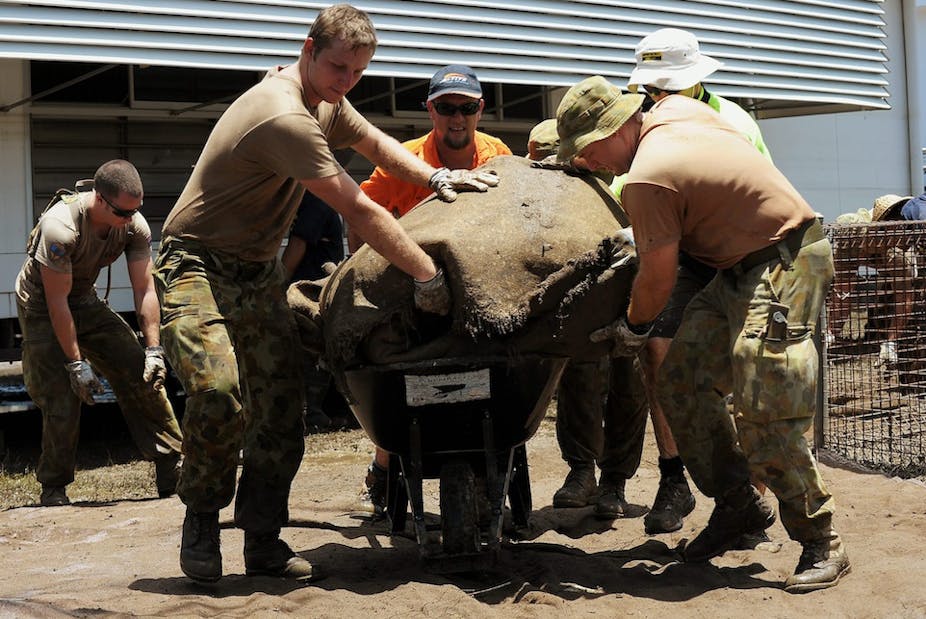
We also do short-term disaster recovery particularly well. The construction of a temporary school in Dunalley, Tasmania, just weeks after the fire razed the original school building is testament to this. Such an effort would not have been possible without the tireless work of volunteers and construction crews working around the clock to restore ‘normality’ to the affected community.
However, the rapid speed with which a town or city can be cleaned up and rebuilt presents important issues for the long-term future of disaster affected regional communities.
An approach to recovery that is “replacement” focused limits the scope for affected communities to redesign their local economies in new and exciting ways; it simply restores what already existed. Such approaches have enormous potential to create perverse outcomes and hinder the long term prospects for community sustainability and renewal.
Once we deal with the immediate crisis, disaster opens the possibility for positive long-term change for local businesses and communities. For many small communities the disaster relief investment will be the greatest influx of resources it has had in decades or longer. Innovative reconstruction and recovery initiatives are needed to realise the potential of these resources for communities.
Unlike the response, and physical and social recovery phases of disaster, Australian governments and communities appear to be not as well versed in coordinating and facilitating the economic recovery and renewal of affected communities. Anecdotal evidence exists to suggest that the approach to recovery used in response to recent disasters may overlook the region’s long-term economic goals and fail to provide the necessary foundations for economic renewal.
However, we need stronger evidence on this issue. We need to learn from the disaster-affected communities who are now two or more years down the road of recovery.
The Regional Australia Institute is investigating the current process of recovery, the approaches used by governments, regional leaders and communities and its outcomes in four of these communities - two in regional Queensland (Emerald and Cardwell) and two in regional Victoria (Carisbrook and Marysville).
This issue is not so much about theory and policy principles. We must understand the practicalities of long term recovery so we can fill the policy knowledge gaps. This will allow us to ask whether our recovery processes and some of the restrictions around the use of recovery funds are helping or hindering the long term recovery and renewal of communities.
We also need to understand how communities themselves can drive the process of renewal.
The findings of the study will inform debate as to whether policy change is needed to better facilitate long term economic recovery of regional communities.
That way we can be more confident that affected communities will have the scope and support to recover and renew after disaster strikes.
Co-author Jessie Davies is a Research Assistant at the Regional Australia Institute and recently graduated with BA/BSc from the Australian National University.