
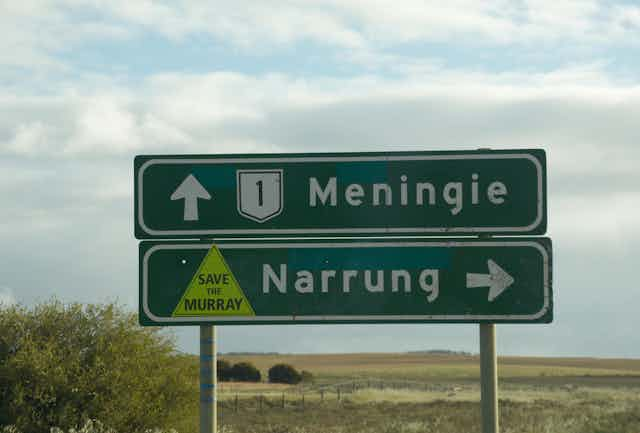


As the final version of the Murray-Darling Plan heads to Parliament there seems little doubt that the debate will continue. The sticking point remains the volume of water to be returned to the environment, encapsulated in new constraints on water extractions known as the sustainable diversion limit (SDL). Given the already extensive and protracted debate about the plan and the decision by the Basin Authority to opt for an SDL that can be “adapted” over time, it might be expected that consensus would now be emerging. So why won’t this issue go away?
Nearly all parties agree that a healthy river basin is their ultimate objective. Clearly, this is difficult to define with precision, and the extent to which society is willing to accept environmental degradation will (and has) changed over time.
There is also some evidence that environmental preferences vary across the Basin, with the so-called divide between city and the bush often offered as a reason for disagreement. Importantly, there is also a good deal of uncertainty about the ecological response obtainable from different SDLs and related works. This is precisely why a plan based on adaptive management makes sense, but the corollary is that various protagonists can continually bemoan the lack of certainty (for the environment or for farmers) as a reason to forestall a decision.
People also get agitated because this is far from the first time the government has proclaimed it will fix the Basin once and for all. In their 2009 paper, “Two Decades of Murray-Darling Water Management: A River of Funding, a Trickle of Achievement”, Lee and Anciv tallied government monies distributed to address the environmental ills of the Murray-Darling since 1997.
Their estimate of $25 billion is mostly Federal Government funding transferred to states and territories for on-ground works. This funding approach makes sense, because the states have most knowledge about how the rivers are operated and the Federal Government has most of the cash.
However, there are also opportunities for the states to exploit information asymmetries; at least, incentives exist for them to “try it on”.
The southern states of Victoria, New South Wales and South Australia are where contests over water and related funding are most severe. That’s because this is where most over-allocation has occurred.
The first two states have extensive irrigation sectors, although the structure of those industries varies markedly because the water rights were specified differently. In Victoria (and South Australia), most water in agriculture is used by perennial enterprises that don’t cope well with extended supply interruptions. In contrast, much of the irrigation water in New South Wales is used opportunistically for annual crops, like rice and cotton.
This is important for two reasons. First, producing annual crops has been portrayed by Victoria and South Australia as “low value”, implying shrinking these sectors to achieve the SDL is in the national interest. Second, if climate change results in several consecutive years of drought, as witnessed at the start of this century, the most costly enterprises to maintain will be those that dominate Victoria and South Australian irrigation. If this is the case, annual agriculture in New South Wales will be more sustainable and profitable, but of course this is all uncertain.
All states have shown a propensity to treat the “loss” of water from their jurisdictions to meet the SDL as a contest. In Victoria, limits were put in place to prevent farmers willingly selling their water to the Commonwealth Environmental Water Holder. Nonetheless, Victoria was happy to receive an additional $1.2 billion of federal money for its controversial Irrigation Renewal Project, even though it is not clear how this expensive project will be maintained in the long term.
New South Wales responded by reaching agreement with the Federal Government about how it should procure water. It also got access to infrastructure funding for its farmers. Again, it is not at all clear who will pick up the bill on refurbishing these works in the years to come.
In addition to the rivalries between states, there is an important contest underway between irrigators themselves. On the one hand, irrigators who are part of communal irrigation networks are under pressure to remain in irrigation and support infrastructure projects in preference to water buybacks. On the other hand, there is mounting evidence that many farmers have benefited from buyback programs, using the cash to restructure their businesses (National Water Commission 2012). In many respects this is a contest between those who want to stay in irrigation in its current form and those taking the opportunity to adapt.
The upshot is that the combination of uncertainty, substantial Commonwealth monies on the table, state rivalries and irrigator differences means that the debate about the Basin Plan is not about to subside.