


Public transport has risen to the top of the campaign to-do list for the upcoming Western Australia election. Both Labor and Liberal have unveiled plans to bring a rail network to the airport - it’s now a matter of how this will be achieved.
The West Australian declared on its front page that transport, especially rail, would be the main election issue and the premier admitted they were probably correct.
When last in government Labor had previously backed a short link between the present Domestic Airport and the Midland Rail Line and had even put it in for Infrastructure Australia funding. But Colin Barnett took over shortly after and immediately withdrew this submission and there it lay smouldering away until the election drew nigh.
In 2012 the Western Australian Transport Minister Troy Buswell announced plans for a major upgrading of roads to the airport (the Gateway Project) that would serve the new combined International and Domestic Airport, currently under construction. The original plan was designed with no need for an airport rail link, based on the assumption that people in Perth mostly drive. But behind the scenes, planning for an airport rail line under the runway was quietly being conducted through the Public Transport Authority.

In December 2012 as the first main shot for the election, Labor announced METRONET. This consists of a series of extensions to the heavy rail system including a link to the airport. But in a major difference to the government it would be part of a Ring Rail around the middle suburbs of Perth.
There was an immediate boost to Labor’s ratings in the polls, as a major project that would ease the public’s lack of transport options. The government was quick to react to Labor’s proposed rail network by criticising the costs of the project.
Ring rail
The Ring Rail is a concept that has been raised several times in the past, including the original Stephenson-Hepburn Plan in 1955, and is even conceptually presented in the state government’s own strategic plan, Directions 2031.
As part of a PhD project over the past year we have been developing a similar concept with a few differences.
The figure below shows a Ring Rail following a freight rail reserve in the south and east and two freeway reserves in the north. Fast bus services linking to this rail enable the outer suburbs to have significantly quicker commutes. This has already been demonstrated with dramatic success in the Northern and Southern Rail Lines, which both now carry over eight lanes of traffic.
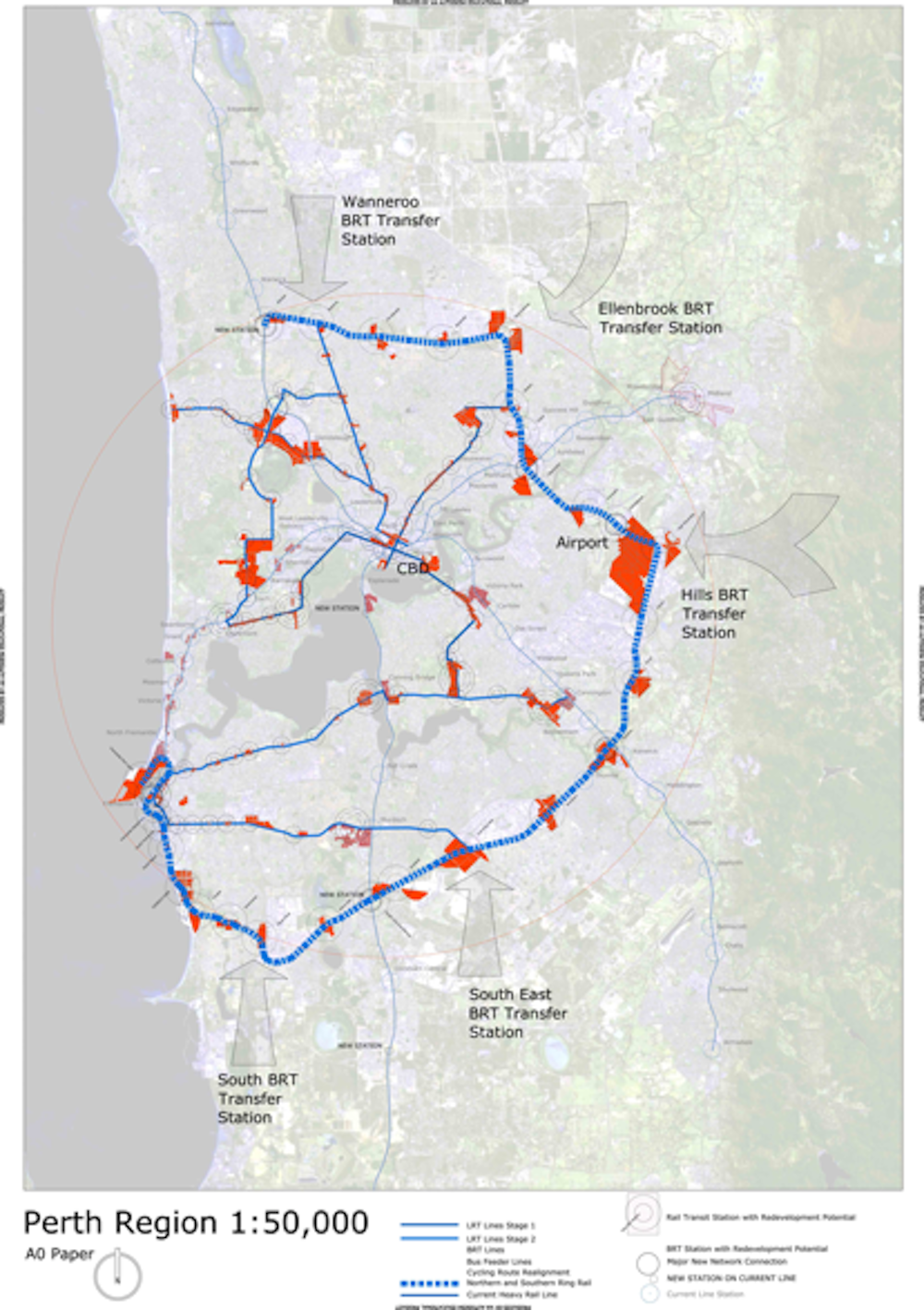
Inside the Ring Rail we have suggested a set of Light Rail lines, to attract urban redevelopment around their stations and around the heavy rail lines. Our calculations suggest the next 30 years of urban development could be accommodated in these Transit Oriented Developments, including the airport.
Not only do we believe that this system could be built quickly and relatively cheaply (no major land acquisition, tunnels or bridges), but our calculations suggest the urban development attracted could pay entirely for the new rail lines through the mechanism of value capture.
Election promise
The Ring Rail concept has had considerable publicity in recent months. The two main parties have been dancing around the key ideas, with Labor clearly winning the debate for a visionary concept that largely follows our own.
Most recently, on February 10th the Premier announced as a key part of the Liberal campaign to build a $1.895 billion airport railway. It would run in a tunnel under the runway and reach out to the adjacent Hills suburbs largely following the route of the Ring Rail.
By announcing the airport rail the Coalition’s stance has become much more committed to a rail future, and in reality is building the first step in the Ring Rail.
The rail debate in Perth will rage up until the March 9th election, when its likely a much clearer set of options will have been clarified. But what is clear now is that the airport rail link is likely to be built one way or the other in Perth. We hope it will go further and be part of a visionary Ring Rail.