


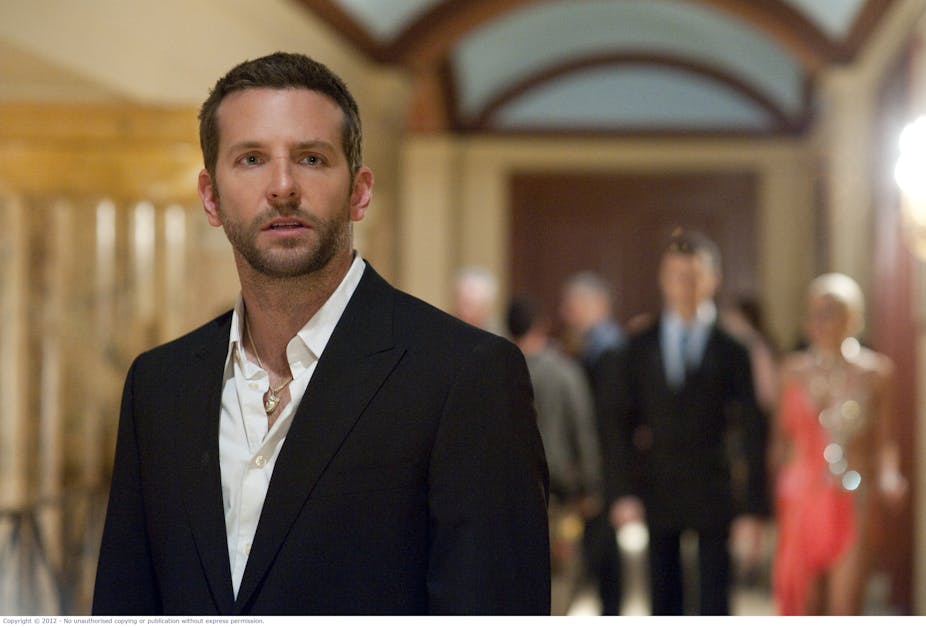
From Psycho onward, film portrayals of the mentally ill have contributed to the stigma faced by people with these conditions. Films tend to create and reinforce stereotypes of the mentally ill as “homicidal maniacs and narcissistic parasites”. Silver Linings Playbook is a refreshing departure from this pattern.
Exaggerated cinematic portrayals of mental illness have largely bypassed bipolar disorder, whose periods of depression alternate with episodes of mania or milder hypomania. People experiencing bipolar disorder may believe they have special powers, go without sleep, talk incessantly, act recklessly and experience racing thoughts and irritability.
Silver Linings Playbook, whose main character suffers from bipolar disorder, portrays the condition with unusual honesty. Pat, played by Bradley Cooper, has just been released from a court-ordered stint in a Baltimore psychiatric hospital after violently attacking the man who was having an affair with his wife (the movie’s own shower scene, presented in flashback).
Having lost his wife, home and teaching job, he moves in with his parents and is soon pursued by Tiffany, a grieving widow played by Jennifer Lawrence, who is lost in her own darkness. An improbable romance develops while Pat tentatively reconnects with family and friends.
The film presents bipolar disorder deftly and accurately. Pat has periods of sleeplessness and paranoia, hatches wild plans to win back his wife in spite of her restraining order and resists taking medication. He blurts out his uncensored thoughts, flies into hair-triggered rages and hallucinates when stressed. He lacks insight into his effect on others and uses glib therapy-speak when he talks with them.
His search for the silver linings in life seems desperate, driven by a need to deny and avoid the presence of “negativity” wherever he sees it; a novel by Hemingway, who was perhaps bipolar himself, is angrily hurled through a window for lacking a happy ending. Pat’s confusion and fear while “white-knuckling it” through his turmoil is palpable. For all this, he’s a fully realised, rounded and sympathetic character, not a psychiatric exhibit.

The other people in Pat’s life are also captured with warmth and acuity. His brother and his best friend act awkwardly around him, apologising cravenly for failing to visit him in hospital. His father, Pat Senior, shares his history of violent behaviour, has an assortment of minor compulsions and superstitions and blames himself for Pat’s predicament.
His mother looks stricken with anxiety but helps to engineer his budding romance. Tiffany pushes him away and pulls him in with savage need. His therapist is down-to-earth and practical, a man who can wear face-paint to the football, not the all-knowing oracle or neurotic buffoon depicted in many movies.
Indeed, perhaps the most truthful aspect of Silver Linings Playbook is that it shows how much Pat is not a solitary sufferer but a man embedded in a web of relationships (romantic and familial) that offer the possibility of recovery and growth.
Although the clinical literature sometimes shows bipolar disorder exclusively as a disease of the brain, with medication as its only effective treatment (a belief that seems to be widely shared among laypeople), the condition is intimately connected to the person’s experience as a social being. Its episodes are often triggered by interpersonal strife and recovering from them can be aided by some relationships and sabotaged by others.
The importance of relationships for recovery is well established. Social support (having a social network to provide practical help, advice and emotional connection) enhances clinical outcomes in conditions as diverse as schizophrenia and cancer, just as a sense of belonging to social groups promote the health of school students and elderly dementia patients alike.
But relationships can also be destructive. Research on “expressed emotion” suggests that people experiencing conditions like bipolar disorder are more likely to relapse, and to do so more severely, when their families are prone to criticise or become emotionally enmeshed with them. Social connections can make and break.
By the end of the film, Pat finds a sense of belonging in the warm embrace of his family and his new love. For others, it’s necessary to escape the structures of home and family and strike out on a journey of self-discovery.