
The future in science fiction is often presented in a dystopian setting. Certainly films such as Ridley Scott’s Blade Runner, Andrew Niccol’s Gattaca and Alfonso Cuarón’s Children of Men follow this pattern. But why?
A dystopia is an imaginary world deliberately conceived as being worse than our own; a utopian one conceived as better. But many science fiction worlds are neither better nor worse – merely different.
An obvious example is provided by George Lucas’s six Star Wars films, each set a long time ago in a galaxy far, far away. That galaxy is essentially neither better nor worse than our own, but certainly different (in space people can, it seems, hear you scream).

Ridley Scott has directed two other science fiction films besides Blade Runner: Alien and Prometheus, neither of which is truly dystopian or utopian. Their world is essentially a logical extension of our own, albeit with better-developed technologies and – the crucial difference – formidably hostile alien species.
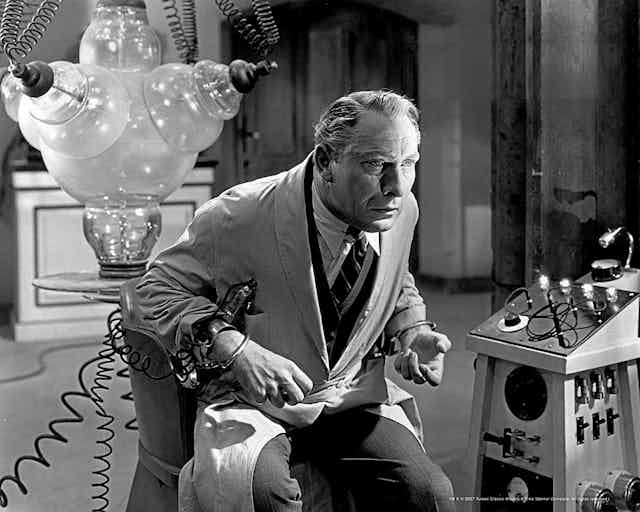
Indeed, much science fiction cinema is actually set in a world identical to our own, except for the presence of some distinctive fictional invention and its often-eccentric or emotionally tortured inventor.
Notable examples include the various film adaptations of:
- Mary Shelley’s Frankenstein
- Robert Louis Stevenson’s The Strange Case of Dr Jekyll and Mr Hyde
- HG Wells’s The Time Machine.
Even Robert Zemeckis' Back to the Future and its sequels fit this pattern very nicely.
Science fiction cinema can sometimes be positively utopian. The most famous British science fiction film of the 1930s, William Cameron Menzies' Things to Come, was a utopia, at least in its eventual resolution.
More contemporary examples of utopian science fiction clearly include the 11 Star Trek films. The world of Star Trek – the United Federation of Planets, Star Fleet, even the USS Enterprise itself – is indisputably a utopia. It is set at a time when technological innovation has effectively solved the practical problems confounding humanity.

People travel the galaxy in star-ships, their food and drink supplied by replicators, their fantasies enacted out and fulfilled in holodecks. Their collective social life appears similarly unproblematic.
On Earth, poverty, inequality and social conflict have been eliminated, so that both genders, all races and various sexualities are equal. In the wider universe, humanity lives at peace with neighbouring alien species in the Federation.
What applies to science fiction cinema also applies to science fiction literature. Science fiction novels, plays and short stories might well be utopian, for example:
- Edward Bellamy’s Looking Backward
- Ursula K. Le Guin’s The Dispossessed
- Kim Stanley Robinson’s Pacific Edge
- Iain M. Banks' series of eight Culture novels
They have perhaps more often been dystopian, for example:
- Karel Capek’s R.U.R
- Yevgeny Zamyatin’s Mi
- Aldous Huxley’s Brave New World
- George Orwell’s Nineteen Eighty-Four
- Ray Bradbury’s Fahrenheit 451
- Margaret Atwood’s The Handmaid’s Tale
More commonly, however, they have been neither. Not one of the 54 novels Jules Verne published in his lifetime was a utopia or dystopia. Of the eight novels in Victor Gollancz’s The Scientific Romances of H.G. Wells, only In the Days of the Comet and Men Like Gods were utopias. The first of these – simultaneously both utopia and dystopia – was dropped from the Seven Science Fiction Novels collection published in the United States.
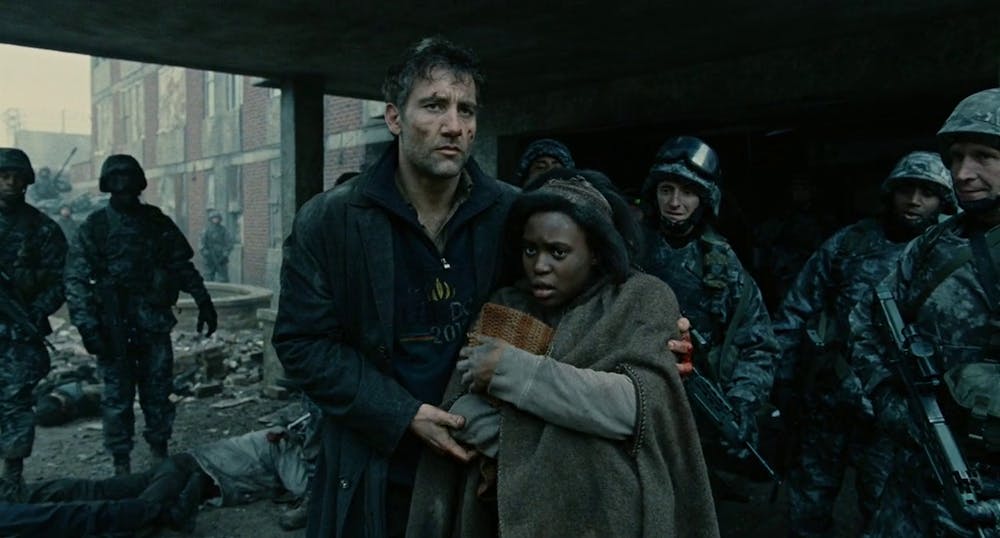
Yet, for all these careful qualifications and amendments, it remains true that much science fiction – and often the most interesting examples, in both literature and the cinema – is indeed dystopian. There are, no doubt, many reasons for this. But the most important is that utopia is fundamentally boring, since nothing much can happen in a place where nothing much is wrong.
Utopian writers and film directors have come up with a whole series of devices designed to circumvent this boredom, among them:
- the sexual romance within utopia (William Morris’s News from Nowhere and Bellamy’s Looking Backward both adopted this device, which has been taken up by the vast majority of subsequent utopias)
- the distant view of utopia from its extremities (in both Banks’s Culture novels and the Star Trek films the action typically takes place on the edges of the utopia)
- the external threat to utopia (again, characteristic of both the Culture novels and the Star Trek films).
But the sheer persistence of these utopian strategies for discounting boredom suggests how powerful a problem it might actually represent.
By contrast, dystopias are rarely charged with boredom, since their stock in trade of human beastliness remains oddly captivating to our conventional post-lapsarian sensibilities. This is too negative a conclusion, nonetheless, since dystopia also often has a deliberately positive function.
The more serious of the worse worlds of dystopian fiction typically take as their political or moral purpose the intention to warn against undesirable likely future developments.
Dystopia goes in and out of fashion, but it was almost certainly at its most influential in Europe during the first half of the 20th century – that is, in a time and place in which there were two dreadful wars, the Great Depression, Stalinism and Fascism. In short, a time and place with much to be warned against.
If dystopia has once again become fashionable in film and literature, it’s almost certainly because we too now have much to be warned against.

Blair Donaldson
logged in via Facebook
Looking forward to a fall in property prices with all the empty houses around courtesy of the approaching end of the Mayan calendar cycle :-)
tqft
logged in via Twitter
Apparently Blakes7 is to be remade - rebel convicted of falsified child porn charges is sent to distant isle without recourse (other than the improbable escape). Treachery, thievery, collusion & conflict.
Jonathan Maddox
Software Engineer
Tell me it's true!
Mat Hardy
Lecturer in Middle East Studies at Deakin University
Brave New World really was a utopia. Just not for a couple of the characters!
Often the dystopian elements in some of these universes are really nothing more than a future world setting of contemporary issues: crime, discrimination, economic exploitation, environmental degradation, disenfranchisement etc. Perhaps that is their attraction, in the same way that the Romeo and Juliet story works in just about every genre setting you can imagine.
Ian Donald Lowe
Seeker of Truth
Sorry but I found Brave New World to be totally distopian and the world described as allien to humanity as any world ever described in science fiction. It does have similarities to the modern world and the projected future of a certain group of powerful people.
Mat Hardy
Lecturer in Middle East Studies at Deakin University
But if you were with the program in Brave New World it was a utopia! You were never going to be unhappy because your life was perfectly conditioned to meet your every desire. That's what I am getting at. It's dystopic to us as rational 2012 human beings, but if you lived in Huxley's imagined world without knowing any better you'd be quite content.
Ian Donald Lowe
Seeker of Truth
Would you Mat?
I tend to be opposed to conditioning people to accept or fit a societal model. Perhaps that's why I read it as a dystopian view of the future, even if Huxley really did think he was describing a 'brave new world'. Then again, I have always felt like I am outside the program in many respects.
alfred venison
records manager (public sector)
remember huxley’s pedigree includes the famous liberal minded privy councillor & biologist and the cultural critic matthew arnold. he was raised in a milieu where sophisticated discussion relating to questions of public service/duty & public morality was common. huxley intended “brave new world” to make us & his contemporaries uncomfortable when contemplating the question at the heart of the novel - is it moral or ethical or desirable for a state to drug or otherwise stupefy its citizens in order…
Read moreIan Donald Lowe
Seeker of Truth
Is a slave still a slave, even if he doesn't know he's a slave?
Obviously the answer is yes.
The war on drugs is doublespeak and the true term should be a war of drugs and it's being staged against the populations of the "free world", including our own. The heroin crop is bought and paid for by the alliance of the willing. Hsbc gets the big four Australian banks to launder the drug money. The Mujah Hadim and Taliban were recruited and trained by the CIA. Osama binLaden was a CIA patsy and the…
Read moreLibby King
Mythologist of the Near Future
dystopian indeed ...
Libby King
Mythologist of the Near Future
Just because it's a perfect bureaucracy doesn't make it a utopia. The novel is a warning - a perfect bureaucracy might seem wonderful but, don't be fooled, it is shit. This is precisely the point of "Brave New World" and many other dystopias: crap comes in the pursuit of a perceived utopia, the false perception that perfect order is ideal.
Jonathan Maddox
Software Engineer
Almost two-thirds of that rant is actually true. And the rest might as well be for all the good it does us.
Alison Cone
Public affairs officer
I wouldn't have described The Dispossessed as a utopian novel - both worlds are flawed and far from perfect.
Jonathan Maddox
Software Engineer
And yet ... and yet ...
Dale Bloom
Analyst
My choice of a believable dystopia on film would have to be “THX 1138”, a film made by George Lucas before he became all commercialised. Perhaps he said it all in this film, and afterwards, he just wanted to make money by producing the Star Wars series.
Excuse Wikipedia, but it sums it up rather well as “a dystopian future in which the populace is controlled through android police officers and mandatory use of drugs that suppress emotion, including sexual desire.”
http://en.wikipedia.org/wiki/THX_1138
Seems rather real already.
alfred venison
records manager (public sector)
i've been reflecting in light of this essay on (among other things) stanislav lem & his penchant for bureaucracies. are lem's bureaucracies utopian or distopian or neither or both? it was a long time ago i read it, but i recall a part in the novel 'solaris' where lem describes a bureaucracy, developed over centuries in support of the discipline of "solaristics" research. he chronicles the centuries of changing intellectual fashions & shifting research priorities of solaristics until finally the…
Read moreAlice Gorman
Lecturer in Archaeology at Flinders University
And Lem's wonderful The Futurological Congress - where the bureaucracy uses mass-delivered drugs to deceive the entire world it is living in a perfect society when the opposite its true .......
alfred venison
records manager (public sector)
oh yeah, and 'mockingbird' by walter tevis is one helluva dystopia novel - scared the hell out me when i read it. talk about "seems real" ! it ought to have a wider circulation. -a.v.
Libby King
Mythologist of the Near Future
I think there are a couple of other reasons for there being more dystopian literature than utopian. The first is that so many dystopias come about in the pursuit of utopia (and conformity and perfection) - someone above mentioned "Brave New World" which fits this. Another reason is that dystopian fiction serves a very particular purpose that utopian fiction doesn't - that is provide insights into possible future impacts of present activities. That is, they are calls for the application of foresight…
Read moreLibby King
Mythologist of the Near Future
No way to edit ... boo.
Chris Booker
Research scientist
completely agree - to me the dystopian future genre (when done well) is not really about the future at all, but about the present and taking themes or elements of the current society and projecting them into a future scenario, where, essentially, humans are as they are now, with the same emotional, political, sociological problems, just with different technological capabilities, or facing situations vastly different than our own.
e.g. 'what if we create robots so lifelike they become like human…
Read moreIan Donald Lowe
Seeker of Truth
I have a few issues with this article, which come from a lifetime interest in science fiction.
Read moreStar Trek and it's spin-offs are hardly utopian universes, conflict with one species or another is a constant, whether it be Klingons, Romulans or the Borg Collective. In my opinion, this series just takes human problems and projects them onto an imagined future with no real resolution. (There's a lot wrong with Star Trek but now is not the time to go into all of that.)
1984 is not really a science fiction…
Libby King
Mythologist of the Near Future
I agree entirely about technology, science fiction is a perfect environment for incubating the many forms it might take and the implications it might have.
I have "On the Beach" on my bookshelf; it was just sitting there but it is now leering at me. Thanks for that ;)
(By the by, what do you think of a theory that "Nineteen Eighty-four" as the fantastic version of "Coming Up for Air"? It's one expounded by my boyfriend.)
Ron Chinchen
Retired (ex Probation and Parole Officer)
I think many of the dystopia types of SciFis are not just about the collapse of our society into a dark age but a promise of maybe something better to come. I think of Wyndham's Day if the Triffids, and The Crysallids, George Stewart's Earth Abides, Niven and Pournelle's Footfall, Sturgeon's More Than Human, then there was Canticle of Leibowitz, Emergence, The Survivors etc. They all have a collapse and dystopic sense, but all have a promise for a perhaps better future. The ultimate collapse and rebuilding story as a continuum is of course Stapletion's First and Last Man. Even in Clifford Simac's classic City, when human civilization of Earth had collapsed and most people had gone to the stars, the Earth wasn't just left to the dogs....well not entirely.
Leo Kerr
Consultant
omg no mention of The Matrix....
Anthony Nolan
Ruminant
Dystopias dominate the genre because moderns are well educated enough to no longer believe in utopia but experienced enough to understand that the present already has in it the seeds of the future. Fark.
James Hill
Industrial Designer
For something to compare those dystopias an utopias against try William Sargant's "Battle For The Mind".
Should be much more popular but describes facts, from which fiction provides an escape. Might be too tough to handle for some.
Has some link to the Soma but describes real-time mind control.
Definitely needs to be published on-line.
And no, the only real conspiracy might revolve around why such an important factual subject is not more widely read.
Arthur James Egleton Robey
Industrial Electrician
I have written a Science Fiction piece called The Breeding which I published here
http://coldfusionnow.org/poetry/arthur-robey/the-breeding/
In it I posit infinite wealth which results in sever philosophical constraints placed on the protagonists.
The issue of Utopia being boring is dealt with by genetically modifying humans.
To make a story exciting does not require human conflict.
Stephen Pritchard
Researcher, cognitive science
I take your point that some sci fi is neither dystopian or utopian. However, I also think that such work can still include some social commentary or aspects that hint at a dystopia or utopia, even if the world depicted in total is not truly either.
For example, you suggested that Alien (and Prometheus) are neither. However Alien clearly explores the themes of AI gone bad and corporate interests over personal interests. To me, this is certainly touching on dystopian themes where humanity is being lost to technology and profit-driven exploration, and in such a world soulless AI can achieve precedence over humans. Yes profits-over-people is a present day concern, but it is taken to an unsavoury extreme in Alien. The same themes appear clumsily and less effectively in Prometheus. Its a view of technology and corporations run amok and breaking the shackles of present day legal frameworks.
Libby King
Mythologist of the Near Future
The lack of input from the author makes this less like a conversation than I would have expected from a site with this title. I keep coming back to see his response ...
Matt de Neef
Editor at The Conversation
Hi Libby, I'll send Andrew an email and see if he's happy to jump in and answer some questions. :)