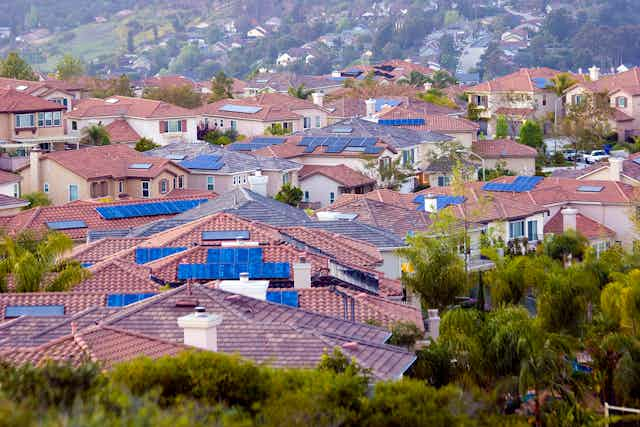
Contrary to expectations, demand for electricity in Australia has been falling for several years. Reasons for this include large price rises (of which the carbon price is a relatively small component), improved home insulation and appliance efficiency, subdued manufacturing, and the rise of rooftop photovoltaic systems (the output from which is not included in demand figures).
Falling demand is placing pressure on the business models of the electricity industry. The potential for the installation of tens of thousands of megawatts of cost-effective rooftop PV systems places severe additional pressure on business models.
The cost of generating electricity from roof-mounted solar photovoltaic panels has fallen far below the retail tariff for both domestic and business customers everywhere in Australia, and is projected to fall further. The simple payback time for a domestic PV system is about five years in Adelaide, seven to eight years in Perth, Melbourne, Brisbane and Sydney, and ten years in Canberra and Hobart. The expected life of a PV system is 25 years.
Large businesses that primarily use electricity during business hours self-consume most of the electricity produced by PV systems on their own rooftops. However, small businesses and house owners rely on the grid to balance the supply of electricity from their rooftop PV system with their own demand. Only rarely would PV production balance with electricity demand within the building.
So a fair and reasonable price needs to be struck for electricity fed into the grid from rooftop PV systems.
The PV industry advocates a 1:1 relationship between the price paid by utilities for electricity fed into the grid by rooftop PV systems and electricity purchased from the utilities. However, some states are allowing utilities to pay very low prices for fed-in PV electricity.
It is widely recognised that electricity providers have over-spent on equipment to meet peak electricity demand. It would be better to manage rather than meet this peak demand.
Cost-reflective retail tariffs are one way to moderate electricity use during times of peak demand. But time-of-use price signals in the wholesale market are muted in the retail market: flat tariffs are more prevalent.
Introducing retail time-of-use tariffs would allow the true value of electricity from roof-mounted PV systems to emerge – particularly in meeting weekday daytime business loads and air-conditioning loads, both of which are well-correlated with PV-availability.
Should state governments and utilities persist in offering very low PV feed-in tariffs, perverse outcomes may result.
If the PV feed-in tariff is below the domestic off-peak tariff (now a common situation in the eastern states) it makes sense for PV owners not to put their power back into the grid. Instead, excess electricity from a domestic rooftop PV system should be used to make hot water in a conventional resistance-heated storage tank. Using PV electricity this way is now competitive with hot water supply from domestic off-peak (night-time) electric, conventional solar and gas hot water heating systems.
However, given electricity is much more useful than heat, from a national perspective this is a poor use of solar electricity.
Another example of a perverse outcome is that battery storage systems, in conjunction with PV systems, are economic in competition with domestic retail tariffs in most Australian capital cities. Batteries allow smoothing of PV system output, storing power when generation is high and releasing it when it’s low. This leads to much higher self-consumption of PV electricity and avoids unrealistically low PV feed-in tariffs.
For example, using current battery and PV system prices, a Sydneysider could store half the electricity generated each day in well-maintained lead-acid batteries, for use in the evening and early morning, and the result would be very economic.
However, domestic battery storage comes with risks. Maintaining and disposing of batteries requires technical skill and care.
This approach illustrates the absurdity of offering PV feed-in tariffs far below 15 c/kWh when the domestic electricity tariff is 20-35 c/kWh. If electricity storage at the domestic level is cost effective, then it must be far more cost effective to do it at suburban, city or state level. At this scale, we could use much larger and lower-cost storage techniques, including industrial-scale batteries, compressed air, flywheels and pumped hydro. Demand management – through switching optional loads on and off to balance supply and demand – is cheaper still.
In order to avoid the perverse outcomes mentioned above, we need reasonable PV feed in tariffs in the range of 15 c/kWh. These should be established in conjunction with demand management, retail time-of-use tariffs and increased use of storage.
This will allow rooftop PV systems to contribute substantially to continued falls in electricity consumption with associated reductions in greenhouse gas emissions.
John Newlands
tree changer
Try re-reading the article and substitute nuclear for solar i.e. nuclear power should get a feed-in tariff under the same reasoning. The economics of high supply and low demand on a mild sunny day suggest any feed-in tariff should be low; try 2c per kwh as in parts of the US. Well-to-do people want pensioners to pay higher bills so theirs are lower. Those same people then want the despised fossil grid to power their aircons on a humid night or heat their homes in an overcast wintry week.
The cost of PV has dropped dramatically probably due to subsidised Chinese manufacturing. This probably won't happen with home batteries which also carry the risk of fire and accidents. Currently the penalty for generating CO2 in coal or gas plant is $23 a tonne but PV costs $400 to displace a tonne of CO2. Either PV is over-hyped or carbon tax isn't high enough. I think PV has had more than enough generous help.
Felix MacNeill
Environmental Manager
John this whole issue is far less clear than you claim and there is substantial evidence to support Andrew's arguments, not least work done by the respected and professional Melbourne Energy Institute: http://reneweconomy.com.au/2012/is-solar-pv-our-best-bet-against-the-impending-gas-price-bubble-99706
Gerard Dean
Managing Director
Mr Blakers,
You said, ' ..a Sydneysider could store half the electricity generated each day in well-maintained lead-acid batteries, for use in the evening and early morning, and the result would be very economic'.
Are you serious? You are talking millions of tonnes of lead acid batteries that require replacement every decade.
How in heavens name is that sustainable? It would suck all of the remaining lead out of the earth for what? So we can run our air-conditioners more cheaply.
Madness, sheer madness.
Gerard Dean
Mike Hansen
Mr
Gerard Dean - predictable as ever. Have you ever considered reading the article before commenting Gerard? Everyone else got the point - that this would be a perverse outcome.
In fact it was not that hard given the paragraph began "Another example of a perverse outcome is that battery storage systems..." and finished with "This approach illustrates the absurdity of ..."
Bob Buick
Retired medical consultant
"Contrary to expectations, demand for electricity in Australia has been falling"
I hope that those expectations included the adoption of mini-fluorescent and LED lighting, LED TV screens, replacement of resistive home heating by the far more efficient reverse-cycle and induction air-conditioners, the move towards gas, microwaves and induction cook-tops in the kitchen and the reduced running of swimming pool pumps after installing pool covers.
These changes were all quite predictable many years ago.
Bob Buick
Retired medical consultant
...and solar hot water, of course.
Chris Owens
Professional
Liberal governments do nothing to dispel the perception that they are welded to coal and they do not accept the reality of climate change.
In Victoria the Baillieu govt has dumped the greenhouse gas reduction target, effectively banned new windfarms with the right of veto for anyone within 2km of a proposed site and slashed the electricity feed in tariff to 8c per kwh when the retail price approximates 23c. No power of veto for anyone living near a coal power station or mine.
Why would anyone install solar power when you are effectively subsidising privatised power retailers and saving a negligible sum from your power bill for your investment?
David Collett
IT Application Developer at Web Generation
A very interesting article. Thanks.
Gaps in the market generally mean business opportunities. As such, could there be a business opportunity for some clever company in buying solar power from householders for 15c and selling it at less than the domestic electricity tariff?
John ED Barker
Adjunct Professor at Murdoch University
A valuable article, Andrew- worthy of many considered comments.
It is depressing to read your statement: "...Instead, excess electricity from a domestic rooftop PV system should be used to make hot water in a conventional resistance-heated storage tank." I think that we can do better than that... The PV electricity could be used in heat-pump water heaters, which have a coefficient of performance (COP) of about 4. By definition, this multiplies the value of the PV electricity by 4. Like a resistance…
Read moreCraig Memery
Energy consumer advocate
Good article, thanks Andrew
I would question one assertion though:
"using current battery and PV system prices, a Sydneysider could store half the electricity generated each day in well-maintained lead-acid batteries, for use in the evening and early morning, and the result would be very economic"
Not sure what analysis you're referring to here, but even using the highest peak prices in NSW and the most affordable grid connect PV/battery/inverter system, at current and trending technology prices and retail tariffs, the batteries would never pay for themselves during their useful life.
By way of comparison, battery storage needs to work economically for balancing off-peak charging with peak consumption before it will work with balancing PV charging with peak consumption, and it's not there yet. See some of our analysis on this at:
http://reneweconomy.com.au/2012/avoiding-the-peak-the-value-of-grid-connected-power-storage-19573
Chris Harries
logged in via Facebook
Craig and Gerard Dean, that's a valid point you are both making but you are backing up what the author Andrew Blakers is saying. We will end with perverse outcomes if tariff rates are set too low.
Here in Tasmania feed-in tariff rates are still reasonably fair for the householder but if dropped down to the level that is now in place in some other states I would take steps to ensure that whatever surplus solar power I generate is used within my household rather than be sold to the utility for a pittance.
This trend is inevitable and will no doubt result in some people taking safety shortcuts when altering their household circuitry. The utilities are cutting off their noses to spite their faces in arguing the case for rock bottom feed-in tariffs.
Zvyozdochka
logged in via Twitter
@ Craig Memery
I've been researching changing our home to at least 12V LED lighting from AGM-deep-cycle batteries, and some powering of 240V devices.
If I could buy a grid-tied PV inverter that worked as a battery-to-AC inverter as well it would be much easier. With a suitable inverter we could run to about 4000W of equipment for bursts. We could just about be off-grid, and the cost almost works, but not quite.
If I could remove the AC to DC power bricks inside every appliance in the home that would also be an advance. For example; our bedside clock radio plugs into 240V. It's a power vampire than doesn't need 240V. Same for the LCD TV, hi-fi system, computers etc.
Craig Memery
Energy consumer advocate
Thanks Chris,
I can't say that I agree that people will buy battery inverter systems even when there is no cost benefit to doing so: based on the current costs, even if there was no feed-in tariff, it would still not be cost effective to have a grid interactive battery inverter system.
Zvyozdochya - check out SP Pro inverters, they are the only model I know of on the Australian market that does what you seek.
Cheers
John Newlands
tree changer
If suitable smart meters become commonplace I suggest the correct small scale FiT should be based on the hourly NEM spot price for large generators, perhaps adjusted for the morning or afternoon trend . Lately this has been in the range $51 to $75 per Mwh or 5.1c to 7.5c per kwh.
http://www.aemo.com.au/Electricity/Resources/Reports-and-Documents/Weekly-NEM-Review-Bulletin
This should factor in the economics of throttling back fossil fuel burners on sunny days while keeping voltage and frequency stable. Say the NEM price for NSW at 3 pm was 5c per kwh. The smart meter then credits 5c for PV grid export til 4 pm then changes that to 6c or whatever at 5 pm. If people don't like it then go off grid or 'less grid' with batteries. Unfortunately payback times for PV will stretch out a few more years.
David Jones
Engineer
John,
as I understand it, this is pretty much how the NSW system now works (with the other eastern states heading the same way) except that the regulator has unfortunately made the pricing voluntary.
This is an attractive arrangement for the retailers as they buy distributed generation for the same or slightly lower cost than from major generators but (since the energy is not visible to the transmission system, it is generated and sold within the local distribution system) they do not get charged transmission fees.
Also, think not in terms of fossil generators "throttling back" but rather expensive to run gas turbines not having to start up. Some of the fossil generators will always be run at less than full output, to provide regulation services. A degree of distributed generation does not change this.
William Ferguson
Software Developer
Good article Andrew.
You are 100% correct wrt the outcomes that loww tariffs will have on battery usage. Very efficient, cheap, long-lived non-toxic batteries will start to hit the market over the next 12-18 months (Zinc-air etc).
At that point unless the grid connection cost and feed-in tariff are more appropriately priced then domestic consumers will disconnect from the grid in droves. This will exacerbate the cost of grid supply as the cost of maintaining the network is spread over fewer and fewer people.
Losing producers from the network means the nation is losing access to a wealth providing resource (cheap, clean power), all because of poorly chosen network pricing mechanisms.
Craig Memery
Energy consumer advocate
People love the idea of going off the grid, but seem to have no idea of the cost, so we crunched the numbers:
http://www.climatespectator.com.au/commentary/when-it-viable-go-grid
The day when it's cost effective - especially in urban areas - to forego an existing grid connection for a stand alone power supply with the same reliability is a time to go yet. Based on current averages (and 2010 electricity prices) you'd be about $40 or 50K worse off in the long run for doing so.
On batteries, I fully support battery development and can't wait for a breakthrough, but I've been hearing that "very efficient, cheap, long-lived non-toxic batteries will start to hit the market over the next 12-18 months..." for years now ... aspiring manufacturers and inventors make all sorts of claims :)
Zvyozdochka
logged in via Twitter
Using PV panels to heat water is insane. We already have an extremely cost effective way to do that which everyone should be required to have; the bog-standard solar hot water system.
David Jones
Engineer
Actually it does make sense.
In most locations, solar HWSs need some back-up heat source; usually electric. In winter this (and the water pump for the panels) can take significant amounts of electricity to run and they are not necessarily off-peak.
Instead, if you use an air source heat pump you avoid the pump losses, get better value from the backup energy consumed (maybe 2X) AND if you install a small PV system to offset the electricity consumed, you avoid the wasted energy which is over produced on sunny days (eg. all summer long) with a thermal system, since it can be fed into the grid.
Because of the COP being much better than 100% most of the time, it requires a smaller PV array than you might think. The only disappointment is that in winter the COP of many systems is pretty poor (because of the low air temperature at night) and some of them give-up and rely on resistive heating.
Zvyozdochka
logged in via Twitter
@ David Jones
I understand what you say, but in almost all areas of Australia it is possible to approach almost all hotwater needs using a modern system (like Apricus) and then only a marginal inline boost at use (rather than into storage).
In effect what you are explaining is that any PV system is oversized. The expense would create a better energy return by having a larger solar hot water collector area. Per unit of expense for energy capture/abatement it's actually extraordinarily difficult to beat solar hot water.
In fact, our advice to government has long been to accelerate solar hot water ahead of feed in PV. I see house after house with a gleaming set of PV panels but no solar hot water. Not sure what those people think they're doing - it's another dud policy outcome from our fossil conflicted Liblabs.
Zvyozdochka
logged in via Twitter
Does anyone know how much lead is actually sitting around at any one time waiting to be recycled from old truck, car, boat or UPS batteries?
Would there be a massive increase in the amount of lead required if we had shareable battery banks between a few houses? That's what we're researching with our neighbours.
Comment removed by moderator.
Kym Lennox
logged in via LinkedIn
Conceptually feeding distributed PV or other generation into the grid makes sense. However, it assumes that the grid can handle this supply without investment. Before considering this point, what is the actual economic value of distributed generation?
The generation is not dispatch-able, so it doesn't offset the majority of centralised generation capacity - without the noted storage systems, what value can PV provide when it is still 30+C at 10pm? While it lowers aggregate consumption, transmission…
Read moreJohn ED Barker
Adjunct Professor at Murdoch University
To add to my previous comment re PV- powered heat pump water heaters (to which there has been no comment), one could add the storage of energy (as warmth or coolth) in the building itself, with the same COP of 3-4. One can run the airconditioner during the day, cooling or warming the building, even in the absence of the dwellers. This will work fine in well insulated, brick buildings. In summer, if the building is cool, only a low energy fan is needed to create a bit of further cooling and comfort through air movement.
These ideas, which are already used by passive solar housing designers and owners, seem to be a mystery to the economists and other theoreticians who seem to think that the only way energy can be used is immediately.
David Jones
Engineer
Kym,
What you say is mostly wrong. Demand peaks in the NEM occur around 3 to 4 in the afternoon (more or less coincident with peak temperatures as you might expect), not 10 pm, and at 3 to 4 pm (eastern standard time) PV systems are still outputting very strongly. The correlation between PV output and demand is actually very high and so the power produced is significantly more valuable than say wind power. For the same reason, PV does significantly offset transmission and distribution loads and…
Read moreKym Lennox
logged in via LinkedIn
I agree that solar generation often offsets peak generation requirements and definitely impacts aggregate demand.
My comment regarding load at 10 pm is purely to highlight a time of a potential local grid peak load that is not coincident with PV generation. This difference is precisely the point, NEM peak demand for generation is often at a time highly coincident with peak solar generation, but that doesn't have any correlation with peak load of any specific part of the distribution infrastructure…
Read moreNeil Gibson
Retired Electronics Design Engineer
This is another example of funny economics from people with no power system experience. The very concept of forcing your neighbor to pay an exorbitant rate for power you cannot use is incredibly unfair as so many getting whacked are poor people ,pensioners and renters. If there is to be a feed-in rate it should be the same as the generators get - currently about 5c/Kwhr as solar panel owners are not paying toward distribution costs as the electricity retailers do and therefore should not charge…
Read moreKym Lennox
logged in via LinkedIn
Neil
I wasn't advocating for this approach as it isn't legal here (district off-grid networks for heat energy are common overseas and more rarely power + Qatar for cooling). Assuming it was legal, the neighbour is already paying the even more exorbitant rate for power the retailers are selling inclusive of the transmission, distribution and other non-generation costs. So the offered price can be a 50% discount against the retail price while still being 20% higher for the seller against the feed-in tariff.
On the social equity issue, while I hope your prediction regarding the mortality rates in the aged are incorrect, the differing price elasticity for electricity consumption between low-income and high-income households definitely makes time-of-day charging very regressive.
Neil Gibson
Retired Electronics Design Engineer
@Kim Lennox. Kim as I understand it in Queensland over 700,000 households are still using off-peak hot water charging. See P90 http://www.energex.com.au/pdf/network/Annual_Network_Management_Plan.pdf.
Reducing peak demand by switching off hot water systems is easier now with new meters available and would not affect consumers very much.
With regard to paying solar panel owners more than wholesale prices for surplus energy the difference is always recouped from non-solar homes and your argument that somehow that the neighbour has to pay anyway is specious because the solar gouging is built-in to the retail rate. It is made worse by the fact that many solar owners are paying nothing or very little towards network costs which inflates further the costs to non-solar homes. It is ironic that those paying the exorbitant rates have already actually paid taxes to subsidise the panels which are ripping them off.
This an awful inequitable scheme which needs drastic changes to make it fair.
Craig Memery
Energy consumer advocate
Neil, it's a bit funny that you demean other people's lack of power system experience and then go on to demonstrate that you don't really understand how the energy market works.
1. There isn't any substance to your claim that "If there is to be a feed-in rate it should be the same as the generators get - currently about 5c/Kwh"
For starters, at the time that solar is generating the average wholesale energy price is higher than that, probably around 8c; but because of how solar interacts with…
Read moreNeil Gibson
Retired Electronics Design Engineer
@ Craig Memery. You should state you actually work for the wind industry so readers can judge what you say in a commercial light. We keep hearing about Big Oil funding but given the multi-billion dollar wind industry is it fair to talk about Big Wind funding propaganda?
Read more1. Current spot prices 10Am ( and very hot in Queensland)
Electricity Price & Demand
State Price Demand
NSW1 $52.83 8618.64
QLD1 $54.23 7476.53
SA1 $51.4 1318.69
TAS1 $50.47 1046.97
VIC1…
Craig Memery
Energy consumer advocate
Neil,
I don't work for the wind industry. I work for a non-for-profit consumer based organisation, and my role with them representing Australian energy consumers is funded by the consumer advocacy panel. Check your facts.
1. Last week in Victoria the spot price hit the market cap of $12,900 per MWh. They vary: that's why the average is higher than that the spot prices you have quoted above. A lot is also sold through hedge contracts that are not reflected in the spot price. Check your facts…
Read moreNeil Gibson
Retired Electronics Design Engineer
@ Craig Memery - My apologies - You do not work for the wind industry.
Read more1. I only checked the spot prices at the moment. It is not unreasonable to assume they are correct or perhaps higher than normal given the heat wave.
2, Yes, it is the retailers not the generators who are forced to subsidise solar panel installations, It was still Goverment mandated and comes out of the same taxpayer's pocket.
3 If solar panel owners are drawing power from the network for the majority of a 24 hour period and…
Craig Memery
Energy consumer advocate
Neil, apology accepted, no worries
1. "It is not unreasonable to assume they are correct or perhaps higher than normal given the heat wave"... Actually it's not that simple.
Very high prices at 10am (the time you referred to) are less common, and with the exception of extreme heat or cold (which today is not), prices don't tend to follow temperature that closely anyway. High prices result from factors other than temp or even demand - Qld recently had high price events ($5,000+/MWh) resulting…
Read moreKen Fabian
Mr
Time of use metering really requires connectivity between appliances and meters to maximise the benefits both for consumers and producers. But owners of solar fitted homes are going to have incentive to add some in-home storage if evening energy costs become higher and the feed in tariff is kept low. That's a market that will only grow - unless energy providers themselves invest in energy storage to do the same thing but do it more cost effectively.
Dedicated home storage systems for grid connected…
Read moreNeil Gibson
Retired Electronics Design Engineer
@Craig Memery. Craig, I love your confidence in the various bureaucracies in control of the electricity industry who of course must have planned the skyrocketing electricity costs that the Feds are blaming the states for and vice versa. If they did not plan it then they are not in control which of course is the case. Time will tell.
Bruce Tabor
Research Scientist at CSIRO
By generating power when it is most needed PV systems should keep a lid on peak prices, which are driven mostly by the costs of network required to meet peak demand:
http://www.smh.com.au/business/creating-electricity-at-home-the-cleanest-and-most-sensible-option-under-the-sun-20120116-1q399.html
However the generators have succeeded in gaming the system (gold-plating it) so we are forced to pay much higher prices than really necessary and receive lower than fair prices for PV inputs.
aligatorhardt
logged in via Twitter
When fair prices for PV generation are not available, due to protectionism of utility profits, people are better off with battery storage and self sufficiency. As the article states, it is cheaper to use batteries than grid backup. The best way to deal with extortion is to replace the utility with batteries, and remove the utility control.
Neil Gibson
Retired Electronics Design Engineer
@Craig Memery
http://www.couriermail.com.au/news/queensland/queensland-households-with-solar-panels-like-to-be-hit-with-tariff-to-pay-for-poles-and-wires/story-e6freoof-1226530032061
It seems that I am not the only one to believe that solar panel owners should pay their fair network costs.
In a draft report, the Queensland Competition Authority recommended fixed fees be applied to solar households.
" "Network tariff reform is a further option to be considered as a means of more equitably sharing the costs of the scheme," the QCA said.
"Specifically, there may be scope for distribution businesses to establish new, cost-reflective network tariffs for PV customers which ensure that these customers are charged their full fixed-network costs, which are largely avoided under the present network tariff arrangements."
The QCA also recommended retailers, rather than state-owned distributors, pay for the power produced by solar households."
Chris Harries
logged in via Facebook
No you aren't the only one arguing for low feed-in tariffs, the utilities are all behind you for starters.
Going back a little bit, attractive feed-in tariffs have been used as a device to incentivize solar uptake and it worked very well. Then it started to work too well and as the price of solar panels came down rooftop solar took off like a rocket.
Then the utilities began to realize that they would lose out on market share of electricity sales if too many people went solar, and so began…
Read moreCraig Memery
Energy consumer advocate
Neil, I don't disagree with the QCA's view.
It's the points you've made on the subject - that a. households that get most of their energy from the grid are still avoiding all or most network costs, b. "solar panel owners are not paying toward distribution costs as the electricity retailers do" and c. "paying little or nothing for their power or network connection" - that are unfounded and incorrect.
The actual distribution costs being avoided are specifically those smeared across the portion of generation on site that avoids import from the grid so it's not even directly related to the issue of feed in tariff amounts.
I agree with the QCA that fixed fees are the solution - with the caveat that they should be based on a demand charge (ie, the actual maximum peak demand drawn by a PV customer in a given year).
Neil Gibson
Retired Electronics Design Engineer
@Craig Memery - I knew we had to agree on something :) . Demand charge would be the best available way to allocate network costs . How that would be accomplished or read with all the meters currently used I don't know. EDMI meters ( my old company) certainly have the capacity to do it.
Craig Memery
Energy consumer advocate
Neil, I reckon the list of things we furiously agree on (equity issues, specific need for protection of vulnerable consumers, need for cost reflexivity in charges, need to remove cross subsidy, possible need to rationalise incentives...) is probably 10 times longer than those we disagree on!
The issue for me here is that a lot of people demonise renewables with oversimplistic or incorrect arguments, and it detracts from the focus that I and other consumer advocates have of achieving a balanced…
Read more