
‘Sexting’ teens: decriminalising young people’s sexual practices

Cases of teenagers “sexting” each other have recently provoked panicked responses by media, parents, educators and policy makers in Australia. Now a Victorian parliamentary inquiry into the practice has been told it’s better to use discretionary powers to deal with sexting cases rather than new laws…

Hkyxq2zn-1348038641
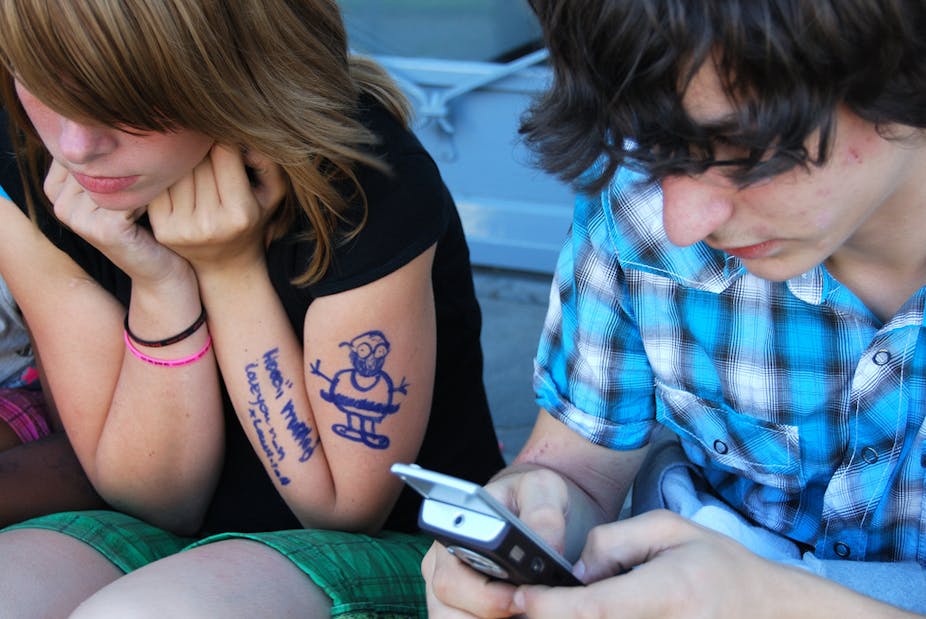
We need to acknowledge the diverse contexts in which teens engage in sexting. Mahdi Abdulrazak

Cases of teenagers “sexting” each other have recently provoked panicked responses by media, parents, educators and policy makers in Australia. Now a Victorian parliamentary inquiry into the practice has been told it’s better to use discretionary powers to deal with sexting cases rather than new laws.

“Sexting” can mean the creating, sharing, sending or posting of sexually explicit messages images or videos via the internet, mobile phones or other electronic devices. There’s growing concern among parents of young people and others in the legal and wider community about the appropriateness of criminalising sexting for youth.

While the age of criminal responsibility varies from state to state, Australian children and teens who engage in sexting practices run the risk of being prosecuted under child pornography laws. They can face severe sanctions.

And once young people are classified as sex offenders, they face long-term consequences, such as having their careers curtailed. Clearly its not in the public interest when such outcomes are the result of consensual sexual activity.

Sexting and the law

The law currently fails to distinguish between consensual and non-consensual sexting. Consensual sexting is when a minor takes a sexually explicit image of her or himself and sends it to someone else. In such instances, it’s clear that no one is harmed or assaulted when the photograph is taken. Nor is anyone hurt when it is initially transmitted to its willing recipient.

Non-consensual sexting may involve coercion or blackmail in the taking of the picture. And significant harms result from further dissemination of images, which is also non-consensual.

The law fails to distinguish between consensual and non-consensual sexting. Hayden Pernia

Because sexting episodes are very diverse, they cannot be easily categorised. In some cases, a teen might take pictures and send them to an adult with whom the minor has an exploitative relationship. In other cases, it may be difficult to determine whether teens who exchange images agreed about to what use the image may be put.

So the complications of distinguishing between consensual and non-consensual sexting are immense. Especially when we look at the practice as it occurs among all the complexities of teen social contexts.

Despite a lot of public interest and concern about teen sexting, there’s little research of it in the context of local teen peer cultures. A recent report from the United Kingdom conducted interviews with teens about their views and experiences of sexting. It found that for teens, sexting involves “a range of activities which may be motivated by sexual pleasure but are often coercive, linked to harassment, bullying and even violence.”

Researchers also found considerable evidence of the age-old double standard – sexually active boys are admired and “rated”, while sexually active girls are denigrated and despised as “sluts”. This evidence suggests girls are more adversely affected by sexting because it often mirrors the norms of pop culture. And, of course, in pop culture trading and circulating images of female bodies holds social currency.

Sexism in our responses

In Australia, the government has tried to educate and intervene in teen sexting practices through film campaigns such as Meaghan’s Story and Tagged.

Unfortunately, these campaigns perpetuate the message that girls are to blame for the negative consequences of a “sext gone viral”. Writing on this issue recently, researchers quoted a blogger who notes the sexism inherent in such messages, “Imagine a drink-driving ad that showed a pedestrian being run over, the car zooming away, and then a caption that said – Watch where you’re walking, pedestrians.”

Researchers found considerable evidence of a gendered double standard in the context of sexting. Vilseskogen

In the Tagged “educational” film, girls are warned about the social and psychological “risks” of sending images of themselves to boys they may be interested in or dating. Boys are not cautioned about the ethics of passing images on to others. But they are warned that non-consensual sexting might get them on the sex offender register.

Individual accountability, responsibility, and victim-blaming appear to be the most common approaches to tackling the complex issues around teen sexting. This clearly needs to change. What is needed is a more rational and informed response to sexting.

Sexting, discretion and the law

A recent study in the US showed that as many as 24% of 14- to 17-year-olds surveyed had engaged with some kind of sexting practice. We can safely assume that the practice is just as widespread in Australia. Unless current legal and policy responses to sexting are reconsidered, a quarter of the current teen population could end up prosecuted for creating, possessing, or distributing nude images.

Once a youth has been charged, and guilt has been established, there’s no discretion for taking him or her off the sex offenders' register. What’s more, how different states police children and young people in this area is inconsistent. Discretion is fundamental to ensuring that laws designed to protect young people do not result in the shaming or automatic criminalisation of teens involved in sexting.

The challenge to overcome here in addressing the failures of current legal responses to sexting lies in finding ways to acknowledge the diverse contexts in which teens engage in sexting, as well as address the harms that can result for teens facing peer pressure to engage in the practice.

We need to change the way the law tackles this complicated issue and ensure it’s done with sensitivity. Most of all, we need to prevent the unnecessary prosecution of young people.

Articles also by These Authors

Sign in to Favourite

Want to follow The Conversation?

Sign up to our free newsletter to get the day's top stories in your inbox each morning, with a special wrap on Saturday.

Help us have better conversations — donate

Join the conversation

11 Comments sorted by

  1. Karl Schaffarczyk

    Law Student at University of Canberra

    Thanks for the great article.

    How does the question of sexism play out in the use of discretionary powers?

    How many prosecutions of teens have occurred due to texting?
    What's the gender breakdown?
    Were they prosecuted for posession of an image of themselves, or another child?

    I would hypothesize that all prosecutions would be of males, no matter where the image came from, despite females frequently participating in sexting.
    Does this hypothesis hold water?

    report
    1. Stephen Prowse

      CEO at Wound CRC

      In reply to Karl Schaffarczyk

      It is my understanding that a number of minors have already been prosecuted under sex offence laws that were never intended to be used for this type of case and will now be labelled as sex offenders for the rest of their lives.

      Adolescents are already under enough stress today without having to carry this load through the rest of their lives. The legislation has unintended consequences and should not be used for this purpose.

      Parents also need to be educated as to the consequences of going to the police.

      report
    2. Gary Myers

      logged in via LinkedIn

      In reply to Karl Schaffarczyk

      The difficult with discretion is the potential for discrimination in the application of the discretion. Someone from a "good family" (well off and white) would probably be treated better than others born into less favourable circumstances.

      report
    3. Mat Hardy

      Lecturer in Middle East Studies at Deakin University

      In reply to Stephen Prowse

      It's really the inherent weakness in any type of zero tolerance / mandatory penalty approach to any problem: one size does not fit all. As I understand it in NSW, police do not have any discretion about referring under-age sex offences for prosecution. It is compulsory for them to put it through the courts. And thus, the girl or boy who texts a nude picture of one of their peers goes through the same process as the career paedophile.

      report
    4. Robert Tony Brklje

      Robert Tony Brklje is a Friend of The Conversation.

      retired

      In reply to Stephen Prowse

      Always remember when it comes to phones, it is account holders, the parents who are sexting from an external viewpoint not teens, as minors in Australia are restricted from initiating contracts.
      Without an investigation there is no way for someone outside the relationship to know who is actually in the relationship and dependent upon who the players actually are often it can result in terrible consequences for one of them.
      Unfortunately once the investigation is under way it is bound by the law to complete it's course and substantiate the value of the investigation and provide restricted public proof of the parties involved and protective measures taken.
      The reality is that minors provide the greatest threat to other minors, rather than image presented by mass media of adults being the greatest threat to minors. One can be reported and sensationalised to sell content and the other should not.

      report
  2. Lynne Newington

    Lynne Newington is a Friend of The Conversation.

    Researcher

    Whose to blame then?, Churches blame society, society is made up of families....
    Adolescents are being exposed to so much more the last twenty years and censorship has gone wild.
    Even with religious on their boards who should be holding the reins a little, but these days even they're in no position to censor anything with what's going on, the full extent slowly unravelling.

    report
    1. Gil Hardwick

      Anthropologist

      In reply to Lynne Newington

      Exposed to so much more? I can only guess, Lynne, that you mean exposed to so much more education, prosperity and well-being than we ever experienced.

      I have written here before that I have seven uncles, three brothers and two sons, and how stood at the trough and showered with near all of them. I attended boarding school, swam competitively, played football, in the days when we'd just got a TV and were only allowed to watch it for a certain time after dinner before being sent to bed. For over…

      Read more
  3. Geoff Taylor

    Consultant

    Sensible discussion on this requires that certain key terms be defined first.
    Eg. Sexting. This suggests a sexual text message and not a picture.
    However if does include a picture, the assumption seems to be that the intention or purpose is always sexual.
    The discussion also seems to assume that as far as the law is concerned, sexting is an issue only for children and youth. Consider the widespread transmission of images of a recent royal holiday.
    Then, as in any good inquiry, we need to question…

    Read more
  4. Gil Hardwick

    Anthropologist

    First, sexting is not the same as nude selfing, which is posting a naked image of oneself. Sexting in any real sense is nothing much more insidious than the usual teenage tittering except these days by mobile phone, and in the process making more of a statement on simple emergence from childhood than commission of serious crime.

    Second, it is grossly delusionary to suppose in law that child, pubescent and adolescent sexuality is nonexistent, that children are blithely innocent, that communication…

    Read more