Shade cloth over reefs? Scientists call for ‘last resort’ measures

Unconventional tactics, including using shade cloth to protect corals from heat stress, must form part of future ocean management and conservation plans, argues a scientist from the University of Queensland. In a paper published in Nature Climate Change today, Ove Hoegh-Guldberg, director of the Global…

M5jvb5y8-1345185202
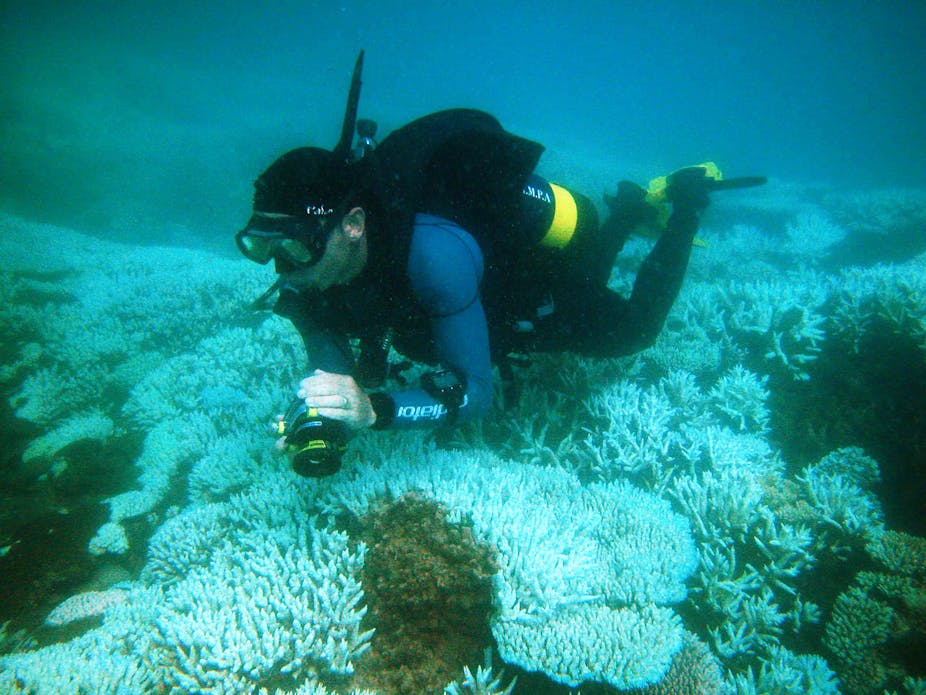
Scientists have suggested using shade cloth to protect corals from the heat stress that leads to coral bleaching. AAP

Unconventional tactics, including using shade cloth to protect corals from heat stress, must form part of future ocean management and conservation plans, argues a scientist from the University of Queensland.

In a paper published in Nature Climate Change today, Ove Hoegh-Guldberg, director of the Global Change Institute at the University of Queensland, together with Greg Rau of the Institute of Marine Sciences at the University of California, and Elizabeth McLeod of The Nature Conservancy, say new tactics are needed to save oceans from CO2 emissions.

“It’s unwise to assume we will be able to stabilise atmospheric CO2 at levels necessary to prevent ongoing damage to marine ecosystems,” Professor Hoegh-Guldberg said.

“In lieu of dealing with the core problem – increasing emissions of greenhouse gases – these techniques and approaches could ultimately represent the last resort.”

In addition to using shade cloth over coral reefs, the paper suggests novel marine conservation options, including applying low-voltage electrical current to stimulate coral growth and mitigate mass bleaching; adding base minerals such as carbonates and silicates to the ocean to neutralize acidity; and converting CO2 from land-based waste into dissolved bicarbonates that could be added to the ocean to provide carbon sequestration.

“We need to remember that all of these ideas are extremely costly, especially when compared to solving the core issue of reducing CO2 emissions,” Professor Hoegh-Guldberg said. “If we address emissions, the costs are a tiny fraction of global GDP growth each year.”

Such measures are likely to be small-scale solutions said Alistair Hobday, marine and atmospheric research scientist at CSIRO.

“They will probably have a place when things get very desperate but may not be true mitigation measures,” Mr Hobday said.

Despite this, Mr Hobday said novel solutions are required. “We need to be mature enough to listen to all sorts of arguments.”

Mr Hobday likened the solutions to triage: “You decide who needs the help and then you just get in there”.

Similar examples in science include putting light coloured sand over black sand on beaches to help turtle reproduction, and rescuing chicks before returning them to the nest during periods of extreme flooding, Mr Hobday said.

The reports authors acknowledge in the report that short of stabilising if not reducing atmospheric CO2, there may ultimately be no satisfactory conservation options for the ocean, either globally or regionally.

“However, now is the time to find out,” they write.

Sign in to Favourite

Want to follow The Conversation?

Sign up to our free newsletter to get the day's top stories in your inbox each morning, with a special wrap on Saturday.

Spinner
Help evidence based journalism become the norm and donate

Join the conversation

30 Comments sorted by

  1. Trevor Ellice

    Geologist

    SHADE CLOTH OVER CORAL REEFS!!!!

    - what are you guys smoking?

    or this just an old fashioned doomsday cult?

    report
    1. Wade Macdonald

      Technician

      In reply to Trevor Ellice

      Agreed....

      A 15 year study finished just last year reported no net coral loss from the GBR across several key sites.

      All this despite the claims of the GBR being in environmental chaos by the fear campaigners.

      The lunatics are running the university asylums. No wonder no one believes in environmental scientists these days?

      report
    2. Wade Macdonald

      Technician

      In reply to James Haughton

      No doubt the GBR faces some threats but the idea of putting up shade cloth in amongst cyclone ravaged reefs sounds like a great way to createplenty of 'shade cloth drift nets' and kill more biodiversity than it would save. What about all the international ships that pass through the area and other vessels?

      Who are these people and where did they get the qualifications from?

      Stop listening to the fear campaigners and learn the truth....

      Quote... "At the scale of the whole GBR, there was no net decline in hard coral cover between 1995 and 2009."

      http://www.ncbi.nlm.nih.gov/pmc/articles/PMC3053361/

      report
    3. James Haughton

      Social Policy Researcher

      In reply to Wade Macdonald

      Anyone can cherry-pick sentences out of context, and find short-term variations in data. The same paper comments that "Regional estimates of coral cover using the manta-tow method are available from the mid 80's and found average reef-wide coral cover across the GBR declined from 28.1% to 21.7% between 1986 and 2004". Over the same period, coral calcification declined by 14%, and "the data suggest that such a severe and sudden decline in calcification is unprecedented in at least the past 400 years". http://www.sciencemag.org/content/323/5910/116.short

      report
    4. Wade Macdonald

      Technician

      In reply to James Haughton

      The GBR was around long before man and it will still be here in some form long after we are gone.

      This is a prime example of marine science going to the dogs and your defending it?

      The reef always has localised impacts from flood years and creates coral loss scenarios for many to use as scare tactics on the dumb masses.

      But covering expansive cyclone affected atoll systems in shade cloth? Seriously people...get a grip!

      report
    5. Richard Dale

      logged in via Facebook

      In reply to James Haughton

      (1) The pH of the oceans is greater than 7. How can we have "ocean acidification" if oceans are basic? You cannot acidify something that is not acidic after the process.

      (2) The pH of oceans varies over very short time scales and very short distances far more than human activity can affect it (while still remaining greater than 7). Therefore ocean fauna must be tolerant to variation in pH.

      (3) Ocean acidification has nothing to do with a lunatic plan to shade the Great Barrier reef.

      Three reasons that a Social Policy Researcher should not go onto a web discussion and blurt the first mythical environmental catastrophe that comes into his head.

      report
    6. Mike Hansen

      Mr

      In reply to Wade Macdonald

      "The GBR was around long before man and it will still be here in some form long after we are gone."

      Wade - that is ideology not science.

      report
    7. William Julius Valo

      Student (Science)

      In reply to Richard Dale

      1) Do you know anything at all about the pH scale? It's a logarithmic scale which identifies the concentration of H+ ions (more H+ ions = more acidity)

      So, despite the fact the the oceans is at roughly pH 8.1 (which is basic), any movement towards 0 is STILL an acidification. Also, because this is a logarithmic scale, a movement of pH 0.1 represents approximately a 25% increase in H+ ions which is not exactly a trivial amount.

      2) WTF. This is actually a lie.

      3) yes it does. One of the primary effects of ocean acidification is the reduction of available carbonates (CO3 for the uninitiated). What do you think coral reefs are made of? Bingo, carbonates.

      Go post your lies and ignorance elsewhere

      report
    8. Greg Adcock

      Scientist

      In reply to William Julius Valo

      William,

      your reply is a bit harsh and misses an opportunity to educate and provide citations. While you might perceive that this is trolling, responses like yours don't help.

      Regarding point 2 I think Richard is trying to express something that is actually not a lie. Temporal variation in pH at a location can be quite high. Here is a randomly chosen free to access paper that has a nice colour pic showing this http://www.pnas.org/content/105/48/18848.

      What Richard is doing is confusing the above affect with a sustained and continuing drop in average pH. The temporal variation is greater than the average change measured and predicted due to increased atmospheric CO2.

      What Richard needs to understand is that adaptations that allow a beast to cope with pH fluctuations do not protect them against a lower average. Coping and thriving are different things.

      report
    9. Trevor Ellice

      Geologist

      In reply to Mike Hansen

      I think one day when the climate wars are over and everybody has recovered from the fog - this article and this website generally, will be seen as an example of how far we slipped away from enlightenment; during this remarkable period of human history were we caught dose of group insanity.

      report
    10. Mike Hansen

      Mr

      In reply to Greg Adcock

      Richard's argument re ocean acidification is the same as arguing that because there are large temperature differences between night and day or summer and winter, then global warming is nothing to worry about.

      report
    11. Wade Macdonald

      Technician

      In reply to Mike Hansen

      Ideology is thinking the GBR is about to explode Mike.

      Any proof that the GBR will not be around longer than man to claim this ideology?

      What do you think...10 years, 50 years before the GBR is a sand bar?

      report
    12. Trevor Ellice

      Geologist

      In reply to William Julius Valo

      reduction of available carbonates! umm what about limestone - you know the stuff the GBR is made of. Only the outer skin is alive the rest 99.999% of the structure is made of the living corals deceased ancestors.

      Can one even imagine the buffering effect on the worlds oceans of the vast deposits of limestone (actually that is why the current atmosphere can be consided depleted in co2, it has been sequested by fossil living organisims). The notion that a trace of a trace gas (co2) could upset that buffer is plainly ludicrous. Ocean acidification is the last resort of the climate charlaton.

      ps it is actually the bicarbonate ion that is important in an aquaous solution of CaCo3

      pps Richard your points were succinct and useful - thanks for posting

      report
    13. Mike Hansen

      Mr

      In reply to Trevor Ellice

      Who to believe?
      Trevor Ellice who repeats the claims of the shock jocks - CO2 is a trace gas - what harm could it do?
      Or the following scientific organisations?
      The US National Oceanic and Atmospheric Administration
      http://www.pmel.noaa.gov/co2/story/Ocean+Acidification
      "Since the beginning of the Industrial Revolution, the pH of surface ocean waters has fallen by 0.1 pH units. Since the pH scale, like the Richter scale, is logarithmic, this change represents approximately a 30 percent increase…

      Read more
    14. Trevor Ellice

      Geologist

      In reply to Mike Hansen

      this only illustrates the shocking state of institutionised science these days - these are motherhoood statements which start off be correct then lurch towards alarmistism violently. The question after this is soo bloody what a little bit of co2 dissolves in the oceans - who knew? wow scarey stuff man.

      These statements are political and do not stand scientific rigour - the outfits that utter them should be ashamed.

      So we are so sure as the average of worlds oceans? what is the error bar on this estimate? is the proposed effect within this range? mmm interesting questions.

      mm actually I think the NOAA statement is misleading the Richter scale is to base 30 the ph to base 10 - can somebody check the maths. And the way it is framed with percentages very misleading this is what is experienced all over the place and no cause for alarm.

      report
    15. Mike Hansen

      Mr

      In reply to Trevor Ellice

      "The Richter magnitudes are based on a logarithmic scale (base 10)."
      http://www.geo.mtu.edu/UPSeis/intensity.html

      "A Richter Magnitude Scale is any of a number of ways to assign a single number to quantify the energy contained in an earthquake. In all cases, the magnitude is a base-10 logarithmic scale obtained by calculating the logarithm of the amplitude of waves measured by a seismograph."
      http://en.wikipedia.org/wiki/Richter_magnitude_scale

      What was that you were saying Trevor - "this only illustrates the shocking state of institutionised science these days" I do not think you can blame institutions for your lack of knowledge.

      report
    16. Wade Macdonald

      Technician

      In reply to Mike Hansen

      I would rather have a strawman argument anyday than be part of the pro alarmist movement of conservation clowns.

      report
  2. Comment removed by moderator.

  3. Philip Dowling

    IT teacher

    I have read this article carefully.
    I can conclusively say that Ove has a new funding submission in progress, a rather poor grasp of basic mathematics and physics, a quirky sense of humour, a case of relevancy deprivation syndrome or is a fan of Ern Malley.
    Incidentally has he opened a file on this proposal?

    report
    1. Wade Macdonald

      Technician

      In reply to Philip Dowling

      You only have to look at the other blogs and forums to see how much this article has been laughed at.

      This sites respondents who panic for alarmist climate change measures are simple not of sound mind.

      report
    2. fret Slider

      Developer

      In reply to Wade Macdonald

      This is the best laugh we've had in the UK since Muller became a convert. It's a shame its cost you so much money and has made Australian science look, well, unhinged.

      report
  4. Comment removed by moderator.

  5. Alistair McDhui

    Retired engineer

    Is Australian academia full of climate kooks?

    Corals evolved during the Cambrian Era, when CO2 levels were eight to twenty times higher than today. The great coral reefs of the Permian era formed when CO2 was as high as 3,000 ppm CO2.

    The extra CO2 will allow the symbiotic algae to grow much faster thus providing the energy to overcome the eaxta back reaction rate for the precipitation of carbonate ions.

    report
    1. Jason Page

      logged in via Facebook

      In reply to Alistair McDhui

      Wrong... extra Co2 will create anaerobic conditions under which no other sealife will survive. The conditions you have described in the so-called Cambrian era developed over millions of years, not 100.

      report