
Most parents will tell you that as soon as they announced their pregnancy, the advice started rolling in. Much of it might have been sensible and evidence-based, but it’s difficult to sort the myths from realities.
Given so much of a new parent’s life is spent settling infants and working out their rapidly evolving sleep patterns, questions soon arise about how to get a baby to sleep, where they should sleep, and for how long.
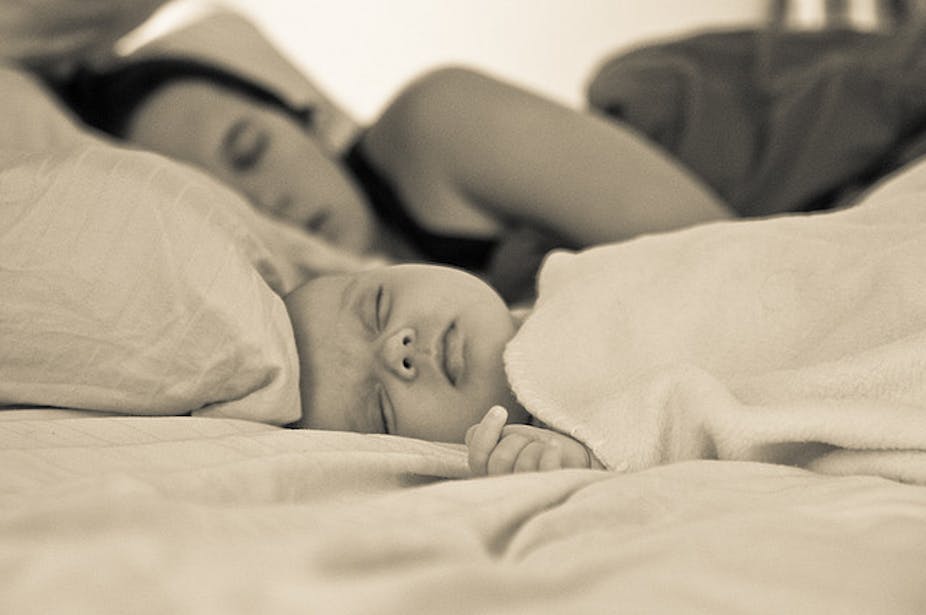
For many parents, bed-sharing becomes a workable option to settle their infant and to gain much-needed sleep. But is it worth the risks?
Sharing a bed with an infant is a risk factor for SIDS, the unexpected and sudden death of an infant during sleep. While a public health campaign has successfully promoted strategies to reduce the risk of SIDS in Australia by 80%, many parents still sleep alongside their infants.
SIDS and Kids brochures state that “sharing a sleep surface with a baby increases the risk of SIDS in some circumstances”. Specifically, “babies who are most at risk of sleeping accidents whilst sharing a sleep surface are babies less than three months of age, and babies born preterm or small for gestational age (low birth weight)”.
Sleep patterns
In March 2010, a national Galaxy Research survey commissioned by Proctor and Gamble asked 2,000 mothers with babies and toddlers aged up to two years about their sleep patterns. My colleagues and I conducted an analysis of 1,000 responses, randomly selected to ensure diversity in age, location and socioeconomic background.
The mothers’ responses highlighted the challenges of getting an infant to sleep, with 92% reporting difficulties at some stage. Of this group, 24% regularly or always struggled to get their infants to sleep. Night waking was a common occurrence, with 51% of the babies waking at least once during the night.

Just over half (58%) of the infants slept for six to seven hours per night, while one-third (31%) of the infants slept for four to five hours.
Not surprisingly, many of the mothers said they felt tired (46%). This sense of sleep deprivation resulted in feelings of exhaustion (75%) and irritability (70%). The mothers identified they had lower levels of patience (63%) and greater feelings of frustration (27%) than before giving birth. For just over a third (37%), additional strain was being placed on the relationship with their partner.
The mothers used numerous strategies to encourage their infants to sleep. These included rocking and patting (51%), giving a feed (46%), using a dummy (47%), putting baby in a cot (57%) and allowing their infant to fall asleep in their arms (48%). Just under half (41%) used bed sharing as a strategy to get their infants to sleep.
Reducing the risks
The advice from clinicians and public health experts on co-sleeping is based on evidence and policy: have your baby sleep in your bedroom for the first six to 12 months but not in your bed.
But additional advice is needed to minimise the risk when parents make the decision to bed-share with their infants or see it as a last resort to getting some sleep.
Our research found that for many women use bed-sharing as an infant-settling strategy, driven by a desperate need for sleep. These findings are supported by a 2002 study which identified that 80% of the 253 parents studied at some stage shared a bed with their infant.
So how do we best inform parents about the risks of sharing a bed with their infants? Let’s start with the basics:
Put your baby on his back to sleep (never on his tummy or side)
Make sure his head is uncovered during sleep
Keep the sleep environment smoke-free, and
Provide firm and safe bedding.
In addition to these now well-accepted safe sleeping guidelines, SIDS and Kids recommends you avoid sharing a sleep surface with your baby if:
You’re a smoker
You’re under the influence of alcohol or drugs that cause sedation
You’re excessively tired
Other children are sharing the bed with a baby
The baby could slip under bedding (such as pillows or doonas)
The bed is a waterbed or if the mattress is too soft
The sleep surface is a sofa or chair
Your baby could become trapped between the bed and the wall or the bed rails, or
Your baby may fall off the bed.
It’s important that all parents know not only the risks of bed-sharing but ways to minimise the risk if they choose to share a bed with their infant.
Julie Leslie
GIS Coordinator
Another terrible article from well meaning researchers. This provides little help to deperately sleep deprived mothers. It tries to deliver a single simple message, when really there are many. The "one size fits all and lets keep it simple" strategy just does not work and makes the recipient feel more confused (and ultimately lose confidence) when their situation does not match.
The changes in sleep patterns from a newborn to a 6 month old to a 12 month old is incredible. You expect to have disturbed…
Read moreSue Ieraci
Public hospital clinician
Ms Leslie - you may not have realised that authors on TC have a word limit. The purpose of the articles is to give succinct information and to stimulate debate. Within the space available, they appear to have done a great job.
Simple, non-intuitive advice in the "back to sleep" campaign has massively reduced the incidence of SIDS (now called SUDI). A similar approach can help minimise suffocation from co-sleeping.
As the authors said, if you choose to do it, make both the physical environment and the situation as safe as possible - and they summarise how. Within the space allowed, the authors have given succinct and practical advice, based on evidence. Isn't that what we need?
Anastasia Powell
Lecturer, Justice and Legal Studies at RMIT University
I wonder what the evidence is about the various co-sleeper 'aids' (whether it is the cradles that attach to the side of your bed, or the 'pod' that sits on your bed). I used a pod myself for those nights when only holding my baby's hand while he lay next to me would give me any chance of sleep! It wasn't very expensive; but some of these so-called 'safety aids' are very pricey and not practical for everyone! I wonder how much safer they really are, or whether vulnerable, sleep-deprived parents are just easy marketing targets.
I also wonder how much cross-cultural research has been done on co-sleeping? Is it the co-sleeping itself? Do cultures where co-sleeping is more accepted experience significantly higher infant deaths? If not, why not? Just some interesting aspects to explore...
Sean Manning
Physicist
We used one of those pod things too. It had firm walls so that you couldn't roll onto it and even had a little night light so that you could check on them when they stirred. I think these things are just fantastic as they allow for more sleep, more bonding and what I regard as a very safe and SIDS compliant situation.
Can't recommend these enough!
Sue Ieraci
Public hospital clinician
Anastasia Powell - you might be interested in the anthropological view expressed in this 2005 paper:
"Why babies should never sleep alone: A review of the co-sleeping controversy in relation to SIDS, bedsharing and breast feeding"
James J. McKenna* and Thomas McDade
http://img2.timg.co.il/forums/1_147673444.pdf
It is important to read this bearing in mind that McKenna is an anthropologist who is a particular proponent of co-sleeping and breast-feeding - he is not a clinician. He does, however…
Read moreIan Clarke
Director, Pacific Strategy Partners
Thanks for this - objective, fact based advice about raising children is hard to find.
Yes, each child is different, and yes there are other factors at work (food/heat/light), but basing advice on facts not myths is a big help!
Comment removed by moderator.
Amanda S
logged in via Twitter
Interesting article, but it doesn't present any evidence of co-sleeping as a risk factor for SIDS. Someone else has raised the question of sleeping practices in other cultures - where is the correlation data on co-sleeping and SIDS in any culture?
I agree there is the potential for risk where the final list of guidelines (ie parents under the influence of alcohol or drugs etc) is not heeded, but generally speaking, a mother in particular is very aware of and responsive to her baby.
I co-slept with my first son and sometimes used a pod thing with my second and I feel it was a very valuable experience.
Mark Amey
logged in via Facebook
I've been trying to find a copy of the Dutch study from around 2004, where they had analysed risk factors in infants who had died of SIDS. From memory the Odds ratio of cobedding and dying from SIDS was around five at , one month of age, and dropped by about one per month. This was corrected for parental smoking, alcohol and other drug use. Also (from memory) smoking multiplied any other risk by a factor of about five or six.
I'm sorry I can't find the study.
Sue Ieraci
Public hospital clinician
Here is a relatively recent study from the Journal of Paediatrics and Child Health:
"Autopsy findings of co-sleeping-associated sudden unexpected deaths in infancy: Relationship between pathological features and asphyxial mode of death"
at http://onlinelibrary.wiley.com/doi/10.1111/j.1440-1754.2011.02228.x/abstract;jsessionid=B4A86B4633F31C872F7EC5DB07FD46F3.d03t02
The findings of this study suggested that asphyxia (suffocation) was the more common cause of death in the co-sleeping group.