
Sick of paying for textbooks? Get them now, free and online

In the same way that free open online courseware is threatening to disrupt traditional universities, open textbook initiatives such as OpenStax College from Rice University threaten to do the same to the traditional textbook market. OpenStax College has taken five of the most popular topics taught in…

7zt5gn3z-1341988578
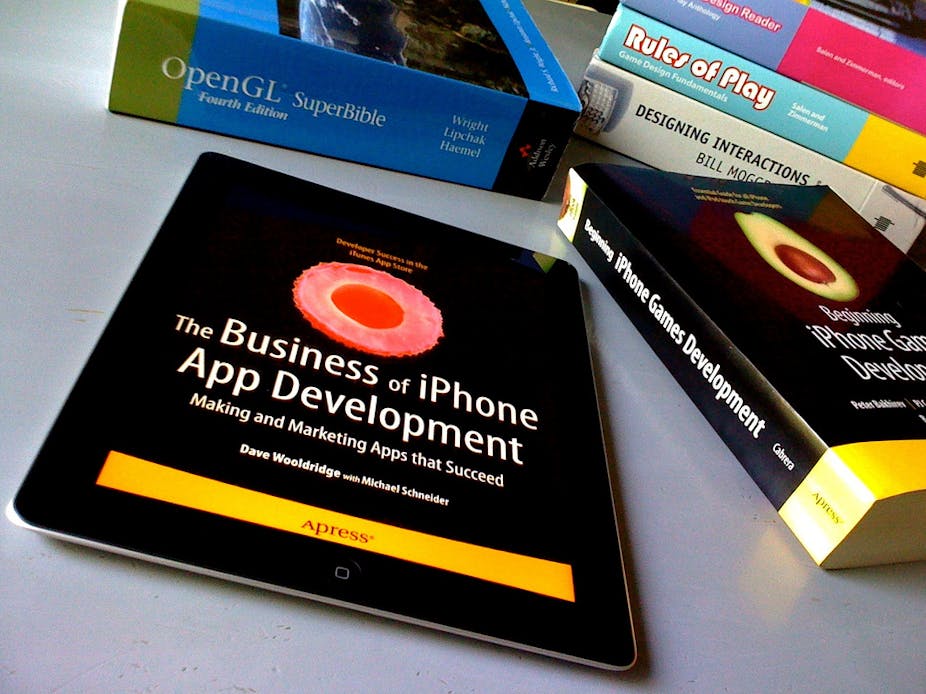
Paying for expensive textbooks could be a thing of the past for university students. Flickr/Abstract Machine

In the same way that free open online courseware is threatening to disrupt traditional universities, open textbook initiatives such as OpenStax College from Rice University threaten to do the same to the traditional textbook market.

OpenStax College has taken five of the most popular topics taught in American universities and produced high quality peer-reviewed textbooks that are available for anyone to download for free.

OpenStax College aims to try and save students at least $90 million over five years by capturing 10% of the US textbook market.

But this is not the first open access textbook venture. Sites like Bookboon and Flat World Knowledge offer free online and downloadable versions of their texts with print versions available at a price. But the difference is that these sites have strong associations with publishers, whereas OpenStax College is run through a university.

Authors of textbooks in Flat World Knowledge receive a royalty on sales of printed versions of their textbooks, whereas authors contributing towards Rice University’s venture are volunteering their efforts. Bookboon funds open access through the inclusion of advertising in the books.

The move to electronic textbooks is something that students have adopted with gusto. In a summary of research at Indiana University over 1,700 students were surveyed for their attitudes and use of e-Textbooks: 87% of students reported reading e-Texbooks over paper versions, while 68% of students never printed any part of their texts, reading everything digitally.

The survey also revealed that the primary reading device was their laptops and only 1% used a mobile device or an e-Reader (this may be a reflection of the time of the study which covered 2009 – 2011, as iPads were relatively new in 2009).

In 2012, MIT teamed up with Flat World Knowledge to provide textbooks for their OpenCourseWare courses. Presumably this will continue with the edX venture.

With the average textbook costing between $50 and $300, the availability of free textbooks would be extremely attractive to students. There is certainly anecdotal evidence that students are resorting to using pirated copies of electronic textbooks to avoid the large financial outlay. Certainly, it wasn’t hard to find a pirated copy of the first textbook I looked for on the internet.

Given that free textbooks are available and that they are at least of equal quality as those available from commercial publishers, the question could be raised as to why they are not more commonly used by academics.

On the assumption that most academics would care about students having to pay for a textbook, there are probably a number of reasons they are not more commonly used. The primary reason is that academics don’t know they are available. Another reason might be time pressures in preparing a course.

Spending time searching for a free textbook is probably not a priority. The practice of making a university course revolve intimately around a text would also make changing textbooks an effort for some academics -especially if they wrote the textbook!

The open textbook’s American focus might also be a disincentive for academics (and students) in some subjects. This is more likely to be an issue in the humanities than in the sciences or engineering.

Aside from the benefits to students, the move to open access textbooks released under creative commons licenses is an important development in education. The ability to use content without worrying about copyright issues is a big advantage, especially when making the courses developed in this way open access themselves.

A considerable amount of effort is spent by universities locking away content on so-called learning management systems simply to avoid copyright issues when non-original content is used. This also allows for academics to modify content and incorporate it with their own to customise the way it is used in their course.

Of more importance, however, is that the world simply doesn’t need 9,603 introductory texts to Sociology that can currently be found on Amazon. Of course, we have so many variants of textbooks because this is the only way that publishers can make money out of books that sell small numbers of copies each (a long tail business model).

Wikipedia has demonstrated the power of a crowdsourcing model in the development of mostly high quality content. Applying this to introductory texts as in the OpenStax College model benefits from a collaborative model of development that can be sustained with constant updates.

The move to open education models of open courseware and content is only going to be of enormous benefit to students. For universities, there is the opportunity of contributing to this movement and reaping the reputational benefits as a consequence.

By making their textbooks free, a university can extend its reach enormously, to hundreds of thousands of potential readers. It can also monetise free textbooks, by selling associated question-and-answer sheets, by incorporating subject related advertising, or by selling a related physical product (such as a calculator, a titration set, or an anatomy lab coat).

Traditional publishers may not be happy with this move. A group of them are trying to sue another open access textbook company Boundless Learning.

But at the end of the day, it is going to be hard to argue against “free” in the world of learning.

Join the conversation

8 Comments sorted by

  1. Gavin Moodie

    Principal Policy Adviser

    Thanx for this, which I found informative.

    report
  2. Jack Arnold

    Director

    An excellent article, thank you.

    No more rush to the library every Monday morning to beat the supervisor to fresh knowledge to expound at morning tea (Eat your heart out Max Webster).

    This article shows the ultimate 'user pays' model for education; only those hardcopy limited students will need to purchase textbooks by download thus bearing the printing cost individually.

    report
  3. Mister Anderson

    Student

    Great article! I can tell you first hand as a forth year undergrad, paying $100+ for a text book that's only useful for ~13 weeks of my life isn't only financially impossible, it's highly impractical.

    report
  4. Robert Tony Brklje

    Robert Tony Brklje is a Friend of The Conversation.

    retired

    Open courseware can extend further than this, students can contribute to it as part of their curricula, after it has been graded of course and found suitable.
    It not only allows lecturers, tutors to contribute it also allows students, especially when open courseware extends beyond University, down to High School and Primary School.
    Local content should of course dominate, not for being better, just where it is equal it allows local lecturers, tutors and students to demonstrate their skills on a public forum, just because it is from a more marketing developed University or a more public relations skilled Lecturer, does not mean that information should dominate, where local content is 'equal', it should always appear in local courseware.
    There is nothing stopping the student from reaching out to other Universities or more well known educators for additional research materials.

    report
  5. Colin MacGillivray

    Retired architect

    Textbooks aren't leather bound or even hardback and the paper doesn't smell good so bibliophiles don't buy them to put on their shelves, unread, or sniff the pages.
    There will, in time, be no printed textbooks if the "68% of students never printed any part of their texts, reading everything digitally" increases much.
    Could be the start of the end of all printed books.

    report
  6. Gil Hardwick

    Anthropologist

    You might want to advise other UWA Faculties, David, of the utility in simply providing an iPad or similar in place of the endless course readers still being printed up and sold at up to $60-70 per unit, that contain nothing more in fact that journal articles already available online in PDF.

    Or better, since the Federal Government already pays some $2,500 extra each year for expenses, which students have anyway used to buy a laptop or iPad, or both, simply post everything to the new Moodle LMS and let them download their coursework readers.

    It's not just about digital editions, but the sheer weight of carrying books around. At least uni students have gained a bit of height and weight. Watch some of the barely pubescent high school kids on the bus or train every morning, staggering under loaded backpacks nearly as big as they are, with their sports gear carried separately in another bag again.

    The time approaches . . .

    report
    1. David Glance

      Director, Centre for Software Practice at University of Western Australia

      In reply to Gil Hardwick

      Hi Gil, yes, selling students printed copies of lecture slides and course reading material has always seemed a little unfair to me. And my daughter has had to carry a 3 kg laptop into school every day, around school between classes and back again to charge up for the next day. Fortunately (ironically), next year the school may ask her to pass the laptop on to the year below (there is no more money to buy new laptops). By the time she gets to university I expect tablets to be well-and-truly embedded in student's lives at least.

      report
  7. Andrew Page

    Professor, Psychology, UWA

    I read the article with interest but was disappointed when I followed the links. At this stage I could only find one Introductory Psychology text. It was a reasonable book but only "free" in that the online access through a webpage is free. To get a downloadable version of the ebook and access to quizzes etc then required students to pay. This is not vastly different from standard textbooks, which offer different rates if you purchase the paper copy (with "free" access to the online material and quizzes) vs the electronic copy alone. Thus, the differences don't seem to be as stark as the article seems to convey. Yes, it is true that the content is accessible for free, but the whole package is not free and once you start to purchase these additional components the apparent differences start to dissipate. Thus, my question is, are these online sources really a revolution in infromation delivery or just a different marketing model that uses the term "free" as a hookline?

    report