Start solids at ‘around six months’: new infant feeding guidelines

Infants should be exclusively breastfed until six months of age and solids should be introduced at “around six months”, according to official new infant feeding guidelines released today. The guidelines, released by the National Health and Medical Research Council, are based on the latest scientific…

683x4c9b-1361148947
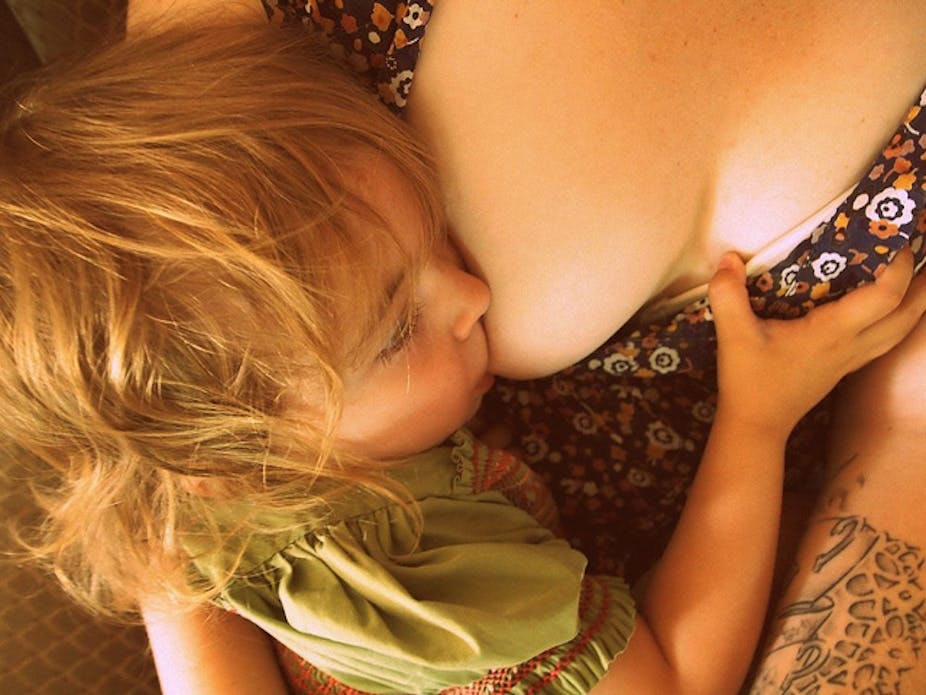
The NHRMC’s infant health guidelines recommend that breastfeeding is continued until 12 months of age and beyond, for as long as the mother and child desire. http://www.flickr.com/photos/ameli0rate

Infants should be exclusively breastfed until six months of age and solids should be introduced at “around six months”, according to official new infant feeding guidelines released today.

The guidelines, released by the National Health and Medical Research Council, are based on the latest scientific findings and are an update on 2003 guidelines.

The decision to keep the recommended age at which solids are introduced to around six months is significant because the food industry had lobbied to have the recommended age reduced to four months, one expert has said.

A press release accompanying the release of the guidelines said there were several differences between the old and new guidelines.

The press release said that, “Specifically, the evidence has strengthened for:

  • The benefits of breastfeeding.
  • The association between breastfeeding and a reduced risk of becoming obese in childhood, adolescence and early adulthood.
  • The association between breastfeeding support and increased duration of exclusive and any breastfeeding.
  • The importance of introducing solid foods at around 6 months of age to meet nutritional requirements and decrease risk of allergy development.
  • The order of introducing solids; as long as iron-rich foods are included in first foods, foods can be introduced in any order and at a rate that suits the infant.
  • The implementation of the Baby Friendly Hospital Initiative improves breastfeeding outcomes."

Professor Amanda Lee, Chair of the Dietary Guidelines Working Committee, said the scientific evidence clearly showed that “around six months of age is the optimum time to introduce solids for children.”

“There have been some reports in the media about allergies and the suggestion that infants should be introduced to solids at an earlier age to stop allergies. We found no evidence of that,” she said.

However, the new guidelines said that delaying the introduction of solids beyond six months may increase the risk of allergies.

“We don’t want mothers to be introducing solids after seven months,” Professor Lee said.

Dr Karleen Gribble, Adjunct Research Fellow at the School of Nursing at the University of Western Sydney said it was “a really big deal” that the new guidelines retained six months as the recommended age that babies start solid foods.

“There was extensive lobbying to get that changed [to four months] from industry,” said Dr Gribble, who was not involved in writing the new guidelines.

“We’ve yet to have the labelling changed on baby foods in Australia, so if you go into the shops you’ll see baby foods labelled as suitable from four months.”

Introducing solids too early put the baby at risk of infection, said Dr Gribble.

“And also their guts aren’t really mature enough to digest the food properly anyway. When the recommendation was four months, a lot of parents were introducing them at two to three months because ‘their babies were very advanced’,” she said.

Dr Yvette Miller, Senior Lecturer in Public Health at the Queensland University of Technology, said she was pleased to see the guidelines made it clear that infants do not need other fluids in the first six months of life.

“This is something about which there is still a lot of conflicting advice and confusion among women. Some of our recent work has found that infants who are given other fluids early (like being given water in the first month of life) have double the risk of too-early introduction of solids,” said Dr Miller, who was not involved in writing the guidelines.

Dr Miller said it was good to see the guidelines advising that continuing breastfeeding beyond the six-to-12-month period is beneficial for mother and baby and recommending unrestricted breastfeeding (instead of scheduled feeds) as a practice that may overcome many common breastfeeding problems.

Breastfeeding

Where possible, babies should be breastfed exclusively for the first six months of life and breastfeeding should continue for “as long as the child and mother desire”, the document said.

To help facilitate that, health workers should encourage community-based services supporting breastfeeding families and “support in the community and workplace for flexible work schedules, suitable environments for breastfeeding, expressing breast milk, storage of expressed breast milk and child care,” the document said.

Paid parental leave schemes and lactation break entitlements should also be promoted, the guidelines said.

Research showed that breastfeeding reduced the risk or severity of obesity, SIDS, asthma, urinary tract infections and a range of other problems, the guidelines said.

While most women do not have medical problems that prevent them from breastfeeding, the guidelines recognised it will not be possible for everyone and provided advice on how health workers and parents can ensure formula is used correctly.

Crying

It is normal for six-week-old infants to cry for around three hours a day, the guidelines said.

“Despite the fact that disease is diagnosed in less than 5% of such infants, they are at risk of medicalisation of their behaviour, and of diagnosis of a range of disorders, including colic (unsettled infant), ‘silent reflux’ and lactose intolerance. They are also at risk of early cessation of breastfeeding,” the document said.

Sign in to Favourite

Want to follow The Conversation?

Sign up to our free newsletter to get the day's top stories in your inbox each morning, with a special wrap on Saturday.

Spinner
Help evidence based journalism become the norm and donate

Join the conversation

14 Comments sorted by

  1. N Mitchell

    Stay at Home Mother

    Excellent summary of the research! I wish you'd shared this one on Facebook instead of the controlled crying can of worms piece.

    report
  2. James Akre

    Independent author and commentator

    This is encouraging news and the obvious choice in the light of evidence. However, it is worth recalling that the World Health Organization doesn’t recommend that infants should be exclusively breastfed for the first six months of life “where possible” (see paragraph 10 of the Global Strategy for Infant and Young Child Feeding http://www.who.int/nutrition/publications/infantfeeding/9241562218/en/index.html). Nor would we expect to see health authorities anywhere recommend that, where possible, children…

    Read more
    1. Rosemary Stanton

      Nutritionist & Visiting Fellow at University of New South Wales

      In reply to James Akre

      James

      I am 100% in favour of breastfeeding, but I also realise there are situations where it isn't possible for a mother to breastfeed. This may include mothers who are ill or when babies are adopted.

      Also, we have to accept that some women simply don't want to breastfeed. I'd love to be able to change that, but in practice, if that is a mother's decision, she (or other carers) will need to know something about safe use of formula.

      report
    2. James Akre

      Independent author and commentator

      In reply to Rosemary Stanton

      Rosemary,

      That's an excellent point you've made, and one that I attempted to highlight by distinguishing between a public health recommendation and practical considerations for its implementation.

      Given the way this forum's software functions, I wonder whether the second paragraph of my comment, and especially its final sentence, was visible when you read it. It reads: In contrast, saying that “the guidelines recognised it will not be possible for everyone and provided advice on how health workers and parents can ensure formula is used correctly” sensibly accepts reality and counsels accordingly.

      James

      report
    3. Karleen Gribble

      Adjunct Research Fellow, School of Nursing at University of Western Sydney

      In reply to Rosemary Stanton

      Rosemary, what can be done about the labelling of complementary foods "from 4 months" in Australia. It's nearly a decade since the recommendation for duration of exclusive breastfeeding changed and yet FSANZ have not acted in this area.

      report
  3. Richard Hockey

    logged in via Facebook

    The guidelines give the impression that they are based on evidence. The evidence used in this report for when to introduce solids ranges from extremely weak to non-existent.

    report
    1. Sue Ieraci

      Public hospital clinician

      In reply to Richard Hockey

      There is an entire volume entitled "Literature Review" that apparently backs up the NHMRC guidelines.

      IN the section on starting solids, there is one comment: "UK Food Standards Recommendations: Nuts in infancy are okay but not whole nuts until > 3 years due to the risk of choking " with no citations."

      "extremely weak to non-existent." is spot on.

      report
    2. Rosemary Stanton

      Nutritionist & Visiting Fellow at University of New South Wales

      In reply to Richard Hockey

      Page 86 of the Infant Feeding Guidelines lists a number of references to support 'around 6 months of age' as the ideal time for introduction of solids. There is also a section on why parents and carers should not delay introduction after this time or introduce solids earlier.

      report
    3. Rosemary Stanton

      Nutritionist & Visiting Fellow at University of New South Wales

      In reply to Sue Ieraci

      Sue
      I've searched the infant feeding guidelines document for "UK Food Standards Recommendations" to no avail. Can you tell us the page number please?

      Several references are given as to why nuts themselves need not be restricted for fear of increasing allergic reactions (eg from the Australiasian Society of Clinical Immunology and Allergy, the European Food Safety Authority and another from Pediatrics (Greer et al).

      Whole nuts (as opposed to nut pastes or ground nuts) are listed along with raw carrot and chunks of apple as being a choking risk in the practical advice to parents. There is no reference given for this - it was considered commonsense advice. Infants can (and do) choke on hard lumps of food.

      report
    4. Richard Hockey

      logged in via Facebook

      In reply to Rosemary Stanton

      The references are summarised on p 779 of "A review of the evidence to address targeted questions to inform the revision of the Australian Dietary Guidelines". The references only mention 4 months and are all rated as poor. So where does 6 months come from? IMO the credibility of these guidelines can only be rated as poor as far as evidence goes.

      report
    5. Rosemary Stanton

      Nutritionist & Visiting Fellow at University of New South Wales

      In reply to Richard Hockey

      Richard

      The evidence report was designed to answer targeted questions and is listed as one of the five key sources used for the DGs. (p5 of main DG document explains this). The only question addressed in this waswhether age of introduction of solids was related to weight. As you correctly noted, the evidence for this was rated as D level (weak) - that is, there is insufficient evidence to suggest it has any effect on future weight. This is not that the search for evidence is 'weak', but rather that no strong evidence relating future obesity and age of introduction of solids exists.

      Please note that additional reviews were done for the much more comprehensive Infant Feeding Guidelines produced for health workers. If you read the Infant Feeding document, p 86 (sections 9.2.1 and 9.2.2) you will find quite a list of references included there on why around 6 months is the ideal time for introducing solids.

      report
    6. Richard Hockey

      logged in via Facebook

      In reply to Rosemary Stanton

      Thanks for this. Have checked these studies out and only one actually insists on exclusive BF to 6m and seems to have started out with that being its goal. Even then it concedes that the evidence is not there. The evidence is extremely weak for 6 m and seems to be ideologically driven.

      report