


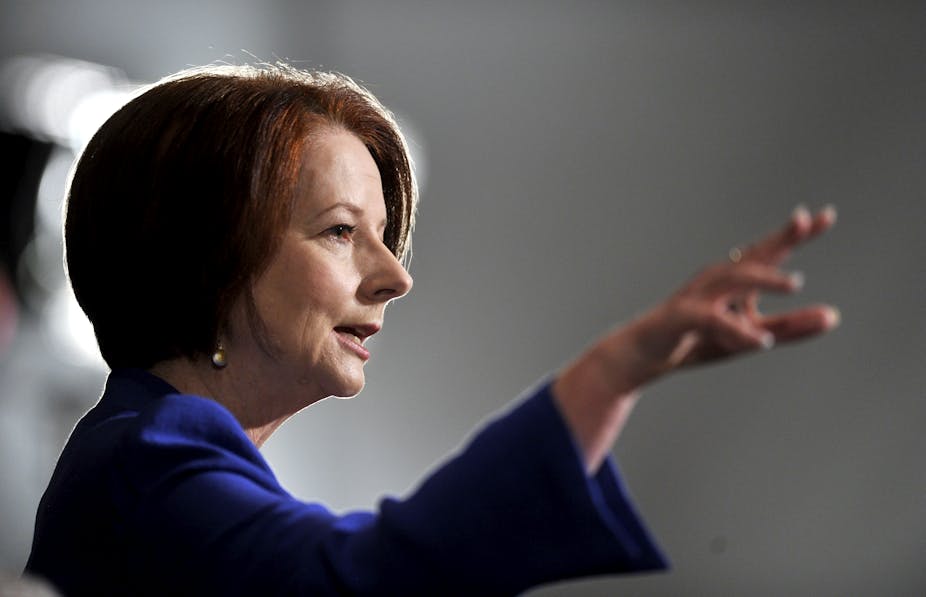
The battle over the future of Australia’s school funding arrangements has started in earnest. Outlining the government’s response to the landmark Gonski Review, Prime Minister Gillard spoke of a national and moral crusade for Australia’s students.
In this fight, she would not be taken hostage by recalcitrant states or vested interests. Yesterday the prime minister even called on the mining industry to use their influence to convince state premiers to “get on board”.
The premiers and the opposition heeded her call to arms from opposing camps. Premiers from Victoria, Queensland and Western Australia have railed against the plan – they can’t afford the billions demanded of them and the Commonwealth should stop intruding on their territory. The opposition meanwhile barked months ago that they would repeal any reforms in government.
This aggressive bluster is a long way from Gonski’s carefully researched and sophisticated proposals for fixing Australia’s broken school funding system.
A national plan?
The Commonwealth’s National Plan for School Improvement has many worthy elements but in the end was light on detail, politically problematic and in some cases, contrary to Gonski’s advice.
It is true that the plan’s centrepiece - a needs-based funding benchmark applied equally to all schools, based on their size, with additional loadings for certain disadvantages – mirrors the Schooling Resource Standard proposed by the Gonski panel.
But the other initiatives and the implementation strategy run counter to Gonski’s core recommendation that the Commonwealth should back off schools and respect the states as partners holding constitutional responsibility for the sector.
Victoria’s Premier Baillieu slammed Gillard’s plan as unprecedented intervention and micromanagement in schooling, saying it would result in a massive bureaucratic burden. Premier Barnett from Western Australia opined that if there’s one thing that can’t be run from Canberra, it’s a school.
The NSW government was one of a few states to respond positively, largely due to the fact it had recently announced what it described as “Gonski plus” reforms for its public system. In truth, these NSW reforms are more accurately described as “Victoria-lite” given its southern neighbour introduced the “core plus disadvantage loadings” funding model and greater principal autonomy almost twenty years ago.
NSW’s and Victoria’s efforts in fact demonstrate precisely why Commonwealth intervention was not needed to improve school funding arrangements. States are already experimenting – many already have elements of a core plus disadvantage loadings model to distribute funding and most have been increasing school autonomy and teacher quality for decades.
They’ve just been hampered in their reform efforts by increasing Commonwealth initiatives, limited resources and a lack of detailed information on what other systems are doing.
Gonski recognised this, calling for increased system and school-level autonomy, enhanced transparency and greater information sharing, along with increased funding targeted to lowest performing schools, as the keys to improving results.
State strife
This advice seems lost on Gillard, who will now take her National Plan to the states and systems to nut out the financial details. She’s asking them to make tough budget choices and warning she won’t be held to ransom by their demands.
Such language suggests she’s negotiating with terrorists, not democratically elected government partners. And it certainly doesn’t reflect jurisdictional respect or the flexible, bilateral agreements that Gonski recommended.
The prime minister suggested the states would provide about 70% of the additional $6.5 billion dollars deemed necessary under her plan. This is unfeasible.
States already provide over 70% of all government funding to schools, and 89% of the funding for public schools. Furthermore, under Australia’s peculiar fiscal settlement, the states have almost no revenue raising capacity and depend on Commonwealth grants to meet their constitutional spending obligations.
The only way they could chip in an extra four or five billion dollars is if the Commonwealth increases its untied “GST cash back” grants to the states by a consummate amount. Given Gillard has already ruled out “blank cheques”, this appears highly unlikely.
Building an Abbott proof fence
Although legislation will be introduced this year – prior to agreements with the states – the Commonwealth’s National Plan and new funding formula won’t begin it’s slow phasing in until 2014. And even then, it will take two parliamentary terms to implement a system which won’t be assessed against the government’s end goal of higher international test performance until 2025.
It begs the question of voters’ patience; thirteen years is a long time to wait. Perhaps this is intentional. Polling suggests it’s unlikely that Labor will win the next federal election let alone ones after that, so the Gillard government has nothing to lose by promising such a big funding increase. If their luck changes, they can find the money later.
These expectations of incoming Coalition government have seen suggestions of what journalist Paul Bongiorno called an “Abbott-proof fence” – a way to make undoing the reforms, as the opposition has promised, more difficult.
Yet, the Coalition’s plans are equally unfeasible. They promise almost as much new funding as Labor and claim they’ll make Australia number one internationally even faster using a hodge-podge of policies ironically mirroring Labor’s own proposals. These include increasing principal autonomy and high-stakes testing.
However, they go further ignoring in Gonski’s recommendations by maintaining the Commonwealth’s impossibly compromised, half-implemented, inadequate funding system currently in place, claiming – contrary to all evidence – that this system isn’t broken at all.
Like Labor, they’re also fuzzy on where this new funding would come from, given other high-costs policy promises made to date and their promises to repeal the mining and carbon taxes.
Where’s the leadership?
Landmark reforms are needed. Australia must prioritise the lowest performing students and it must aspire to have a funding system that is among the best in the world for both quality and equity.
But contrary to the aspirations of both Gillard and Abbott, these pursuits do not require increasing the Commonwealth’s policy role in schooling. Indeed, ever more Commonwealth carrots and sticks waved at states, schools and teachers can make the situation worse, as precious resources are diverted from learning to responding to the high-stakes accountability requirements.
Rather than being reduced, complexity and inefficiencies are amplified. And Australia’s students, despite the best of intentions, are the unfortunate losers from this territorial battle.