
Strange bedfellows: Julian Assange and Ecuador

Julian Assange’s appearance on the balcony of the Ecuadorian embassy in London to hold forth on his current situation, and President Obama, added a bizarre new chapter to the long-running Wikileaks saga. It remains to be seen whether Assange will indeed be able to take up asylum in Ecuador as British…

Rxjkw33b-1345422691
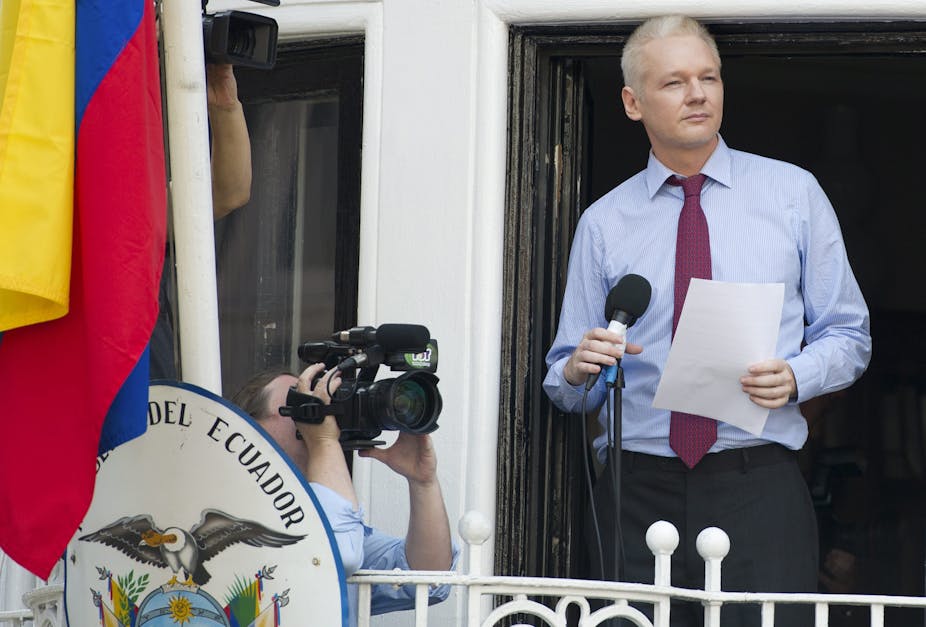
Julian Assange addresses the media from the balcony of the Ecuadorian embassy in London. EPA/Facundo Arrizabalaga

Julian Assange’s appearance on the balcony of the Ecuadorian embassy in London to hold forth on his current situation, and President Obama, added a bizarre new chapter to the long-running Wikileaks saga.

It remains to be seen whether Assange will indeed be able to take up asylum in Ecuador as British police maintain they will arrest him as soon as he leaves the Ecuadorian embassy, and may even move to seize him inside the building.

But how is it that Assange has come to see a small South American country as his saviour? And what does Ecuador have to gain from confronting the UK, and by extension the US, over Assange?

A new South American reality

On Saturday, August 18th, the socialist and social-democratic leaders of ALBA (The Bolivarian Alliance for the Peoples of Our America) convened in the coastal city of Guayaquil, Ecuador to debate whether and how to support Ecuador’s decision to grant asylum to WikiLeaks editor, Julian Assange.

The decision? Perhaps not surprisingly, a full-scale denunciation of the threats by the United Kingdom to “storm” the Ecuadorian embassy if Assange were not released and a renewed commitment to honouring Ecuadorian sovereignty and international law. As representative after representative underscored, Latin America will no longer tolerate the “colonial” incursions of either the UK or the United States, the latter of which is seen by growing numbers in the region to be ultimately behind the most recent “witchhunt” against Assange.

As Minister of Foreign Affairs, Ricardo Patino, put it with characteristic bluntness on August 15th:

“Colonial times are over, but through its behaviour, the United Kingdom and its allies have shown they retain the same imperial condescension toward the ideals of liberal governance and the rule of law that they have held in the past, applying or discarding them whenever it’s convenient…The fact that such a mentality exists at the highest levels of government shows why people like Julian Assange are necessary to keep official excesses in check – and why people like him are so ruthlessly pursued when they speak out.”

By late in the weekend of 18-19 August, the “anti-colonial,” “pro-sovereignty” rallying cry of the Correa administration seemed only to be growing in force – as supporters descended on the embassy in Quito and Evo Morales of neighboring Bolivia underscored that it was not just Ecuador’s sovereignty, but that of the whole region that was at stake: “Britain … is wrong,” he said decisively on Friday, August 15th: “The threat is not only an aggression to Ecuador, it’s against Bolivia, it’s against South America, against the whole of Latin America.”

Foreign relations ministers of Venezuela, Nicolas Maduro (L); Colombia, Maria Angela Holguin ©; and Chile, Alfredo Moreno ®; attend the Unasur Foreign Relations Ministers Council in Guayaquil, Ecuador, 19 August 2012, where they supported Ecuador against the ‘threat’ by the British government to go into the embassy in London to arrest the founder of Wikileaks, Julian Assange, and called for dialogue to resolve the situation EPA/Jose Jacome

The banana republic mistake

For observers unfamiliar with Ecuadorian politics, the investment of this small Andean country in the well-being and safe passage of an Australian national wanted by the United States, the UK, and Sweden for crimes ranging from attacks on national security via the release of classified State Department documents to sexual assault, seems baffling at best and little more than outdated, “banana-republic” hyperbole at worst.

After all, with important trade relations with the UK and the U.S. hanging in the balance, there is apparently far more to lose than to gain – especially when the actual extradition of Assange is not only unlikely, but near-impossible.

To most observers, it seems that Correa is engaged in a kind of political grandstanding – more symbolic than pragmatic – that will likely consolidate his bid for re-election in early 2013 and position him squarely as a charismatic, front-line participant in the “Bolivarian Revolution.”

While in recent years Hugo Chavez and Evo Morales have occupied international center-stage as the outspoken leaders of the “Bolivarian revolution” – engaging in sweeping reforms that include the nationalization of formerly foreign-dominated industries, the institutionalization of broad-ranging social welfare programs that target the poorest of the poor, and the re-writing of national constitutions to ensure novel sets of indigenous and environmental rights, it may be that Rafael Correa is now making a play for greater visibility as a new kind of leader of the global Left.

The new socialism

At a time when the regional turn toward “the socialism of the 21st century” is increasingly volatile (since the administration is alienating large segments of its indigenous constituency by opening the country to large-scale mining and other extractive projects in partnership with the Chinese – who, perhaps not incidentally, nominated Assange for the Nobel Peace Prize in 2010), there is a need for precisely the sort of anti-colonial, anti-imperial rallying cry that brought Correa so decisively into office in 2007.

A protestor outside the Ecuadorean embassy in London. EPA/Karel Prinsloo

For some on the ground in Ecuador, however, the ironies surrounding this power play are great. While the country has been exalted from afar for its radical environmental rights legislation, and it is unquestionable that it has achieved impressive gains in fighting illiteracy, improving access to primary school, and increasing cash transfers to single women and low-income families, the administration that now claims to be defending Assange on the grounds of protecting “freedom of the press,” has been involved in repeated and aggressive attacks on its own national media.

As highlighted by groups like Human Rights Watch and the Inter-American Commission on Human Rights, Correa has gone violently after mainstream newspapers, like the Guayaquil-based El Universo, whose opinion editor was sued by the administration in 2011 for defamation of character and subsequently sentenced to 3 years in prison and a $40 million dollar fine (subsequently rescinded).

While such ironies anger those who are losing faith in “the citizen’s revolution” overseen by Correa’s Alianza Pais, it should not be forgotten that Correa has good reason to both fear the duplicities of the United States and to support those – anywhere, of any nationality – who seek to expose them.

For more than four years after the signing of the agreement for the U.S. military base in Manta in 1999, the U.S. military allegedly sunk eight Ecuadorian-flagged fishing vessels in Ecuadorian territorial waters in flagrant violation of the terms of the agreement. In 2008, when Colombian forces violated Ecuadorian sovereignty by killing Raul Reyes – a lead commander of the Revolutionary Armed Forces of Colombia (FARC) – in the northern province of Sucumbios, it was believed that they had done so with information provided by the U.S. government. And as Correa himself recognises, the U.S. has for a long time been actively funding anti-progressive police forces within the country.

Since he took office in 2007, he has worked hard to eradicate such influence from Ecuadorian politics – and as a result, he is perhaps excessively sympathetic to the sorts of revelations made public by Julian Assange.

While the desire to step into a clearly defined leadership position within the Bolivarian Revolution is doubtless at play here, there is also no reason to doubt Correa’s well-founded concerns about the assaults on Ecuadorian sovereignty in which the U.S. has long been engaged.

Sign in to Favourite

Want to follow The Conversation?

Sign up to our free newsletter to get the day's top stories in your inbox each morning, with a special wrap on Saturday.

Help us have better conversations — donate

Join the conversation

12 Comments sorted by

  1. Anthony Nolan

    Ruminant

    Thanks for this article that sheds some light on the situation in Ecuador. It is certainly a significant advance on the haranguing of Ms Assange by the John Michael Howson, for which he has been suspended:

    http://www.news.com.au/national/john-michael-howson-suspended-for-his-on-air-attack-on-julian-assanges-mother/story-fndo4cq1-1226454165712

    Nazi taunts against Ms Assange, apparently. Personally I couldn't bear to listen to his hectoring of her. Unfortunately, we can expect much more of this…

    Read more
  2. Anthony Nolan

    Ruminant

    There is more to human rights, of course, than allowing bankers to run your newspapers and broadcasters. Here's a link to a 2010 US State Department Report on Human Rights in Ecuador:

    http://www.state.gov/j/drl/rls/hrrpt/2010/wha/154504.htm

    A positive review, over all. Not without problems, especially amongst the police, but good to note:

    "There were no reports of politically motivated disappearances."

    and

    "The government or its agents did not commit any politically motivated killings; however, there continued to be credible reports that security forces used excessive force and committed isolated unlawful killings."

    and

    "All private employers with 30 or more workers belonging to a union are required to negotiate collectively when the union so requests".

    Anyway, read it yourself.

    report
  3. Comment removed by moderator.

  4. Colin MacGillivray

    Retired architect

    Assange's association with Equador is a simple case of your enemy's enemy is your friend. Any friend will do when your enemy could imprison you for life.
    The article said "wanted by .....Sweden for crimes ranging from ...... to sexual assault,"
    The definition of sexual assault is uniquely Swedish. Assange spent a month there answering any questions required of him about the events now described as sexual assault before leaving for the UK.
    There is without doubt an international political aspect to this issue.

    report
  5. William Bruce

    Artist

    The article says..."....an Australian national wanted by the United States, the UK, and Sweden for crimes ranging from attacks on national security via the release of classified State Department documents to sexual assault, seems baffling at best..."

    ?? He is wanted to answer questions re sex by Sweden (after political interventions)....but where is the evidence regarding the rest you mention?

    report
    1. Philip Dowling

      IT teacher

      In reply to William Bruce

      I am puzzled that none of the photographers or video cameras failed to catch Woody Allen on camera during Julian's dramatic appearance on the balcony of the Ecuadorean assembly.
      It is obvious that this whole grand affair has been scripted and filmed as his last ouevre.
      Woody's invisibility in this soap opera shows his true mastery of his craft.
      Some have suggested that Tony Scott's apparent suicide was related to the deal done with Julian and Woody.
      I would be interested to hear of anybody who can confirm either scenario.

      report
  6. mitchell w. eddy

    Bartender

    The present situation has motivated an interest in the social movements which have been gradually gaining momentum throughout South America in the preceding decades; this is certainly a good thing.

    After years of exploitation, which is well documented by a number of writers, in particular Edward Galeano and Stephen Bunker, there is a genuine progressive movement in a number of different countries, uniting under the Bolivarian notion of Gran Columbia that Simon envisioned once the Spanish had been…

    Read more
  7. Peter Ormonde

    Peter Ormonde is a Friend of The Conversation.

    Farmer

    "....(subsequently rescinded)."

    Wanna explain how that happened at all? Sub-edited to the point of distortion really - given that the Correa actually pardoned the bloke who'd been found guilty of defaming him. Didn't want to see him gaoled, apparently.

    Not sure how this qualifies as "going violently after mainstream newspapers" myself. Any journalists gaoled? Any political prisoners? No, Correa is insisting that newspaper owners stick to the law. Some of them - and their hacks - don't like that. But they are not being gone after "violently".

    Far more to human rights than this freedom of the press angle - depends what the press does. Or are we going to campaign against cross-media ownership on the basis of human rights for newspaper proprietors now?

    Not a particularly balanced or well-considered piece actually. Needs more work.

    report
  8. Dan Fashaw

    Brain Surgeon

    I wonder how the UK and the US can so blatantly go after a person without a huge uproar. Assange has support, but he should have more. Its been up to the citizens of the western countries and governments of unrelated countries to take up the battle.

    I believe freedom of speech is indeed at risk, for governments like the US and UK to say he must answer to his crimes in Sweden but then fail to deny that they will extradite him to, and punish him in, the US shows that that they are looking to get revenge against anyone who speaks of or shows their dark secrets.

    As for Ecuador and their questionable human rights in their country. The bad does not erase the good, nor the good the bad. I don't think the domestic human rights policies of Ecuador legitimately apply to the Assange case. There may be irony and a call for their domestic policies to be revised but that doesn't affect their treatment of Assange and their desire to stick it to the west.

    report
  9. David Murray

    logged in via Twitter

    Note to Assange and his supporters. Look what Ecuador is doing to its erstwhile Assylum seekers. Alexander Barankov is a Belarussian former soldier whose blogs exposed corruption and state repression in Europe's last dictatorship. Right now he is facing deportation back to Belarus after the 'Bolivarian democracy' became friendly with 'Workers Belarus'. This is the fate that awaits Assange should the wind change there.

    report
  10. John Newton

    Author Journalist

    Academic rigour eh? Then apply it to the names of those in your stories: it's not Ricardo Patino but Ricardo Patiño - a very important distinction for the Spanish

    report
  11. Anthony Nolan

    Ruminant

    BTW:

    "Daniel Ellsberg, the most famous whistleblower in the United States, praises Ecuador for granting political asylum to Julian Assange to avoid extradition to Sweden for questioning over sex crime accusations. "I congratulate Ecuador, of course, for standing up to the British Empire here, for insisting that they are not a British colony, and acting as a sovereign state ought to act," says Ellsberg, who leaked the Pentagon Papers in 1971, the secret history of the U.S. involvement in Vietnam."

    I'm sure there are readers of The Conversation who are only vaguely aware of who Ellsberg is or of the significance of the Pentagon Papers.

    Full statement at Demcoracy Now: http://www.democracynow.org/2012/8/17/daniel_ellsberg_i_congratulate_ecuador_for

    Anyway, if it's ok with Ellsberg, it's ok with me for Assange to take asylum in Ecuador.

    report