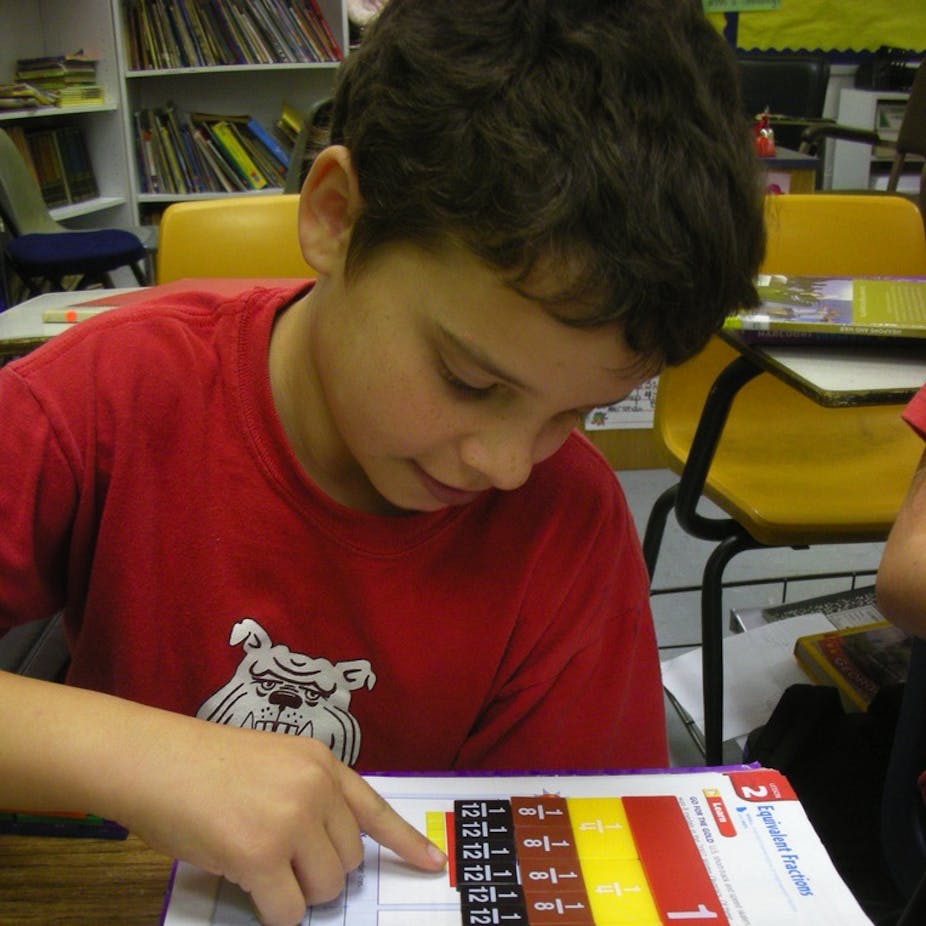
Girls are losing ground in mathematics and science education in NSW, with the number of female students studying no maths for their HSC more than doubling in ten years, according to a new report from the University of Sydney.
The percentage of girls studying no maths jumped from 9.5% in 2001 to 21.8% in 2011. Just 13.8% took one maths and one science subject for their higher school certificate in 2011, according to the report, compared with 18.6% for boys, for which there had been a marginal decline.
The research by John Mack and Barry Walsh reveals a growing gender disparity over the last 10 years, with just 1.5% of girls studying advanced maths alongside physics and chemistry.
“That’s a shocking figure,” said Dr Rachel Wilson, senior lecturer in educational assessment and research methodology at the University of Sydney’s Faculty of Education & Social Work.
The report reveals the gender disparity in maths and science participation is now greater than it was in the 1980s.
Dr Wilson said 10 years ago Australia was well positioned on performance rankings such as PISA and TIMMS, but a more recent decline is likely to be compounded by falling maths and science participation levels.
“The scores are down, the ranks are down with them, but the participation is looking really bad, so that means we’ve got a long path ahead of us to recover.”
Dr Wilson said education choice was a major contributor to the decline in maths and science participation, with 13.5% of girls choosing to study family and community studies in 2011, a subject that was not on offer in 2001.
“Something’s gone wrong there that you have nearly as much educational value put on community and family studies as you do on maths.”
Dr Wilson said while many educators did not want to compare Australia with the higher performing nations of Japan and Korea, for cultural reasons, even comparisons with the UK and US left Australia falling behind on maths.
“I don’t think it’s an issue of parenting it’s of educational choice and quite possibly having too much of it.”
The report comes after the Federal Government committed $22.5 million for the Australian Maths and Science Partnerships Program in last year’s Budget, following recommendations from Chief Scientist Ian Chubb to boost participation in science, technology, engineering and maths.
Dr John Ainley, principal research fellow at the Australian Council for Educational Research, said boosting the uptake of science and maths required generating a sustained interest in the field and allowing students to develop a level of competence so they felt confident in what they did.
“The early experience of engagement with science and mathematics is really important,” Dr Ainley said.
“The crucial thing is not just to have novel things that catch people’s interest, but novel things that are built on in a sustained way.”
Dr Wilson has suggested maths be made mandatory in order to improve Australia’s international education rankings.
However Dr Ainley said this could simply result in more students studying basic maths.
“I’m more concerned about getting kids engaged at a higher level at maths and that involves putting in the hard work before they get to Year 10.”
Regan Forrest
logged in via Twitter
"just 1.5% of girls studying advanced maths alongside physics and chemistry"
As someone who studied that subject combination in Year 12 some (ahem) 20-odd years ago, I find this startling.
I wonder if changes to university pre-requisites (which I understand are less stringent than they once were) are a contributing factor. Double maths, physics, chemistry were what you took if you wanted to 'keep your options open' for uni. Now, taking these perceived "hard" subjects might be seen as TER score suicide.
David Clerke
Teacher
Perhaps what are students doing is Economics, Law and accountancy and earning much more money!
Regan Forrest
logged in via Twitter
Back in my day (!), people planning to study economics and accountancy needed maths at year 12.
Peter Redshaw
Retired
David, if students are studying economics and accountancy without maths and statistics than I think they will struggle if they can get into the degree at all. Economic is all maths in one form or another. Accountancy you need to understand the tax code, but you also need maths. And I would also suggest that there are many areas of the law in which you need a good grounding in maths. And this is true for so many degrees.
ayesha baig
student
Some people thinks that money is first priority for choosing subjects, but its as well include student's interest in relevant field .http://www.tvcorners.com/
Peter Redshaw
Retired
I am stunned, how can you do HSC and not do any maths or science. What are they doing when and if they go onto University? It is bad enough doing only one maths and science subject, but to do none seriously limits your choice at higher education. I find it hard to think of many degrees that do not at least include statistics.
Choice, this is choice gone mad. This is the problem with choice is that what it ends up being is the choice to avoid the very subjects that offer you real choice. It…
Read moreEad Roberts
Human
Do people seriously not get that the world has changed? Kids are dropping out of school in their droves - most of them bored shitless. We can no longer get away with justifying forced choice of maths and science on national security and vague economic terms. There is a glut of unemployed physics and mathematics PhD's around the world. We've got more than we can use!! Maths and science do not offer "real choice". Actually being able to choose offers real choice.
Hysteria about maths is seems to be little more than "I did maths, and so should you". Community and family studies deal with topics far more important to actual competent humans than does maths.
Regan Forrest
logged in via Twitter
But who here is advocating for more maths and physics PhDs? I'd wager there is a glut of English Literature PhDs too, but that doesn't mean we shouldn't teach school kids to read.
Ead Roberts
Human
I'd happily wager that the VAST majority of adults would fail a Year 8 Maths test. We don't use anything in ordinary life beyond the skills acquired in primary school. So why on earth would we want to make school even more tedious by forcing students to waste years suffering through crap they and the majority of their peers will never personally use?
Regan Forrest
logged in via Twitter
You may well be right. Many adults are functionally innumerate and don't understand basic things like how interest rates work. And suffer the consequences when loan sharks come along.
Are you saying this is a good thing?
Ead Roberts
Human
And yet they had compulsory maths. I'm saying that maths as it is currently conceived is a hoax and needs to be reinvented.
Peter Redshaw
Retired
Ead, I do not know what area of work that you do, or whether you went on to do higher study, but you will be surprised how many areas of study require a good grounding in maths, statistics and the sciences. It may not mean that you become a mathematician, or a scientist, but still many course/degrees require a certain minimum level of maths and especially statistics for which you need a certain minimum level of maths.
You may be able to do an arts degree without a high level of maths or the sciences…
Read moreEad Roberts
Human
But not a better understanding of reality perhaps! If you agree with me that the vast majority of adults would fail a Year 8 maths test, then there simply can't be that many areas that require a good grounding in maths - and the vast majority of this vast majority DID do maths. As for your strange notions of the values of degrees and the options they open for you, recall that Jobs was a college drop out - a phenomenon very common amongst successful entrepreneurs. Only a tiny fraction of the populace require calculus, yet that is the pinnacle of secondary school maths education, towards which all the other bumph is aimed and justified.
Lydia Isokangas
Student in Finland
I would be shocked if most adults couldn't pass a year 8 maths test as it covers basic numeracy required in everyday live. I know this because I'm currently homeschooling my daughter in the Australian curriculum in preparation for our return to Australia. Even with only year 8 maths your life and job options would be severely limited. To have a reasonable job you would need at least year 10 levels for most jobs that are available today.
Steve Jobs dropped out of college only because his parents…
Read morePeter Redshaw
Retired
Ead, the vast majority of adults would fail a Year 8 maths test, and that is supposed to be a good thing? As for college drop outs being successful entrepreneurs, what type of entrepreneur are you talking about. I can think of a number of those entrepreneurs who where pretty knowledgeable in the maths and sciences in the first place and probably done a year or more of University before they dropped out. Some of them dropped out because their lecturers/tutors had nothing to teach them in the area…
Read moreEad Roberts
Human
I'm obviously not communicating myself clearly enough. First, I am not saying that it is either good or bad that most adults would fail a Year 8 test. I'm saying that's the reality, and that they virtually all have been exposed to compulsory maths at school. So compulsory maths at school is not the solution you are looking for since compulsory maths has not produced the understanding you think is necessary. I do make the further point that the understanding you are looking for is neither necessary…
Read morePeter Redshaw
Retired
Ead, primary school maths being good enough for most people to have a successful and productive adult life! What sort of life is that? On the basic wage, if they can get a job in the first place. I am talking about career options for those children at school who will be working in a very different world to the one now let alone the one I started in. This is not the beginning of the 19th century. We are into the 21st century.
My father left school with only primary school maths back in the…
Read moreEad Roberts
Human
I'm not sure if I'm not being clear enough or you're not reading what I've written Peter. The CURRENT situation is that the majority of adults will have experienced compulsory maths, and we agree that the vast majority would likely fail a Year 8 maths test. What does this say about the value of compulsory maths at school? Less than 0.5% are employed in areas requiring higher order mathematics. Surely you aren't claiming that the 99.5% who don't use higher order maths have dead end careers and…
Read moreMarion Brook
BA, Grad Dip Ed (student)
Part of the problem is relevance, or rather girls failing to see the relevance maths and science subjects have (will have) in their future studies and lives.
For a multitude of reasons I won't go into, high school aged girls tend to show a preference for humanities subjects. Now, this could work in our favour - as someone above noted, an education in the Humanities will still require a solid grounding in maths. If the statistics, data and logic components that are essential to so many humanities…
Read moreEad Roberts
Human
I agree with part of what you're saying Marion, except that maths simply ISN'T relevant to the humanities. There are certainly some aspects of maths that it would be desirable for any competent adult to understand - financial literacy, statistical literacy etc. - but the bulk of secondary school maths is taken up with nonsense such as simultaneous equations, quadratics, and eventually calculus. The big problem is that maths has turned into Latin and should be dumped for the same reasons. Maybe then something useful would arise from its ashes.
Lydia Isokangas
Student in Finland
Hi Marion,
I think part of the problem is the 'real' value society places on maths and science - knowledge in these areas is not seen as being part of being a well educated person. I saw this in action when I studied engineering; I, along with all my fellow engineering students, were obliged to study a humanities subject at university to ensure that we had a more rounded education while students who studied humanities/arts/business/law etc were not under a similar obligation to study a science…
Read moreLydia Isokangas
Student in Finland
I forgot to add that I also often see scientists and engineers who have no understanding of the complexities of society and people as they have had no exposure in their studies to these areas. They're kinda like the proverbial 'bull in the china shop' when it comes to dealing with people from different cultures and backgrounds. They feel that the explicit nature of science/maths will conquer all, even when there are many very embarrassing white elephants constructed and implemented around the world to show that this is simply not true.
Marion Brook
BA, Grad Dip Ed (student)
Hi Lydia,
Thankyou for expanding on my comments with such insight and eloquence - you stand as testament to the advantages of the "well rounded" education.
Funny that you mentioned the piece on risk assessment, I had the very same piece in mind when I wrote my original comment.
My point was really that the discrete divisions between maths, science and humanities subjects that our education system appears to promote are false divisions. Mathematical reasoning and scientific methodology are used to answer ultimately humanistic questions (like relative risk - Will my child be safer with or without vaccination? Should I be more concerned about nuclear power or fossil fuels?) while the humanities (by helping us to understand our humanity) can teach us how to communicate and disseminate our scientific and mathematical findings to the greatest number of people with the greatest level salience.
Peter Redshaw
Retired
Ead, maths isn't relevant to the humanities? It was very relevant when I did a number of humanities courses. For a start it is highly relevant to statistics and statistics is highly relevant to research within the humanities. And Ead, even though the humanities are very important within higher education, within our society, it is only one area of study or job opportunity. And as we very well know many people will over their lifetime change their area of work, or those areas of work will themselves change requiring a much broader knowledge bases.
Ead Roberts
Human
I'm all for breadth of knowledge. I'm saying that the level of maths being called for here is ridiculously narrow. There are important elements of mathematics that I think most adults should have a good grip on, but most of these are already (or should be) covered in primary school. Secondary school is already choked with an over emphasis on specialised mathematics rather than providing a truly diverse range of knowledge for students to select from.
Lydia Isokangas
Student in Finland
Hi Ead,
I'm sure everyone else is as curious as I am - what work do you do where you feel that primary school maths is sufficient? Which careers do you know of that do not call for a higher level of maths than year 8? I'm really curious and I really want to understand your argument.
With my background in engineering its obvious that I have used all of the maths that was taught at school and then some, but I note that all the other commentators from diverse backgrounds in humanities and business are all arguing for maths (including calculus) not to be optional in the senior years of school.
Regards,
Lydia.
Ead Roberts
Human
Given less than 0.5% of the workforce are engineers, scientists and/or researchers there are very few jobs that require higher level maths. Virtually every other job, almost certainly over 90%, would require no more than primary level maths as preparation - anything more specialised is part of on the job training. Compulsory maths is a failed experiment and I would argue that the maths we have in schools today is a hang over from the 50's when fears of Sputnik and Reds under our beds steam rolled through education to churn out as many physicists as possible. The world has moved on, but education is lagging behind. I imagine that, like my favourite example Latin, calculus in high school will eventually be seen as the relic it is.
Peter Redshaw
Retired
Marion, I agree relevance is a problem and it is a reason why some school do teach the subjects in more multi-discipline holistic project based approach. It is one of the reasons why when I went back in later life to do a degree that I chose both the University and degree that I did. The degree was a multi-discipline degree that included planning courses, environmental science courses, as well the natural and pure sciences. And they were mostly taught in a way that demonstrated the links the courses including the core part the maths and statistics played in those courses.
But I do not think that this is the only problem. So often the attitude of both parents and teachers towards these subject areas can have just as much or more influence on the interest and keenness of students in these areas. It would be interesting to do a study of both the parental as well as teacher link to the students that do the higher maths and science subjects at high school.
Gary Myers
logged in via LinkedIn
Chicken or egg. Are girls avoiding these subjects because they don't see it as matching their career choices, or are they making career choices because they want to avoid maths and science topics.
Craig Minns
Self-employed
And does it matter? If fewer girls are choosing maths than boys is that really a problem that needs addressing, or simply an emergent feature of some essential gendered difference that is not amenable to social engineering?
Surely not everything has to be seen as a feminist issue?
Kim Darcy
Analyst
Rachel, I just quickly skimmed your linked data. It looks like the % drop can be *partly* explained by the recent increase in school leaving age to 17. I'd assume that the bulk of those extra students forced to stay on at school would have been among the least academic of their Year 8 cohort. So maybe it's not surprising that so few (if any) of this 'forced' group took any HAS Maths or Science.
Read moreAnother trend I quickly gleaned is that if you just focus on 1 Maths/1Science combo, the trend has no…
Stephen Wade
logged in via Facebook
Mathematicians and scientists etc are always going to overstate the value of what they do, but that's not to say that their point of view is inherently false and that the opposite (i.e. maths beyond year 'x' is worthless) is true; it simply means you have to take their claims with a dash of salt.
In my mind, when someone says mathematics is boring, it's as illogical as someone saying music is boring, or that playgrounds are boring. All three are quite the same! A playground isn't fun until you…
Read more