Swan says budget surplus now unlikely: experts respond

Treasurer Wayne Swan has acknowledged it’s unlikely the government will deliver the budget surplus it had been promising for next year, following the release of a disappointing monthly financial statement for October. “There has been a substantial hit to profits that Australian companies have experienced…

Tcns4fkw-1355979284
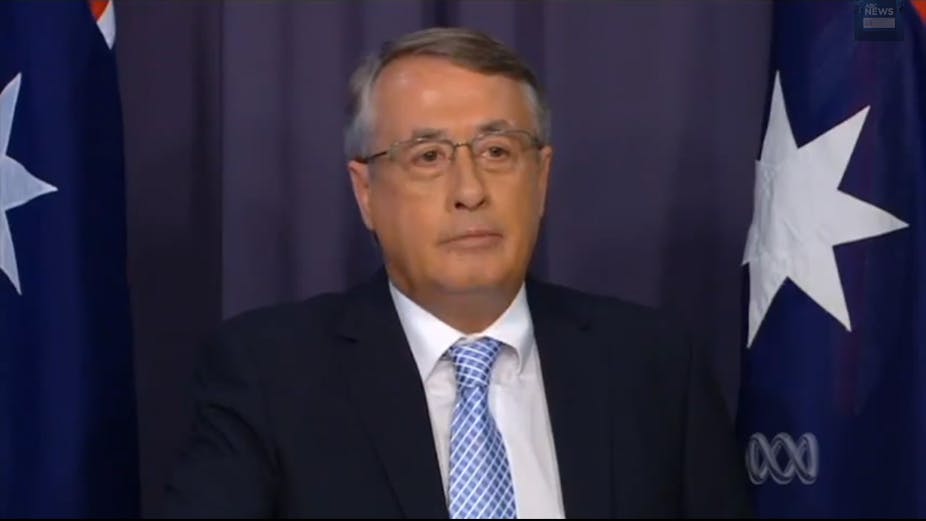
Wayne Swan tells journalists the government’s promised budget surplus is now unlikely to be delivered. ABC News

Treasurer Wayne Swan has acknowledged it’s unlikely the government will deliver the budget surplus it had been promising for next year, following the release of a disappointing monthly financial statement for October.

“There has been a substantial hit to profits that Australian companies have experienced in the early months of this financial year,” Mr Swan told journalists in Canberra today.

The government had planned to deliver a surplus of $1.1 billion for 2012/13, however today’s October financial statement showed falling cash receipts, with a $3.9 billion reduction in the four months to November.

“What we’re seeing in our own numbers today means that $160 billion has been ripped from the budget bottom line over five years,” Mr Swan said.

He argued that it was falling revenues rather than increased government spending that was hurting the budget outcome, adding that it would not be responsible for the government to continue to make up the revenue hole if it threatened growth or jobs.

The Conversation has collected expert reaction to this news from economic, business and political experts.


Sinclair Davidson, Professor of Institutional Economics at RMIT University

It was inevitable, mostly because this is a government that spends too much money.

Every year they’ve been talking about cuts but these cuts have always been on future expenditure or proposed expenditure. They’ve never actually cut current expenditure.

I think the government has been right in trying to return to a budget surplus. It is good policy to have a budget in balance or surplus rather than deficit.

Unfortunately they haven’t had the fiscal discipline to cut the spending they should have.

The problem with planning to go into deficit is when the unexpected happens it makes it very difficult for you to return to surplus.

They spent too much on the stimulus packages in 2009.

Of course they will argue that they’re doing much better than our friends in Europe or North America. But we’ve got to be in a good position relative to our own expectations of where we should be and we’re not at that level. We’re not where we should be.

One of the big problems with these fiscal crises is they kind of sneak up on you. In 2005/06 the Western countries were saying “We’re fine”, and that turned out not to be the case.


George Argyrous, Senior Lecturer at University of New South Wales

The attempt to achieve a surplus bought about its own undoing – as you try to achieve a surplus through austerity all you do is drive economic growth downwards, with the implication you’re more likely to get a deficit.

They’ve actually contributed to bringing about a deficit rather than achieving a surplus.

When you look at the dynamics of the effect of government spending on the operation of the economy, that’s what you get.

What the government should do is just accept that occasionally governments go into deficit and that’s a normal way of coping with slowdowns in growth.

Its like someone running up a hill – you have to breathe hard to get up the hill but you relax a bit when you’re coming down. The economy’s still running up a big hill.

If the politics of ditching the commitment to a surplus was ever going to be in place it’s now. Even business groups are lining up to say a surplus is not the way to go at the moment.

Most people would understand that occasionally you have to go into deficit to finance key spending. As long as the government does it wisely the same logic should apply.

It surprises me that the government hasn’t used this as a political tool in its favour to differentiate itself with conservative governments in the States who are blindly pushing for surpluses at all costs.

I think that would have been a strong political message but they gave themselves no back door. It was all so predictable.


John Wanna, Sir John Bunting Chair of Public Administration at Australian National University

Unlike most macroeconomic commentators, I actually think it was worth the government aiming to bring a balanced budget in.

That has been a big control on their spending, and I think that has been important.

Having now realised that they’re going to have to relax that commitment is probably pragmatic, and probably expected. But I think having that target was important: because when governments don’t have targets, it makes them flail around a lot more.

That said, the target wasn’t achievable, mainly because of the lack of revenues coming in — not because of government spending.


Gregory Melleuish, Associate Professor, School of History and Politics at University of Wollongong

I wonder whether it was all inevitable. At some stage they were going to have to bite the bullet on the fact that the surplus might not be achievable.

The Labor Party was trapped by the idea that it was going to achieve a surplus, using that as a measure of their economic credentials. So they invested an awful lost of political capital into that idea.

It’s interesting that Swan has said it’s not about the fact they’re spending too much, but about the fact that revenues have dropped off considerably. It’s interesting too the news that has come out that Queensland also had a considerable decline in its revenue. I suspect that this is the case across the states, which is why we’re hearing noises about things like wanting to increase the GST.

Labor were hoisted on their own petard because they made this into a symbol of their responsibility and if they can’t deliver, then this could be used to indicate they’re not economically responsible. To understand this you have to go back to the history of the Labor party. The Whitlam government was seen as financially irresponsible, so Hawke and Keating went out of their way to develop their economic credentials, and they did that very successfully.

This time the Labor party has had the GFC, and the question is whether they can continue to be identified with Hawke and Keating rather than Whitlam, which some people might now wish to do.


Tim Battin, Senior Lecturer, Political and International Studies, School of Humanities, at the University of New England

The surplus admission from Wayne Swan is not surprising. But what is remarkable is the way in which he got himself cornered in trying to achieve a surplus, when international conditions didn’t favour a budget going to surplus.

It wouldn’t have been good policy to try and persevere when the conditions didn’t warrant it.

I think the taxation debate is a healthy debate to have — to discuss our revenue requirements. One possibility is that unless some people seize an initiative and look at the way in which our revenue is inadequate — that is, our tax is too low — the initiative will certainly be taken up by others who will argue that we need to increase direct taxation.

Already we are starting to see some people suggest that the way to get more revenue is to increase the rate and base of the GST.

People like Wayne Swan, one thinks, should be in there trying to formulate a different kind of debate, or different terms on which the debate takes place so that we look at our total tax base: inheritance taxes, tax on the wealthy, tax expenditures — which overwhelmingly benefit those who are well off — and so forth.


Nick Economou, Senior Lecturer, School of Political and Social Inquiry at Monash University

This announcement is a reality check about a number things.

It’s a reality check about the state of the Australian economy. But it’s also a reality check about any idea that the government might have been going to a March election.

They were beginning to believe their own rhetoric about how well they were doing in the polls, but the last Newspoll has reversed that trend.

So it looks like the strategy now will be to say to the community: look, in the interest of realism we have to abandon this silly idea of a surplus. It’s probably the wise thing to do – most responsible economists would agree.

But will this damage them electorally? It seems to me that they’re already damaged anyway. They could make a virtue out of being seen to be pragmatic. Say to the voters: we had this promise of the surplus but the economic situation now doesn’t warrant it, we’re responding to what’s going on.

The opposition will criticise them no matter what they do. So it’s a wise move for them to make but they need to start changing the prevailing political winds. What they’re trying to do is they’re trying to paint Tony Abbott as the ideologue – a catholic ideologue, a conservative ideologue – ideologues don’t change, they don’t respond to changing conditions.

So politically I think it’s in the government’s interests to change their position. But for better or worse, it’s still the government and as such it can set the agenda, it can get it through parliament with little opposition in the Senate or from the cross benchers, so I don’t think there will be too much adverse reaction.The coalition will go berserk, but the danger for Gillard is that he might try to weave this into a general critique of her as someone that you can’t trust. But Abbott hasn’t proven to be very effective recently in landing too many punches so he needs to link this in with that more general critique of trustworthiness.

Sign in to Favourite

Want to follow The Conversation?

Sign up to our free newsletter to get the day's top stories in your inbox each morning, with a special wrap on Saturday.

Help us have better conversations — donate

Join the conversation

65 Comments sorted by

  1. Chloe Adams

    writer

    I don't know what to say other than I'm quite impressed with the polite commentary in the article. They're all so polite about the incompetence of this government. They kind of remind me of a corporation I once worked at that had a policy of cutting their noses off in spite of their faces or shooting themselves in the foot. Just as long as they could satisfy their bureaucratic processes and keep themselves in paying jobs.
    It should be a crime to have so many cuts to pensioners and yet suggest so many benefits to be paid for people who aren't yet proven refugees for five years or more.

    report
    1. Marilyn Shepherd

      pensioner

      In reply to Chloe Adams

      Chloe, what sort of stuff do you smoke? No-one is getting any benefit from not being able to work and subsisting on 85% of the dole for no reason.

      We should let people work, after all we force single mothers to work and abuse young unemployed if they don't.

      Forcing a group of people not to work is beyond deranged and it is illegal to boot.

      Why do you think that all the problems of this country are caused by just a few thousand human beings?

      It is not their fault they can't or don't want to stay home to die.

      And a surplus is nothing more than collective larceny without providing services.

      report
    2. Richard Charisma

      logged in via Twitter

      In reply to Chloe Adams

      Not a few thousand, Marilyn, thirty thousand. And the numbers are increasing every year.

      There's no shortage of fortune seekers who have incentive to come to start a new life in Australia.

      I'd say that there might be 500 million people in the world who'd be better off living in Australia than whatever shit hole they live in now.

      The cold hard economic reality is that we can't afford to give them asylum. Not all of them, hell, not even the 30 000 that are already here. We already had to start cannibalising our Aid budget to pay for these interlopers.

      Wake up to hard economic reality Marilyn.

      report
    3. Chloe Adams

      writer

      In reply to Chloe Adams

      Marilyn, now that the government has effectively announced that they'll give benefits to asylum seekers, the numbers will increase significantly. It won't be 30K a year, it'll go up to 50. In fact I do wonder if our border patrol will be able to effectively monitor our borders.
      And where do these people go? Urban centres.
      How is infrastructure where you live Marilyn? How is public transport? I know where I live, it's quite crap.
      At the present time, the state governments, those that are liberal…

      Read more
    4. Spiro Vlachos

      AL

      In reply to Chloe Adams

      Well put Chloe, too many excuses for failure. I know as an individual, if I spend more than my income I will have to borrow. That would be my fault. Also, if I don't make enough money to cover my expenses, also my fault. Some of these guys are following the govt line that its not their fault companies dont make profits.

      report
    5. Felix MacNeill

      Environmental Manager

      In reply to Chloe Adams

      Chloe, if you were impressed with the polite tone, why did you bother to spoil it with bigotry?

      All you've done is bring the usual complainers and refugee-blamers out of the woodwork, but contributed nothing useful.

      Hello fellow boat people who are now posting here (Richard, Chloe and Spiro) - perhaps we should have selaed the borders before you or your ancestors arrived. I expect you'll shriek and be offended by this observation, but you're very happy to dish it out to others, aren't you?

      Given your claims to economic rationality, I don't suppose youi'd like to check the nett economic impacts from imigration - including refugees?

      report
    6. Spiro Vlachos

      AL

      In reply to Chloe Adams

      Felix Macneill you just dont have any respect for the science.

      report
    7. Ted Stead

      Consultant

      In reply to Chloe Adams

      Spiros: "...if I spend more than my income I will have to borrow. That would be my fault. Also, if I don't make enough money to cover my expenses, also my fault"

      Indeed, though don't fall into the trap of thinking that government should be run as a business or household. That kind of thinking will lead us nowhere.

      report
    8. Chloe Adams

      writer

      In reply to Chloe Adams

      @ Felix

      Oh whenever anyone says anything negative suddenly its bigotry?

      When my ancestors came here there were quotas and these quotas were based on employment requirements. When my ancestors came here, they came here to do the jobs that the Anglos felt beneath them. That's what Greeks, Italians and other Europeans were for back then.

      Where are the jobs now? Factories are closing there is not a high need for unskilled labour now as there was then. So where are most of these asylum seekers…

      Read more
    9. Felix MacNeill

      Environmental Manager

      In reply to Chloe Adams

      Spiro, you say:

      'Felix Macneill you just dont have any respect for the science.'

      Coming from you, I rate that as one of the best endorsements I've ever had.

      (Just a tiny little by-the-way, I don't suppose you'd care to explain exactly what that 'science' might hapen to be?)

      report
    10. Felix MacNeill

      Environmental Manager

      In reply to Chloe Adams

      Oh and Chloe, after reading your long comment at the bottom of this thread, I simply couldn't have done a better job of refuting everything you say as you have done yourself.

      report
  2. Theo Pertsinidis

    Theo Pertsinidis is a Friend of The Conversation.

    ALP voter

    Simple terms is punters terms... so here goes.

    Collectively as a country we do not need to have a surplus. Not for profit organisations do not.

    The best indicator for the strength of a country is its currency.

    The Australian dollar is equivalent of a stock price and what the punters have paid to get it there.

    A stock price takes into consideration sales, assets, and services.

    When the business improves the stock price improves.

    Just a ask a successful stock money maker.

    The stock price of Australia has always been better with a ALP government.

    AAA rating, treasurer of the year, low unemployment, low interest rates for business to expand... and all this with the best minimum debt in the world.

    The political stats according to Newspoll etc. do not do ALP justice.

    Seems egos and monarchists do get in the way of a good time.

    report
    1. Richard Charisma

      logged in via Twitter

      In reply to Theo Pertsinidis

      Umm, wrong. The AUD isn't strong, its historically never been weaker. Its just that what you're trying to measure it against, the USD, has historically never been even MORE weaker.

      I mean, the Americans are printing $80 Billion dollars per month, you can't measure anything against that sort of recklessness accurately!

      But when you measure the AUD against a stable mark like Gold, the AUD is just about at all time lows, and has been for the last 3 years.

      report
    2. Spiro Vlachos

      AL

      In reply to Theo Pertsinidis

      "The stock price of Australia has always been better with a ALP government."

      Usually a company's stock price depends on the profits the company earns. In Australia, company profits have near zero growth for five years, yet govt spending continues to increase. Only a fool would not realise that this is not due to Labor. Forecasts of tax revenue five years ago held assumptions about past revenues, when the Coalition was in govt. Only a fool would not accept that this is due to a pathetic Labor party. Of course, when you are in business you can choose to earn a profit. So why earn a profit and pay taxes to help the Labor party when the Labor party wants to tax you out of existence.

      "Collectively as a country we do not need to have a surplus."

      No, never a surplus! We can collectively run an infinite length ponzi scheme. The problem is that company revenues will not be able to make up the payments and democracy will prevail to send these clowns on their way.

      report
    3. Spiro Vlachos

      AL

      In reply to Theo Pertsinidis

      "Morgan Poll latest...52.5% 2PP Labor!"

      Tony Grant, that is a face-to-face poll. I can just see now rusted on labor supporters (with teeth missing) answering LAY-BAA. But, since you are interested. Phone polls give:
      Nielsen: 52-48 to Coalition
      Newspoll: 54-46 to Coalition
      Essential Research: 53-47 to Coalition
      Galaxy: 54-46 to Coalition
      Morgan phone poll: 51-49 to Coalition;

      report
    4. Lyn Gain

      Social science lecturer

      In reply to Theo Pertsinidis

      Spiro, Well designed face to face polls are the most rigorous and reliable of them all. The results have only been out a day. When were the other polls conducted? Voters' attitudes do change. Thanks to Tony Grant for drawing attention to it. Here is the link http://www.roymorgan.com/news/polls/2012/4852/

      report
    5. Philip Starkey

      Physics PhD Student

      In reply to Theo Pertsinidis

      Tony, Spiro: you do know those polls have a 3% margin of error right? Because no one in Australia surveys enough people, we actually have no idea who is in front in the polls.

      report
    6. Spiro Vlachos

      AL

      In reply to Theo Pertsinidis

      Philip you are absolutely correct, although I doubt it is a matter of how many surveyed that generates the margin of error. More likely the sample selection issues. Prediction of elections has been written about quite a lot. The best I have ever found for an Australian context is a paper written by the former professor Andrew Leigh:

      http://scholar.google.com.au/citations?view_op=view_citation&hl=en&user=lGGBrI4AAAAJ&citation_for_view=lGGBrI4AAAAJ:qjMakFHDy7sC

      The paper finds that betting markets are the best predictors. So if we assume that Centrebet is the best the odds are currently:

      Coalition $1.24
      ALP $3.90

      Or, colloquially, a whitewash.

      http://centrebet.com/#Sports/2062830

      Happy new year!

      report
    1. Richard Charisma

      logged in via Twitter

      In reply to Sean Lamb

      You may have a point, but I think the debate needs to be about were spending can be cut, not where taxes can be raised, because money spent by the public sector is inherently less efficiently allocated than money spent in private enterprise.

      That's why George Argyrous is wrong. Or well, not wrong, but short-sighted. Sure, in the short term, austerity creates a correction (which involves temporary contraction). But what is being corrected is mal-investment, or capital that has been allocated at…

      Read more
    2. Lyn Gain

      Social science lecturer

      In reply to Sean Lamb

      There doesn't seem to be a reply button for Richard Charisma, so I'm putting my response here. I see that the old chestnut "money spent by the public sector is inherently less efficiently allocated than money spent in private enterprise". Efficient allocation is a fraught and value laden concept. I would like to see some evidence for Richard's assertion. The 'efficiency' of the market leads to lowest income groups missing out. Well targeted public expenditure helps correct this

      report
    3. Felix MacNeill

      Environmental Manager

      In reply to Sean Lamb

      I'm with Lyn - the mere repeating of trite canards doesn't make them any more true.

      It is not axiomaticaly the case that the public sector is more or less efficient than the private or allocates finite resources more or less efficiently.

      the more relevant, rational and intersting question is whether money is well invested - case by case. the private sector makes every bit as many stuff ups as the public - arguably more - but, while they may be accountable to the market place (when they're unable…

      Read more
    4. Ted Stead

      Consultant

      In reply to Sean Lamb

      I'm with Lyn and Felix - show us the evidence.

      Let's not forget that it was "faith in the free market over a bureaucratically controlled central command" which gave us the GFC. And now "we are the descendants that are having to deal with the consequences of our fore-bearers" who did what the free market is designed to do, and make profit, oblivious to the cost to broader society.

      Are you sure this is the most stable policy?

      report
    5. Spiro Vlachos

      AL

      In reply to Sean Lamb

      Lyn, you said: "The 'efficiency' of the market leads to lowest income groups missing out." Do you have evidence to support your assertion. Or is it your political motivation built by feelings of inadequacy that need to be medicated by a higher authority. In your case, a socialist government?

      report
    6. Richard Charisma

      logged in via Twitter

      In reply to Sean Lamb

      There is actual a very sound explanation for why money spent by the public sector is inherently less efficiently allocated than money spent in private enterprise. You see, its because of the true-value price finding mechanism of the free market.

      So you see, what happens in the free market is that ALL data across the entire scope of the market is automatically collated and aggregated by the price-finding mechanism to signal with perfect accuracy how people may most efficiently and effectively serve…

      Read more
    7. Richard Charisma

      logged in via Twitter

      In reply to Sean Lamb

      @Ted Stead, I repudiate your assert that "it was faith in the free market over a bureaucratically controlled central command which gave us the GFC".

      In fact, it was bureaucratically controlled central command which gave us the GFC, not the free market.

      Because you see the GFC was caused by the bursting of the housing bubble in the USA. This housing bubble was directly caused by a central command bureau, namely the US Federal Reserve.

      The Fed kept official interest rates far too low for far too long, thus causing a massive speculative bubble in US real estate.

      Had interest rates been allowed to be set as a function of the free market, taking into account supply and demand for loanable capital, they would have been much higher, thus preventing any bubble from developing in the first place, removing any possibility for said bubble to burst, preventing the GFC from ever being triggered.

      report
    8. Richard Charisma

      logged in via Twitter

      In reply to Sean Lamb

      @Ted Stead, let us also not forget that the implied US Federal Government guarantee of Mortgage Insurance companies Fannie Mae and Freddy Mac were also distortions in the free market by bureaucratically mandated command economics, which created moral hazards that also led to the catastrophic bursting of the real estate bubble in the USA.

      The genesis of the GFC can in no way be attributed to functions of the free market, in fact, the exact opposite is true. It was distortions in the free market caused by centrally controlled command economy bureaus which explicitly led to the GFC.

      report
    9. Lyn Gain

      Social science lecturer

      In reply to Sean Lamb

      “ALL data across the entire scope of the market is automatically collated and aggregated by the price-finding mechanism to signal with perfect accuracy how people may most efficiently and effectively serve one another's needs and best interests.” You write as though the price finding mechanism is a living entity or immutable physical law, instead of someone’s theory. And where you came up with ‘needs’ and ‘best interests’ I’m blowed if I know. All market mechanisms do is come up with a price, supposedly based on rational calculation of individual interests relating to buying things. There is no perfect market as posited by the early economists.

      report
    10. Lyn Gain

      Social science lecturer

      In reply to Sean Lamb

      Spiro, I don't normally respond to posts containing offensive personal remarks. However, if you woud like to see some evidence, I refer you to a book I wrote in 1994 called 'The Magic Answers', in particular the chapter called 'Efficiency, competition and choice'. I am sure you can get it on interlibrary loan.

      report
    11. Felix MacNeill

      Environmental Manager

      In reply to Sean Lamb

      It's been a while since I've read such a string of fary tales as Richard's turgid and patronising little essays on free market economy 101.

      Childish strawman techniques like comparing North Korea with South Korea are not even undergraduate level [for those who still can't work it out the two screaming fallacies are that (a) nobody was suggesting that we should become like North Korea and that (b) last time I checked, the South Koreans have quite a vigorous and effective public sector. And the cyanide metaphor as an attempt to refute an argument about balance could be used in a high school tecxtbook on basic reasoning and fundamental faalacies (sorry, Richard, but using a little school boy Latin doesn't make your argument any less silly).

      Normally, Richard, I would endeavour to be polite, but you have been so patronising that I really couldn't be bothered.

      report
    12. Richard Charisma

      logged in via Twitter

      In reply to Sean Lamb

      @Lyn Gain, the price-discovery mechanism of the market is not a theory, it is an observable real phenomenon. Through the dynamic balance of supply and demand, the market calculates which activities, products and services are most required and/or desired at a particular time and place, and communicates this information to participants as a particular price point. There is nothing theoretical about it, it is an immutable law.

      So therefore, price signals to participants how they may most valuably…

      Read more
    13. Richard Charisma

      logged in via Twitter

      In reply to Sean Lamb

      @Felix, your incoherent and rambling comment is almost illegible, yet I managed to somehow deduce two points you were trying to make. Unfortunately for you, they are both erroneous.
      a) Certainly nobody wants to PURPOSEFULLY become like North Korea economically, yet we certainly shall become like North Korea economically if we pursue predominantly central command economic policies, just like East Germany, just like the USSR, just like China before Deng Xiaoping's free market economically rational…

      Read more
    14. Ted Stead

      Consultant

      In reply to Richard Charisma

      Reading those entries from Richard, above, is like being transported back to the 19th century.

      The price finding mechanism can apparently “…signal with perfect accuracy how people may most efficiently and effectively serve one another's needs and best interests.” In order for this to be true you must assume that everyone has the same immediate and complete information about the market from now until the year infinity – otherwise the price signal would be wrong. I certainly don’t have that information…

      Read more
  3. Bob Buick

    Retired medical consultant

    I'm certainly not a trained economist, but it seems obvious that we can waffle on forever about whether Labour has spent too much, taxed too little, or simply been the victim of international conditions that they weren't smart enough to forecast. However, it's blindingly obvious that other than theft, extortion, dodgy dealing or pure luck, wealth can be created only by productivity. Australia's productivity is appallingly bad by international standards and it would be a miracle if the political wing of the Trade Union movement (the Labour Party) would alienate its power base by trying to improve it.

    report
  4. ManO'Steel(town)

    ManO'Steel(town) is a Friend of The Conversation.

    logged in via Twitter

    Now the Government has reviewed the promise of a surplus and, given global economic trends, scrapped it, it's, apparently a lie. This seems to be the Simple Simon economic mantra of Opposition and their ultra conservative, vested interest, business backers itching to pull the trigger on a government with a reformist, community focused agenda.
    Of course, not to scrap the surplus would be irresponsible. There's no question about that in the commentary here. But don't expect to hear that from Abbott and his team of dinosaurs. It's much easier to call everything a lie, than to have to face the truth and be honest about it.
    And we witnessed proof of that yesterday when Abbott and Hockey, meandering endlessly through a news conference about economic responsibility and lies sprinted for the exit the moment someone asked a question about sneaky Mal Brough and Ashbygate. Perhaps the journo forgot to say "Simple Simon" first.

    report
    1. Ted Stead

      Consultant

      In reply to ManO'Steel(town)

      "not to scrap the surplus would be irresponsible"

      Indeed. The budget balance should be an outcome, not a target. It's simply a barometer about the rest of the economy. Trying to run a surplus in our situation is self-defeating, as Swan has just found out.

      We run a current account deficit and like to save some of our income. With that in mind, take a look at the Financial Balances Map: http://goo.gl/aj7hn

      It's not difficult, but for whatever reason it seems to now be taken for granted that surpluses are 'good'. Have a look at how many times we've ran surpluses here (and in the US and UK, as other examples). It's the exception, not the norm.

      If we keep striving for surpluses, we'll keep deliberately forcing people into unemployment. Lack of jobs and skill spans generations, and is a massive cost to society.

      report
  5. Ted Stead

    Consultant

    "I think the government has been right in trying to return to a budget surplus. It is good policy to have a budget in balance or surplus rather than deficit." - Sinclair Davidson, Professor of Institutional Economics at RMIT University

    I am shocked that a professor of economics could come out with such garbage!

    He makes no reference to the fact that Australia runs a permanent current account deficit, and that the private sector saves some of its income. In this situation, all other things…

    Read more
  6. Fred Moore

    Builder

    The Australian Federal Government is running a PONZI or pyramid scheme, boosting the base of the PYRAMID with criminal minded cut-throat economic immigrants under the pretense of HUMANITARIANISM.

    The Budget surplus failure is identically equivalent to a PONZI Pyramid collapse.

    The consequences will be Bernie Madoffian in nature. All the bottom layers of the Pyramid with all their wealth invested in the schemes authors will lose their dough. Superannuation being the big disappearance but by…

    Read more
  7. Spiro Vlachos

    AL

    Charis, the only interviewee you have here that is employed in a position that is not part of a humanities school is Sinclair Davidson. Can we have some more economists, or those that are employed in positions in economics schools rather than humanities?

    report
    1. Lyn Gain

      Social science lecturer

      In reply to Spiro Vlachos

      Spiro, You seem to be unaware that economics is, in fact, one of the social sciences - and one of the least reliable of them. Did you think it was a physical science?

      report
  8. Edward Sainsbery

    Private citizen

    I am wary of anyone who thinks the Labor government's stimulus in 2009 was unnecessary (thinking of you, Sinclair). We've seen depression-era conditions in Europe and 10%+ unemployment in the USA while Australia's unemployment has just tipped over 5%.

    I'm also surprised that a professor of institutional economics fails to consider the implications of pro-cyclical contraction. I would hope they'd be aware that that can be truly disastrous.

    As with the matter of the surplus promise, it's economic relevance is nil (although having a surplus as an aspirational is undoubtedly a positive thing). We're talking a few billion dollars either side of a balanced budget here, when last year's budget deficit reached $44b. In other words, no matter how you look at it, this is a highly contractionary budget - not necessarily what's required right now when business confidence is tanking..

    report
  9. Bob Weis

    Film maker

    It's hard to reconcile what is happening in the real economy and the comments made here.
    While Australia has the best performance in the OECD post GFC and people have been calling for a deficit this financial year the government had the correct policy setting to achieve a surplus. Receipts fell in a hole with tax collections falling dramatically and the Treasurer immediately came out with the news that the targeted surplus may not be achieved.
    So, what is a budget? A plan for future expenditures and receipts.
    Why would anybody (an Australian citizen in particular) crow about the facts as they reveal themselves? I don't have an answer for that.
    Meanwhile thanks to a very hard working and alert government we are in good economic shape with low inflation, low unemployment and good prospects for the future.
    Compare that with ....

    report
  10. Tony Grant

    Student

    Abbott hasn't been "totally exposed yet" the weeks leading up to election 2013..."Abbott (family) a history of cowards and traitors" coming to you via information technology and more...

    report
  11. wilma western

    logged in via email @bigpond.com

    Both the "experts" and many of those who commented seem amazingly superficial. Those who claim the govt spends too much didn't deign to specify where too much was being spent nor did they compare the spending by the Gillard govt with that of the Howard govt for example.Howard got in a higher proportion of gdp in taxes and spent more as a proportion of gdp (that's including tax handouts to those who didn't need them ) than the Swan- Gillard govt has. No-one discussed Swan's statement that his announcement…

    Read more
    1. Richard Charisma

      logged in via Twitter

      In reply to wilma western

      @wilma western, all you're saying is that Swan and the government shouldn't be blamed for misleading everyone because all mainstream conventional economists got the forecasts wrong.

      No derr! They've been wrong about everything since 2007! They missed the GFC, they missed the currency wars, they keep thinking the Sovereign debt crises are resolved. They have been wrong about absolutely everything.

      Yet the contrarian economists like myself and the experts I listen to, have been RIGHT about everything…

      Read more
  12. Bob Weis

    Film maker

    To all of the comments about the perfection if the market versus the government sector I would just add three letters GFC. Democracy is about both not one to the exclusion of the other.
    The free market has no interest in elderly people without means nor in providing Ll the short-term loss making infrastructure that drives future growth.
    George Bush and his neo-con poet masters left the US economy in the mess we are all feeling the effects of now.
    Government has a role to play - Swan and Gillard and the Labor Party have done well by any measure except prejudice

    report
    1. Richard Charisma

      logged in via Twitter

      In reply to Bob Weis

      I've already addressed this: the GFC was caused by government interference in the market, i.e. the Federal Reserve setting interest rates too low for too long, and the implicit Federal Government guarantee of Freddie Mae and Freddy Mac which was a moral hazard, both of which caused a bubble in US residential mortgages to develop, which when it burst was the direct cause of the GFC.

      Capitalism is necessary for Democracy (although Democracy is not necessary for Capitalism), because Democracy is…

      Read more
  13. Bob Weis

    Film maker

    Joe Hockey understands economics? This is delusional and says more about the person making the claim - go back and look at the man's speeches over the life of this government. See if you can find a substantial issue he was right on rather than displaying the vituperative and nasty and petulant behaviour of a mob who can't believe they don't occupy the Treasury benches.
    Hockey is. A nasty head kicker with the mental apparatus to match but not a thinker of any stature unless he is hiding it deeply.

    report
    1. Richard Charisma

      logged in via Twitter

      In reply to Bob Weis

      Wow, you ask for examples, yet you haven't provided any yourself, just a nasty string of ad hominem attacks. As for which issues Hockey has been right on, well, he has been right on every issue, most notably the pre-GFC regulations he drew up while a minister in the Howard government which saved Australia from the excesses of the financial industry overseas and buttressed us from the effects of the GFC.

      report
    2. Bob Weis

      Film maker

      In reply to Bob Weis

      If you need examples of "nasty ad hominem attacks" read your own contributions to this thread.
      As to your robust but unillustrated defense of Mr Hockey Ithink it is absurd to say that anybody is always right, I am not always right and I am not Right. Perhaps it was just a typo

      report
    3. Richard Charisma

      logged in via Twitter

      In reply to Bob Weis

      What, Bob? I have been subjected to nasty ad hominem attacks in this thread, most notably by Felix MacNeil. But I have been very gracious in receiving them, and I certainly haven't perpetrated any myself.

      And if you want to assert that Hockey has been wrong, you need to point out where. I said initially that, in his overseas speeches, he has indicated that he correctly understands the problems with the world economy to be.

      Here it is: http://www.macrobusiness.com.au/2012/04/the-end-of-the-age-of-entitlement/
      You really should read it. It is a wonderful articulation of what the problems with the modern economy are and what the solutions should be.

      report
    4. Felix MacNeill

      Environmental Manager

      In reply to Bob Weis

      Bob, sorry - I have to post here to respond to Richard Charisma's cry-baby claim that I made ad hominem attacks - every attack i made was against richard's arguments which are eccentric and ideologically extreme. His attempts to refute what I said completely failed to address my criticisms - and if he considers his responses 'gracious' that explains quite a lot about his grasp of reality.

      Actually, Richard, this is now an ad hominem attack - you are a pompous hypocrit.

      report
    5. Richard Charisma

      logged in via Twitter

      In reply to Bob Weis

      I addressed both of your criticisms, Felix, and debunked them both. Thus we can see why you are reduced to, in your own admission, petty and pathetic ad hominem attacks.

      report
  14. Theo Pertsinidis

    Theo Pertsinidis is a Friend of The Conversation.

    ALP voter

    Saw this at ted.com which gets to the heart of surpluses. A link to the story is included.

    ---

    "Will you make a pledge to give away all the income you make over the national median in your country/state/or province?

    I am not saying this is the right thing to do, so please no hate mail. But if anyone would like to make a pledge to give away all their salary above the national median in their country/state/ or province, feel free to do so here. You can give away the money to a worthy charity…

    Read more
  15. Comment removed by moderator.

  16. Noel Peters

    Mr

    So when did Gillard and Swan first realise they weren't going to be able to deliver a surplus. Did the light just come on now or was it earlier. Only 3 days earlier they were telling us they're was no way they would not deliver a surplus. The common theme with Gillard is that nothing she says can be taken seriously and only some of her actions can she recall when it suits her.

    report
  17. Peter Redshaw

    Retired

    Well I must admit what I heard here was more like political spin than an economic response or analysis of The Treasurer and government's admission that the surplus was unlikely. I would not expect anything more from Sinclair Davidson as is and would only ever be a coalition spin mister in his response. But even with the rest of them I failed to see any serious analysis in regards to either the government's budget earnings or expenditure, or the work economy and its ongoing impact on the Australian…

    Read more
    1. Peter Redshaw

      Retired

      In reply to Peter Redshaw

      In the last sentence of the last paragraph I meant to that "These lies, along with the acceptance of the current level of overwhelming greed in the market place, is not 'only' damaging our economy, it is damaging our democracy.

      report
  18. John Kelmar

    Small Business Consultant

    Again we find politicians lying whenever it suits them. Swan couldn't deliver a surplus if his life depended on it - he needs so much education it would take two lifetimes for him to understand business basics.
    First he need to learn that a Government should not be spending more than it earns - don't take lessons from the Greeks, Spanish, and Italians.
    If the income is diminishing, then cut back on spending i.e. reduce politician's pay until the deficit is eliminated, stop wasting Australian…

    Read more
  19. Firozali A.Mulla

    PhD

    His right Read on the UK policy " David Cameron said Sunday he wanted to serve as British prime minister until at least 2020 to oversee a range of reforms including a renegotiation of Britain's relationship with Europe.In a raft of interviews ahead of a midterm review of the progress of his coalition government on Monday, Cameron also defended a largely unpopular decision to remove child benefit payments from higher earners. He stressed it was in Britain's economic interest to remain a full member of the EU to enable the country to influence the direction of the single market."If we were outside the EU all together, we'd still be trading with all these EU countries, but we'd have no say over the rules of the market into which we sell," Cameron said." You see we have a huge hole in the middle THE EURO and if we do not fis this we have problem in the EAST WEST also I thank you FirozaliA.Mulla DBA

    report
  20. Firozali A.Mulla

    PhD

    May be the WEST ought to learn from the EAST as A strength from the EAST and we have this growing up already China?s trade surplus surged 48.1 percent to $231.1 billion in 2012, though total trade volume grew at a much slower pace in the face of economic weakness at home and abroad, according to the latest official data. Exports from the world's second-largest economy rose 7.9 percent to $2.05 trillion from the previous year, while imports increased 4.3 percent to $1.82 trillion, the national customs…

    Read more