
Tasers in the spotlight – comforting myths and shocking realities

“These weapons save lives. We never said they were toys.” — NSW Police Commissioner Andrew Scipione Damning coronial findings and confronting media footage have put police use of Tasers in the spotlight. Last month, the NSW Coroner presented her findings into the death of 21 year-old Brazilian, Roberto…

4n3d6g27-1352859071
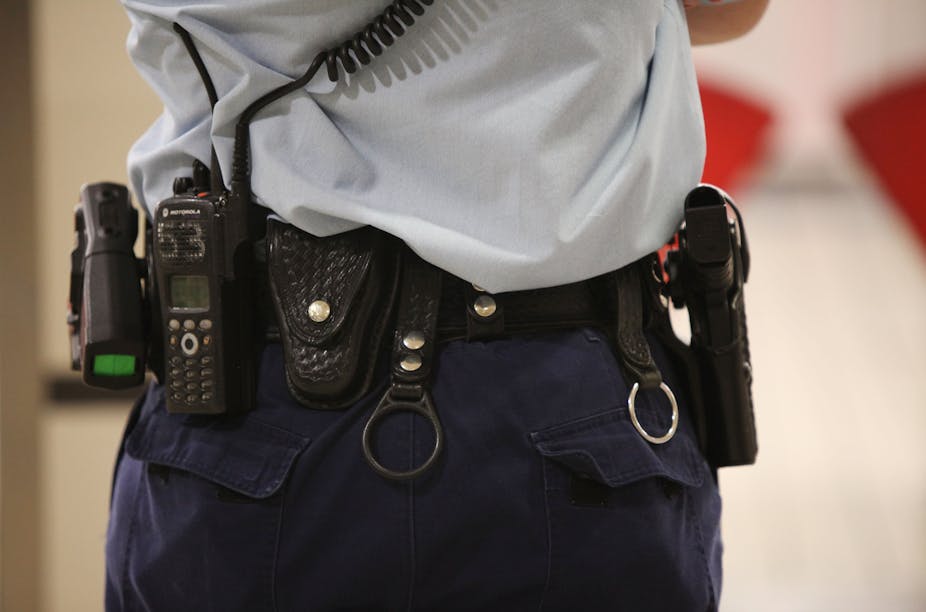
Police claim that Tasers save lives, but the reality is that they facilitate excessive use of force and police brutality. AAP /April Fonti

“These weapons save lives. We never said they were toys.” — NSW Police Commissioner Andrew Scipione

Damning coronial findings and confronting media footage have put police use of Tasers in the spotlight. Last month, the NSW Coroner presented her findings into the death of 21 year-old Brazilian, Roberto Curti. Chased and tackled to the ground by police in Kings Cross, police used Tasers 14 times, including while Curti was lying face down and handcuffed. Police also used up to three cans of capsicum spray on him.

The coroner found that left alone there was “not a shred of evidence that he would of caused any harm”. She also criticised police for being thuggish, finding they had used excessive force, acting recklessly and dangerously.

In the same week the New South Wales Coroner made her findings, the ABC’s 7.30 aired footage of a 14 year-old Aboriginal boy tasered by Queensland police. Handcuffed and on his knees he screamed in pain and cried for “mummy” as police continued to threaten him with the Taser. He had also been sprayed with capsicum spray. A solicitor with the Aboriginal Legal Service claimed that the footage, taken from the Taser-cam, shows one of the worst cases of police brutality he has seen in his career.

In the aftermath of the coroner’s finding, police have fallen back on a key Taser myth in their defence – that Tasers save lives.

There have been a number of recommendations made about changes to training and guidelines to address the growing evidence of police abuse and to reduce the likelihood of fatalities. But the reality is that Tasers will continue to facilitate excessive use of force and police brutality, and Taser related deaths will continue, regardless of the implementation of the recommended changes.

Less than lethal?

Taser is the brand name for an electro-shock device that delivers 50,000 volts. These weapons, one of a category known generically as “less-than-lethal weapons”, have incrementally become standard issue in Australian policing since the mid 1990s.

Originally confined to specialist police, they moved into everyday policing after “successful” trials. The introduction of Tasers into Australia policing follows an earlier roll-out of these weapons in the United States. The introduction of Tasers in Australia also followed on from the introduction of capsicum spray, another less-than-lethal weapon, that like Tasers, has been associated with a growing number of deaths. Five people in Australia have died after being tasered by police.

Eloctroshock weapons had very bad press prior to their introduction into policing in western countries. The electric cattle prod, used against protesters, was seen as a hallmark of authoritarian or despotic regimes. Electricity was understood to be the torturer’s tool of choice. But Taser successfully rebranded the electroshock devise in the 1990s by claiming it was a life-saver.

Drifting in the wake of the charged emotional environment following fatal police shootings, police forces, and the manufacturers who stood to profit, promoted these weapons as an alternative to firearms and deadly force.

But the reality is that Tasers are not an alternative to firearms. The police guidelines for Taser use make this plain. Police are typically instructed not to use Tasers when people are armed, the primary circumstance when police are justified in using firearms. In fact, the circumstances of Roberto Curti’s death are typical of the circumstances where tasers are used.

No alternative to a gun

An Amnesty International study of police use of Tasers – based on 98 deaths – found that 90% of those who died after being Tasered were unarmed and many did not appear to present a serious threat. In addition many were repeatedly shocked or subject to prolonged shocks.

While the police and manufactures balk at the figures, there is a growing list of Taser-related deaths and no evidence that Tasers reduce fatal police shootings.

Tasers are also inherently open to abuse. They leave few marks and a push of a button inflicts high levels of pain and instant incapacitation. Police typically use these weapons to gain compliance, as instant punishment and as an outlet for frustrations and violent dispositions.

Typical recommendations in the wake of controversial Taser deaths or incidents suggest changing guidelines or improved training. Neither of these suggestions is likely to have any impact.

Guidelines always leave Taser use open to police discretion, and the police hierarchy typically supports the exercise of that discretion. While restrictive guidelines are preferred, none will confine Tasers to “saving lives”.

Training is not the answer either. Police, for example, are already told not to repeatedly Taser. Increased Taser training is likely to reduce the already inadequate police training time devoted to how to negotiate and communicate with people, particularly people who are mentally ill. An increase in time devoted to Taser training is likely then to reduce police competence in using peaceful alternatives to force.

The reality is simple. Tasers are not suitable police tools in a democratic society.

Articles also by This Author

Sign in to Favourite

Want to follow The Conversation?

Sign up to our free newsletter to get the day's top stories in your inbox each morning, with a special wrap on Saturday.

Spinner
Donate and become a friend of The Conversation

Join the conversation

22 Comments sorted by

  1. R. Ambrose Raven

    none

    Fair comment.

    Taser International – the Taser manufacturer - has long disputed claims the weapon affects the heart. Yet Tasers caused 530 deaths in the U.S. between 2001 and 2012. Note that they are an "increasingly popular consumer item" , Taser International's sales thus being assisted by its notoriety, just as gun sales go up in America after each mass killing.

    Tasers are an issue that tends to bring up seamy and unpleasant behaviour, especially by politicians and police. They all want…

    Read more
  2. Andrew Remely

    logged in via Facebook

    Great article...

    I think there are also some deeper questions to be asked here. If the police are miss using Tasers and capsicum spray what else are they doing? And what’ wrong in the culture of the police where torturing people is somehow acceptable?

    It might also be time to change the design of the Tasers to make it more difficult for police to misuse. For example they could be reconfigured to restrict the number of discharges within a given period, ie someone can be shocked twice within a single deployment and that’s it.

    report
  3. Mia Masters

    pensioner

    "The use of these weapons causes acute pain, constituting a form of torture,'' the UN's Committee against Torture said.

    "In certain cases, they can even cause death, as has been shown by reliable studies and recent real-life events,'' the committee of 10 experts said.
    http://www.dailytelegraph.com.au/news/breaking-news/tasers-a-form-of-torture-says-un/story-e6freuz9-1225758523986?from=public_rss

    "The output current upon contact with the target will depend on various factors such as target's resistance, skin type, moisture, bodily salinity, clothing, the electroshock weapon's internal circuitry, discharge waveform, and battery conditions"
    http://en.wikipedia.org/wiki/Electroshock_weapon

    In addition, individual vulnerabilities, 'wiring', ANS, sympathetic tone/balance all would contribute how an individual responds and if the effect is fatal. This does not require a diagnosed heart condition/illness.

    The question should be: How could the taser effect NOT affect the heart?

    report
  4. Rajan Venkataraman

    Citizen

    Dear Prof McCulloch
    Thanks for this article. I believe this is a very important issue and I've been shocked as much by the incidents of brutality as by the seeming indifference in our society at what I can only describe as torture being inflicted by the authorities in recent times against a foreign student, an aboriginal child and a mentally ill man.

    Like you, I believe that Tasers are facilitating this kind of violence. Like you, I believe that police undertakings to review "official guidelines…

    Read more
  5. Jeff Haddrick

    field manager

    "90% of those who died after being Tasered were unarmed and many did not appear to present a serious threat. In addition many were repeatedly shocked or subject to prolonged shocks."

    What a dismal statistic. But it fits with the impression that I've had for some time, that police often use these 'no leathal' weapons for payback and intimidation. Or as you say,"Police typically use these weapons to gain compliance, as instant punishment and as an outlet for frustrations and violent dispositions"

    In theory these weapons should, and in fact probably do, save some lives. When you say "The reality is simple. Tasers are not suitable police tools in a democratic society", I'm not sure whether I think you've gone too far (simplistic) or not far enough. 'Correct application of those weapons should sit ok in a democratic society, but are the police themselves over utilized as tools of a democratic society?

    report
    1. Yoron Hamber

      Thinking

      In reply to Jeff Haddrick

      Sorry, but what is a correct application? If you want people that can handle their profession you need to train them, they also need to be fit as a police, and have access to a backup if needed. What they don't need is lethal weapons, using them to get rid of their frustrations.

      What you get thinking that way is ordinary people arming themselves, it's a spiral of violence.

      report
  6. Comment removed by moderator.

  7. Halle Browne

    logged in via Twitter

    It is without a doubt that Australian citizens are being used as target practice. And that the Australian government has allowed for this to happen is even more deplorable. Why? Well it keeps politicians happy as they promise us less crime and safer streets and more police. More police means people are not trained adequately to deal with what they are faced on the streets. Yes it may be a hard job, but less than a year academy training is not enough. Let's be real. Are they psychologically…

    Read more
  8. Sue Ieraci

    Public hospital clinician

    I see two issues here that police work has in common with health care.

    First, there is community risk aversion that pushes providers to "do something". We don't like children dying from missed meningitis so we want everyone to have antibiotics (side-effect: inappropriate use of antibiotics). We don't like criminals to get away - we want them apprehended. Side-effects: car chases and Taser firing.

    Second, we have young, inexperienced, immature workers on the front line. Yes, they are supervised…

    Read more
  9. Peter Frank

    logged in via Facebook

    What ever happened to the old baton, are the police that lame to use the same laws that is afforded to every other person?

    I remember the police saying that the Taser is an alternative to firearms some years ago, now you get 50,000v in your body just for running!!!

    I would like to know if the police have restricted electrical licenses with HV code? as I cant find anything that exempts them under any state electrical laws and anyone working with anything that is over 1000v must have a license.

    Here is a good read if your a Coroner! "Taser sued a coroner in Indiana who had ruled that Taser caused the death of a man in 2004", seems common in the US and I wonder if that has some effect in Australia form case studies.

    Read more: http://www.azcentral.com/news/articles/2008/05/02/20080502taser0503.html?nclick_check=1#ixzz2EAEtHZl2

    Just my 2 cents worth...

    report
    1. Peter Frank

      logged in via Facebook

      In reply to Peter Frank

      Sorry brain thinks faster the the fingers can do typing. About the Baton, I was meaning lame "not" to use the same laws as to self-defence

      report
    2. Robert Tony Brklje

      retired

      In reply to Peter Frank

      The baton required a duty of care as any severe blow to the head can result in a blot clot entering the brain and ending in death.
      Meanwhile of course the electric whip and chemical torture provide that erection satisfaction without substantially reduced risk of punishment for blatantly feeding sadistic sexual satisfactions.
      The original claim for these less lethal devices was as an alternate to the use of firearms.
      In the case 14 year old aboriginal boy, would the police have shot the boy in the back of the head when he was handcuffed and kneeling with their pistols several times or not.
      Were the less lethal weapons used as punitive punishment outside the rule of law and the purview of the courts.
      Less lethal weapons categorically turn police into judge, jury and executioner when it comes to punishing innocent people for offending the ego of arresting officers.

      report
    3. Peter Frank

      logged in via Facebook

      In reply to Peter Frank

      That's very true Robert but I do see the baton as a means to use force that is one level up from active aggression and any person not just the police, can use a stick or other blunt weapon in self-defence in those circumstance, except police can carry while on duty. It's just that you or I have to find one around you at the time LOL.

      report
    4. Halle Browne

      logged in via Twitter

      In reply to Peter Frank

      I agree with you Frank on why is the state waging war against it's own people. If that's the case wipe out the police force and allow the army to patrol the streets, at least they have better training.

      Although I have never had anything to do with the armed forces, I believe that it would be a difficult job to go into foregin lands knowing that you may never return home to your loved ones. These soldiers spend a lot of time critically reflecting on their job, their situation, their interaction…

      Read more
  10. Halle Browne

    logged in via Twitter

    Frank, it sounds like you may be an electrician. You are most certainly right about the HV codes and that there is nothing that exempts these weapons, in view that they are 50 000 volts and like you said anything that is 1 000 needs a licence. I am sure that they are not licenced at all.

    They were introduced really quickly without proper consideration, research and any real thought. That is so evident in the 500 deaths in USA, 26 in Canada and now 6 in Australia.

    And you can bet on it Frank, that the your last paragraph about Taser being sued for deaths is happening in Australia. Who are they to hold the world at ransom anyway?

    report
    1. Peter Frank

      logged in via Facebook

      In reply to Halle Browne

      Hi Halle,

      I spent nine years in the Australian Army in Infantry and did two operations and just hate seeing the states trying to run a war against it's own good or bad people. I don't know what happed with the police 20 years ago but I sure do know that now they love acting like the US police and turning a very peaceful place (like the NZ and UK, whos police don't carry firearms) into a war zone. If a police office can't use a baton instead of it's replacement the Taser, then they should get…

      Read more
  11. Halle Browne

    logged in via Twitter

    The link below shows the tasering of Angela Jones, who had a cardiac arrest and would have died if police did not do CPR on her. Taser companies are now saying that they cannot tell from the video if this was actually the case, something to that effect. This style of wording was also recently used by a coroner in a high profile case in Australia. Capitalism has infiltrated the government and now its institutions.

    http://afteramerica.wordpress.com/2012/11/24/woman-suffers-heart-attack-after-cop-tasers-her-3-times/

    report
  12. Halle Browne

    logged in via Twitter

    The link below brings you to the tasering of Angela Jones, an actress on her way home, pulled over by police and when asked to show them the contents of her bag she panicked. She suffered cardia arrest.

    Note the comments by taser company at the end. This is exactly what a Coroner recently said in a high profile inquest in Australia. It is almost like they are being tutored into what and what not to say. Pretty bad state of affairs.

    Sorry I thought I lost this post, but it is another link.

    http://www.youtube.com/watch?v=30JnVAPUVnE

    report
  13. Tim Scanlon

    Debunker

    I've seen a few articles and studies on the "less lethal" weapons and have been amazed at the wounds inflicted and how lightly they are used. The worst was the bean bag rounds that were fired into protesters faces, causing blindness and skull fractures.

    Tasers and pepper spray seem to be used as "compliance" tools rather than as a weapon, this is the issue I see as the real problem. A weapon is meant to be a method of force to stop crimes and criminals, and basic weapons training states that you…

    Read more
  14. Yoron Hamber

    Thinking

    Those cops definitely need to see a jail from the inside´. Tasers are lethal weapons, if they weren't deaths wouldn't be reported. And a commissioner defending this kind of over violence against kids need to get his head examined.

    report
  15. Sue Ieraci

    Public hospital clinician

    An experienced policeman was killed by an axe-wielding person in a domestic violence dispute today - leaving behind a spouse and children.

    That doesn't excuse poor judgement amongst other police officers but it does put the risk of their everyday jobs into perspective.

    report