
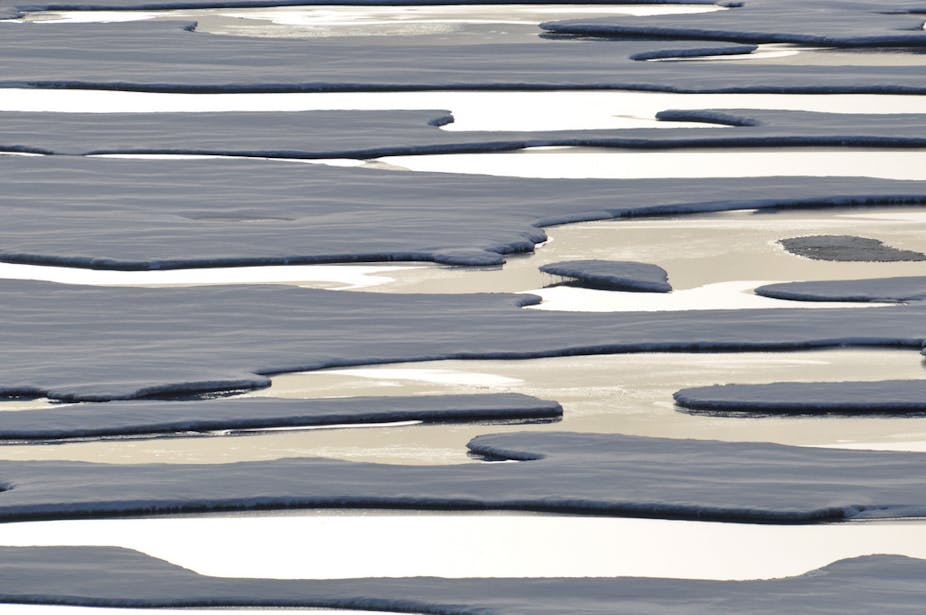
We are seeing the first signs of dangerous climate change in the Arctic. This is our warning that humanity is facing a dire future.
The Arctic region is fast approaching a series of “tipping points” that could trigger an abrupt domino effect of large-scale climate change across the entire planet. The region contains arguably the greatest concentration of potential tipping elements.
If set in motion, these can generate profound alterations which will place the Arctic not at the periphery, but at the core of the Earth system. There is evidence that these chain reactions have begun. This has major consequences not just for “nature”, but for the future of humankind as the changes progress.
Research shows that the Arctic is now warming at three times the global average. The loss of Arctic summer sea-ice forecast over the next four decades – if not before – is expected to have abrupt knock-on effects in northern mid-latitudes, including Beijing, Tokyo, London, Moscow, Berlin and New York. The loss of sea ice – which melted faster in summer than predicted – is linked tentatively to recent extreme cold winters in Europe.
Arctic records show unambiguously that sea ice volume has declined dramatically over the past two decades. In the next 10 years, summer sea ice could be largely confined to north of coastal Greenland and Ellesmere Island, and is likely to disappear entirely by mid-century.
Some environmental and biological elements, including weakening of the oceanic biological carbon pump and the thermohaline circulation,melting of the Greenland ice cap, thawing of Arctic permafrost and methane hydrate deposit, the decline of forest and peat fires in the boreal region, may be linked in a domino effect of tipping points that cascade rapidly once this summer sea ice is lost.

Despite this danger, semantic confusion masquerading as scientific debate – although providing excellent media fodder – had delayed an urgent need to start managing the reality of dangerous climate change in the Arctic.
And of course there are those who benefit from a warmer Arctic. A drop in Arctic ice has opened new shipping routes, expanded oil, gas, and mineral exploitation, increased military and research use, and led to new harbours, houses, roads, airports, power stations and other support facilities.
It has triggered a new gold rush to access these resources, with recent struggles by China, Brazil and India to join the Arctic Council where the split of these resources is being discussed. Not everyone is in favour of reducing the impact of warming on Arctic ice.
But all of us need to take this melting seriously. Top predators such as polar bears are declining. More methane gas is entering the atmosphere as permafrosts and submarine methane hydrates thaw. Freshwater discharge has increased 30% in recent years. And the Arctic Sea is warming faster as the ice cap melts, trapping more solar heat instead of reflecting it back into space, since ice reflects about 90% of the indecent solar radiation compared to the absorption of 60% of solar radiation by an open ocean surface devoid of ice.
In the subarctic region, dieback of the boreal forest and desiccation of peat deposits is leading to uncontrolled peat fires (such as those that plagued Russia in the summer of 2010) increases with warmer weather. This burning will further enhance greenhouse gas emissions.
We expect the Arctic will switch from being a carbon dioxide sink to become instead a source of greenhouse gases if seawater temperatures rise 4-5°C.
The rate of Arctic climate change is now faster than ecosystems and traditional Arctic societies can adapt to. Tipping points do not have to be points of no return. Several tipping points, such as the loss of summer sea ice and melting of permafrost, may be reversible in principle – although hard in practice.
However, should these changes involve the extinction of species – such as polar bears, walruses, ice-dependent seals and more than 1000 species of ice algae – the changes could represent a point of no return.
The Arctic crisis is a test of our capacity as scientists, and as societies, to respond to abrupt climate change. We need to stop debating the existence of tipping points in the Arctic and start managing their dangerous reality.
Comments on this article are now closed.
Michael Brown
Professional, academic, company director
Your references relate to the 2007 experience, and there has been little change since then, with no significant change in Antarctica for decades. You talk about tipping points and projections, but this sort of talk is emotive and undermines the authority of scientists whenever the forecasts are proven wrong.
And the locals say the polar bear population is pretty healthy:
http://www.tunngavik.com/2010/06/03/nunavut-tunngavik-inc-and-gn-agree-the-polar-bear-population-is-healthy-in-nunavut%E1%93%84%E1%93%87%E1%95%97%E1%91%A6-%E1%91%90%E1%93%90%E1%96%93%E1%95%95%E1%92%83%E1%91%AF%E1%91%A6-%E1%90%8A/
Nick Kermode
logged in via email @hotmail.com
Michael, this type of anecdotal information has only a small chance of being accurate. Scientific studies certainly disagree with it. Polar Bears depend on sea ice for survival. The declining trend of sea ice (which is most definitely true) means less food, so what do they do? Look elsewhere of course, in the increasing settlements within range. More sightings, less bears doesn't seem counterintuitive here, it makes perfect sense.
http://psc.apl.washington.edu/wordpress/research/projects/arctic-sea-ice-volume-anomaly/
Byron Smith
PhD candidate in Christian Ethics at University of Edinburgh
" there has been little change since then"
False. Check out summer sea ice volume over the last few years.
http://psc.apl.washington.edu/wordpress/wp-content/uploads/schweiger/ice_volume/BPIOMASIceVolumeAnomalyCurrentV2.png?%3C?php%20echo%20time%28%29%20?
Michael J. I. Brown
ARC Future Fellow and Senior Lecturer at Monash University
I strongly agree with Nick and Byron, and disagree with my namesake.
Tim Scanlon
Author and Scientist
Nicely said Carlos. I've been disturbed by the measured changes in the ice quantities at the poles. The ramifications are already obvious, even going as far as almost starting an international incident between Canada and Russia in the Arctic.
The alarming thing for me is that ice is disappearing faster than even the worst predictions. It is seriously time to do something to limit climate change.
Marc Hendrickx
Geologist
And while we're at it, we should also do something, anything to limit plate tectonics!
Tim Scanlon
Author and Scientist
And Marc chips in with another unfunny and deliberately derailing comment.
How about we compare some other natural events with a man made alteration of natural events. Say, people dying of old age versus people being murdered. People will die anyway, so lets just let murder go on.
Any more specious reasoning Marc? Or do you want to start talking about reducing emissions of GHGs before we ruing the planet? Because we need to start doing something instead of having this pointless denial argument.
caerbannog666
logged in via Twitter
This geologist is definitely math-challenged -- compare plate tectonics time-scales with current Arctic-warming time-scale.
Marc Hendrickx
Geologist
So you deny the link between plate tectonics and climate.
John Nicol
logged in via Facebook
I believe 300 people recently died in Europe from a heat wave, or was that a cold snap.
John Nicol
logged in via Facebook
"Logged in via Twitter" is very seriously challenged by his understanding of geophysics.
Very small changes in the earth's behaviour can trigger huge variations in the temperature. Easily measurable changes in climate result from small variations in the length of day (LOD) which results from planetary or otherwise induced, very small variations in the rate of rotation.
Such changes in LOD are measured in milliseconds, They can also be induced by relatively small changes in the distribution…
Read moreTim Scanlon
Author and Scientist
I would just like to thank Carlos again for his article.
I'd also like to thank Markus Fitzhenry for the email threat I received today. I hope you didn't get one too Carlos.
Markus, I'll post my references if you can even find one that passed peer review.
James Szabadics
Technical Development and R&D Manager, Plantation Timber Industry
Hello Tim,
Sea ice loss in the Artic has been offset a little by sea ice gain in the Antarctic.
http://arctic.atmos.uiuc.edu/cryosphere/IMAGES/seaice.anomaly.antarctic.png
The rate of change in the Arctic summer sea ice minimum has indeed been significant during our observations but it has only been observed since 1979 so we have no apples to apples comparison to say if this is unusual in a historical context compared to say during the Roman Warm Period or other climate optimums.
The…
Read moreMichael J. I. Brown
ARC Future Fellow and Senior Lecturer at Monash University
There is a simple introduction to record highs, record lows and climate change at
http://www.youtube.com/watch?feature=player_embedded&v=MW3b8jSX7ec#!
Record lows and cold snaps can still occur, but we would expect them to be outnumbered by record highs and heat waves. Certainly this is happening in Australia and the US.
Tim Scanlon
Author and Scientist
James, I'm not sure where you are getting that information from but it is incorrect. There is no net gain in ice, as you have to account for the volume not just the area covered. All the research indicates that the rises in sea level have been driven by the loss of ice and warming of the seas.
Please read this article that nicely and simply explains the science conclusions:
http://www.skepticalscience.com/antarctica-gaining-ice.htm
James Szabadics
Technical Development and R&D Manager, Plantation Timber Industry
Tim,
The information on "sea ice" area (not to be confused with ice sheets and glaciers) I posted above comes from Department of Atmospheric Sciences at the University of Illinois. I said that Antarctic sea ice gain is offset a little (not completely!) by sea ice increases in the Antarctic. You best tell them they are wrong if the blog site you linked to has better information that falsifies their measurements of sea ice area.
The Arctic is completely sea ice - if it melts completely there will be no change in sea level. In the southern hemisphere the area of the sea covered by ice has been increasing since 1979. Sea levels have nothing to do with Arctic Sea summer sea ice losses.
Only melting land ice can raise sea levels. That includes Antarctic and Greenland ice sheets as the main sources and yes they are melting during an interglacial period. During a glacial period they will gain ice.
James Szabadics
Technical Development and R&D Manager, Plantation Timber Industry
correction - I said in the first post that Artic sea ice losses are offset a little by Antarctic Sea ice gains (Not completely offset!) i.e. I never claimed any net sea ice gain.
Tim Scanlon
Author and Scientist
So I'm guessing you didn't go and read the references cited in the article I linked.
Didn't think so.
You might want to read some of those studies on world ice, because it isn't pretty. Especially seeing as your comments are contrary to both this article and the science referred to.
James Szabadics
Technical Development and R&D Manager, Plantation Timber Industry
Hi Tim,
Your guessing and assumptions regarding my following your link are invalid and in any case are irrelevant to the sea ice trends. I did read the blog article in the link you posted.
Also my comments are not in any way contrary to the article. They are complimentary and factual. I challenge you to point out where the article contradicts anything I said. I have no problems if you wish to take me to task on a specific statement I have made that is in error, but please refer to the specific statement and be to the point. I am happy to admit if I have made a mistake. I also dont mind if you want to clairfy something I have said to make sure the meaning is clear.
David Arthur
n/a
Excellent point, John; tectonic movements may well affect climate.
In this case, however, we already have a clear causal path from atmospheric greenhouse gas concentrations (ie [GHG]) to ocean heat absorbtion to heat transfer to the Arctic to thawing permafrost and sublimating submarine clathrates. We don't need to invent other possible mechanisms until we have ruled this one out.
What's more, the driver of this mechanism ([GHG]) is partially under our control. I think Prof Duarte's point is that Arctic methane evolution is evidence that the opportunity to limit [GHG] may start to evade us in the next couple of decades.
David Arthur
n/a
Excellent point, John.
In "Impact of sea ice cover changes on the Northern Hemisphere atmospheric winter circulation", Tellus A 2012, 64, 11595, DOI: 10.3402/tellusa.v64i0.11595, Jaiser et al describe how increasing Arctic (boreal) summer ice melt destabilises northern hemisphere air flows over the subsequent few months, resulting in penetration of lower latitudes by polar air masses.
In other words, it is Arctic warming that is driving freezing European winters.
One consequence of this is the increasing divergence between NOAA and NASA global average temperatures on the one hand, and Hadley Centre CRU temperature on the other that can be seen over the last decade as European winters have worsened, and is due to incomplete weighting of Arctic temperatures in the latter.
James Szabadics
Technical Development and R&D Manager, Plantation Timber Industry
Not that it rates as a scientific study of overall change in sea ice extent but you may find this article from 1922 interesting on the topic of rapid changes and ice loss seen previously in the Arctic. (From 1922 newspaper in the US Library of Congress)
http://chroniclingamerica.loc.gov/lccn/sn84026912/1922-11-08/ed-1/seq-2/;words=ARCTIC+WARMING+OCEAN?date1=1836&rows=20&searchType=basic&state=&date2=1922&proxtext=arctic+ocean+warm&y=12&x=16&dateFilterType=yearRange&index=2
You will need to zoom in on the article in the middle of the page
Graeme Harrison
Management Consultant
Marc Hendrickx,
Read moreYou seem to suggest climate change is a nonsense, from your suggestion that we should also limit plate tectonics.
I have proposed a new tipping point, which is where heating the outermost parts of the crust causes crustal expansion, thus changing the forces at the tectonic plate joints. The current rate of volcanic and seismic activity are 'averages' based on current loadings of a 'dynamic equilibrium' at such points. As soon as forces change, so does level of tectonic activity…
Alvin Stone
logged in via Facebook
Michael Brown, this is the Lord Monckton defence used in his presentations. In the restricted area you mention indeed polar bears have increased in numbers. It is however an isolated area close to a landmass where the food is readily available. However, overall numbers have dramatically declined because the majority of polar bears live well beyond these coastlines on floating ice. In general, polar bear numbers have declined substantially with only a small number of areas showing improvements or maintaining population numbers.
As for Marc Hendrickx, it is clearly a waste of time for anyone to engage with him. He has no interest in evidence around climate change, just a position that he defends with the same old tired canards and faux comparisons. I think we all have better things to do than respond to his ravings.
John Nicol
logged in via Facebook
Alvine,
I have yet to place any scientific fact on this blog or anywhere else for that matter, and have someone who obviously knows all about climate science, such as your self respond with anything but ad hominum remarks.
Why is it that you can come to a discussion forum and refuse to "discuss"??
This is a serious question which should be answered.
Marc has made a valid point, yet in your view, it is "clearly a waste of time..." For God's sake, put your case against what he says and allow him to comment. That is what used to be called a "conversation".
John Nicol
Alvin Stone
logged in via Facebook
If Marc is talking about volcanism then it is a waste of time. Numerous independent sources give absolutely no credence to the proposal that volcanoes, underwater or on the surface, produce more carbon dioxide than man.
To continually reiterate the same responses to the same questions and and see no change from the deniers group simply wastes our time. It is not a discussion if someone can't listen to reason.
Equally, as it is so often pointed out, to do the same thing over and over again and get the same response while expecting a different one is essentially a definition of insanity. Why would intelligent people waste their time with this?
Andrew Glikson
Earth and paleo-climate scientist at Australian National University
The volcanic emissions argument has been one of the misconceptions evidence-free advocates of open-ended carbon emissions have been recycling for years.
According to the US Geological Survey volcanic emissions produce approximately ~200 MILLION ton CO2 per year whereas anthropogenic emissions produce some ~26 BILLION ton CO2 per year (this was in 2007 and has been increasing since), i.e. ~ >150 times, as below:
"This seems like a huge amount of CO2, but a visit to the U.S. Department of Energy…
Read moreAndrew Glikson
Earth and paleo-climate scientist at Australian National University
There have been discussions of acceleration and deceleration of plate tectonics (see below).
Periiods durting which such changes occurred included the last ~50 million years, i.e. from the early Eocene, during which the climate cooled by more than 7 degrees C.
There is a better argument those who promote open ended emission of carbon gases into the thin breathable atmosphere (<10 km) can use, if they wish, i.e. the gradual warming of the sun, which has grown by some 30% since 4.5 billion years…
Read morePeter Best
Computer Programmer
Thank you Carlos, very informative. Articles like this are one of the reasons I love this web site.
Marc Hendrickx
Geologist
Based on comments above it seems climate alarmists, like members of other fundamentalist sects completely lack a sense of humour.
PS Alvin, that is the worst mullet I have seen in a long time.
Tim Scanlon
Author and Scientist
Nope. It's just you Marc: you aren't funny, nor correct about climate change.
Marc Hendrickx
Geologist
Thanks for proving my point Tim
Alvin Stone
logged in via Facebook
Dear Marc, long hair does not a mullet make. I hope your scientific understanding is better than your observation skills. Please offer us up a a photo of yourself for comment, I'm sure there will be humour in that.
Michael J. I. Brown
ARC Future Fellow and Senior Lecturer at Monash University
Interestingly, humour was part of the Kruger and Dunning study of illusory superiority (http://citeseerx.ist.psu.edu/viewdoc/download?doi=10.1.1.64.2655&rep=rep1&type=pdf).
Those with a poor sense of humour had a greatly inflated view of their abilities.
Is blaming the audience when jokes fall flat consistent with a good sense of humour?
Nick Kermode
logged in via email @hotmail.com
Snap! Although I think I can hear Lt Steven Hauk laughing.......
Matt Stevens
Senior Research Fellow/Statistician/PhD
If the physics is so well understood, then the climate models would be accurate at predicting, which they are not, as empirical based models show.
So, can someone tell me the answer to this:
What were the triggers in the past that led to increasing temperatures and what were the negative feedback loops that lead to decreases in temperatures? Have these questions even been thought about? Surely there must be some way of identifying what was going on in the air from earth samples from when things…
Read moreAlvin Stone
logged in via Facebook
Matt, the questions you ask are a regular part of a paleoclimatologists work. They look at them every day and have a surprisingly good understanding of the links. As recently as November 2011 a paper came out which used the exact methods you have described here to determine there was a significant and consistent drop of carbon dioxide in the atmosphere that led up to the formation of the Antarctic ice sheet.
In regards to the mating of polar bears with grizzlies, this is expected because the…
Read moreJohn Nicol
logged in via Facebook
Alvin,
If the polar ice cap melts it may well become a problem for polar bears.
BUT it will be no more an indicator that carbon dioxide was responsible for the warming between 1979 and 1997, which everyone accepts, even though some of the data used is a bit dodgy, coming from recording stations which were relocated or urbanised, with "estimated" corrections. Some were omitted without any explanation. However, accepting the warming claimed is not a problem. What is a problem is that there…
Read moreNick Kermode
logged in via email @hotmail.com
Hi John. Of course there have been estimates, errors, wobbly models,problems with data collation, political interference, genuine mistakes, unexplained phenomena and some (educated) guess work in the years of research into climate, and we certainly don't understand variability very well even still. However none of these things disprove the AGW theory. The mechanisms are just so simple and so well understood and provide by far the most complete answer to the Earths warming.
I find some of your…
Read moreJohn Nicol
logged in via Facebook
Hi Nick. Nice to hear from you and that you recognise the erros and wobbly models a bit like I said. So we are in agreement there. I have written a few things below which also show that there are many other aspects of this discussion where you and I can agree, sometimes fully.
First, no one is talking about these things, these vast errors, the failure of the models as yet to be able to reproduce future climates which are then verifiable, as disproving AGW theory. In the words of the IPCC…
Read moreMichael J. I. Brown
ARC Future Fellow and Senior Lecturer at Monash University
I find it remarkable that John Nicol has yet to compare his own model of how CO2 absorbs infrared light with measurements of the transmission of the atmosphere and the infrared spectrum of Earth. Is one doing science if one produces a model but never compares it to readily available data?
If one wishes to further expand one's reading on the ability of various gases to absorb light, one could look at the HITRAN website (http://www.cfa.harvard.edu/hitran/) and the references contained therein.
Nick Kermode
logged in via email @hotmail.com
Thanks for taking the time for providing a detailed response John. Let me try understand your logic.
1. You believe Human activity has increased CO2 levels in our atmosphere....agreed?
Read more2. You believe CO2 absorbs long wave radiation and re radiates it in all directions, including back towards earth....agreed?
3. You believe slowing the rate of heat escape (of anything with a fairly constant input) will cause it to warm up...agreed? (jumpers and blankets would be a waste of time if not)
4. You…
Nick Kermode
logged in via email @hotmail.com
Actually, I wouldn't put it past most of them!
John Nicol
logged in via Facebook
Hi Michael,
I agree that it is about time that I published something on climate, if for no better reason than to satisfy people like your good self.
But no, I am working through a series of further calculation beyond the simple summary I have had on the net for so long, with a view to testing the effects of the absorption of CO2 at various levels, the reradiation which is expected from some analyses to return to the earth;'s surface and cause the major process of heating the earth, and the…
Read moreMatt Stevens
Senior Research Fellow/Statistician/PhD
Thanks for your response Alvin. I wish I had time to read the stuff, but am trying to finish my own PhD (unrelated discipline). I just read http://www.skeptic.com/eskeptic/12-02-08/#feature and it is an excellent summary of the issues and debates. I do think the argument needs to ensure that it doesn't get involved in the mirky waters of green ideology and deep ecology, which are clearly not options for the developing world, when they see the developed world and want what we have.
Worryingly though, of many academics I speak to outside of the environmental science world, are skeptical, don't feel convinced about the dterminants of climate change and also believe in technological fixs and human adpatation.
All the best in your research.
cheers
John Nicol
logged in via Facebook
Sure, we have another point of agreement. We should not be wasting world resources in the here and now. We should look at preserving them for as long as possible. This is a justifiable argument which wouild strongly support for obvious very real and practical reasons.
Howevewr, we should be focussing on these facts and not being swayed by arguments concerning the hypothesis about carbon dioxide. If we want to lift people out of poverty as we should, if we want to preserve the country side as…
Read moreDavid Arthur
n/a
Matt, here's my partial answer to your question about triggers causing atmospheric CO2 concentration (ie [CO2]) to vary by describing some PROCESSES (as opposed to 'triggers') that have driven changes in [CO2].
The climate always has changed and always will change. The issue for us is the RATE at which it changes - slowly enough, and ecosystems adapt without large extinctions. Too rapid climate change disrupts ecosystems.
The ongoing processes causing climate to change are continental drift…
Read moreCaroline Copley
student
I have no problem coming to terms with the IPCC views, but it is clear the issues can be complex and that there are debates that need to be had. These articles no longer surprise me sadly.
Read more-I agree that a long term geological view is necessary. What worries me is that an in-depth geological view may show things we are not prepared for.
The emissions of volcanoes are currently low, but you wouldn't say we are experiencing a boom in them just now! Do we know if their activities greatly exceeded…
Alvin Stone
logged in via Facebook
Hi Caroline,
I thought I would respond to your comment because there is some work being done on exactly this area at the Centre of Excellence for Climate System Science by Prof Andy Pitman and his crew working in the research program The Role of Land Surface Forcing and Feedbacks for Regional Climate.
Even at this early stage, there are indications of changes in land-use having significant effects on climate with a couple of papers released in the past six months looking at this.
In my…
Read moreTimothy Curtin
Economic adviser
What rampant idiocy! It is just as likely that very cold winters cause warm summers as the reverse claimed here. Is there a single climate scientist here or anywhere who has even minimal statistical competence? Certainly, none at The C!
James Jenkin
EFL Teacher Trainer
Sorry, to me as a non-expert - is the polar bear population increasing or decreasing? Thanks!
Alvin Stone
logged in via Facebook
Overall, James, there is a clear decline. The only pocket where this decline is not occurring is along the Alaskan coast where the polar bears are less dependent on floating ice for hunting.
However, in these areas we are starting to see polar bears mating with grizzlies, so we could potentially see a decrease in pure bloodlines of polar bears in this region over time too.