
Testing the test: NAPLAN makes for stressed kids and a narrow curriculum

NAPLAN tests – the literacy and numeracy tests given to primary and secondary students – are causing health problems and promoting a culture of “teaching to the test”. A national study released today surveyed around 8,300 teachers and found the tests had unintended consequences, particularly on how…

Kqgb53ry-1353645948
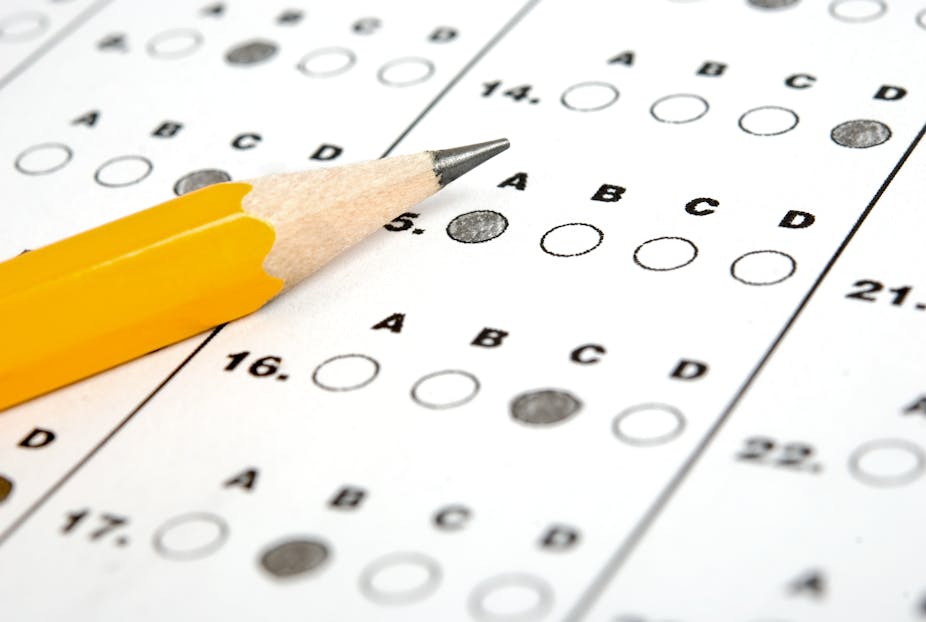
Literacy and numeracy tests are having a negative impact on Australian students. Test image from www.shutterstock.com

NAPLAN tests – the literacy and numeracy tests given to primary and secondary students – are causing health problems and promoting a culture of “teaching to the test”.

A national study released today surveyed around 8,300 teachers and found the tests had unintended consequences, particularly on how the curriculum was taught, student health and school reputation.

Melbourne University’s Nicky Dulfer discusses the findings below.

What are the major findings in the study?

The major findings can be broken down into four key areas. The first major finding is around the fact that teachers are really unsure as to the purpose of NAPLAN.

We asked teachers and educators across the whole of the nation: what do you think NAPLAN is for? And they think it’s a school ranking tool, they thinking it’s a method of policing school performance. Some say it might be a diagnostic tool but that it doesn’t quite fit that role.

So there’s some confusion about what the purpose of NAPLAN is.

The second finding is to do with enrolments. And the idea that if you were a school that got poor results in NAPLAN, or poorer than expected results in a NAPLAN test, how that might affect your school. And teachers felt overwhelmingly that it could affect media reporting about the school, which would affect the reputation of the school, how parents felt about the school, how staff felt, the morale of the students and the staff and also it could affect the school’s ability to attract and retain teachers and students.

We also asked about areas around health and well-being. But teachers were only allowed to talk about students who had reported issues or parents who had reported issues. We didn’t want teachers to say “I’ve heard about issues”, they needed to have hard evidence.

And they reported that they had a number of students who said they were feeling stressed, there were students that were concerned they were too dumb to sit the NAPLAN.

There was a fear of parents' reactions to the test results, if the school performed lower than expected. There were some teachers who reported that kids do feel sick before the test or freeze during the test. There’s some sleeplessness and some crying.

Teachers also responded with anecdotes in that section – there were many stories of kids not wanting to go to school and things like that.

The final area that we looked into and asked teachers about is the one that teachers have the most control over and are also the people that know the most about it. And that is the impact of the testing on curriculum and teaching.

And we asked them what the impacts on the curriculum and teaching are, and there were some very strong results about the fact that NAPLAN preparation is taking up a lot of time in a crowded curriculum, that there are other curriculum areas that are seen as not as important because they’re not tested. That they teach more to the test, so they make sure that they cover the knowledge that’s on the test, and that means that they’re not teaching other things.

It has actually reduced the amount of face-to-face talking time they have with their students and it’s narrowed the range of teaching strategies.

We also asked them about how they were able to use the NAPLAN results and how useful it was. One of the overwhelming responses was that it comes through so late, that it’s not as useful as they would like. They can’t use it as a diagnostic tool.

So predominantly they said they looked through the data and they checked if there were any surprises – if students were performing well-above expected or well-below expected.

Does the study then offer new information or does it confirm what we already know?

It’s the first time to my knowledge that NAPLAN has been looked at nationally from this perspective.

We know that in other countries there’s been great criticism of high-stakes testing. There have been times in Australia when people have said NAPLAN isn’t a high-stakes test, it’s not treated in that way.

But given these findings, NAPLAN is a high-stakes test because it does have consequences for students' success and teacher practice.

The study confirms that what is happening overseas is also happening here. But it’s the first national study of its kind, to my knowledge, that asks teachers what is happening in your classroom because of NAPLAN. We also had over 8,000 responses so it’s a strong study from that point of view.

Given your findings, do you think NAPLAN should be reformed or replaced? What are the alternatives?

I don’t think it needs to be abolished but I think that we do need to start to look at some of the impacts of NAPLAN, intended and unintended. And to actually enter into a conversation about it – after all it’s one test on one day, it’s been given a lot of importance, it’s been put up on the website, and it has an ability to impact on all these aspects.

So can we de-emphasise it in some way? Can we make sure that parents understand that it’s not the be all and end all? Can we de-pressurise the situation?

Do we need to run it every second year, for example? We need to think about the way that it is impacting on students and see if there are other ways.

I’m not saying it’s a useless measure, but it something that is now having quite severe unintended consequences that we need to look into and ask, is there anything we can do?

This study focuses on teachers' perceptions of the effects of NAPLAN – are there other ways to measure its effects? Is there more research needed?

Absolutely, this is just the tip of iceberg. We’ve only asked the teachers at this point. Certainly this study is a first step, we’re also hoping to ask the students themselves for their opinions and ask parental opinions.

But we also need to understand the research and the policy that sits behind it as well. But what we were seeking to do was get a voice from those educators who have largely, remained fairly quiet on the issue until now.

Sign in to Favourite

Want to follow The Conversation?

Sign up to our free newsletter to get the day's top stories in your inbox each morning, with a special wrap on Saturday.

Become a friend of The Conversation and donate

Join the conversation

14 Comments sorted by

  1. James Jenkin

    EFL Teacher Trainer

    "Certainly this study is a first step, we’re also hoping to ask the students themselves for their opinions and ask parental opinions."

    It's good Nicky Dulfer suggests asking students how they feel. We can't rely on anecdotes about student stress from teachers opposed to NAPLAN.

    Also, it would be useful to test the assertion that NAPLAN negatively affects learning. Has student performance in other areas of the curriculum declined?

    However, will the research rigorously pursue such questions? I'm not filled with confidence. The statement 'this is just the tip of the iceberg' suggests the researcher is already convinced NAPLAN is bad, and is looking for evidence to support this view.

    report
    1. Bruce Williams

      logged in via email @fastmail.fm

      In reply to James Jenkin

      On a site aimed at conveying university research to a wider public, we should expect responsible and accurate reporting of results. This is a big number study, so presumably the results were tabulated. Where are the numbers here? What measures were used to determine stress? How many children are stressed? Some degree of stress actually improves performance while too much depresses it: what is the NAPLAN picture? Would the kids stressed by NAPLAN also exhibit stress before having to submit projects to deadline? Was this even thought about?

      Practically every sentence of this article invites questions of this kind, so that, as it stands, it cannot be taken seriously.

      If a significant number of teachers do not understand the purpose of the NAPLAN test - and again, the numbers and context are missing - we might well ask why? Is their understanding affected by the disinformation campaign mounted by the unions?

      report
  2. Brian Lennon

    logged in via Facebook

    plato told

    him:he couldn’t
    believe it(jesus

    told him;he
    ...wouldn’t believe
    it)lao

    tsze
    certainly told
    him,and general
    (yes

    mam)
    sherman;
    and even
    (believe it
    or

    not)you
    told him:i told
    him;we told him
    (he didn’t believe it,no

    sir)it took
    a nipponized bit of
    the old sixth

    avenue
    el;in the top of his head:to tell

    him

    ... And he, and she, and the ALP, stlill don't believe it.

    report
  3. Jane Hunter

    Academic

    Important study findings here Nikky ... but I still want to see the evidence that standardised testing and tests like NAPLAN lead to better student learning outcomes? Where is the evidence? National? International? How is NAPLAN useful to teachers when results are released so late in the school year? Rhetorical questions BTW. Albeit anecdotal ... two recent stories : one, my teacher education students increasingly report on their return from prac that large blocks of learning time in primary schools are spent on rehearsing for NAPLAN even when the tests are not until 2013? Why? Only maths and literacy seems to be taught at many primary schools now... little time for social studies, PDHPE, creative arts and science. And the second story: my young niece says she is also doing NAPLAN practice now at school .... in Term 4? I ask : "What do you think of that?" She responds: "Boring ... why do we have to learn this way?"
    Why I ask?
    NAPLAN needs an urgent review.

    report
    1. Philip Dowling

      IT teacher

      In reply to Jane Hunter

      It is great to see that academics quote anecdotes as evidence these days. Presumably an educational academic.

      report
  4. Bob Buick

    Retired biological engineer.

    You make some good points, but I have just a couple of comments:
    1. "Teaching to the test" should not be a problem. It should be the whole purpose. If the test is faulty, fix the test (which many of our "academics" are poorly equipped to do). In due course, hopefully most of these kids will have to pass more advanced tests - unless "educators" plan to hand out degrees and diplomas like boxes of cereal.
    2. "And they reported that they had a number of students who said they were feeling stressed…

    Read more
    1. Jack Bowers

      Learning Adviser

      In reply to Bob Buick

      I would beg to differ, Bob, on both your points:

      1. If you can find a test which reliably and validly measures everything you want from your curriculum, then I'd agree that teaching to the test should be the whole purpose. But we know that even the best tests (or tasks) are very limited in their assessment capabilities: learning is complicated and multifaceted, and no one test goes anywhere near measuring the desired outcomes of education; and therefore, your proposition is simply impossible…

      Read more
  5. Jack Bowers

    Learning Adviser

    Peter Garrett's comments on Radio National this morning said everything we need to know from the government's point of view. He denigrated the study, asserted that teachers don't understand NAPLAN and gave some patronising assurances about the govt's commitment to education reform.

    That is, Garrett doesn't care about the research because it doesn't fall into line with the policy. The policy CAN'T be wrong, so everyone else must be. In the eyes of the government, this is not about education at all, this is about winning a media contest for the next election.

    Nicky's nuanced analysis of her research showed up Garrett's agenda perfectly - but he will win because "winning" for the govt is about them winning an election, not about improving education outcomes.

    report
  6. Brian Lennon

    logged in via Facebook

    The testing fallacy is subscribing to the delusion that giving a grade actually accomplishes something. I am currently in Ohio, and the local legislature has just decided to give school districts A-F grades. I invite people who think NAPLAN is anything other than a political smoke job imposed on children and teachers to imagine a system where their parenting, probably as complex a task as teaching, was graded by a bunch of politician-appointed bureaucrats, with financial penalties, loss of jobs…

    Read more
  7. Louise Zarmati

    PhD graduate at Deakin University

    I have taught in schools for twenty years and trained pre-service teachers at a number of universities for ten. I have never been a big fan of testing but in NSW we have lived with the the School Cert and HSC for such a long time now we are inured to it. However, I am also a parent and my views on NAPLAN changed unexpectedly this year when my Year 7 son did the NAPLAN test. He asked me how important it was and whether or not he should study for it. I replied that he didn't need to worry as it was…

    Read more
    1. Philip Dowling

      IT teacher

      In reply to Louise Zarmati

      I generally agree with your comments. However I didn't have to worry about my children stressing about the results. They were too illiterate and enumerate to understand them.

      report
  8. David Briggs

    logged in via Facebook

    I cannot believe the hand wringing about NATPLAN. I am more than a little sceptical about the research. A survey of teachers who are generally opposed to the test. I am surprised the criticisms are not more strident!

    It's not great to unnecessarily cause kids anxiety, but really, life throws up all sorts of challenges. Sitting a test is unlikely to rate. In any case, aren't we teaching kids resilience. How can this happen without being exposed to the odd challenge along the way. It surely is not beyond teachers and parents to manage the NATPLAN process so kids are not traumatised.

    There may be ways the test can be improved, and ways that the information can be accessed and used by parents wishing to make decisions about their kids education. The results don't capture the whole picture of what constitutes good education, but it is a very good place to start that conversation. So harden up for goodness sake.

    report
  9. Philip Dowling

    IT teacher

    I find it disappointing that an academic would regard this survey as yielding any data other than the percentage of members of teachers' unions who had bothered to answer the survey and could recall the hype and spin put out by the teachers' unions in their publications.
    It would seem that about 15 % of those who responded need to be sent off to remedial comprehension classes or to the union re-education gulag, where they will be forced to copy out the last twelve issues.

    report
  10. David Donaldson

    adult educator

    Yes, article obtained a lot of media coverage, but it is thin and lacks objectivity. As a practising teacher, Dowling's comments have potential value but are so disdainful and combative. My only personal experience of NAPLAN is of friends, educated parents whose local school council dictated that the school must teach for the test. The child was bored and becoming resistive to school. The govt has done a poor job on helping the public to understand what educational testing is and how it can be used. I suspect there are ideologues in the Ed dept and the PM dept who have carried over from Howard years.

    report