
The case for shutting down Hazelwood power station – some facts and figures

Under its Clean Energy Future, the Federal government will negotiate to close 2000 MW of the dirtiest fossil fuel power generating capacity in Australia by 2020. With the price on carbon now in operation, there will be pressure on some highly carbon intensive station to remain viable – this policy pre…

Dfczqxdw-1341296754
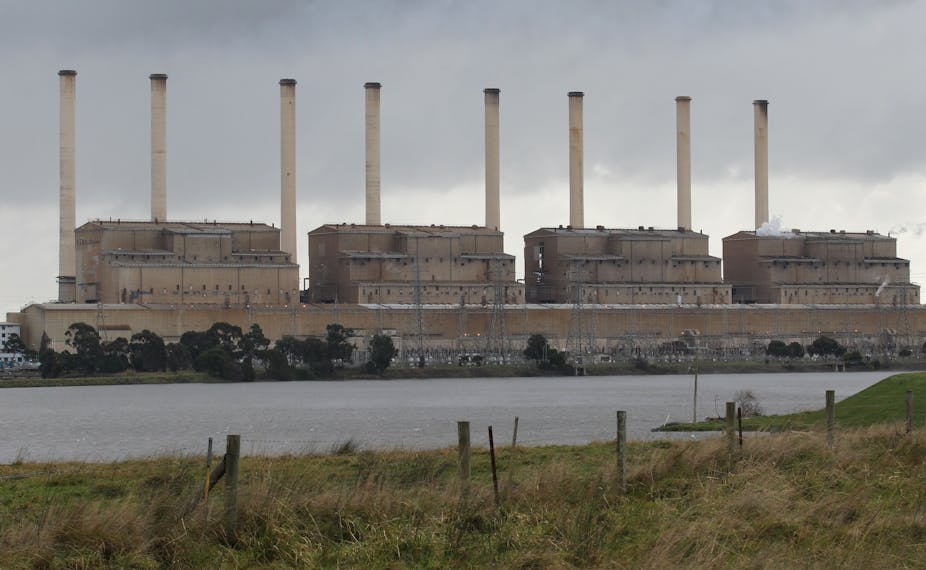
With Australia’s highest carbon intensity, Victoria’s Hazelwood coal-fired power station is a prime candidate to close down part of its generating capacity. AAP

Under its Clean Energy Future, the Federal government will negotiate to close 2000 MW of the dirtiest fossil fuel power generating capacity in Australia by 2020.

With the price on carbon now in operation, there will be pressure on some highly carbon intensive station to remain viable – this policy pre-empts the failure of the most vulnerable businesses and provides some certainty as to which stations will close, as well as compensating the companies affected, including the workers who will lose their jobs.

As reported in April in the Climate Spectator the plants under consideration are Hazelwood, Yallourn and Energy Brix in Victoria, Playford B in South Australia and Collinsville in Queensland.

The most likely combination of these stations is Hazelwood and the much smaller Energy Brix which both rely on the same open cut coal mine in the La Trobe Valley. So assuming these are the stations that close, what will be the impact on Victoria and Australia’s carbon emissions and electrical energy system?

Hazelwood power station is a 1600 MW brown coal generator made up of eight 200 MW units which were constructed between 1964 and 1971. It is the oldest coal-fired generator currently operating in Victoria, and not surprisingly has the highest carbon intensity of any power station in Australia at 1.52 tonnes of CO2 for each mega-watt hour* (MWh) of electricity produced (as reported by the Australian Energy Market Operator.

It is just ahead of Playford B in South Australia, but Playford only has a capacity of 240 MW. Loy Yang B produces more carbon (20 mega tonnes versus 18 for Hazelwood), but also produces almost 40% more electricity. Hazelwood is a clearly a prime candidate for the Clean Energy Future program to purchase and shut down 2 GW of the most carbon intensive generating capacity.

In 2011, homes, business and industry connected to the National Energy Market (the NEM, made up of Tas, SA, Vic, NSW and Qld) consumed 200 TWh of electricity. The power stations combined produced 186 Mt CO2. Hazelwood supplied 6% of the NEM’s power and 10% of the emissions.

Station Capacity (MW) Power (TWh /year) Carbon Intensity (tCO2 /MWh) Carbon (Mt CO2)
Loy Yang A 2210 16.7 1.21 20.2
Hazelwood 1600 12.1 1.53 18.4
Bayswater 2640 17.2 0.99 17.6
Yallourn 1480 11.7 1.42 16.6
Eraring 2680 13.6 0.99 13.7
Loy Yang B 1000 8.6 1.24 10.6
Mt Piper 1400 10.3 0.94 9.5
Liddell 2000 8.3 1.08 9.0
Wallerawang 1000 6.4 1.05 6.7
Gladstone 1680 6.8 0.96 6.6
Australia’s 10 biggest carbon emitters.AEMO (http://www.aemo.com.au/)

So what happens if 6% of the generation is removed? Will we have rolling blackouts? Who will take up the slack?

A few years ago when demand was continuing to increase, this might have been a serious question. But, since 2008 total demand in Australia has been decreasing at between 1% and 2% per year, a decrease of almost a gigawatt.

The effect has been that generators are operating at lower capacity factors – with wholesale electricity prices not seen in a decade – and claims that no new fossil generating capacity will be required in Australia for a decade. That means no new state-of-the-art generators that would have much lower emissions than Hazelwood.

Hazelwood runs at an average of around 85% capacity, or 1.4 GW. So the 1 GW decrease in demand is close to the total contribution of Hazelwood. Turning it off would more or less take us back to the supply and demand balance of 2008.

This would have the effect of increasing wholesale electricity prices by around 2 c/kWh – returning prices to the levels seen before 2008, and restoring some investor confidence to build new and cleaner capacity.

Even without new capacity, the effect of shutting down Hazelwood and the slack being taken up by existing generators that have on average 30% lower emissions, would reduce CO2 emissions by 5 Mt per year, or 3% of Australia’s electricity sector emissions.

In the national energy market, there is around 50 GW of capacity listed. On average we use 22 GW – so there is plenty of capacity sitting idle much of the time, waiting for the extreme demand days when the temperature reaches into the 40s.

With 2 GW removed from the system, there is a concern that the system may struggle to meet peak demand. But those hot days tend to be sunny, when rooftop photovoltaic (PV) will be producing at its maximum. In the last two years almost 2 GW of solar PV capacity has been installed nationally. Just as long as we use our air-conditioners when the sun is shining.

*A mega-watt hour is the amount of electricity generating by a 1 mega-watt generator operating for one hour.

Join the conversation

14 Comments sorted by

  1. Garry Claridge

    Systems Analyst

    Thanks Roger.
    I wonder if some of the loss can be made-up with solar and wind generators in the that area. This would also create jobs.

    report
  2. John Newlands

    tree changer

    I can't say if closing Hazelwood would endanger the NEM's reserve capacity requirement but the other stations would almost certainly have higher average running costs. For example increased use of open cycle (gas turbine only) plant is expensive and has nearly the same CO2 as some modern average black coal fired plant.

    From personal observation PV output is not especially well correlated with air conditioning demand. The heat lingers on in the late afternoon as the sun sets. Wind farms are usually…

    Read more
    1. Roger Dargaville

      Research Fellow, Energy Research Institute at University of Melbourne

      In reply to John Newlands

      Point taken that PV doesn't meet the evening demand (I was a little tongue in cheek with my comment that we should only use AC when the sun is shining). But, there is lots of scope for small scale storage and load management that have not been considered to date.

      Nuclear has lots a advantages, but a number of disadvantages including a lack of social license to operate in Australia. I worry how long it might take for pollies to take that on.

      report
    2. David Arthur

      n/a

      In reply to Roger Dargaville

      Roger, can you comment on the idea of rooftop solar PV charging a bank of deep-cycle batteries, on which the householder subsequently draws? Could the battery bank be grid-connected, rather than the solar array directly?

      If so, the household's load on the grid would be considerably smoothed over 24 hours, and with a large enough solar array the house may not ever be importing power from the grid.

      report
  3. John Robert Davidson

    Retired engineer

    If we assume that the program for shutting down coal fired power will be driven by emission reduction targets Hazelwood looks like an obvious early candidate in any logical plan. However, it is not as simple as that since there are other factors to be considered.
    For example, shutting Hazelwood will change peak loadings for various parts of the grid. If the result is a need for grid upgrades shutting Hazelwood may be a very expensive per tonne CO2 abatement.
    Standby is another key issue. Power…

    Read more
    1. Roger Dargaville

      Research Fellow, Energy Research Institute at University of Melbourne

      In reply to John Robert Davidson

      Lot of good points John. One thing to note is that brown coal power stations in Victoria run at pretty much constant output slowly varying on scales of days. Hydro from Snowy and across Bass Straight as well as gas provide all the peaking capacity.

      There are definitely difficult problems to solve with managing load and the variable supple from renewables. But these are not surmountable - we just haven't tried yet as we've always had cheap fossil fuel.

      report
    2. Geoff Mason

      student

      In reply to John Robert Davidson

      Nice article, Roger. Really succinct and well explained.

      John RD talks about needing smart ways to reduce peak demand which really is a case of many billions of dollars in savings just sitting there waiting to be grabbed.

      Here's a few thoughts/questions on reducing peak demand:

      1) Will the reduced price and increased uptake of solar PV effectively tackle a large share of the problem?

      2) Is there a place for governments to invest in 'virtual' powerplants made up of strategically dispersed…

      Read more
    3. John Robert Davidson

      Retired engineer

      In reply to Geoff Mason

      I am a bit skeptical about the effectiveness of peak pricing. Our average power bill is less than $3/day, The financial incentive to put much effort into reducing power or moving away from peaks is pretty small. I might do easy things like moving clothes and dishwashing to off peak times but I am unlikely to turn the air conditioner on or off.
      More to the point, during a heatwave, most people will put up with high price electricity and keep the air conditioner running.
      Which brings me back to air conditioners and PCM's

      report
    4. Roger Dargaville

      Research Fellow, Energy Research Institute at University of Melbourne

      In reply to Geoff Mason

      Thanks for your comment Geoff.

      Increased PV will help, but as others have noted, PV tends not to provide power late in the day when summertime demand typically peaks on hot days. It would be an interesting question as to what kinds of storage could be used to briefly store the PV generated power for a few hours to help with that mismatch, and at what price they become viable.

      I am keen to investigate combined heat and power generators in apartment buildings or connecting neighbourhoods. It…

      Read more
  4. John Robert Davidson

    Retired engineer

    Roger: Switching air conditioning from on demand power to controlled power would make an enormous difference to peak loadings and the ability of the system to take advantage of solar PV. You could of course make this switch to controlled power and let people be more uncomfortable during heat waves.
    Switching air conditioning to controlled power could be done without sacrificing comfort could be done by using phase change materials (PCM's) to store cold (or heat.) The added bonus is that average air conditioning power consumption can actually drop significantly if the PCM's are frozen at night when the air temperature is much lower.

    report
  5. Stephen Pritchard

    Researcher, cognitive science

    It was once gossip that Hazelwood would have closed ages ago, but was kept open so its owners could grandfather its emissions permits once emissions trading came in, and make a motsa. Now the government is talking about paying Hazelwood to shut down.

    Can anyone confirm the truth or falsity of this gossip?

    report
  6. Chris O'Neill

    Telecommunications Engineer

    "Just as long as we use our air-conditioners when the sun is shining."

    So what will happen when, not if, the very high temperatures continue until sunset, as they commonly do in southern locations such as Melbourne?

    I don't have any problem with Hazelwood's capacity factor being greatly reduced as should happen with a Carbon price. But it's foolish to make capacity completely unavailable at any time whatsoever, even for half an hour a year.

    Why can't we just let the Carbon price do it's job and avoid forcible, economically inefficient intervention.

    report
    1. Roger Dargaville

      Research Fellow, Energy Research Institute at University of Melbourne

      In reply to Chris O'Neill

      Hi Chris - as I understand it, the point of the Government negotiating to close 2 GW of plant is to provide some economic certainty. It's an additional measure to the carbon price, which might put Hazelwood out of business anyway, but if it struggles of for a while, so will all the other generators who have been receiving below LCOE spot market prices for some time now. The market will then provide incentives to build new capacity or systems that will meet the markets needs, whether it's gas fired power, storage systems, demand side management I don't know.

      Hazelwood is capital intensive and uses very cheap fuel - it's only viable when it's running all the time. It would never function as a backup generator.

      report
  7. David Jones

    Engineer

    I understand that closure of Playford B was announced in April and that the adjacent "Northern" Power Station is also to be closed for 6 months per year, leaving it available only for the summer peak.

    report