

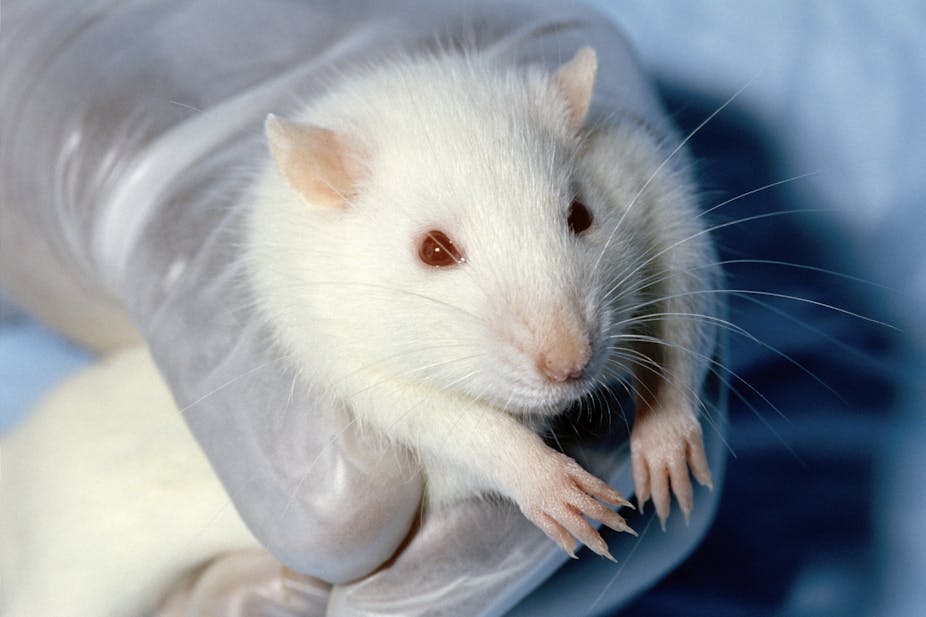
More than six million animals are used in experiments in Australia each year. Many endure pain and distress, and most are killed after their use.
The research community claims that our regulatory framework ensures animals are only used for scientific purposes when their use is essential and justified. We challenge this “clean image” and believe much animal experimentation today is unreasonable and continues the abuses of the past.
We also believe that the Australian public is being kept in the dark about the research use of animals. As in the cases of live exports and factory farming, public disclosure will be the key agent for change.
Animal advocacy groups argue unethical research that causes harm to animals and has insufficient benefits is still routinely approved in Australia. There are many examples – shaking lambs' heads until they die to test hypotheses about “shaken baby syndrome”, breast implants in pigs, feeding junk food to rats and brain surgery on marmosets.
That such studies have proceeded after ethics approval suggests to critics of current practice that something is seriously amiss.
Animal experimentation in Australia is governed by the National Health and Medical Research Council’s (NHMRC) Code of Practice for the Care and Use of Animals for Scientific Purposes and state laws. According to the NHMRC, the purpose of the Code is to “ensure the ethical and humane care and use of animals used for scientific purposes as defined in the Code."
This self-regulatory system is currently under review. Although compliance is strongly impressed on institutions and researchers, there are no penalties for not complying.
In many respects, the purpose of the Code is to legitimise the interests of the “industry”. The Code allows acts against animals which, if committed by an ordinary person outside a research institution, would be regarded as offences under the animal cruelty legislation.
Animal Ethics Committees
Under the Code, ethical review is conducted on every research proposal by an Animal Ethics Committee (AEC). These committees must have at least four members, with one having a commitment to animal welfare (the Category C member) and another who “should be viewed by the wider community as bringing a completely independent view to the AEC”, normally a layperson (the Category D member).
Approval decisions are made on the basis of consensus and any proposal must satisfy the committee that the requirements of replacement (not using animals where possible), reduction (reducing the number of animals used) and refinement (minimising impact) have been considered.
The contentious projects we mentioned above suggest that self-regulation of the animal research community is either too weak or not being properly complied with, or both. We’re puzzled that the AEC member with a commitment to animal welfare and the layperson assented to these experiments.
We suspect that in these cases the independent members were not independent or, if they were, perhaps they were restricted in expressing their point of view. Several critics (for example, here and here) have claimed these are common problems with the operation of AECs.
Independently of the experience of AEC members, the principles and overall approach of the Code itself show how difficult it can be to reject projects as unethical. Despite some seemingly strong provisions to protect animals, we believe the Code biases AECs toward approval.
Under the Code, animal lives have no intrinsic value. As long as their suffering can be minimised “where possible”, they can be used and then disposed of in scientific projects of “merit”. The Code uses a lot of words, such as “necessary”, “essential” and “justified”, but is short on criteria for how these critical terms should be interpreted.
In the crude harm-to-benefit calculation that the Code sees as constituting ethical assessment, benefit (mostly to humans) will nearly always outweigh harm to animals even before the particulars of a project are examined. Because if there’s little harm caused when pain and discomfort are minimised as much as possible (relative to a project’s objectives), and killing an animal after use is doing it no harm, then minor benefits, and even minor potential benefits, will be sufficient to justify using animals.
Lack of disclosure and transparency
Like many before us, we discovered that it’s very difficult to find publicly available documents detailing the deliberations and decisions of AECs. This is despite the fact that the NHMRC and universities (big users of research animals and the focus of this article) are funded by taxpayers.
We could easily retrieve the AEC terms of reference for most institutions, as well as meeting dates and, in some cases, even the names of AEC members. But we found very few instances where an associated animal welfare organisation of a Category C member was named.
We couldn’t find the applications for the contentious studies listed above, nor the records of the AECs that approved them. In fact, we couldn’t find the AEC applications records for any research project that uses animals – that information is just not in the public domain.
When we contacted the major universities, we either received no reply, were directed to irrelevant information on a website, or were told that these details were the subject of confidentiality agreements to protect intellectual property. But how can intellectual property be an issue after research is published, as in the cases we cite?
Surely the veil of secrecy that hangs over AECs is unreasonable. The public should know the details of ethical assessments of animal use projects and be assured that animal welfare and community points of view are adequately represented.
Animal experiments with dubious benefits coupled with the lack of transparency have led us to believe that research involving animals approved under the Code is not necessarily essential and justified. If our assessment is correct, we doubt that animal ethics processes are as rigorous as the research community often claims.
A vital and urgent first step to change this situation and start seeing a reduction in the number of the animals used for experimental purposes is greater transparency. In particular, universities need to allow greater public scrutiny of their Animal Ethics Committees.
Mark Carter
logged in via Facebook
The principal problem with so called 'full disclosure' is that details can, and are, taken out of context, twisted through emotive language or simple exaggeration and deployed tactically to a low-information public by activists pursuing fringe agendas.
If we had a general public who were not so alienated and ignorant of the necessary realities of farming and medical research then the animal rights activists use of their snuff-movies would not be so effective.
Educate the public, show them that animals are not objects, but they aren't people either. Show them where their food comes from, but show them the creatures which die in pest control in arable farming. Show them how research is conducted, but show the results of no medical advances too; the dead babies, the maimed shattered lives. Be honest: explain that despite the claims of the campaigners, 'Cruelty-free' is usually a fantasy- there are no easy answers to these issues.
Rob Buttrose
University of Melbourne
I hope you can see the implications of your view in the first few paragraphs. You seem to be arguing that the public should be kept in the dark about animal experimentation because they are "alienated" and "ignorant" and would only be unnecessarily upset if they knew more. So, the Nazis reasoned about the death camps. So authoritarian governments have argued throughout history.
The public does need to know more about animal experimentation in scientific research because much of that research…
Read moreRob Buttrose
University of Melbourne
John Hadley's article https://theconversation.edu.au/nothing-to-hide-opening-the-files-on-animal-research-9686 is relevant here. I note the deafening silence of the research community to his invitation for them to open up more about their animal studies.
Tim Scanlon
Debunker
I agree Mark. We had all sorts of issues trying to do our trials on feeding, I still have the ethics committee hounding me every six months or so for an update on the trial when it ran for 12 weeks in 2007. It shows that there is a lot of pressure to "do no harm" and yet a lot of the time the research itself is not understood. We can't just start with public disclosure, we have to start with appropriate understanding so that they can understand what they are being presented with.
Also @Rob, you've just demonstrated Godwin's Law in your response to Mark.
Mark Carter
logged in via Facebook
Oh come on Rob, are you honestly claiming that the public understand any of these topics enough for most of them to take anything other than a knee-jerk response next time an activist's animal snuff movie is fed to the media? Drip feeding emotive half-truths to illicit moral panic is a pretty weak excuse for a democratic process at work mate.
I want to inform the public FULLY about the complexities of the human/animal relationship before inviting plebiscites on animal rights crusade topics. An…
Read moreHelen Marston
CEO Humane Research Australia Inc.
“Dead babies… maimed, shattered lives”(?) and you’re suggesting that activists twist things through emotive language? From what I’m reading you seem to be implying that the tax-paying public are not smart enough to understand such a complex issue so perhaps best to keep them in the dark (for their own good?).
If the public don’t understand then let’s give them the details they need – all of them – and then let them decide whether their taxes should be supporting such unethical and scientifically-flawed research.
One thing I do agree on however is that animals “aren’t people either”. Spot on! And that’s exactly why experimenting on animals is so dangerously misleading. The very complex and intricate differences between species make them inappropriate and unpredictable models for human medicine.
Mark Carter
logged in via Facebook
@Helen "and you’re suggesting that activists twist things through emotive language"- you aren't used to a dose of your own medicine, are you?
Gillian Cohen
Research Associate, School of Public Health, The Univerity of Sydney
Perhaps what needs to occur in society is a better grasp of and discussion on ethics and what we consider, as a society, to be acceptable behaviour. Your comments make the assumption that the only way to have medical advances is through animal experimentation, which is not true. It has not been put to people about the true cost of medicine/ some medical procedures.
The public certainly do not accept the live export of animals once they see the reality of it. The education and debate of the general…
Read moreMark Carter
logged in via Facebook
Odd how so many have queued up here to tell me I'm wrong then gone on to say that we should instead educate the public... which was exactly the point I was making!!!
The difference though is that the animal rights ideologues talk of education what they really mean is simple one-sided single-issue propaganda. Putting these debates into their real wider context doesn't appeal because, frankly, it would put most professional animal rights advocates out of a job.
Rob Buttrose
University of Melbourne
Mark wrote "Putting these debates into their real wider context doesn't appeal because, frankly, it would put most professional animal rights advocates out of a job" I suppose you were trying to be amusing, but such a flippant remark does you no credit. This is serious issue. Frankly the off-hand attitude of many researchers who use animals to the ethics of what they are doing ( as well as "I am an expert - so trust me" stance) indicates to many of us that you are NOT treating the issue seriously. You often say animal advocates need training in science and a greater understating of science. You guys need to take more ethics classes and read more of the animal ethics literature.
Mark Carter
logged in via Facebook
@Rob Who was joking? I am quite serious. Professional animal rights ideologues are a fifth wheel.
Tim Scanlon
Debunker
Rob, I think your ad hom on Mark is in poor form.
Mark is a zoologist, he is studying them in their native habitats as we speak. As such, he has more understanding of actual impacts of research on animals, the ethics involved and the general public's understanding of that research and ethics. I'd actually say that he is treating the issue seriously, but that it is hard to take some of the comments here seriously as they are too far detached from reality, being informed by idealism instead of facts.
Patrick Stokes
Lecturer in Philosophy at Deakin University
Tim: you said that Mark "has more understanding of actual impacts of research on animals, the ethics involved and the general public's understanding of that research and ethics." The thing one notices in comments on this site however is that many scientists do seem, though clearly well-meaning and genuinely morally engaged, to be under-informed in ethical theory. Now, it's not their job to know their Mill from their Moore, and we can't expect every research scientist out there to take four years out of their training to study philosophy. But we do seem to need some sort of deeper ethical engagement than the sort of unquestioned utilitarianism that seems to hold sway at present.
I can understand how put-upon researchers feel given how adminstratively onerous ethics processes can be and how hard it is to get the point and importance of one's research across. At the same time, I don't think it's helpful to dismiss legitimate moral questions as the result of 'idealism.'
Mark Carter
logged in via Facebook
@Patrick. I dont believe I used the word 'idealism'- I said 'ideology' though- very very different...
Patrick Stokes
Lecturer in Philosophy at Deakin University
@Mark, No it was actually directed at Tim (who said "idealism instead of facts"). The new commenting system makes this stuff much harder to follow.
Dianne Koneitzko
logged in via Facebook
Frankly, the tone of your comment resembled remarkably that of "activists pursuing fringe agendas" only from the opposite side. Firstly, this epidemic attitude that the general public are ignorant because they don't have a university degree or are in research themselves really isn't helping anyone. Secondly, maybe they wouldn't be so ignorant if they were informed of these issues. The fact is, most things are taken out of context these days especially with the mob mentality of social media like facebook…
Read moreBetty M
Coordinator
Good comment, Rob.
Ian Musgrave
Senior lecturer in Pharmacology at University of Adelaide
"We’re puzzled that the AEC member with a commitment to animal welfare and the layperson assented to these experiments."
Why the puzzlement? They will have read the actual applications, and understood them, rather than relying on the cartoon accounts published online which distort the purpose and findings of these studies.
Rob Buttrose
University of Melbourne
I assume you are referring to the case studies listed on the Humane Research Australia website.
http://www.humaneresearch.org.au/case-studies/
Would you care to elaborate why these are "cartoon accounts" and how they distort the purpose and findings of the studies?
Milica Markovic
Member of the public
Let's start by enabling the public to read the actual applications. Transparency is best practice.
Monika Merkes
Honorary Associate, Australian Institute for Primary Care & Ageing at La Trobe University
Hi Milica
Read moreWhile we did not find research applications submitted to animal ethics committees, we did manage to find one annual AEC report from Latrobe University, available online at http://www.latrobe.edu.au/quality/quality-documents/AQC-agenda-part-2-8-June-2011.pdf.
Animal use returns in this report indicate neither the number of animals used in projects nor the number of animals killed. In contrast to the Human Ethics Committee reports included in the same document, not even the names of the…
Gillian Cohen
Research Associate, School of Public Health, The Univerity of Sydney
Any research being conducted by public funds, including research in Universities should be publicly available for anyone to see. This philosophy is also behind the movement towards all research publications that arise from publicly funded research should be available in free access journals.
Dave Hawkes
Research Officer (Viral tools and Neuropeptides) at The Florey Institute of Neuroscience and Mental Health
Hi Monika, the attachment you link to appears to be similar (not the same) as forms I filled out several years ago where the animal use was in a separate document.
Tim Scanlon
Debunker
I agree. Let's just jump straight to human testing.
Joe Gartner
Tilter
Rob Buttrose wrote:
"So, the Nazis reasoned about the death camps. So authoritarian governments have argued throughout history."
A bit early in the debate to whip out the nazi death camp analogy isn't it? Surely there's slightly less overwrought and emotive cards to play first.
As Mark carter aptly and succinctly put it below (or above, dependant upon when you read this):
"Educate the public, show them that animals are not objects, but they aren't people either."
Rob Buttrose
University of Melbourne
Not really. It is an authoritarian viewpoint to say that you don't want the public to know something because they are "alienated" and "ignorant" and would take take the wrong view. It is a viewpoint that is really not tolerable in a democratic society. History is full of examples of what can happen otherwise. I could have probably chosen another example than the particular one I did - but the general point does not hang on it.
Why don't we talk about what matters : the disclosure and transparency issue ?
Monika Merkes
Honorary Associate, Australian Institute for Primary Care & Ageing at La Trobe University
Tim,
Read more"We can't just start with public disclosure, we have to start with appropriate understanding so that they can understand what they are being presented with".
I assume you mean by this that we should start with researchers presenting their proposals in a way that is accessible to the non-scientists on the AEC. Please correct me if I misunderstood.
My response to you is that according to the Code, researchers are already required to do this. The current Code (7th edition 2004), on page 13…
Tim Scanlon
Debunker
I was meaning the broader public. Until either the language of science is understood by the public, or it is communicated so as to make it understandable, then just releasing information doesn't improve the situation.
As for the AEC in plain language, my dealings with AEC and EC in general would suggest that the committees are as much to blame as researchers when it comes to poor language use. The forms I have filled in are more akin to a wordy legal notice than anything designed to be clear and understandable. I'd be happy to see reform on AEC and EC because they should act as a level of peer review for science experiments (remove those needless experiments you mentioned in the article), but instead are acting as a hindrance and deliberately closed system that is about passing the blame.
Monika Merkes
Honorary Associate, Australian Institute for Primary Care & Ageing at La Trobe University
Hi Tim
I disagree. The role of AECs is not peer review. The focus is on the animals and their welfare.
As the Code outlines, "The role of the AEC is to ensure that the use of animals is justified, provides for the welfare of those animals and incorporates the principles of Replacement, Reduction and Refinement". p. 10, Australian code of practice for the care and use of animals for scientific purposes http://www.nhmrc.gov.au/_files_nhmrc/publications/attachments/ea16.pdf
PS --- dear decision makers on web-related matters @ The Conversation, it's really awkward not being able to respond to someone's comment directly. The old system worked much better, methinks.
Tim Scanlon
Debunker
I said "should act" not "do act". In this manner they would be able to act as a review of science and science needs so that weighted ethical decisions can be made.
Darren Saunders
Garvan Institute
Rob, Monika
Have either of you sat on an animal ethics committee?
Sean Lamb
Science Denier
I am sure they would accept any invitations that the Garvan might like to offer.
Monika Merkes
Honorary Associate, Australian Institute for Primary Care & Ageing at La Trobe University
Hi Darren, no I haven't been on an AEC. With my views on animal research, I doubt any university or research institute would welcome me on their AEC.
Rob Buttrose
University of Melbourne
No Darren, I have not. As you would have read in the article, however, we do have the written testimony of some who have. I have also spoken to some former Category C members. The picture is fairly uniform : the expectation that the protocol will be approved before discussion even begins, the high-handed and often arrogant attitude of the scientists involved and the general failure do ethical assessments as required by the Code.
Ian Musgrave
Senior lecturer in Pharmacology at University of Adelaide
Rob Wrote: "I assume you are referring to the case studies listed on the Humane Research Australia website.
http://www.humaneresearch.org.au/case-studies/
Would you care to elaborate why these are "cartoon accounts" and how they distort the purpose and findings of the studies?"
Lets start with the title "Shaking Lambs to Death!" which completely misrepresents the study and is an obviously emotional ploy.
Read more"South Australian researchers have shaken anaesthetised lambs to death.." makes it sound…
Rob Buttrose
University of Melbourne
From the publication:
2.1. Experimental protocol
Nine anaesthetised (isoflurane) and ventilated lambs were manually grasped under the axilla and vigorously shaken with sufficient force to snap the head back and forth onto the chest, similar to head motions believed to occur in human NAHI. In addition to this acceleration/deceleration of the head, there was also considerable lateral and rotational head movement. Each lamb was shaken in this manner 10 times of 30 seconds duration over a 30 minute…
Read moreIan Musgrave
Senior lecturer in Pharmacology at University of Adelaide
So, Rob, you agree then that the Humane Research Australia website distorts the paper.
Ian Musgrave
Senior lecturer in Pharmacology at University of Adelaide
Rob wrote: " I note the deafening silence of the research community to his invitation for them to open up more about their animal studies."
You have never been the target of animal extremists then, have you.
Ian Musgrave
Senior lecturer in Pharmacology at University of Adelaide
Helen wrote: "The very complex and intricate differences between species make them inappropriate and unpredictable models for human medicine"
Not really, they are very good for some things (high blood pressure, antibiotics) and not good at other things (Brain-Behaviour stuff), and okay for most things.
Helen Marston
CEO Humane Research Australia Inc.
Not really okay at all, not when you consider that systematic reviews conducted in the areas of toxicity testing and biomedical research have shown that alternatives are far more predictive of human outcomes than data obtained from animals.
Does University of Adelaide offer any initiatives into the development and validation of alternative methodologies?
Ian Musgrave
Senior lecturer in Pharmacology at University of Adelaide
Conversation overlords, the new commenting system REALLY is double plus ungood.
Dave Hawkes
Research Officer (Viral tools and Neuropeptides) at The Florey Institute of Neuroscience and Mental Health
I have previously commented on articles and comments by the two authors of this piece. I am a strong supporter of constant review and improvement of the currently animal use processes (including AEC etc). I guess my questions to the two authors is this;
Can you please give me a situation where you think animal research is required?
Since you have touched on the field of neuroscience in your article could you please give an example of how researchers can study, and therefore develop more treatments, the brain, specifically conditions such as, traumatic brain injury, stroke, alzheimers, addiction, etc.
I have asked the second question before and have been told of the development of computer models etc. Unfortunately we do not have enough information to accurately model a single cell let alone the compex processes within the brain. I look forward to you response.
Monika Merkes
Honorary Associate, Australian Institute for Primary Care & Ageing at La Trobe University
Hi David, I can't think of a situation where animal research is required.
I've previously written an article for the Conversation "Animal research provides a flawed model, so why not stop?" https://theconversation.edu.au/animal-research-provides-a-flawed-model-so-why-not-stop-7890 That pretty much sums up my view.
Rob Buttrose
University of Melbourne
David, there are no doubt situations where I would regard animal research as justified, necessary, essential , causing minimum pain and suffering and therefore ethical. I think most addiction studies do not meet these criteria but there will be some other neurological studies that do. The point, however, is that by the above standard - which is supposedly enshrined in the Code of Practice - a great deal of current experimentation would be ruled out and should never have passed ethical approval…
Read moreRob Buttrose
University of Melbourne
As you can see Monika have different opinions on this, but the point of view in our article is not abolitionist. It as, as I say below, the view that much animal research is unethical and has to stop.
Dave Hawkes
Research Officer (Viral tools and Neuropeptides) at The Florey Institute of Neuroscience and Mental Health
Thank you for your response Monika and Rob.
Monika your statement "I can't think of a situation where animal research is required" appears to suggest an ideological position and you are free to hold it.
Rob
I understand your point and you seem ok with some animal research in some cases. So we both agree that animal research is necessary and that has to fall within certain guidelines, what we are disagreeing with is where to draw the line. I think that understanding the mechanism of addiction (to drugs, or food, or other behaviors) and understanding whether a baby with head trauma could be due to normal activity (in which case we could warn parents against it, such as with the way a baby should sleep which has helped to reduce SIDS deaths) or if it is due to abuse are things work examining but you don't. As you say it is all about the grey areas.
Rob Buttrose
University of Melbourne
That is about the size of it.
Read moreHowever, I don't say these things - e.g. addiction mechanisms and head trauma - are not "worth" examining, but that we are not justified in using animals the way we have done in most instances to examine them. There is a difference. There are many things that it would be useful and profitable to discover, and we could do so by experimentation on animals or humans. There is further question of whether it is ethical and should be allowed
Too often the scenario seems…
Helen Marston
CEO Humane Research Australia Inc.
Hi David,
I think the recent opening of the Monash Biomedical Imaging (http://www.mbi.monash.edu.au/) will allow for much progression in the area of neuroscience - without the need for animals.
Rob Buttrose
University of Melbourne
David,
it may be as you say be all about the grey areas but I think history has shown that more and more areas of animal experimentation are turning black ie. forbidden. In Descartes times, physicians nailed dogs by their paws to the dissecting table and cut them open fully conscious without any anaesthetic. In the sixties, researchers did abominable things, such as keeping animals in tiny boxes exposed to extreme heat to see what happened to their brains. (Singer's Animal Liberation is full…
Read moreDave Hawkes
Research Officer (Viral tools and Neuropeptides) at The Florey Institute of Neuroscience and Mental Health
Helen Marston, These new facilities are great and will be utilised but still don't come close to allowing the sort of work that is currently being done. I know of work which is being done (in animals) that is looking to develop new technologies and treatments to reduce the effects of stroke, things like impairment, physical and mental, paralysis, death etc). This sort of work can't be done passively. Interestingly a lot of work done with imaging is also done in conjunction with animal research.
Dave Hawkes
Research Officer (Viral tools and Neuropeptides) at The Florey Institute of Neuroscience and Mental Health
Rob, I guess I am a little disappointed, we were having an exchange of ideas and then you felt the need to talk about monkey torure undetaken 350 years ago (time of Descartes). Is it any wonder that few people with disenting views have posted on this thread. You and Monika have views to which you are entitled to but can you acknowledge that your views are coloured by your beliefs. I have looked at some of the papers posted by Monika and there is certainly some evidence in the specific cases of some…
Read moreHelen Marston
CEO Humane Research Australia Inc.
Hi Veronica,
Thank you for your enquiry about animal use in psychology. I apologise for the delay in getting back to you but it’s been quite hectic here.
Animal models are not predictive modalities for humans. This applies to neuroscience as much as it does to any other medical discipline.
The failure of the animal model in neuroscience is well documented - there are more than one thousand drugs that have been shown to be neuroprotective in animal models of stroke - but not a single one has been shown to be effective in humans. The genetically modified Alzheimer mouse models have been a huge disappointment to the pharmaceutical industry, which has significantly cut back on its investment in this area of animal testing.
Ian Musgrave
Senior lecturer in Pharmacology at University of Adelaide
Helen wrote: "The genetically modified Alzheimer mouse models have been a huge disappointment to the pharmaceutical industry, which has significantly cut back on its investment in this area of animal testing."
Ironically, the Alzhemier mouse was developed based on our understanding of **human** disease, using key proteins everyone flagged in humans. If anything, it has clarified some important issues in AD progression.
AD drug research is being cut back because **nothing** we have tried works, whether based on animal models, human disease understanding or on tissue culture. This is not a failing of animal models, this is a failing to understand something fundamental about the disease.
https://theconversation.edu.au/new-very-distant-hope-for-treating-alzheimers-10597
Helen Marston
CEO Humane Research Australia Inc.
Ian,
Consider the following concerning the use of non-human primates - who you would expect to be more predictive of human conditions:
1. Brain research using NHP falls under the heading of “basic research”. Basic research is defined as “Experimental or theoretical work undertaken primarily to acquire new knowledge of phenomena and observable facts without any particular application or use in view. It is usually undertaken by scientists who may set their own agenda and to a large extent organise…
Read morePaula W
editor
Thanks for the article. Unfortunately universities, research institutions, pharmaceutical companies etc live in the dark ages in terms of business best practice which demands stakeholder engagement, transperancy, social responsibility among other values. A time will come when they will not be able to continue with their current practices and that day cannot come fast enough.
Ian Musgrave
Senior lecturer in Pharmacology at University of Adelaide
Helen wrote: "Not really okay at all, not when you consider that systematic reviews conducted in the areas of toxicity testing and biomedical research have shown that alternatives are far more predictive of human outcomes than data obtained from animals."
Hmm, changing the gaol posts there (toxicity tests are not relevant here), but lets see, here's a short list of smoe major therapeutic developments from animal experimentation, sulphonamide antibiotics, discovered using animal experiments, the…
Read moreHelen Marston
CEO Humane Research Australia Inc.
There will always be examples whereby researchers will claim that animal experiments were integral to specific discoveries. That’s not to say however that such discoveries (and arguably more) could have been made by other means, which of course would have been pursued had animals been taken out of the picture. Additionally, many discoveries were made by non-animal methods, and later experiments on animals served only to convince scientists that these earlier breakthroughs were correct.
Similarly…
Read moreGillian Cohen
Research Associate, School of Public Health, The Univerity of Sydney
One of the issues that has not yet been discussed is the value of evidence. It appears to me that many experiments are repeated more often than in necessary to reach an acceptable level of evidence. When these experiments involve animals, the cost is more than just wasted tax payers dollars in unnecessary repetition of expensive experiments and wasted human resources, but the dreadful waste of animal lives.
Merkes and Buttrose mention the shaking of lambs head to prove shaken babies syndrome - really - what a dreadful waste. This is where animal ethics committees do need to be asking if there really is a need to repeat experiments, especially where there are animals involved.
Ian Musgrave
Senior lecturer in Pharmacology at University of Adelaide
I am uncertain as to why you think gathering the evidence that will prevent innocent people from being charged with manslaughter (or conversely, allowing manslaughter to be detected that would otherwise be missed) is a waste.
http://www.sciencedirect.com/science/article/pii/S0967586812001014
Gillian Cohen
Research Associate, School of Public Health, The Univerity of Sydney
There are nineteen papers referenced in this study. Did it need to be replicated? At what point will enough evidence be enough evidence? There are many things that have already been proven - continual experimentation in regards to these is unnecessary, unethical, and a waste of money and resources.
Ian Musgrave
Senior lecturer in Pharmacology at University of Adelaide
"There are nineteen papers referenced in this study. Did it need to be replicated?"
It wasn't a replication, this provided NEW evidence about non-accidental head injury, and shows that you do not need head impact for death, a hotly debated issue which previously had no evidential support, with important implications for both forensics and legal issues.
Also, just referring to something doesn't mean you are replicating it, these references from the paper give background the to rationale for the…
Read moreGillian Cohen
Research Associate, School of Public Health, The Univerity of Sydney
Ian, we need to take this idea away from the lamb study - I don't have time or interest to go into it to see if the papers are background or replication or trying to gather more evidence about one particular point - I am happy to believe you that more needed to be done.
The real point is that there are examples where scientists are exploring issues that are already pretty much settled. But the hierarchy of evidence is held up as the absolute, and its used to justify continual experiments, especially…
Read moreRob Buttrose
University of Melbourne
Ian,
let's remind ourselves of what is justified in the use of animals under the Code of Practice.
The relevant section is:
JUSTIFICATION 1.1 Scientific and teaching activities using animals may be peformed only when they are essential:
Read more• to obtain and establish significant infomation relevant to the understanding of humans and/or animals;
• for the maintenance and improvement of human and/or animal health and welfare;
• for the improvement of animal management or production;…
Ian Musgrave
Senior lecturer in Pharmacology at University of Adelaide
Gilllian wrote: "I don't have time or interest to go into it to see if the papers are background or replication or trying to gather more evidence about one particular point"
Then why did you use the paper in the first place, and why did you make a point of pointing out there were 19 references. If you can't be bothered to check the details of the paper you want to use as a case in point, how do we know your general statements are correct.
Ian Musgrave
Senior lecturer in Pharmacology at University of Adelaide
Rob wrote: ""preventing innocent people from being charged with manslaughter " come? Would it be "for the improvement of human welfare?" Or for "the understanding of humans""
Boggle
I cannot even begin to understand the confusion of mind that would produce that sentence. Did you really mean to write that?
Gillian Cohen
Research Associate, School of Public Health, The Univerity of Sydney
Ian, I feel I have to point you to the community standards of the Conversation.... https://theconversation.edu.au/community_standards
the quote that Rob has made that you mention was your own.
I mentioned the lamb study because you referenced it, after the type of study was mentioned in the article.
Commenting on either of these issues didn't address the points that Rob and I made.
Ian Musgrave
Senior lecturer in Pharmacology at University of Adelaide
Gillian wrote: "I mentioned the lamb study because you referenced it, after the type of study was mentioned in the article. "
What you said was this "Merkes and Buttrose mention the shaking of lambs head to prove shaken babies syndrome - really - what a dreadful waste."
And i asked you why you thought it was a waste, then you replied that it had 19 references, which was irrelevant to the issue.
Again, why did you use this example, if you have not actually looked at what the paper was doing. If your point was a more general one about over replication, why not use a real example in the first place?
Rob Buttrose
University of Melbourne
Ian wrote "I cannot even begin to understand the confusion of mind that would produce that sentence. Did you really mean to write that?"
Ian, you are becoming a little personal here as is your tendency. I suppose you mean that it is just obvious that the experiment would be justified under the Code's criteria of "maintenance and improvement of human health and welfare". Well, I'm not at all sure that the intention of that clause covers legal/forensic questions - "welfare" in this case is too liberally interpreted..If this is right, then given the impact on the animals involved, I am believe the AEC concerned made an error in deeming this experiment justified under the Code.
Ian Musgrave
Senior lecturer in Pharmacology at University of Adelaide
Rob wrote: "Well, I'm not at all sure that the intention of that clause covers legal/forensic questions - "welfare" in this case is too liberally interpreted."
I can assure you it is the intention to cover forensic questions as well.
Rob Buttrose
University of Melbourne
Ian, what about this paper two years before in the same journal. Exactly the same shaking experiment done!
Journal of Clinical Neuroscience 17 (2010) 237–240
Diffuse neuronal perikaryal amyloid precursor protein immunoreactivity in an ovine model of non-accidental head injury (the shaken baby syndrome)
John W. Finnie, Jim Manavis, Peter C. Blumbergs *
Ian Musgrave
Senior lecturer in Pharmacology at University of Adelaide
Rob wrote: "Ian, what about this paper two years before in the same journal. Exactly the same shaking experiment done!"
Is it now? What were the aims of the two different experiments, what were the methodologies used? What were the key differences?
Rob Buttrose
University of Melbourne
I am still unconvinced that before this study it was not known whether shaking a baby’s head alone could cause its death without any additional head trauma “required”. Isn’t that just silly? If you shake a baby’s head long and hard enough of course it will die, just as if you shake a grown man’s head long and hard enough, he will also die. Without a limit on intensity and duration, no experiment is needed to establish this result – we have enough medical knowledge and experience of broken necks…
Read moreIan Musgrave
Senior lecturer in Pharmacology at University of Adelaide
Rob writes: "I am still unconvinced that before this study it was not known whether shaking a baby’s head alone could cause its death without any additional head trauma “required”."
You are not a pathologist, and if we have learnt one thing from science it is that "common sense views" are quite often wrong. When professional pathologists with all the tools available to them do not agree, we can be sure there is uncertainty.
Rob writes that: "Even if we grant that this study shows that a particular…
Read moreRob Buttrose
University of Melbourne
You don't have to be pathologist to know that if you shake a baby's head long and hard enough (with no limit on intensity and duration) it will die. Surely, with sufficient force (capable of being exerted by an average adult) its neck will break. That's what I wrote, that is what you apparently you did not read.
You say the finding of the study implies that "people cannot be convicted of deliberately causing head trauma on the basis of "shaken baby syndrome" alone". True before and after this study, if there is no corroborating evidence and no confession. Also, as the paper says "the lesions found in NAHI are not pathognomonic for inflicted head trauma".
Has there been a single case (before this paper) of a person being convicted of inflicting head trauma , without any corroborating evidence, and based solely on the reasoning alone that a baby with "shaken baby syndrome" died, and therefore there must have been head trauma? Of course not.
Ian Musgrave
Senior lecturer in Pharmacology at University of Adelaide
Rob wrote: "Surely, with sufficient force (capable of being exerted by an average adult) its neck will break."
That has nothing to do with "shaken baby syndrome", where death (when it occurs) is accompanied by a constellation of relatively subtle pathological changes in the brain and eyes.
If you do not understand this, then your comments on what should or should not be obvious to trained pathologists is irrelevant.
Monika Merkes
Honorary Associate, Australian Institute for Primary Care & Ageing at La Trobe University
The shaking of lambs by researchers at Adelaide University did not help to prove shaken baby syndrome in a recent court case in the Melbourne Magistrates Court. Rather, a medical expert said that such experiments are of little value.
This is from The Age:
Royal Children's Hospital opthamologist Dr James Elder “… said he was aware that "shaken baby syndrome" was a controversial issue in medical circles.
Read moreThere was a group of medical professionals who believed the concept was false but Dr Elder…
Monika Merkes
Honorary Associate, Australian Institute for Primary Care & Ageing at La Trobe University
Hi David Hawkes
Read more"Monika your statement "I can't think of a situation where animal research is required" appears to suggest an ideological position and you are free to hold it."
I'm open to change my mind if I see the evidence (and understand it). As Helen Marston pointed out we don't have meta analyses, but the two systematic reviews below support my view:
Perel, P., Roberts, I., Sena, E., Wheble, P., Briscoe, C., Sandercock, P., et al. (2007). Comparison of treatment effects between animal experiments…
Monika Merkes
Honorary Associate, Australian Institute for Primary Care & Ageing at La Trobe University
Hi David Hawkes
"Hi Monika, the attachment you link to appears to be similar (not the same) as forms I filled out several years ago where the animal use was in a separate document."
Yes, that's quite possible. Unfortunately, related documents are not publicly available. BTW, I wonder whether the pdf we linked to is meant to be on the web. If it's meant to be there, congratulations to La Trobe University for providing us with a glimpse into the workings of AECs.
Cat Mack
logged in via Facebook
@Rob Buttrose Hear Hear!
Joseph Walsh
logged in via Facebook
The authors' evident lack of experimental scientific experience and abundance of ideological bias is very disappointing in this article. For the examination of plenty of important perinatal research questions lambs are an indispensable model. Even more important (in my opinion, at least) is the use of primate models in neuroscience. Without such models we have practically no means of examining some of the most fascinating and critical questions that the biological sciences have ever undertaken.
Besides these ample justifications for the use of animals in research, from an animal rights stand point surely the authors' attentions would be better focused on say the meat or forestry industries where animal rights issues are of genuine substance and not merely an obstructionist distraction.
Gillian Cohen
Research Associate, School of Public Health, The Univerity of Sydney
Primates are so close to humans we may as well experiment on people. I agree with Peter Singer's arguments on this topic. There are people, who to use ethical terminology, are marginal lives, and therefore have less value to the world than primates. Lets start using this group for experiments rather than animals that have real value to us in other ways.
Mark Carter
logged in via Facebook
Gillian, can I ask which 'marginal people' you would nominate for experimentation? Aboriginals? Drug addicts? Or asylum seekers? Gays maybe? Perhaps Jews?
Gillian Cohen
Research Associate, School of Public Health, The Univerity of Sydney
Hi Mark,
I am pointing out that there are very robust ethical arguments around the moral status of animals vs humans that don’t appear to be considered by the medical/ scientific community when deciding to perform vivisection. These people who write about this are not professional animal rights loonies, but considered, well respect and educated academic philosophers.
I’ve provided some references to help you get your head around what professional ethicists define as “marginal cases”. The…
Read moreDave Hawkes
Research Officer (Viral tools and Neuropeptides) at The Florey Institute of Neuroscience and Mental Health
Hi Gillian, Emotive language aside, you put forward an ethical argument but have over simplified the biological argument. Use of animal models have their shortcomings but to use humans, "who are not fully human" ("mentally retarded persons whose cognitive and social capacities, human infants, the senile, the comatose, and the cognitively disabled, orphaned infants that are severely cognitively disabled" etc) would also be less than optimal because, for example the mapping of brain circuitry, the findings could not be applicable to the wider population as each of the groups of humans you have described are not only different from the average person but also from each other.
Joseph Walsh
logged in via Facebook
Even in a society that can accept human based research, primate models like marmosets are still greatly superior for the addressing of certain research questions where their greater breeding capacity and shorter lifespan is advantageous.
More generally, the proposition that all animal research should be banned is very similar to the idea that cadavers shouldn't be used for any medical or scientific purpose. Both animal rights and respect for the dead are important principles for many people and thus it is right that scientists should be conscious of these things (perhaps via some sort of ethics committee?). However to let either of these considerations act as a trump card in all situations is so restrictive to scientists as to be absurd from a utilitarian point of view.
Michael woodcock
Educator
Why not tell everyone about the issues, hiding it away as suggested will draw all the crazies out on their soap box. I am totally against animal testing, as well as animal live exporting, however, I am willing to be told why I should think otherwise. I may not change my mind , it may even entrench my ideas. If someone foists plainly amoral ideas and it is only the fully informed but who have an axe to grind or the uninformed have the stage, people who are ill informed will find the non informed have control of everything. Then long live the revolution - especially the second one.
Milica Markovic
Member of the public
In December 2011, the Institute of Medicine declared that most of the invasive chimp studies was scientifically unnecessary - see Nature, 480, 424-425, 2011.
david slatyer
administrator
i was a "D" member of one of these committees for about 5 years until about 5 years ago and agree with your concerns . there certainly is a strong culture for all the committee to approve the projects .
it was right at the end before i jacked up and said i would not approve one of the submissions .
the committees were severely curtailed in our state about this time , i suspect they were costly , time consuming and the "C" and "D" members were starting to be experienced enough to start to seriously question what we were approving .
Rob Buttrose
University of Melbourne
Hi Dave, yes other ex-members of AECs have given similar accounts. (Some papers are referenced in our article).
Read moreSidelining of cat c and Cat D members may be common, but the legal situation is clear. Every use of animals in Australia for scientific/medical purposes must be subject to approval by an Animal Ethics Committee. All such use must also be in accord with the Code of Practice for the Care and Use of Animals for Scientific Purposes. No AEC,no compliance and an institution, should, by the Cruelty…
douglas leith
teacher
What species of animal is predictive for humans? There is not one. Even primates are not predictive. Will vivisectors now say 'science does not have to be predictive', ie it does not have to tell us anything about humans. The onus is on supporters of animal experiments to show the benefits to humans that have resulted from animal experiments. There are none. Not only have we not benefited but beneficial medicines and treatments have been delayed usually fior decades by misleading results obtained in animals and it is not possible to say what therapeutic substances and treatments have been lost due to ineffectiviness or harm to experimental animals. Supporters of vivisection use misleading and fallacious argument to support their claims, the post hoc fallacy being most common. A causal not a casual relationship must be shown between animal exp and any human benefit. For some facts about this issue seem safermedicines. org mrmcmed. org vivisectioninformation. com et al
Ian Musgrave
Senior lecturer in Pharmacology at University of Adelaide
Rats and mice are pretty predictive in terms of cardiovacular disease and antibiotics (with the exclusion of Leprosy, which only infects armadillos as well as humans [no, that's not a joke])
Here's a short list of some major therapeutic developments from animal experimentation, sulphonamide antibiotics, discovered using animal experiments, the entire **class** of antihypertensive diuretics discovered from side effects on animals (and developed to therapeutics through animal experiments), the…
Read moredouglas leith
teacher
Thanks Ian, there is not a reply option after your comment. You are referring to cherry picked examples here. Penicillin was delayed for 29 years as it is systemically ineffective in rabbits and it was good luck that guinea pigs were not used initially; http://www.afma-curedisease.org/pdf/penicillin.pdf "How fortunate we didn’t have these animal tests in the 1940’s, for penicillin would probably never been granted a license, and possibly the whole field of antibiotics might never have been realized…
Read moreIan Musgrave
Senior lecturer in Pharmacology at University of Adelaide
Yes, the new commenting system is double plus ungood.
But the whole "animal testing delayed penicillin" thing is a myth see here (you will have to manually scroll down, the hyperlink to the first item doesn't work)
http://speakingofresearch.com/extremism-undone/bad-science/#1
And here
http://www.understandinganimalresearch.org.uk/how/myths-and-facts
and where would we be without some Respectful Insolence
http://scienceblogs.com/insolence/2008/03/17/bad-scientific-arguments-in-the-service/
Cat Mack
logged in via Facebook
As far as I can tell there is only one comment in this discussion thread that raises the substantive ethical issues - and the dogged scientists don't appear to have addressed the fundamental issue. We use animals in various (lethal) experiments precisely because they are not US. But if we remove the blatant speciesism ..... how would the situation look then?
Cat Mack
logged in via Facebook
(Only the conversation seems to know how these comment threads are supposed to work. However.)
I note that today's AGE carries the front page story of Monash's monkey farm and also notes that, contrary to much that is implied here, the rate of animal experiments using primates has actually doubled in the last 5 years. Research scientists using animals have a powerful vested interest in self rationalization. - the advice - publish or perish - applies to scientists too, and are we not producing…
Read moreRob Buttrose
University of Melbourne
Those, like myself, who argue against the level and nature of much current experimentation on animals make the case on 3 fronts. All have been discussed in this forum. They are that:
1) the research community in general attaches insufficient value to animal lives and too willingly trades a certain denial of particular animals’ interests in avoiding pain, suffering, bodily alteration, confinement, trauma and death for the by no means certain satisfaction of, in many cases, the less significant interests, of unspecified human beings.
2) there is a range of alternatives to animals, often willfully ignored by the research community, for examining medical and scientific questions
3) the value of animal studies for advances in human health and treatments is greatly overstated
When you add these up I believe you only get one answer : much animal experimentation is unethical and should be stopped.
Mark Carter
logged in via Facebook
You first point is just a subjective value judgement, and the other two are pretty bold claims to just throw out there unsupported.
1) In arable farming the 'less significant' interests of the consumer in eating the crop are put ahead of the lives of birds, mice, bats etc killed through pest control. If your point holds true for research, its the same in the case of all farming, no, in which case every human alive is committing some grand sin by your ethical model.
2) The idea that animal 'alternatives' are 'wilfully ignored' is nothing short of conspiracy theory. Who would opt for a course of research which costs more, is far more time consuming and puts them and their families at real risk of targeting by animal rights terrorists if viable alternatives were actually available? A very long bow to draw...
3) An extraordinary claim. Can you back it up with evidence (other than grey material drawn from the usual activist sources)?
Patrick Stokes
Lecturer in Philosophy at Deakin University
Mark, just on your reply to 1), even if you're right that Rob's point makes the use of pest control immoral (perhaps it does but it's not the clear entailment you seem to imply), how is that an objection to the point? Is an ethical theory necessarily incorrect because it entails that "every human alive is committing some grand sin"?
To use an admittedly hackneyed example (eh, it's the weekend): it's not hard to imagine that at some point in history every human alive thought that the world was flat. (I wasn't kidding when I said hackneyed). They were, as it turns out, all wrong. If we can be universally wrong about natural facts, why not about moral ones?
Mark Carter
logged in via Facebook
I keep raising the comparison with agriculture here because I see its impact on animals as directly parallel to the role of animals in research- animals die and are hurt to make our food- not just meat but all food. We all put our own interests ahead of theirs every day. Abolitionist conclusions based on high minded abstractions we read of here being applied to research (conducted far away by people we don't know) become farcical when applied to the production of the food we all eat.
Patrick Stokes
Lecturer in Philosophy at Deakin University
I think you're quite right to see agriculture as relevant here Mark; I'm just very wary of any claim that an ethical claim must be wrong because it entails a radical change in our practices. (My motivation here is that a lot of people - probably myself included most of the time - seem to think ethics is something that we have to adhere to right up to the point where it becomes too inconvenient. There's no a priori reason to think that ethics should be easy for humans to live up to).
I don't dispute that we put our human interests ahead of that of other animals and that this is often morally legit; the question really is when and under what circumstances we are entitled to do so. Most people already seem to agree that painful and/or lethal testing of cosmetics on animals is putting a relatively trivial human interest ahead of more fundamental animal interests and isn't ok; the question is whether other practices also fall on the wrong side of that line.
Rob Buttrose
University of Melbourne
In the three points, I was summarizing a position not presenting the argument for them. The support comes from the literature, but in those terms I was primarily thinking of the discussion here (posts by Patrick, Helen, Cat and Gillian and their references ).
You say my first point is just a subjective value judgement. You really can’t put down a claim by calling it a “subjective value judgement’ without argument. You seem to think that any value judgement is subjective and is as good as any…
Read moreHelen Marston
CEO Humane Research Australia Inc.
@Mark Carter, I don’t think that Rob’s claim that “the value of animal studies for advances in human health and treatments is greatly overstated” is an extraordinary claim at all.
Many discoveries were made by non-animal methods, and later experiments on animals served only to convince scientists that these earlier breakthroughs were correct.
William Harvey for example, has been credited as being the first to provide an accurate description of the blood’s circulation in 1628 through using animals…
Read moreMark Carter
logged in via Facebook
@Rob Sorry mate you are crossing a line for me. You really can't expect to be taken seriously when you repeatedly ignore pertinent points from those who disagree with you but instead indulge in appeals to the authority of your own learning. I am out of this discussion.
I won't let this experience undermine my opinion of ethics, a pursuit I actually hold in high regard despite the words put in my mouth here by some. Dogmatic animal rights activists dressed as ethics practitioners however are something I hold in less high regard...
Seamus Gardiner
Citizen
In order to allay any ethical concerns about mistreatment of sentient beings perhaps we should consider the viability of breeding anencephalic animals (perhaps with just a functioning cerebellum), and perhaps humans, for experimentation. Or perhaps we could destroy the cortices of animals under anaesthetic prior to experimentation - that way we could do with them what we will without any ethical concerns about cruelty.
Of course, this would limit experimentation upon animals for the purposes of testing neurological responses.
Gillian Cohen
Research Associate, School of Public Health, The Univerity of Sydney
The ethical argument is not just about cruelty, it is also about choice of animal. Both humans and non-humans animals are animals. If we are going to breed anencephalic animals, they probably should be human, as there is no valid reason to assume that humans are better (more valuable) than other animals.
For me, its about the assumption inherent in animal research that all animal research for human benefit is valuable, without ever questioning if the ends justify the means. When the ends involve…
Read morePatrick Stokes
Lecturer in Philosophy at Deakin University
The article touches upon, and Rob's comments discuss further, what I really take to be the core issue here, which no-one seems to have taken up a clear stance on thus far. The basic starting question, which some of the comments here seem to be skirting around, is: do animal lives have any intrinsic claim upon us to preserve them? (Note I'm carefully avoiding the language of 'rights' here, for reasons I won't bore you with). If we don't get clarity on that basic question, it seems to me both sides…
Read moreJoe Gartner
Tilter
Well put, Patrick. The core of this is indeed what claims other animals have from us. Stating that we are animals does not suffice to make this claim valid. I would also ask what beliefs animals have in respect of claims they have towards us. I believe a measure of reciprocity should be added to the moral equation.
If a crocodile does not have beliefs towards us in respect of liberty, kindness or freedom from pain why should we measure the crocodile by the same instrument. Does sentience make us liable for obligations towards other species, especially those with scarce regard to us?
Mark Carter
logged in via Facebook
Excellently put Patrick, and to answer you adequately I'd need more time than I have and a rather better format than this comment thread.
Gillian Cohen
Research Associate, School of Public Health, The Univerity of Sydney
Hi Joe,
may I assume that you are saying that any animal (human or non-human) that does not share reciprocal ideals, (you've mentioned "respect for liberty, kindness or freedom from pain") means that they are less than humans? For this to be so, these values must be shared by all humans, and equally not shared by any non-human animals.
All humans share the same values. We can judge from behaviors that there is certainly not a shared value of "respect of liberty, kindness or freedom from pain…
Read moreReema Rattan
Editor at The Conversation
Let me know if you would like to write an article that would start that debate, Patrick.
Rob Buttrose
University of Melbourne
I agree and as I said in the article little or no value is attached to animals' lives either by the Code of Practice or by the practitioners of animal testing (otherwisethey probably would not be doing most of what they are doing!)
On the rights view and Singer's utilitarianism (at least in Singer's view) killing animals for our ends is not justified. Both Reagan and Singer argue the case for mammals greater than one year of age, but are prepared to extend the benefit of the doubt (i.e. whether…
Read moreRob Buttrose
University of Melbourne
There was a very disturbing report published in The Age on the weekend
about a monkey farm in Victoria and the way the animals are being used in experiments at Monash and Melbourne.
http://www.theage.com.au/victoria/the-monkey-farm-primates-being-bred-for-experiments-20121124-2a0gz.html
I believe the article backs our claim that AECs need greater obversight and reform, and must be more transparent.
To quote
"Professor Anne Keogh, head of heart transplant research at St Vincent's Hospital…
Read moreCat Mack
logged in via Facebook
More on the actual state of play in today's AGE
http://www.theage.com.au/victoria/scientists-kill-half-a-million-animals-20121201-2ao42.html
The article seems to confirm the concerns that have been raised in this thread. What is particularly concerning is the significant increase in numbers of animals being used.
Perhaps the community could overcome the clear conflict of interest that exists with university ethics committees by 1) having committees independent of the university 2) having someone within the scientific community act as devil's advocate on such committees.
I suspect that the ease with which ethics approval is gained is actually producing lazy (or at least unimaginative) responses to the issue of animal welfare - hence the continuing increase in animal use.
DM Stonecutter
logged in via Facebook
I worked as an Animal Ethics administrator for a major medical research institute until recently. It was a frustrating affair - for both the scientists and the proponents of animal welfare.
I really disliked the role. But I honestly believe an AEC is essential.
The AEC model currently employed is an administrative and beaurocratic nightmare where the progress of science suffers because everything takes too long. The ethical concerns of reducing the numbers of animals used and reducing the…
Read moreDM Stonecutter
logged in via Facebook
Please note the agendas could run in excess of 1000 pages, and there were two meetings a month that ran for five hours each.There was no 'rubber stamping' of submissions, many were reagended after committee recommendations had been incorporated. Its true that its rare that an experiment would not be approved. But the majority of submissions were scrutinised so heavily that they were discussed at two committee meetings. Committee members donate their time, some were reimbursed for parking costs.
DM Stonecutter
logged in via Facebook
It frustrates me to see The Age publish such a negative story regarding animal testing for medical research, and it's an insult after such glowing coverage of the Melbourne Cup. So why is one form of 'cruelty' to animals alright if you get to wear a silly hat and have a public holiday in honour of it? The scientists that employ animal models are developing the drugs and surgical techniques that are saving lives (or at least trying to for both humans and animals), the racing industry is just lining its own pockets (and supplying research with loads of free slow greys...)
Does my head in! It's an uncomfortable truth.
Working in this area has had a profound effect upon me. I'm not anti animal testing, but I cant say I like it. But the best approach is to be transparent and open the debate.
Rob Buttrose
University of Melbourne
The simple answer is that the direct intention of much animal experimentation is to harm healthy animals. No other use of animals in our society has that intention, even though much harm does come to animals indirectly in factory framing, horse racing and the like.
That is why why even though in terms of numbers of animals affected experimentation is towards the bottom of the scale, many have argued that it is the most heinous, morally problematic of all our uses of animals.
DM Stonecutter
logged in via Facebook
Hi Rob,
The tricky thing with an AEC (I sort of believe it's the best thing too) is that very reasonable people can have entirely opposing views of what is ethical and morality. The code of practice and the structure of the AEC is an attempt to accommodate that. It needs fine tuning obviously if one side is hijacking the show and there's a community condemnation of what is occurring.
Your views are different to my own. My motivation of commenting in the first instance was to share a POV from…
Read moreDM Stonecutter
logged in via Facebook
Without wanting to sound pompous, it is very difficult for the layperson to participate on an AEC if they do not have a scientific background. For example, simple mendelian genetics, surgical techniques, and statistics is not common knowledge for many. Category C (animal welfare) and category D (layperson) representatives of the Committee really needed to invest a lot of time in background research in order to understand the experiments submitted to the AEC. I was incredibly impressed by the enthusiasm of our committees' Cat C representative with the time taken to prepare for the meeting. The Cat A members (vets) would go above and beyond too.
Rob Buttrose
University of Melbourne
Donna, I have read all of your comments to the article with interest. As one of the authors, I was hoping that there would be more responses from those who have served on AECs or like you, have had a position within the AEC system. Unfortunately, that has not happened and it's not clear whether it’s the confidentiality issue or that people just don't want to comment for other reasons.
I understand the point you make that “it is very difficult for the layperson to participate on an AEC if they…
Read moreDM Stonecutter
logged in via Facebook
Hi Rob,
Read moreThere was a great emphasis on s. 2.2.15 of the Code. I don’t believe compliance is impossible, rather it is a challenge. In my AEC experience, these are the various issues that arose regarding committee members understanding the applications –
Many researchers do not speak English as their first language. Yes, these people are skilled at their profession, and passed IELT’s, etc. But the application of presenting technical information in the form Plain English can be difficult to even…
DM Stonecutter
logged in via Facebook
Regarding the veil of secrecy - there's a stigma attached to this. Researchers and animal house staff fear for their personal safety as some animal liberationists can be extreme and threatening. Some experiments are not yet published and are commercially sensitive. I presume that my old employer will be unhappy I have commented on this topic.
Rob Buttrose
University of Melbourne
Confidentiality restrictions on AEC members are often justified by claiming there are intellectual property and commercially sensitive considerations to be taken into account to protect the research in question. If the research is already published, then that can’t be a reason that the public should not access the decision making process that led to the research being approved in the first place. Take the lamb shaking case. The experiment was an abomination in many people’s view (including my…
Read moreSteve Martin
logged in via email @iprimus.com.au
As a person who has had some considerable experience as a Cat.C. member, it is the norm to have to sign a confidentiality agreement which makes it very difficult to discuss anything outside the meeting. Most lay members find it very difficult to take on this role as it goes against their principles, but do it in an attempt to try and alleviate as much suffering as possible for the animals. I liken this to a well known catch-phrase used by one of our previous politicians that it is "keeping the bastards honest".
DM Stonecutter
logged in via Facebook
I like this attitude, and agree its a good approach to your role on an AEC!
Maddy Jones
logged in via Facebook
I am a long term cat C member. I think there are a number of significant places where concerns about animals and their well-being can be missed or fail to be addressed in the present structure:
- reliance upon the researcher for expertise about the species and it's needs / failure to require AEC to consult with independent experts in the species and the impact experimental design etc
- the lack of a central data base recording applications, method, results and researchers
- the reliance on researchers self reporting unplanned deaths or other issues
- experiments that are scientifically questionable are approved if the animal welfare concerns can be "managed" because it's not our role to tell researchers their methodology is not going to address the question they are asking.
Any examples will clearly identify the institution that I am a cat c member.
DM Stonecutter
logged in via Facebook
I think your last point is a complete tragedy. If there are experienced researchers on the AEC they have a responsibility to question the methodology of these submissions.
our chair completely bollocked a research who had some creative thing going on with cohorts and sent it all back to the drawing boar to be resubmitted.
It's all very subjective.
One AEC seems to vary to another. I remember a submission approached by another AEC and quite frankly, we were shocked as it would not have made our grade.
I too am trying really hard to be candid but yet maintain a dignified confidentiality to not out my previous AEC.
A super stalker may have worked it all out. I'm half nervous I'm about to receive a nasty letter from my old AEC telling me to shut up.
There's no stonecutters in the phone book, only on the Simpsons....
DM Stonecutter
logged in via Facebook
Ps. I typed my response on my iPad, it's full on typos.
Rob Buttrose
University of Melbourne
In one of your comments, you mentioned that some researchers and animal house staff feel vulnerable to threats from animal rights protesters. So in the sense of identifying these individuals , more transparency and disclosure seems unwise. Do you think that if, as we advocate in the article, there were more public access to the ethical assessments of AECs, committee members would similarly feel vulnerable? This is an interesting point from a number of perspectives. In quite a few cases (as we…
Read moredouglas leith
teacher
"How fortunate we didn’t have these animal tests in the 1940’s, for penicillin would probably never been granted a license, and possibly the whole field of antibiotics might never have been realized."7. Prof. Parke DV: Clinical Pharmacokinetics in Drug Safety Evaluation. ATLA 1994, 22:207-209
Read moreIan Musgrove, you claimed by reference to a pro vivisection site that we have antibiotics due to animal experiments. The truth is quite the opposite, penicillin was delayed by 29 years due to animal…
Ian Musgrave
Senior lecturer in Pharmacology at University of Adelaide
As I have pointed out before, the whole "animal testing delayed penicillin" thing is a myth see here (you will have to manually scroll down, the hyperlink to the first item doesn't work)
http://speakingofresearch.com/extremism-undone/bad-science/#1
And here
http://www.understandinganimalresearch.org.uk/how/myths-and-facts
and where would we be without some Respectful Insolence
http://scienceblogs.com/insolence/2008/03/17/bad-scientific-arguments-in-the-service/
Rob Buttrose
University of Melbourne
The first of Ian's references is to "Speaking of Research" , a pro-vivisection website ( I don't normally use this term but they call their opponents anti-vivisectionists, so I am perhaps entitled).
For that reason, I would be skeptical of some claims made there. I am not, however, qualified to comment on the science of the penicillin studies, so I leave that to others. It is obvious, though, that the material on that site does not address many of the points made by Douglas. Perhaps Ian would be good enough to have a go at that by himself and explode the "myth", as he calls it, in his own words?
The ignorance of ethical theory on that site is in evidence at http://speakingofresearch.com/extremism-undone/ar-beliefs/. I do feel qualified to comment on that.
The second link is to a blog, called "Respectful Ignorance". I could not find penicillin mentioned anywhere. There was an ad for Free Electricity , which I should follow up.
Patrick Stokes
Lecturer in Philosophy at Deakin University
Rob: I just had a quick look at that page you linked to - bloody hell, that is one of the most theoretically naive discussions of ethics I've ever seen in my life. Just woeful. Dismisses Bentham without understanding a word of it and then simply asserts a rights-based contractarianism as if it's so obvious nothing further needs to be said.
Whatever side of the debate we might come down on, that is a simply atrocious basis upon which to base one's views.
Rob Buttrose
University of Melbourne
Patrick, yes exactly. I imagine the influence is Carl Cohen, the darling of the experimentation community. In its eyes, Cohen has "proved" animals do not and cannot have rights. You'll never read a philosopher as rude and dismissive as he is in some of his exchanges with Regan.
Patrick Stokes
Lecturer in Philosophy at Deakin University
I also find it interesting that he's taking a utilitarian (i.e. Bentham) to task for not grounding a theory of 'rights'; I'm not a utilitarian but one strength I think it does have is precisely that it *doesn't* try to cram normativity into a rights-based framework. (Singer, for instance, has argued that 'rights' is basically just a form of shorthand for picking out ranges of undesirable actions, so "we have a right to free speech" is a compressed way of saying "not interfering in people's speech will tend to produce utility-maximising outcomes"). It doesn't even seem to occur to this person that morality might not be a matter of 'rights' exclusively, so the whole thing about rights proceeding from mutual agreements that animals cannot form is moot.
Rob Buttrose
University of Melbourne
Patrick, some peculiar arguments here too http://pro-test.org.uk/facts.php?lt=a (linked from the other page)
where the naive view about rights gets the author into real trouble:
" Animals are incapable of assessing their own beliefs and actions and so cannot meaningfully either give their consent to be killed or to deny it. The argument that its inability to give consent does not mean that it is not entitled to a right to life is flawed, to follow it to the extreme would result in the granting…
Read moreRob Buttrose
University of Melbourne
Some of you may have read my letter to The Age on Sunday on this subject. http://www.theage.com.au/national/letters/sunday-age-big-issue-animal-testing-20121208-2b2tn.html
Anyone who has submitted a letter to the Age will know that it can be edited (sometimes considerably) before it is published . My letter was a case in point. Just for the record, this is what I wrote originally:
Dear Sir,
Your editorial on animal experimentation (Age, 25 Nov) stated “Nothing less would be expected” than…
Read more