

The lunatic environmental fringes: who are they?

It is a commonly expressed belief that pro-environmentalists are different from the majority of the population. The stereotype has them as more left wing politically, more activists and generally more involved with society. But how does this stack up against reality? In the Anatomy of Civil Societies…

Sfv95wj3-1347254806
Pro-environmentalists: they’re actually pretty mainstream. Mardi Grass 2011

It is a commonly expressed belief that pro-environmentalists are different from the majority of the population. The stereotype has them as more left wing politically, more activists and generally more involved with society. But how does this stack up against reality?

In the Anatomy of Civil Societies Research Project, my colleagues and I have been coming up with data to answer just these sorts of questions. The project is not focused specifically on environmentalists, but the results looking at this dimension of individual citizens' social priorities is telling.

In this project we have been systematically examining the social preference structures of large samples of citizens in Australia, the UK, the USA and Germany. Our report on Australia garnered significant press, particularly because it showed a dramatic decline in interest in environment-related issues between 2007 and 2011. However, this was not the original intent of the project, which was focused much more on examining the social, economic and political preferences of societies and those at the extremes in particular.

In delving deeper into this data one can see a very interesting set of differences between individuals. Here we are focusing on those people with very low environment-related preferences and those with quite significant environment-related preferences. These groups are important because, in many ways, these are the individuals who define the social debate on this topic. It is important to understand who they are in Australian society.

For simplicity in this article we concentrate only on the extremes (the general population being somewhere in between). The “anti-environmentalists” are those that rate environmental issues as last across the dimensions of social, political and economic issues that we examined. The “pro-environmentalists” are those that rate environmental issues as their top priority. Table 1 gives a picture of how they compare in our national sample of 1,508 Australians of voting age.
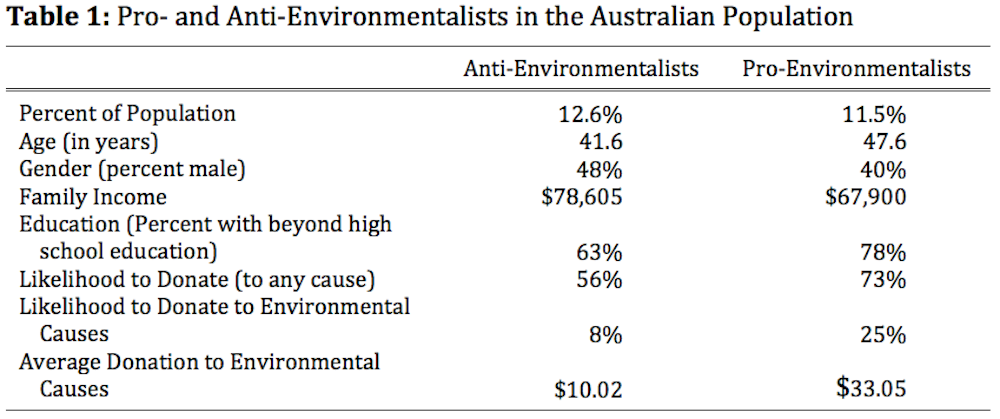
We see immediately some interesting differences and similarities. First, the two groups are approximately the same in terms of representation in the population. The pro-environmentalists are, on average, older, moderately less wealthy, more educated, more likely to give to charities and significantly more likely to give to pro-environment groups. What is interesting, however, is that their strong pro-environmental stance does not lead to overwhelming support for pro-environment civil society organisations. Seventy-five percent of those with very strong pro-environmental preferences do not give anything at all to pro-environmental organisations.

Table 2 outlines the voting likelihood of pro- and anti-environmentalists. This data is from the last Federal election. To keep the interpretation simple, we have shown these as the odds that someone would vote for one party over another given they were in the pro- or anti-environmental category.
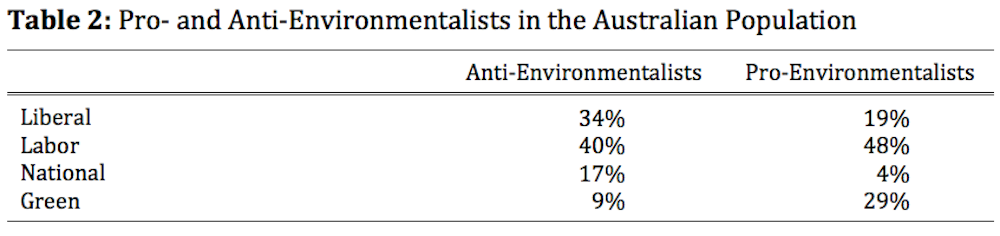
Again, the results are interesting. Being a radical pro-environmentalist implies that you are very unlikely to vote for a Liberal-National candidate and much more so for a Labor or a Green candidate. However, it is not a natural given that a Green candidate would win out over a Labor candidate. In addition, anti-environmentalists are nearly as likely to support a Labor candidate as they are to support a Liberal candidate.

Having a pro-environmental preference means you are unlikely to support a Liberal-National candidate. But an anti-environmental preference is less informative, except in implying that you won’t support a Green candidate.

Perhaps the most interesting aspects of what we find in our results is the degree to which these individuals will trade off their pro- or anti-environmental preferences against other issues of social, political and economic importance. The table below shows the preference scores across 16 categories of issues (see our report for specific definitions and methods). One should interpret the scores on a 0-100 scale and as representing the percentage likelihood that the issue is salient to the individual.
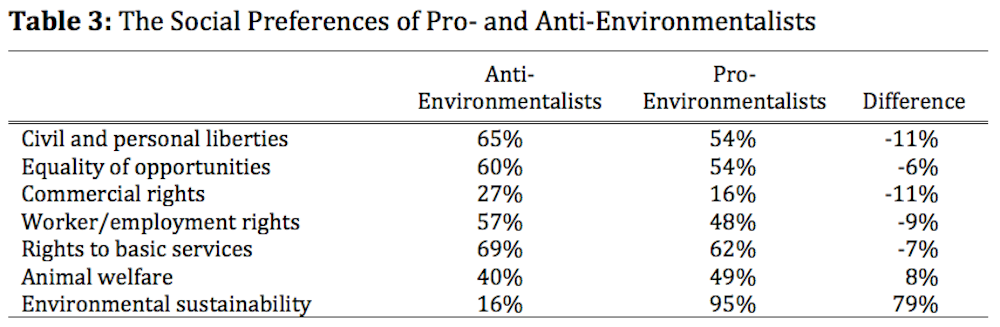
Let’s first examine where there are no real differences – global security, global social and economic well-being, societal social and economic well-being, food and health, minority rights, rights to basic services, equality of opportunities, and animal welfare. It implies that in 10 of the 16 general social, political and economic categories, anti- and pro-environmentalists in Australia are not all that different.

In the one case where a big difference arises – commercial rights – the general concern for this category of issues is small for everyone. All we are seeing is that pro-environmentalists are simply even less concerned with commercial issues.

The three areas where we see big differences that matter are crime and public safety (where pro-environmentalists show significantly less concern), individual economic well-being and civil and personal liberties. Most telling is that pro-environmentalists are willing to sacrifice civil and personal liberties significantly to achieve environmental outcomes.

On the other side of the ledger, anti-environmentalists are much more likely to give up on environmental concerns to improve factors that influence individual economic well-being, such as the daily cost of living.

Our picture of the extremes of the environmental sustainability discussion is not quite so simple as it might otherwise seem. The lunatics on the left are not so different from the lunatics on the right.

But there are differences. These differences are most likely representative of very fundamental philosophical positions on two dimensions that we can phrase as questions. First, to what degree are you willing to give up something you care about for an environmental outcome? Second, to what extent do you believe that we need to constrain the rights of other individuals to an environmental outcome even when they don’t want to be constrained in their choices?

Join the conversation

52 Comments sorted by

  1. Tim Scanlon

    Debunker

    My problem with certain environmental groups, and these aren't necessarily fringe groups either, is that they have a very large anti-science bent.

    I have experienced this personally, know of several other scientists who have experienced this personally, and see it far too often in the media. Environmental groups only use science when it already agrees with their pre-formed ideals, they are not informed by science as they should be. This is all too common, but environmental groups often try to cherry pick or justify their stance with evidence, often distorting reality, which raises ire amongst the well informed and often deceives far too many people.

    report
    1. Chris Owens

      Professional

      In reply to Tim Scanlon

      Another empty generalisation to go with the article.

      In the midst of the Anthropocene, academics on the public purse theorise on the motives of pro environmentalists and have the cheek to label them "the lunatics on the left". We have one of the worst record of mammal species loss in the world over the past 200 years and several more species are on the edge. And the response from governments? Reduce green tape, reduce monitoring of endangered species, slash budgets of threatened species programs, ramp up development, etc.

      Perhaps the authors would like to hear some of my generalisations on the motives of academics advising governments and critique their performance or lack thereof.

      report
    2. Paul Moonie

      PhD student, solar energy

      In reply to Tim Scanlon

      I have similar experiences, Tim. I like a pragmatic approach to solving environmental problems and that can often be met with strong, unscientific resistance.

      But, that's like any interest group to some extent I suppose.

      report
    3. Paul Wittwer

      Orchardist

      In reply to Tim Scanlon

      Tim, I would like for you to post some specific examples of "certain environmental groups, and these aren't necessarily fringe groups either,.... that ... have a very large anti-science bent."

      In my experience environmental groups are acting entirely on environmental science. It is the science alone that has alerted environmentalists to the threats to the natural world. Without science there would be no environmentalists.

      The anti-science bent, as I see it, comes mostly from the conservative side of politics and by extension the capitalist and some of the religious mob. This mob are variously either in denial, delusion or outright deception about the Human race's destruction of the environment which has been discovered and confirmed by science.

      report
    4. Tim Scanlon

      Debunker

      In reply to Paul Wittwer

      Don't get me wrong, I'm not saying that there isn't anti-science rife throughout all parts of government and organisations, I'm just saying that green groups are usually ideology driven, just like other groups, and don't make their opinions based upon facts.
      Some quick examples:
      The Greens and their stance on GM - ideology based and unscientific.
      Greenpeace and their stance on GM - ideology and agenda driven, wholly unscientific.
      The Greens and their claims in the media about climate change, which were actually just weather cycles, well understood and well documented. This was particularly harmful to getting action on climate change because they confounded climate and weather, tried to use scare tactics that were unnecessary and just caused pushback.
      The WWF have been accused of all sorts of different exaggerations and lies whilst chasing donations.

      report
    5. Tim Scanlon

      Debunker

      In reply to Chris Owens

      No need for the negative comment Chris, I'm quite happy to elaborate, and have done so below.

      My point is that green groups, like most organisations, are ideology driven and don't need facts. They cherry pick the facts to suit their world view.

      To quote one liberal party science adviser: "Isn't it great when science agrees with our policies." I'm sure the labor party science adviser has said similar things as well.

      report
    6. Tim Scanlon

      Debunker

      In reply to Paul Wittwer

      I should add that in my experience in agriculture, the environmental groups that are on ground doing the actual work are very much science based, if not doing science to find the best methods.

      My main issue is with the more political and media orientated organisations.

      report
    7. Mark Dudley

      Training & Development Manager

      In reply to Paul Wittwer

      Paul, I would suggest that stating "environmental groups are acting entirely on environmental science" is quite a stretch, even though many would be acting mostly based upon the science. My own experience of joining the Green Party six years ago is that the rank and file (not the political face) ranged from ideologically driven (not necessarily a bad thing) to fundamentalist in outlook. My membership lasted only until my second meeting.

      By default no social policy can be driven ENTIRELY by the science. The degree to which the science is manipulated can determine the effectiveness and indeed the attractiveness of the approach. I agree that much of the awareness of environmental issues is down to the work of "green" groups, but personally I am as comfortable with the ownership of the message coming from the far left as I am of it coming from the far right.

      report
    8. Paul Wittwer

      Orchardist

      In reply to Tim Scanlon

      Tim, I don't accept that the Greens stance on GM is anti-science. It could be said that it is anti-big business and their attempts to control food production, or anti-dangerous side effects of that particular branch of science of which their have been a few instances.
      Science has produced some horrors for life on this planet but you don't need to be anti-science to recognise this fact and advocate a very cautious approach in some areas, GM being only one of many. I would add also that the blame for those horrors should probably be sheeted home to the profit motive rather than the science itself.

      report
    9. John Newton

      Author Journalist

      In reply to Tim Scanlon

      Big call Tim Scanlon - anti-GM is ideology driven? Pretty sure you'd find many scientists around the world to gainsay you there.

      Tell me how the promotion of monocultural farming practices and the use of a seed - Roundup Ready - that is self-defeating in its purpose (super weeds are rendering it useless) and that promotes the profligate use of a chemical that is being proven extremely dangerous - glyphosate - is good science - let along good sense?

      report
    10. Daniel Kinsman

      logged in via Twitter

      In reply to Tim Scanlon

      The Greens are the only party that base their decisions on evidence and science. I watched parliament question time yesterday, the Greens stated their case and cited facts and figures. Meanwhile Labor and Liberal spent the whole time avoiding the issue at hand and taking potshots at each other. If you don't believe me just read the transcript yourself: http://www.openaustralia.org/senate/?id=2012-09-18.82.2

      report
    11. Leo Kerr

      Consultant

      In reply to Tim Scanlon

      Tim, I'm sure Lord Monckton and Alan Jones would completely agree ......

      report
    12. Tim Scanlon

      Debunker

      In reply to Paul Wittwer

      That is incorrect and is not supported by science. I also don't appreciate the illogical statements (appeals to nature, non-sequiters, burden of proof, the slippery slope, etc). None of your statements are rational, but rather emotive, which is exactly what the Greens appeal to with their rhetoric.

      Genetic manipulation of plants and animals has been occurring in agriculture for ~10,000 years. The techniques used in modern breeding have included all sorts of manipulations in the lab, including…

      Read more
    13. Tim Scanlon

      Debunker

      In reply to John Newton

      Appeal to authority statements are also unscientific John.

      How can you be against an entire field of agricultural and genetic science? That is irrational. You can be against the introduction of specific breeds and cultivars that are produced, but to be against the entire concept of breeding is just anti-science.

      Your run-on sentence of anti-agriculture statements is lacking in understanding of farming and science. First off, the term super-weeds is a term you don't seem to understand. Weed…

      Read more
    14. Tim Scanlon

      Debunker

      In reply to Daniel Kinsman

      I'm afraid that is just an example of what I stated previously. They only use the figures that they like. Watch re-runs of Yes Minister to see what I mean about quoting "facts and figures" not necessarily meaning that they are being scientific.

      Don't forget the classic dihydrogenmonoxide scandal. You can come up with all sorts of dangerous sounding figures as long as they have no context. It can sound really bad that we have had several flood events in Queensland in the space of 18 months, but the Greens come out saying it was evidence of climate change, when there was no study linking the two. Weather isn't climate, and climate change would be what drives those events, not the events themselves. Just for one example.

      report
    15. Tim Scanlon

      Debunker

      In reply to Leo Kerr

      Monckton and Jones are the most definitive examples of anti-science there have ever been. I don't think you can compare any group bar the flat earth society to them.

      report
    16. Chris Owens

      Professional

      In reply to Tim Scanlon

      Tim, environmentalists are a broad group with widely differing views. If you vote Labor or Liberal, it doesn't mean you agree with all of their policies. In many cases they have the same policies that the majority disagree with. Some policies of all political parties are populist. Your Greens anti-science generalisation does not reflect the environmental community I know. Most have a tertiary qualification and many incorporating a science discipline.

      Environmentalists could say the agriculture industry has introduced hundreds of environmental weeds (mostly grasses) which are invading virtually every national park and area of native vegetation in Australia displacing indigenous species and resulting in local extinctions and major management issues. However it is unlikely these naive introductions are representative of the current AG industry.

      report
    17. Tim Scanlon

      Debunker

      In reply to Chris Owens

      Most weeds are introduced via backyards and nurseries. So it would be factually incorrect regardless of who said it.

      My point still stands, and I have qualified my statement above. I'm not having a shot at the environmental groups who are involved directly on ground, I've found them to be great (in general). But the political and lobby groups that are in the media daily are not involved on ground. They are largely ignorant of reality. Put another way, I spent several years in Landcare/Catchment groups and never met a Greenpeace, Greens, etc, representative or member. Met heaps of scientists, plenty of government agency bods, few local MPs, but not one of these supposed champions of the environment.

      report
    18. Paul Wittwer

      Orchardist

      In reply to Tim Scanlon

      Tim, you're probably well aware of the excellent work on apricot breeding being done by SARDI of which I am a beneficiary being an orchardist. This is all conventional breeding but which has produced some amazing results. Conventional breeding is slow compared to GM but gives time to discover unintended consequences.
      But even conventional breeding can produce some alarming results as the E. Nitens genetic improvement program has shown in it's poisoning of oyster farms in Tasmania.
      I agree with…

      Read more
    19. Chris Owens

      Professional

      In reply to Tim Scanlon

      I was talking about grasses. The grasses in most cases were introductions for agricultural/livestock industry looking for superior features such as growth characteristics, higher stocking rates, etc. In the north Buffel and gamba are typical examples. See what Catalyst had to say about Gamba: http://www.abc.net.au/catalyst/stories/s1199756.htm

      report
    20. Paul Wittwer

      Orchardist

      In reply to Tim Scanlon

      Tim, the champions of the environment are those that lobby governments. The environmental movement has learnt, belatedly, that the tactics of big business work best in that direct political lobbying achieves far more than protests and 'on ground' activism.
      This in no way means that the 'champions of the environment' are out of touch with reality or that demonstrations are redundant.

      report
    21. John Newton

      Author Journalist

      In reply to Tim Scanlon

      Firstly, is productivity all we're after with food systems? Secondly super-weed is a simple - lay - term for - a weed resistant to an overused herbicide.

      and thirdly, please read this http://tinyurl.com/98zot94

      report
    22. Tim Scanlon

      Debunker

      In reply to Paul Wittwer

      Actually, conventional breeding doesn't really test the same way GM does. Think about how many fruits and nuts cause allergic reactions in the wider population, they weren't tested to make sure they were safe.

      And the Greens are not saying that at all. They do not want any GM, at all, ever! The opposition also has nothing to do with the "profit motive" that is a red herring thrown about all the time. No one stops Pfizer or Bayer from making a profit on their drugs, or from selling drugs with harsh…

      Read more
    23. Tim Scanlon

      Debunker

      In reply to Chris Owens

      I agree that there are some examples, but the vast majority of weeds are being introduced for gardens and nurseries. I forget the figure, but it is a huge number annually and staggering over the past decade.

      Also, a lot of the introduced grasses (e.g. subclover) have been specifically bred for Australian conditions, so they are only weeds in the context of where they occur rather than being a foreign species.

      report
    24. John Harland

      bicycle technician

      In reply to Tim Scanlon

      "No one stops Pfizer or Bayer from making a profit on their drugs, or from selling drugs with harsh side effects that they sell treatments for the side effects"

      Well actually, there are many who wish they could prevent those companies selling poorly-researched and dangerous pharmaceuticals..

      Jphn

      report
    25. Tim Scanlon

      Debunker

      In reply to John Newton

      John, an article in an online newspaper is not peer reviewed science. But of course, peer reviewed science has shown various GM products to be safe.

      Secondly, super-weed was being misused as a term. Resistance does not arise from overuse, that is just plain wrong. Resistance arises when applications don't result in 100% kill of weeds. The survivors usually have some immunity which is then passed on and thus selection pressures can result in those survivors passing on their genes.

      Finally, are…

      Read more
    26. John Newton

      Author Journalist

      In reply to Tim Scanlon

      A little ingenuous Tim - the article in the Nouvelle Observateur points to an article in "Food and Chemical Toxicology" which is peer-reviewed.

      And as for a growing population, please tell me how gm helps feed them -assuming that there isn't enough food to feed the world already - distribution is the problem, not volume.

      And none of the problems you have mentioned - salinity, acidity et cetera asre hrlped by allowing a farmer to pour shit loads of glyphosate on his crops.

      The biotechs have been trumpeting their ability to feed the world for years - and come up with nothing. Good farming practices will solve those problems, putting back into the soil, not stripping it.

      One of my standard practices when dealing with adent supporters of gm is to put their names into a search engine next to words like Monsanto and Syngenta - and there you are. Case closed. No point in continuing any factual discussion

      report
    27. Paul Wittwer

      Orchardist

      In reply to John Newton

      John Newton, well done! There I was wondering why this guy wasn't being reasonable and was calling me irrational and emotional. I agree, no point continuing any factual discussion. Quite a relief thanks.

      report
    28. Tim Scanlon

      Debunker

      In reply to John Newton

      Your last statement is nothing more than a pathetic ad-homenim, especially considering I have never worked for any chemical companies. Please retract your statement and apologise.

      John, you assume that RR and Bt don't help with rotation management and productivity. You also assume that they don't allow for management of those issues. But mostly you are assuming that there is no current GM work looking into salt, drought, frost, etc, tolerance. Please don't assume this, because they are already…

      Read more
    29. John Harland

      bicycle technician

      In reply to Tim Scanlon

      Firstly, I support Tim's request for an apology.

      His views are consistent with those of many agricultural scientists. I disagree with some of his ideas but that does not make him an agent of multinational agribusiness.

      That said, the replenishment of soils can be done in different ways. Some involve mining and a lot of energy use, others involve more recycling. The present-day economics of each relative to the other should not be the end of the discussion. Economics is a social and political construct, not a physical absolute or a measure of th ecological health of agricultural systems.

      As well, there is a clear difference between a classical free market in agricultural supplies and the creation of cycles of dependency by companies with majority control of segments of the market

      report
    30. Tim Scanlon

      Debunker

      In reply to John Harland

      I'd like to see recycling of effluent as a fertiliser. Early work with biosolids here in WA is showing they aren't up to scratch. Also the economics of it just doesn't work unless you are running a horticulture farm right next door to the ponds.

      Someone linked me to some work being done in SA that looks promising. I'm still not convinced that they have dealt with the heavy metal contamination, but creating a dry granule fertiliser is what needs to happen. If it can't integrate with modern machinery it just won't happen. Spreaders are costly to run when you are spreading wet product, and covering the land several times to fertilise and seed is not feasible in large operations.

      report
    31. John Harland

      bicycle technician

      In reply to Tim Scanlon

      There has been a deal of development of separation techniques over recent decades. It may become economical to separate out nutrients in forms that are east to transport and easy to apply with availble technologies. Also to remove contaminants and even, perhaps, to reecycle them.

      Again, economics are tied in with politics and both development of techniques and adjusting the relative economies of each are politically feasible.

      It is a goal worth keeping our eye on.

      report
    32. John Newton

      Author Journalist

      In reply to Tim Scanlon

      My apology submitted - but what you call modern agriculture is destroying the planet. There are better ways.

      report
    33. John Harland

      bicycle technician

      In reply to John Newton

      Is it just "modern agriculture", or is it population and economic pressures that require thrashing the land to a degree that leaves many farmers and agricultural scientists, as well as greenies, uneasy?

      report
    34. Tim Scanlon

      Debunker

      In reply to John Harland

      Population and economy both, pretty much one in the same. I disagree that agriculture is thrashing the land, because that would imply that after 10,000yrs we'd be going backward, which we aren't. Climate change has halted our progress, such that our advances are about equal with declines due to hotter and drier conditions.

      report
    35. Marion Brook

      BA, Grad Dip Ed (student)

      In reply to Paul Wittwer

      While I'm not prepared to comment on Greenpeace's overall science/anti-science bent, you can't get much more anti-science than this act of wilful ignorance.

      “CSIRO GM crop attacked by Greenpeace had "negligible" risk.”
      http://www.lifescientist.com.au/article/393593/csiro_gm_crop_attacked_by_greenpeace_had_negligible_risk/

      Greenpeace broke into a trial plot of GM wheat and slashed the lot. It was a trial plot people – science in action. Whether you're for or against GM, you'd have to agree; that was an act of pure anti-science ideology.

      report
  2. Dale Bloom

    Analyst

    What is the purpose of this article? It is completely out of date.

    There are no longer pro-environmentalists or anti-environmentalists. Any company or major organisation operating in Australia is required to undertake and environmental risk assessment. Here is an example.

    http://www.gbrmpa.gov.au/our-partners/australian-government-agencies/environmental-management-of-defence-activities

    There are no pro-environmentalists or anti-environmentalists. There are only those who carry out a thorough environmental risk assessment, identifying all possible risks and applying effective control measures, and those who don’t.

    report
    1. Dale Bloom

      Analyst

      In reply to Dale Bloom

      There seems to be a lot of deleted comments. I didn’t get to see them, but perhaps the matter needs further explanation.

      A debate over who is pro or anti environment is rather like a debate about who is pro or anti murder. There is no debate, as murder is illegal.

      Legally, no one can be anti-environment either, because of the necessity to carry out environmental risk assessments.

      The focus should now be on how well those environmental risk assessments are being carried out.

      report
  3. Comment removed by moderator.

    1. In reply to Peter Lang

      Comment removed by moderator.

    2. In reply to Peter Lang

      Comment removed by moderator.

  4. Comment removed by moderator.

  5. Ken Fabian

    Mr

    It's been a politically expedient choice of mainstream politics to frame issues like climate, habitat loss and sustainability as driven by an extreme fringe. While attention is focused, deliberately, on the most irrational and extreme voices attention is diverted from the appalling lack of rational policy from mainstream politics. When problems like climate are treated by the mainstream as problems to dodge rather than face, 'suitable' policies developed to achieve the least that can be gotten away with rather than most that is possible, and, in the wake of the resultant inadequate and ineffective compromises, the extremists are blamed for the failures - that's a failure of mainstream politics, not the doing a minority of extremists.

    report
    1. Leo Kerr

      Consultant

      In reply to Michael Shand

      well obviously the Lunatic part of the article is in the readership such as myself :)

      report
  6. Andrew Smith

    Education Consultant at Australian & International Education Centre

    Related issue not investigated is the phenomenon of "greenwashing" where fringe groups e.g. some racists in USA have had a strategy of co opting environmentalists to oppose immigration, population growth etc.. but based on misinformation and personal beliefs.

    The Federation of Americans for Immigration Reform FAIR have been one group doing this for decades now with sympathisers in Australia too who are not very honest about their motives.....

    report
  7. John Harland

    bicycle technician

    It seems to me that most people look at the extremists of either side and navigate a course between them. Using them as channel marker
    The data on tradeoffs for civil rights and other values is highly suspect in that it is highly dependent on the precise wording of the questions.

    With all due respect, Tim, I think your comment about all groups cherry-picking data is spot on. Your specific comments about Green groups, by contrast, seem to reflect your specific professional experience. In that, greenies will tend to be the outsiders and the people you perceive as pragmatic and balanced are likely to be your colleagues and clients. Hardly a fair comparison.

    report