
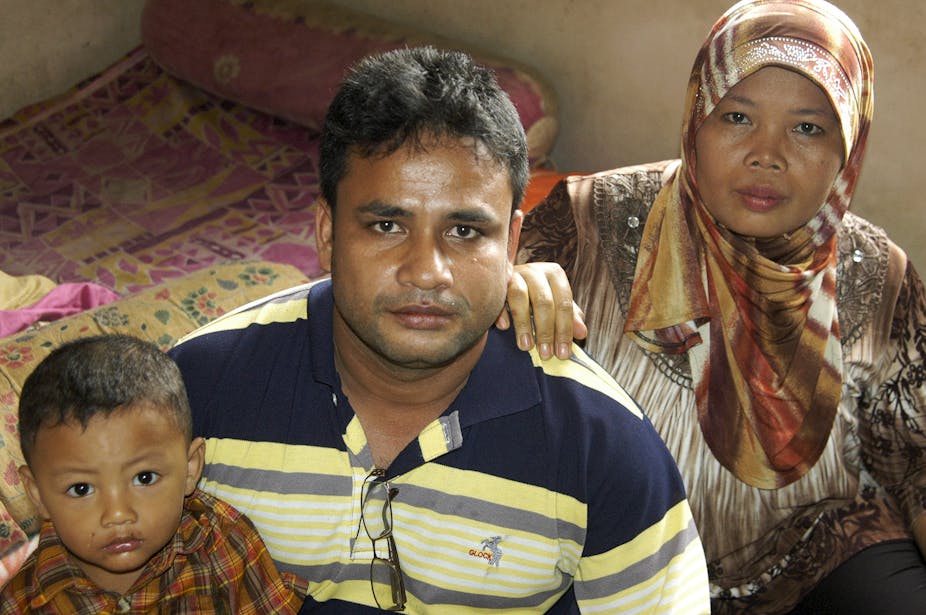
There’s a knock on the door. It’s late, and it has been a wild and stormy night. You wonder who could possibly be outside in this weather.
Opening the door you find a young man collapsed on your doorstep, soaked and shivering. He wants to come inside, where it is warm and dry. It is only now that you remember that you signed up for a local safe house program, where you agreed to take people in distress into your home.
But it is late, and you know that your partner will not be happy to find a stranger on the couch in the morning.
So you tell the man to wait. You make a call to the house across the road, which isn’t a registered safe house but always full of people like the man on your doorstep. You tell them that if they take the man in tonight, they can send over two people in the morning.
The solution strikes you as ingenious – now you are looking after two people, not just one, and your partner will be more comfortable with people you know, at least by sight.
Of course, there’s no way of guaranteeing how the man on your doorstep will be treated in the house across the road.
In exactly the same way, there is no way that Australia can guarantee that asylum seekers to be transferred to Malaysia under an amended Migration Act will be treated with “dignity”, as promised by the Malaysian Minister of Home Affairs, Dato’ Seri Hishammuddin bin Tun Hussein last year.
Despite those assurances, and vague commitments in the operational guidelines that “transferees” will “enjoy an adequate standard of treatment”, a swap deal is not and never has been about the well-being of the “transferees”.
This is clear when we consider that Malaysia is not a signatory to the UN Refugee Convention, that Malaysia has a record of human rights abuse, and that refugees awaiting resettlement in Malaysia are routinely subjected to detention, arrest and harassment from both state agents and a volunteer citizen’s police force.
The only way that this agreement can be justified is through the logic of utilitarianism. Famously, British philosopher John Stuart Mill argued that the role of the state was to provide the greatest good to the greatest number.
Under that logic, the idea of accepting 4,000 extra refugees over the next four years in exchange for 800 – raising Australia’s annual intake to 14,750 – is simply good arithmetic. The 800 are to be sacrificed for the greater good.
Yet the language of Julia Gillard and Christopher Bowen has not been that of utilitarianism. They suspect, rightly I imagine, that the idea of sacrificing some people for the benefit of others, is unpalatable to the Australian public.
Instead they have borrowed their language from an entirely different tradition – that of human rights. Last year, they repeatedly insisted that “transferees” will be treated with “dignity and respect in accordance with human rights standards”.
The modern conception of human rights can be traced back to the German philosopher Immanuel Kant. He argued that we should treat others as ends in themselves and not as a means to an end. This is the foundation of our current understanding of each individual person as a unique, inviolable being.
However, treating others as a means to an end is precisely what reviving the swap deal will do. The “transferees” are being used as a means to the dual ends of increasing Australia’s intake of (other) refugees, and of deterring people smugglers.
In doing so, we are outsourcing our moral and legal obligations to the “transferees”. Morally speaking, there is no denying the fact that they will have knocked on our door seeking asylum, and we will have turned them away.
It is no answer to say to the man on your doorstep that you are willing to shelter two others, but that in return he must be sacrificed. It is equally no answer to deny someone shelter in order to “send a message” to someone else.
If we are to take human rights seriously, there is no room to think in terms of aggregate positive outcomes. Each human being is unique, and each appeal for help deserves to be heard.
If the government is unwilling to do this, then it must stop trying to disguise this utilitarian swap deal with human rights rhetoric. That is why criticisms of the deal which have focused on the insufficiency of human rights safeguards in Malaysia do not go far enough.
The key moral question for Australia now, as it was in mid-2011, is whether or not we are willing to participate in the sacrificial logic of utilitarianism.
Dirk Baltzly
A/Prof. in Philosophy
Outstanding analysis. The only thing I'd add is that the same reasoning applies to the harsh treatment that has accompanied on-shore processing. "Mandatory detention" is not really about protecting the public. It is about deterring other asylum seekers. It is a euphemism for imprisonment and the point of imprisoning people in this way is the same as in the criminal justice system. It is meant as a deterrent.
It may be morally permissible to imprison convicted criminals (partly) as a deterrent to others. It may be that the commission of a crime temporarily removes a person's right not to be used as a means in this way. But asylum seekers are not criminals. Hence to imprison them as a means to deter others from coming here -- even where this deterrent effect is intended to discourage would-be asylum seekers from placing themselves in danger -- is immoral.
Marilyn Shepherd
pensioner
I would call it a crime against humanity.
David Boxall
logged in via Facebook
Dirk Baltzly: ""Mandatory detention" is not really about protecting the public. It is about deterring other asylum seekers."
Deterring asylum seekers (more accurately; stopping the boats) is about votes. Both Labor and the Coalition evidently think that the issue uppermost in the public mind is "border security". It's really up to the electorate to convince them otherwise. We should blame, not the government, but ourselves.
Gary Murphy
Independent Thinker
I think mandatory detention is more to keep people where they can be found and deported if their claims are rejected.
I think the concern in most peoples minds is the numbers - we are looking at over 1000 per month now - and increasing. If current trends continue - it could be 20000 next year? This is not insignificant.
And I think the left really need to take a look at the political realities of the situation. If the current government cannot find a solution - then we will have an Abbot…
Read moreDavid Boxall
logged in via Facebook
We have the right to decide who enters this country. For me, it boils down to what we're entitled to do in support of that right. If we're entitled to do whatever it takes, then the answer is clear; sink the boats and leave any survivors to their fates.
Read moreI see no solution to the refugee problem. Nothing, at least, that we're in a position to do. The way we've been going doesn't address the issue, but it has won elections.
Refugees are a global issue. Countries like Australia, on the receiving end…
Gary Murphy
Independent Thinker
All true.
Not sure exactly what you mean by the 'monstrous legacy of the Howard years'. Do you mean the demonisation of asylum seekers? Do you mean TPV's? Do you mean privatising the detention centres and preventing access?
Basically - the left have to choose their poison. Either support the Labour policy - or you will get the coalition policy (and you will ensure the defeat of Labour next year - and I'm not sure - are the Coalition any chance of gaining control of the Senate with a landslide…
Read moreDavid Boxall
logged in via Facebook
Gary Murphy: "Not sure exactly what you mean by the 'monstrous legacy of the Howard years'." I mean the Diabolic extreme to which he took refugee policy. He managed to so subvert the situation that our perversion is difficult to cure.
Gary Murphy: "Either support the Labour policy - or you will get the coalition policy ...". Are you sure those are the only options?
Gary Murphy: "To just out-of-hand dismiss utilitarianism is silly." Is what we're doing utilitarianism? I think it's far nastier than that.
Gary Murphy: "Australians are very level-headed and more than a bit cynical." John Howard saw the truth about us and exploited it. It won him elections that could not have been won any other way.
Gary Murphy
Independent Thinker
The only other option I have heard canvassed is to let them fly here. Can you think of any others?
I think the real concern of the electorate is the numbers. They seem to be increasing rapidly to the point where we will not be able to cope with them. I think letting them fly here will result in huge numbers.
"What we're doing"? Do you mean the Malaysia solution? TPV's? Could you elaborate please?
If you mean the politicisation of the issue then I fully agree with you. And not resolving the issue will see this continue.
I think you are misinterpreting Howard's 2001 election victory. It resulted from a combination of 9/11 and asylum seekers. Howard was effective - not because Australians are racist (which I don't think they really are) - but because he invoked our fear.
BTW Howard only ever won by default - Australians never liked him.
David Boxall
logged in via Facebook
Gary Murphy: "The only other option I have heard canvassed is to let them fly here. Can you think of any others?" Are you trolling?
Read moreThere's a political party called "The Greens". Their policy is mentioned elsewhere in these comments.
As far as I know, the vast majority of asylum seekers do arrive by air. The "stop the boats" mantra is pure politics. If politics can be considered in any way pure.
It has been suggested (http://www.abc.net.au/7.30/content/2011/s3313602.htm) that, if we're really…
Gary Murphy
Independent Thinker
Trolling? I thought I was just discussing the issue. I was under the impression that that is what this forum was for. You started with the flippant "Are you sure those are the only options?" and your other comment was a little ambiguous.
I found the Greens policy:
http://greens.org.au/policies/care-for-people/immigration-and-refugees
No mandatory detention and asylum seekers able to move freely through the community and find work.
Now it is my opinion (feel free to ignore it or rebut…
Read moreDavid Boxall
logged in via Facebook
Gary Murphy: "Trolling? I thought I was just discussing the issue." Questions that are answered elsewhere on the page where they're posted raise suspicions of trolling. That's why I asked.
Gary Murphy: "... very large numbers of people flying to Australia and seeking asylum ...". Assuming the situation remains as it was the last time I checked, the number of asylum seeker flying here is already far larger than those arriving by boat. If memory serves, more than ten times larger.
Gary Murphy…
Read morePeter Evans
Retired
I agree that is morally wrong to exchange refugees. You need look no further than the point that we are in breach of a solemn undertaking that we entered into. It would be far better using, this analogy, if we went across the road and brought them to our house when we know their life is in danger and that they have chosen to flee that danger. Much as those who helped people affected by the 2011 floods did.
But if I might comment on the debate that has occured on the legislation that was defeated. I find it equally morally wrong that we grab the person and tow them back across the road (where it is safe to do so) in order to create a deterennt. Until someone can identify a difference in the impact of these two policies or in their moral foundation then I fail to see how someone expousing the tow them back approach can take the moral high ground.
Marilyn Shepherd
pensioner
And why our worthless trash media are incapable of thinking about what was actually planned as they prattle about this non-existent legal impasse is beyond me.
The pollies are prattling and babbling like gibber monkeys picking their fleas but the law has not changed one iota.
John Coochey
Mr
I find this article verging on the incoherent. Afghan asylum shopper for example cannot get on a ship to Australia without going through a third country which is not controlled by the Taliban because Afghanistan has no coast! Any asylum shopper who comes to Australia, with the exception of those coming from Irian Jaya have had to have come through or past others, many who have signed the UN Conventions, to get to Australia. There are millions of displace persons in the World how many should we accept and which ones?
Marilyn Shepherd
pensioner
So John, now you bring your lazy racist whine over to here where the grown ups write and think.
How about this then - I am beaten by Freddie, so I come and beat you in retribution. Is that the right thing to do?
In this case 90 refugees drowned last week because the government send messages but no call for a rescue for people in trouble for 41 hours, they did not even give the Indonesians the number to call the people on the vessel.
Now before you whine about Indonesian waters, the only…
Read moreStiofán Mac Suibhne
Contrarian / Epistemologist
I agree the article is incoherent. Gillard should call a referendum. Let the people decide between Naru, Naru & Malaysia, and the Greens open slather policy or business as usual / death in the brine. The Greens/LibNats from different doctrinal positions worried rather have boats sinking than only take UNHCR nominated refugees. What a ghastly business Australian politics is.
Bala Krishna
logged in via Twitter
I writing this in response to the absurdity of arguments put forward by some leaft leaning intelluctualls in australia.
Firstly branding people as racist when ask effective border protection is dishonest argument.
If you have to welcome everybody , who wish to come to australia as a rufugee .Sooner or later you have to dismantle visa system .It is allmost like open borders.
To put things in perpective,majority of ppl coming form afganistan are shias make up 20% of the population .They say…
Read moreJohn Coochey
Mr
Actually under SOLAS which is designed primarily for merchant seamen Australia is not obliged to patrol the World;s oceans to rescue people any more than it was responsible for the hundred odd people who drowned in Bangladesh recently. If there is a ship in the area it is obliged to give what assistance it can, for example it might be putting it self at unacceptable risk in bad weather, think of the Sydney Hobart a few years ago. It appears most of those drowned in the recent sinking were Pakistani, if we are going to have open borders the question remains how many and which ones? Estimates of current refugees range from four and a half million upwards
Patrick Stokes
Lecturer in Philosophy at Deakin University
The whole "they could just settle in other countries" argument is basically a figleaf for "We don't want to admit that being rich places more responsibility on us than on poorer countries. Part of our job as moral beings is to help overcome the arbitrary unfairnesses of life, not entrench them.
There is, however, a kernel of truth in your post: there are a number of displaced people around the world, and the question is, indeed, how we redistribute them across the developed world. I find it hard to believe that our current intake level meets that obligation.
Philip Dowling
IT teacher
So you are a philosopher. I find your opinions not more logically or coherently argued than that of my teenage daughters.
Does this mean that I can apply for advanced standing for them at your university? Just asking?
Diana Brown
Parent; language student
Thank you so much Mr Dowling for the first real laugh of this chilly July morning. I expect your teenage daughters are vastly more logical, coherent and focused than many, many inflexible adults. My teenage daughter certainly is.
Still smiling.
Patrick Stokes
Lecturer in Philosophy at Deakin University
You're welcome in my philosophy class any time, Philip. I look forward to explaining the difference between argument and assertion, pointing out why simply pointing to anecdotal evidence without further explanation isn't an argument, and teaching you how to spot uninterrogated assumptions.
John Coochey
Mr
Yes but how many countries and how long can they settle there and still be legit refugees. There was one on the media who had arrived here after settling in the US and another Afghan refused who had lived in Iran, Greece, the UK Ireland and tried for Canada before becoming a boat arrival. That is not to mention Captain Amed or whatever he was called who successfully duped immigration. If he can so can anyone else. If you once lived in a war zone does that permit you to travel around the world until you get the best deal on offer and then cry "refugee"?
Patrick Stokes
Lecturer in Philosophy at Deakin University
Well, in the case you mention, did he get citizenship/PR in any of those countries? If so it seems pretty clear-cut. If not, then yes I guess he *is* entitled to bounce around until someone takes him.
Besides which, you can't just shut down the whole system just because of the inevitable abuses. We don't shut down public transport because of fare-evaders. There will no doubt be cases like the one you describe, but I'm not sure that tells against the validity of the program as a whole. (I read…
Read moreJohn Coochey
Mr
That is why a central aspect of asylum law was codified in the Dublin Convention also known as Dublin two that you must apply for asylum in or from the first country of safe haven. Just to clarify something, are you advocating open borders to anyone who can show some element of a refugee? There are millions out there
Patrick Stokes
Lecturer in Philosophy at Deakin University
I'm not really sure what 'open borders' would mean here; certainly I'm not saying DIAC should shut up shop and allow unregulated movement of people across boarders. But something like less than 2% of the refugee population is resettled each year; I think we can clearly do significantly better than that, and if we want to stop people risking their lives in boats we need to demonstrate to them that resettlement is a far more likely outcome than it currently seems to be.
To add to what I was saying…
Read moreAlex Malone
logged in via Facebook
I agree with the conclusion but not the argument. You can't dismiss utilitarianism so lightly. How much effort should we expend keeping cancer patients alive? Can we dismiss the point as irrelevant, whether five others die of heart failure in the mean time? The same logic can, and in a mature society must, be applied to refugees.
If the Government's proposal was a sincere balance between the rights of boat people versus those of Malaysian-housed refugees, then we would have a utilitarian dilemma. But we don't. The two have nothing to do with one another. Taking 800 boat people does not prevent us taking 4000 from Malaysia any more than sending them back compels us to.
Steve Hindle
logged in via email @bigpond.com
The soaked and shivering man has nowhere else to go, he needs to live in your house. He also has many friends, they are also soaked and shivering.
There is no moral high ground.
Cheryl Howard
writer
Evidence for there being no moral high ground? Yes there are many who are soaked and shivering, but there are many more who have comfortable dry houses. Sharing and caring is what humans do when they have not been indoctrinated with messages of scarcity.
Steve Hindle
logged in via email @bigpond.com
The present situation is basically onshore processing by default. This is the preferred policy of the Greens but it is leading to mass drownings. This outcome was widely predicted and as such it can be called immoral.
The offshore processing (whether Malaysia or Nauru) is designed to punish and frustrate, not to help people in need. Again it could not be called a morally righteous policy.
The last option could on one level qualify as being on the moral high ground, however the outcome is again…
Read moreCheryl Howard
writer
It is useful to keep in mind that there is never a single cause for any event. Many factors link together to cause an outcome. The conditions at sea at present and overcrowding of unseaworthy boats are two contributing factors to the tragic drownings.
There is also a rush to get as many asylum seekers onto boats while there is onshore processing. The UN creates conventions for the treatment of refugees so that there are guidelines for fair and moral treatment of people in distress, and not ad hoc arrangements made according to electoral temperaments.
I really don't know where the tens of millions are coming from. Most people prefer to remain in their own countries in their own culture. Generally people don't seek an alternative home unless the conditions at home are severe.
Our enviroment could support more people if managed better.
John Coochey
Mr
There is an interesting letter in the Canberra Times this morning by two people who helped Vietnamese refugees in the past. They point out correctly that the new wave of asylum seekers are different. Whole boatloads of adult males who have presumably left their women and children in the dangers zone where presumably they will be now in even greater danger.
Cheryl Howard
writer
Yes, of course, the new wave of asylum seekers are different. Because the situation and times are different to Vietnam.
We live in the present, in the current conditions.
People develop different strategies according to the different hostilities they are confronted with.
John Coochey
Mr
But that does not explain the absence of wives and children unless they are already safely ensconced perhaps not as comfortably as they would like to become accustomed to.
David Boxall
logged in via Facebook
Steve Hindle: "The present situation is basically onshore processing by default. This is the preferred policy of the Greens but it is leading to mass drownings. This outcome was widely predicted and as such it can be called immoral."
Read moreIs there a moral way for Australia to prevent the drownings? There are worse things than dying. In the name of "Border Protection", we impose some of them on asylum seekers.
Australia is not in a position to prevent people smuggling. Our only moral option is to give…
Steve Hindle
logged in via email @bigpond.com
I was also surprised at the initial reports that the entire boat load of passengers were male. I have seen little further reporting or analysis as to why.
It is possible that because phone communications are so much better that the asylum seekers are far better informed as to how to plan their move to Australia.
It would be logical to send a male from each family to make the long journey in small groups to Australia and then use Australia's family reunion system to bring the rest of the family out.
I think the Vietnamese refugees were in more immanent danger and certainly did not have the amount of communications for feed back that is now possible.
Steve Hindle
logged in via email @bigpond.com
"Is there a moral way for Australia to prevent the drownings?"
No, I don't think there is, that was my point.
We can and should take larger numbers of refugees through the UNHCR, but it will never be enough to satisfy the long term demand.
"Australia is not in a position to prevent people smuggling."
Read moreAustralia has prevented people smuggling in the past by the use of cruel methods such as TPVs and offshore processing. (It is likely that cruelty, whether introduced by Labor or Liberal, will…
Philip Dowling
IT teacher
I find this article so simplistic and naive that I find it difficult to believe that it could be written by anybody other than a first year University student.
Having answered my door to many people, I have been asked to help many worthy causes and many more less worthy causes.
Similarly I have been badgered and cajoled in the streets for a cigarette, a couple of dollars, etc.
I wonder how Andre Dao responds to all these requests?
How does he respond in particular to those who have been revealed in the media to be part of an organised begging industry. which is highy organised and whose participants often make more money than those who give money to them?
Patrick Stokes
Lecturer in Philosophy at Deakin University
I'd imagine he responds the way philosophers who have talked about the moral primacy of the encounter with other people (Levinas, Løgstrup etc.) have suggested we should: in an open, trusting (which doesn't imply naive or easily duped) and solicitious way. Why, how do you respond to others in need? By calculating how much they 'deserve' your help before you respond?
Philip Dowling
IT teacher
To circumscribe and simplify a situation in this fashion has been shown to have often fatal consequences as is regularly reported in the press.
http://www.news.com.au/national/good-samaritan-killed-in-crash-at-warwick-farm/story-e6frfkvr-1226398160244
http://www.southernhighlandnews.com.au/news/local/news/general/highway-truck-tragedy-drivers-case-adjourned/2548863.aspx
Your suggested approach means that those who suffer in silence will be ignored.
Patrick Stokes
Lecturer in Philosophy at Deakin University
Thanks for the reply Philip. You make two points here; allow me to respond to them in turn.
1. I'm really unclear as to what you think flows from the examples of Good Samaritans being killed in accidents, let alone how it applies to the asylum seeker intake. Helping someone involves a degree of risk - as does every other form of activity. Risks need to be assessed and dealt with, but that does nothing to reduce the moral validity of the imperative to help. But say we're being completely consequentialist…
Read morePhilip Dowling
IT teacher
1. Risk assessment had not previously been mentioned as a concept in this discussion. I certainly consider that it should be a key concept in this discussion, along with others. To argue that only a minority of good samaritans are killed is an interesting point. However,I do not consider myself merely a statistic, nor do I consider my family a mere statistic.
Read moreI recall a university student who reached out to a dysfunctional person. This act of compassion led to the shotgun slaying of herself and…
Patrick Stokes
Lecturer in Philosophy at Deakin University
1. "Risk assessment had not previously been mentioned as a concept in this discussion. I certainly consider that it should be a key concept in this discussion, along with others."
- I'm not aware that anyone, even those of us who oppose mandatory detention, is arguing that we should perform no background checks on people. Where else do you see 'risk' coming into the equation here?
"To argue that only a minority of good samaritans are killed is an interesting point. However,I do not consider…
Read morePhilip Dowling
IT teacher
Both Mo Ibrahim and Bill Gates had extensive experience in dealing with the real world before they started applying their skills to philanthropy. They both also had shown an ability to analyse and respond successfully to complex situations.
Read moreNo doubt they had also been approached and so had "vision" of many worthy causes.
They both realised that most humanitarian efforts are basically symptomatic while underlying causes need to be carefully selected and addressed. Further they both realised that…
Ned Young
management consultant
Unfortunately, the author's aim is trashed by his flimsy analogy. I have faced precisely this situation on my own front door step, more than once. And I would wager that just about everybody here has well. Here is what I did.
1. Once I called Mission Beat. 15 minutes later, one of their vans arrived with three Mission Australia personnel, one of whom with a first aid kit. I have no idea where they took the man. But I do recall my neighbours, friends, and relatives congratulating my actions. According…
Read moreFred Pribac
logged in via email @internode.on.net
Well done to the author Mr Dao in trying to point out the political and ethical contortions our political leaders are resorting to.
Let's overcome our unbecoming cowardice and instead act as a responsible nation by processing asylum seekers on shore!
Cheryl Howard
writer
Last century Abraham Maslow theorised about hierarchies of need. He conjectured that when basic needs of physical well-being are satisfied, human beings can progress to become self-actualised. He also was aware that very few become self-actualised. Some because circumstances are extremely adverse and others, because they are unwilling to give up the comforts at one level in order to move to a higher level.
Let's be realistic. The unfortunate majority of Australians want to bask in isolated comfort. They do not want to know that people in other parts of the world suffer war and tyranny and sometimes have to flee for their lives.
And so we are all demeaned by the endless illogical arguments and irrational attempts at rationalisation.
When people cannot give because they are afraid that they will have less, they make up stories about those who need help in order to salve their conscience, which is there somewhere, hence the noise they make in order to try to silence it.
Stiofán Mac Suibhne
Contrarian / Epistemologist
I think you have mis-remembered your Maslow's hierarchy. He was studying the top 1% of healthy affluent college students as he did not want to produce "a psychology of cripples'. The theory looks at process permitted in fortunate circumstances. It's quite incorrect to talk about 'giving up comforts at one level in order to move to a higher level'. The first 4 levels are deemed basic needs, they need to be met ongoingly. Only those that have 'metamotivation' once basic needs at met (the deficeincy needs) go on to be driven by 'being needs' and move to being driven by high culture / self-actualisation and so forth.
Philip Dowling
IT teacher
Cheryl,
I am so pleased that you have managed to familiarise yourself with the theory of Maslow.
You state that "They do not want to know that people in other parts of the world suffer war and tyranny and sometimes have to flee for their lives."
I was wondering where you obtained that opinion? Do you have any evidence?
In my extended family, the general approach has been to advance rather than to flee in such situations.
Cowardice is not a quality I would like to see become a new virtue in our society.
I note that Australian defence forces have a recruitment problem. Some demographics have a very low representation.
Cheryl Howard
writer
This site is useful for getting a broader, up-to-date view of the practicalities of Maslow's theory:
http://www.simplypsychology.org/maslow.html
Cheryl Howard
writer
Human beings are equipped with both flight and fight responses, because different responses are required in different situations.
Persecution cannot be fought if all the persecuted are killed. In that situation it would be allowing the persecutors to win. Fleeing a no-win situation enables a person, if an hospitable refuge country can be found, to live and fight another day.
Philip Dowling
IT teacher
It is lucky that my father and his brothers who trained with broomsticks did not have this approach in World War II, or you would not be able to spout such arrant nonsense.
Cheryl Howard
writer
So you are saying that they should stay and fight for the peace and stability of their country, but you can't use the World War II example as comparison, because it is not World War II conditions.
In any war there has to be strategies. Sometimes retreat is necessary because the alternative is certain destruction, which is not good strategy. There are many different ways in which to fight life's battles and they don't all involve direct confrontation.
John Coochey
Mr
Yes but non of them are coming directly from persecution to Australia, with the possible exception of Tamils who in any case could go back to Tamil Nadu their ancestral homeland only forty miles away they could virtually walk there at low tide.The have all found safe haven before they get here, think of Captain Amed who was running businesses in Malaysia but still got residency
Patrick Stokes
Lecturer in Philosophy at Deakin University
Their immediate needs may be the responsibility of the first safe country they can get to, but their long-term resettlement needs are the problem of the entire global community. They become part of the pool of stateless persons for whom homes need to be found. And rich countries, being better able to absorb refugees, have an obligation to take a larger share of that burden. So yes, there should be a presumption in favour of resettlement in Australia, Canada, NZ, the US, UK, France, Germany, Norway etc.
John Coochey
Mr
Yes that is why there must be orderly processing not first to reach an industrialized country getting priority. A friend of mine, a couple of years ago was sent to eastern Nepal to process people who ten years ago had been expelled from Bhutan under an ethnic cleansing program, pressure had been put on Australia to take some because the UNHCR did not like people being in camps for more than ten years.
Patrick Stokes
Lecturer in Philosophy at Deakin University
No argument there, but then if people are sitting in camps for ten years, and if people are prepared to risk *death* making a notoriously dangerous sea crossing, then the international community is clearly not doing anywhere near enough to process and resettle people fast enough. And that, whether we like it or not, comes down to size of the humanitarian intake that countries like Australia accept.
I was thinking over the weekend: surely someone, somewhere has done the maths on this? It shouldn…
Read moreJohn Coochey
Mr
This business always reminds me of the story of the American tourist who found some children playing with an seagull with a broken wing, towing it behind them like a kite, unable to make them stop she bought the bird from them. Next morning her hotel was surrounded by children who has caught seagulls and broken their wings so they could sell them to the American lady
People of course are free to sponsor migrants to Australia I wonder how many reading this blog have done so
Patrick Stokes
Lecturer in Philosophy at Deakin University
Well if we're talking about refugees we do have reasonably clear guidelines on who does and doesn't count as a genuine refugee, so I think the worry about economic migrants really shouldn't come into play here.
Patrick Stokes
Lecturer in Philosophy at Deakin University
I am hugely in sympathy with both the thrust and the conclusion of this article: the author locates the core of morality in the experience of the encounter with another person who is given into our care (as all humans are, usually in very minor ways of course, the moment we have anything to do with them), and I think that's quite right. There's an argument, which I find fairly attractive, that theoretical morality - such as Kantian deontology and Millian utilitarianism - only comes into play when…
Read moreBala Krishna
logged in via Twitter
The views of some of the academics are taught provoking .One problem with academics are the make Hair splitting arguments and takes the debate nowhere.
You have to take a stand,i am not as qualified as some of the academics here are but as I see there are three options
1. Go back to the howard era
2. Leave as it is continue debating about the this so called “Complex” problem.
3. Accept hundred and thousands of rufugees as greens propose.
John Howard was successful is stopping boats and…
Read moreDave Smith
Energy Consultant
Andre,
I don't think you can examine the morality of the Malaysia solution without considering the danger of the boat journeys.
A closer analogy than yours to the current situation. It is a dark and stormy night. You live next to a creek, which is in raging flood. A young man calls across from the far side of the creek: he and his family are looking for shelter. In the status quo: you shout back: "if you and your family can make it across the creek, I have hot dinner and a warm bed waiting…
Read moreJohn Coochey
Mr
I think this is a much more relevant metaphor but one small addition. We are not seeing civil war in Indonesia or massive civil disruption. We are not witnessing a minority being slaughtered on our doorstep. These people have come a very long way and through or past several countries to get here. Because they want a good life in Australia, as do I. How many countries and how long can you live away from the original was zone and still be considered a refugee?
Bruce Waddell
logged in via LinkedIn
This topic brings out such malice in people doesn't it?
I like your analogies because I think the example given in the article is too simplistic.
However I do not like hearing of people drowning so keeping them on dry land is a reasonable, temporary, position to take. I'm inclined to think that once the people have escaped danger their case of being a refugee is settled. From that point on they are homeless and stateless.
But swapping one for two as in the Malyasian solution seems wrong…
Read moreSandra Kwa
Grad Cert Ethics and Legal Studies, CSU
Re: "the sacrificial logic of utilitarianism", Mill wrote that when a virtuous man is considering his good actions towards others, it "is necessary to assure himself that in benefiting them he is not violating the rights - that is, the legitimate and authorized expectations - of any one else." (From John Stuart Mill, Utilitarianism (1863) ch.2). I don't think he'd be too happy to think the common interpretation of his ethical theory has become one of "sacrificial logic" - that is patently unjust…
Read moreJohn Coochey
Mr
I am sure that that says it all once I have figured out what is being said!
Patrick Stokes
Lecturer in Philosophy at Deakin University
The point about whether the utilitarian calculus would come out in favour of taking more asylum seekers rather than fewer is a valid one. The problem of course is we can't know ahead of time what a utilitarian calculus will show - which, as you are no doubt aware, is precisely the problem with Mill's attempts in to try and defend a liberal conception of rights and a distinction between higher and lower pleasures on utilitarian grounds alone. The principle that "Actions are right in proportion as…
Read more