


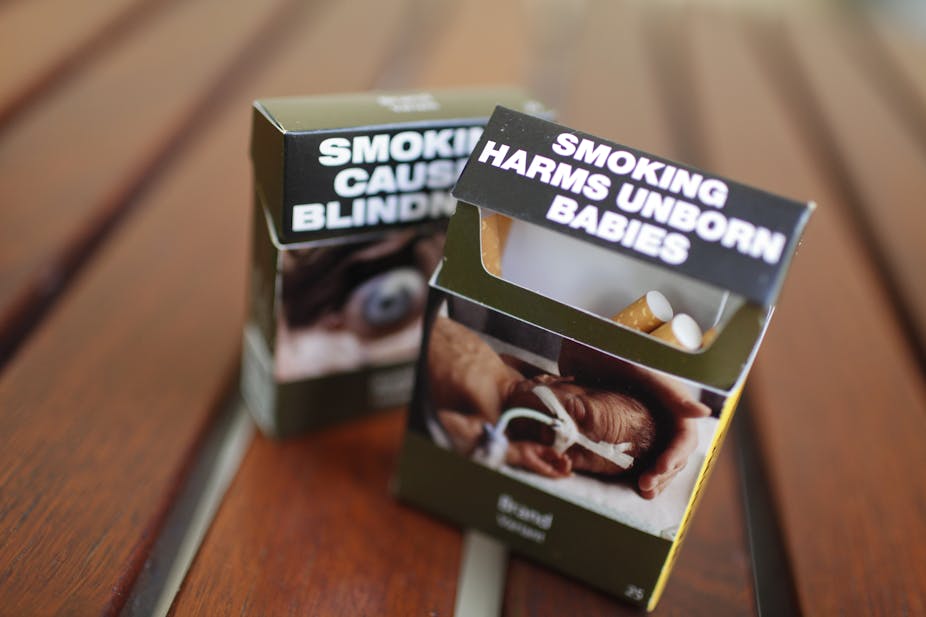
After much political debate, the Australian Parliament passed the Tobacco Plain Packaging Act 2011 (Cth). Australian legislators, such as Richard di Natale, provided moving accounts for the need for plain packaging of tobacco products.
The legislation requires tobacco products to feature standard olive-coloured plain packaging with large health warnings. Naturally, Big Tobacco retaliated with a legal challenge.
And after epic litigation, the High Court of Australia earlier today issued orders ruling that “at least a majority of the judges” are of the view the plain packaging regime is valid under the Australian Constitution.
The High Court rejected the arguments of Big Tobacco that there was an acquisition of property on less than just terms. This ruling is in line with precedents on constitutional law and intellectual property such as the Grain Pool case, the Nintendo case, and the recent Phonographic ruling. The High Court will provide reasons for the decision at a later date – before the retirement of Justice Gummow, an eminent judge on matters of intellectual property.
Setting a precedent
The decision in JT International SA v Commonwealth and British American Tobacco Ltd v Commonwealth [2012] HCA 30 will be an important precedent in Australia and the rest of the world.
Domestically, the Attorney-General Nicola Roxon and the Health Minister Tanya Plibersek have hailed the decision a victory for public health. “This is a victory for all those families who have lost someone to a tobacco related illness. No longer when a smoker pulls out a packet of cigarettes will that packet be a mobile billboard,” Roxon said.
The High Court is a well-respected superior court, with great expertise in the field of intellectual property. The ruling is consistent with other superior courts dealing with questions of tobacco control. In a 2007 case, Attorney General v JTI-MacDonald Corp, the Supreme Court of Canada noted: “When commercial expression is used … for the purpose of inducing people to engage in harmful and addictive behaviour, its value becomes tenuous.”
And in 2012, the South African Supreme Court defended regulations on tobacco advertising under the WHO Framework Convention on Tobacco Control.
The World Health Organization
The High Court ruling is also a boost for the World Health Organization (WHO) and its Framework Convention on Tobacco Control. The WHO has been deeply concerned about the impact of the tobacco epidemic around the world, observing, “Tobacco is without doubt the single most preventable cause of death in the world today. It is the only legal consumer product that kills up to half of those who use it as intended and recommended by the manufacturer.”
The WHO Framework Convention on Tobacco Control recognises that member states are “seriously concerned about the impact of all forms of advertising, promotion and sponsorship aimed at encouraging the use of tobacco products.” Article 11 of the Convention deals with the packaging and labelling of tobacco products and Article 13 addresses tobacco advertising, promotion and sponsorship. The guidelines endorse plain packaging as a means of implementing the Convention.
The WHO has strongly supported the Australian Government’s policies on plain packaging. It has expressed the view that the legislation “will achieve its stated goals of: reducing the attractiveness and appeal of tobacco products to consumers, particularly young people; increasing the noticeability and effectiveness of mandated health warnings; and reducing the ability of the tobacco product packaging to mislead consumers about the harms of smoking.”
Nicola Roxon received a special award from the WHO for “her unwavering leadership” in the field of health. And for World No Tobacco Day in 2012, the WHO disseminated videos, lauding Australia’s regime for the plain packaging of tobacco products:
Joining the Olive Revolution
In the wake of today’s High Court ruling, the big question is who will be next to join the Olive Revolution and adopt plain packaging of tobacco products. Nicola Roxon commented, “Australia’s actions are being closely watched by governments around the world. The message to the rest of the world is big tobacco can be taken on and beaten.”
The United Kingdom has held a public consultation on the plain packaging of tobacco products, and commissioned research on the topic. New Zealand has also engaged in a consultation on the plain packaging of tobacco products.
The great Norwegian leader Gro Harlem Brundtland helped transform WHO and focus its mandate on tobacco control. Norway has prohibited its Pension Fund from investing in tobacco (showing the way for Australia’s Future Fund) and supported Australia’s plain packaging regime in the World Trade Organization (WTO). It looks keen to follow Australia’s lead.
Meanwhile, Australian and Indian public health experts have presented a report to the New Delhi Parliament urging India, the world’s second-largest tobacco consumer and producer, to act. And Roxon has also been promoting plain packaging of tobacco products to the United States Congress and the Obama Administration.
The High Court ruling will embolden countries – such as the United Kingdom, New Zealand, Norway, India and the United States – contemplating plain packaging of tobacco countries. The decision will strengthen the case of the Australia in its international disputes over the plain packaging regime in the World Trade Organization and under the Hong Kong-Australia Investment Treaty.
The decision reinforces the wisdom of the Australian Government in excluding state-investor clauses from future trade agreements. But it’s also important that plain packaging and other measures of tobacco control are embraced by the United States and others - especially during negotiations over the Trans-Pacific Partnership.
Read other articles on plain packaging published since the High Court decision:
On what this decision means for tobacco companies - Big Tobacco crashes at first legal hurdle on plain packaging
On the next battle for Australia under the dispute settlement provisions in the Australia-Hong Kong bilateral investment treaty - Government wins first battle in plain packaging war
On why Philip Morris is using the Australia-Hong Kong BIT to try to stop plain packaging - Why bilateral investment treaties are the last refuge of Big Tobacco