

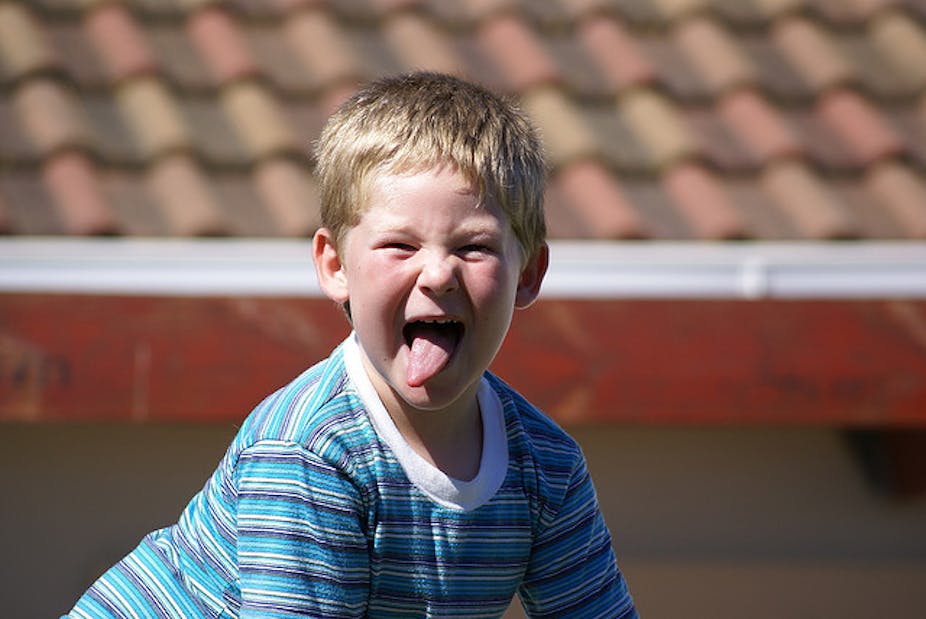
Picture this: you’re standing in a long, slow-moving queue. People around you are disgruntled and complaining. You turn to talk with the person behind you and someone else jumps the queue in front of you. Is it okay to slap him or her – not to hurt them – just to give a clear message that such behaviour is unacceptable?
What if this person’s understanding was limited? Would a slap be more acceptable, more effective? Of course not.
In either of these examples, the “slapper” could be charged with assault. And they certainly couldn’t use the defence of “lawful correction” or “reasonable chastisement” to reflect society’s expectations that citizens ought to behave civilly.
But put a child and his or her parent in this scenario and everything changes.
Psychological impact of hitting
Based on the results of a study published last month which linked “harsh physical punishment” with mental disorders and substance abuse later in life, we wrote an article The Conversation arguing It’s never okay to hit your kids.
The “harsh physical punishment” studied was defined as “includ[ing] acts of physical force beyond slapping, which some may consider more severe than ‘customary’ physical punishment (i.e. spanking)” but was not at the level of “physical abuse”, defined as “being hit so hard it left marks, bruises, or caused an injury”.
The study’s authors concluded that “reducing physical punishment may help decrease the prevalence of mental disorders in the general population”. This adds support to 20 years of research associating physical punishment with harmful effects in childhood and adulthood.
Based on this evidence, we concluded that the defence of “reasonable chastisement” should be removed, giving children the same protection from assault as adults. Heated debate followed. Some readers accused us of bias, misinterpretation of the evidence, and wanting to punish well-meaning parents. Smacking a child was argued to be integral to loving discipline, gaining respect and protecting children from harm.
Cultural change and generational rejection of hitting children was acknowledged by some; while others insisted that smacking children was a parent’s responsibility, effective as discipline (even when children didn’t respond to repeated warnings) and less harmful than verbal reprimands.
Just a little smack?
We often preface words like slap and smack with “only a little” or “just”. These words serve to make the act of hitting a child sound better, or more socially acceptable.
Most parents who smack commonly hit their child with a hand once or more on the bottom, legs or arms. But a smack can refer to anything from a tap on a child’s clothed bottom; gently or forcefully hitting any part of a child’s body, including the face or head; to single or repeated hitting; and hitting a child with a belt, wooden spoon or other object.
A “smack” may cause little physical pain or it could leave a red mark, bruise or injury.

Changing attitudes
Some parents who were physically punished as children may continue this custom. A 2006 Australian Childhood Foundation survey of 720 adults found that 45% of respondents thought hitting that left a mark was acceptable. One in ten thought the use of implements was okay, and a few thought it acceptable to shake children or strike their heads.
But attitudes are changing in the Australian community. Increasing numbers of parents who were smacked as children now reject it as a disciplinary response, though some still use “little smacks” that are forceful enough to at least gain a child’s attention. The child may not be harmed, but even these “little smacks” are not necessary.
Smacking shows children that people are allowed to use physical force to achieve compliance, even when the reason for complying may not be just, fair or even understood. The child is denied the dignity and respect to which children, as human beings, are entitled. And there are certainly more constructive and benign alternatives.
Protecting children from harm requires forethought and supervision, particularly when children are too young to understand dangerous situations. Physically restraining children to protect them from harm isn’t punishment.
But hitting children as punishment for behaviours to be expected in childhood may unnecessarily distress and confuse the child. Establishing age-appropriate boundaries and communicating important messages about safety are more respectful and appropriate alternatives.
Legal considerations
Increasing intolerance of hitting children presents some challenges. What guidance, for instance, does current law provide to people arriving in Australia from countries where “harsh physical punishment” is customary? In Australian courts, cases have arisen where newly arrived parents’ perceptions of “reasonable” physical punishment have been held to be unreasonable.
More broadly, Australian parents are still legally allowed to physically punish their children, although the line between lawful correction and assault is not clearly spelt out.
New South Wales is the only Australian state to attempt to clearly define the “lawful correction” defence to parental assault of a child. It can only be raised if a parent hits a child below the shoulders and does not cause harm lasting more than a short period.
But even physical discipline which goes beyond what is legally allowed does not necessarily result in a conviction, if seen as “trivial”. After the reform, a parent charged with slapping her 16-year-old daughter’s face while in the presence of NSW police escaped conviction.
Prosecutions and convictions reflect societal and judicial values. So reforms to the defence of lawful correction need to be accompanied by easily accessible community education about positive discipline. Reforms should also promote greater awareness of the challenges parents face, along with greater support systems.
Lessons from abroad
In countries such as Sweden, where smacking and slapping children has been banned since 1979, attitudes to children’s rights have dramatically changed. They are now recognised in law and parents are supported, through education and welfare initiatives, to reduce their reliance on physical punishment.
Swedish parents who occasionally smack their children have not had their kids removed, and they have not been convicted on assault charges. But they and their children have no doubt that smacking is not okay.
Law reforms have been educative, encouraging parents to discipline children without resort to unnecessary smacking and slapping. This is the approach we should see in Australia.
Comments on this article are now closed.
Susan McCosker
Former school teacher
I would hope that any bans on smacking would also come with comprehensive education programmes for parents.
I think that the reason smacking 'works' is that parents don't know what else to do. My approach to parenting is to be constantly proactive: I try to not let them get into situations where they can get into trouble. But that is hard work, and from conversations with other parents, it's also not the norm. And my kids still do the wrong thing at times.
Dale Bloom
Analyst
I don’t think education programs are required for everyone, and I refer to another article.
“Stansbury says another surprising finding was that male caregivers touched the children more during discipline settings than female caregivers—and the majority of the time it was in a positive manner. Positive touch included hugging, tickling, and patting.”
http://www.futurity.org/society-culture/nearly-1-in-4-kids-gets-physical-rebuke-in-public/
The positive touch was carried out by the majority of fathers, and it seems instinctive, or they instinctively knew the best way to teach and manage children. This is of course directly opposite to how fathers have been portrayed in the past, to demonise fathers and alienate them from families and children.
So it may require education programs for some people only, and mostly the mothers.
Philip Dowling
IT teacher
Susan, I hate to point out the obvious.
Children do not come with instruction manuals.
Baristas that make your next cappuccino often have more formal training than parents.
To discuss banning any form of smacking ignores the fact that the bigger problem for most children is smack .. and coke and heroin and crystal meth.
http://www.abc.net.au/news/2008-02-14/methadone-death-mum-walks-free/1042564
http://www.community.nsw.gov.au/kts/guidelines/roles/health.htm
The whole smacking issue is largely an ideological and third level issue for most children at risk.
Susan McCosker
Former school teacher
I'd like to know more about the relationships between the mothers and children and the fathers and children.
It's not a study, for sure, but the observations of my peers - mostly mothers out of the workforce while raising pre-school children, with the father in full time work. The children tend to be much better behaved overall for their father than their mother, and I suspect it is related to the children always being with mum and so when dad is with them it is more special. This was really…
Read moreCraig Minns
Self-employed
Susan, that's quite a good point, but it begs the question. Whatever the reason for such a discrepancy across parental gender, it seemingly is real.
Susan McCosker
Former school teacher
And I had thought I'd lost the instruction manuals!
Actually, I believe children do come with instruction manuals, in the form of grandparents, friends, other parents: people who can provide advice on how to raise children. But if, say, all I know what to do is punish - by smacking, screaming at my kids, sending them to the naughty corner etc - then that's what I will do. If my 'instruction manual' doesn't know any better, either, then I may not have any opportunity to learn otherwise…
Read moreSusan McCosker
Former school teacher
Thinking along the lines of your post in which you linked the same study, I recall when I was growing up, boys were told 'we don't hit girls', but girls weren't told 'we don't hit boys' or even 'we don't hit'. I wonder if, subconsciously, women consider it okay to hit, even if consciously we don't believe that to be true at all, because this was the message we were given as children.
I maybe way off the mark, just thinking it through.
Judith Olney
Ms
Interesting observations Susan, I also looked at this study from another angle. The observations in this study were about parental behaviour in public. I wonder if it could suggest that fathers are more concerned with public perception of themselves, more so than mothers. Perhaps this contributes to their behaviour, as far as discipline of children goes.
From my own experience, and that of my friends, discipline, whether physical or not, was usually consistent from my mother, whether in public…
Read moreDale Bloom
Analyst
Susan McCosker
I think you are attempting to demonise fathers by saying they are only well behaved in public. Demonising fathers is very fashionable in our current society it seems, and people’s minds are trained to think negatively of fathers at all times.
I would offer an alternate suggestion as to why the fathers rarely hit their children in the study.
The fathers were aware of their size and strength, and aware they could easily injure a child if they hit them. They are also less easily…
Read moreSusan McCosker
Former school teacher
Maybe you would care to read my response before criticising me so harshly.
Dale Bloom
Analyst
Susan McCosker
"I'd like to know more about the relationships between the mothers and children and the fathers and children."
I just told you.
Susan McCosker
Former school teacher
So... because I'm with the kids for more hours a day than my husband is, and therefore have a different relationship with them than he does, that means I think he's useless?
Like I said, read the comment.
Judith Olney
Ms
Dale, the study you used was about the behaviour of parents in public, in regards to physical discipline of children. A very limited study. You are now trying to draw conclusions from that study, about the way parents discipline their children in general, conclusions that simply don't exist.
There may well be fathers and mothers that exhibit the behaviours you describe, but your comment fails to convince because it is a sweeping generalisation, rather than a observable fact.
The fathers you…
Read moreDavid Zyngier
Senior Lecturer Faculty of Education at Monash University
Giving children smack must be illegal! Even a belt (of alcohol) is shown now to be harmful. But more seriously if teachers act in Loco Parentis and they cannot use corporal (or capital punishment) on the children then how can it be argued that a normal parent can inflict such punishment.
Susan McCosker
Former school teacher
Teachers do not act in Loco Parentis anymore: they now have a Duty of Care.
Mark Harrigan
Dr
The last paragraph says it all. Smacking or hitting is never okay. But, being human, parents are subject to human frailties. Can we really condemn a highly stressed mother or father dealing with an out of control child if they snap and smack them?
We need to esnure we all know it is not okay, but be forgiving of lapses. The law should be the last resort, only to be used where a parent uses physical discipline as a conscious approach repeatedly. We should aim to be forgiving, supportive and educative in all other circumstances, helping parents develop alternative strategies to help address behavioural problems with their children
Jonti Horner
Post Doctoral Research Fellow at University of New South Wales
I'd argue that we can no more (or no less) condemn a highly stressed mother or father for snapping and smacking a child than we can condemn a highly stressed partner for snapping and slapping their partner. Or a highly stressed boss from snapping and smacking their co-worker.
That said, I'm not a parent, so will freely admit that I've never been in that kind of situation. I do know that I've managed to resist the urge to slap my partner, my colleagues, and anyone else who might rile me - and…
Read moreSue Ieraci
Public hospital clinician
" in much the same way that people nowadays don't consider it reasonable behaviour for a husband to discipline his wife if she's "out of line".
But, Jonti, a parent IS responsible for disciplining their children - not for disciplining their spouse. An integral part of parenting is teaching values and choices.
Discipline doesn;t have to be physical - but it does have to involve consequences for one's action. So, if a child requires a lesson that they are resisting , their should be consequences…
Read moreJonti Horner
Post Doctoral Research Fellow at University of New South Wales
You're right :) My point was more that, in the past, is was considered acceptable for someone to discipline their spouse, and it was considered that, at least in some families and some cultures, part of the role of one spouse was to keep their partner in line, and teach them the right way to act. I'm in no way condoning that, by the way (I find the idea morally repugnant - and I'm really glad that things have changed).
I agree that parents are responsible for disciplining their children - I just…
Read moreJudith Olney
Ms
Excellent points Sue.
Yoron Hamber
Thinking
You'll do just fine Jonti.
Jonti Horner
Post Doctoral Research Fellow at University of New South Wales
Hope so :) thanks :)
Mark Harrigan
Dr
Good points from all I think.
Physical violence is never okay. But neither is abuse of any kind, including psychological.
As Parents we want (or at least I think most of us do) to help our children grow up to be happy, healthy, fulfilled adults who can maximise their opportunities as well as make a useful contribution to society.
The trouble is, it aint easy! We are imperfect vessels and sometimes out failures lead to imperfections developing in our children too - and it worries us…
Read moreJudith Olney
Ms
Jonti you make some good points, but I wonder about the threat of the "10 minutes on the naughty stair" as being less abusive than a tap on the bum. Forcing a child to sit on a stair, is deprivation of liberty, just as putting an adult in detention is, although I know that this is not seen as such by most people. Punishment such as grounding, forcing a child to stay in a room etc, are the same, IMO.
There are many ways in which to discipline children, but when taken to extreme, as the authors…
Read moreSue Ieraci
Public hospital clinician
I agree, Mark, that we are all imperfect - so we need to talk about what is desirable rather than what is compulsory.
To do this, however, we also need a realistic understanding of risk and harm. The law and compulsion should only be invoked when there is significant risk of significant harm.
What we're all skirting around here is that there ARE gradations of risk and harm. I am not the only example of a child who was brought up in a loving and secure home but who was occasionally hit for…
Read moreMark Harrigan
Dr
Agreed. Gradations exist. It is not the purpose of the law to regulate all our imperfections. If it was it would be both intolerable and unable to be implemented. The rule of law would then become either tyrannous or arbitrary or both.
I like to use the principle that we should prescribe ends (outcomes) but proscribe means (ways of achieving that outcome). The prescription of ends should be based on shared values and common understanding. The proscription of means should be as minimal as required depending on the degree of trust that exists.
In the middle there is the role of the guide to help find means that work for all in achieving desired outcomes
That's a constantly evolving process of course - which is why these conversations are useful - and no, our proscriptions should not, and cannot effectively, be retrospective.
Dan Fashaw
Brain Surgeon
'Just' and 'only a little', are weasel words. Just like 'may' and 'could' (used thoroughly throughout your article). I disagree that hitting should be banned. But as is goes the politically correct morally superior win the day. I do find it sad however that people who manoeuvre and posture into morally high positions just so they can influence and dictate other people get their way so often.
Limiting social freedoms seems to be the new fad. Not saying smacking is a social freedom but the choice…
Read moreGordon Smith
Private citizen
I agree Dan - it is a little tedious listening to those reeking in moral vanity and superiority that emanates from this forum quite regularly.
Parents need to have authority (which is different than power) and there are times when non-verbal expressions are the only thing that ensures that.
I am of course talking about appropriate force in use of a light smack.
Children need boundaries and whilst I rarely smacked my children there were occasional times when it was the last resort to reinforce those boundaries.
Mark Harrigan
Dr
Interesting that you want to frame the question in terms of moral vanity - none of which is in evidence in the article which instead points to data that smaking is harmful to the child.
Also interesting that you want to frame the debate in terms of the "rights" and the authority of the parent versus the rights of the state. yet the rights of the child don;t feature at all in your discussion?
Children do need boundaries. So do Parents, indeed so do we all.
So what is "appropriate use of…
Read moreYoron Hamber
Thinking
Nope.
Although we're all human, and sometimes our patience ends. But to systematize it, or to think that it should be socially acceptable as a way of 'correction' is not the way to treat a kid. If you don't want that kid to think that violence is the proper solution to someone arguing of course. Because that will be what one teach it if constantly 'correcting' its behavior that way.
Judith Olney
Ms
I wonder when psychological abuse of children will start getting the same treatment as physical punishment such as smacking? In my opinion, and from my own experience and the experience of many of my peers, psychological abuse was far more damaging to them and myself, as children, than the odd smack on the bum ever was.
This psychological abuse took the form of threats of punishment by god, to the point of constant fear and anxiety over any perceived wrong doing or mistake, in my case. In my friends…
Read moreYoron Hamber
Thinking
No Judith, none of those are acceptable. Kids are a blessing to me, no matter what. When they act out it's in a way a reflection on the whole family as I think of it. To blame it on a small kid solely is to put a adult stamp on it, and also presume a reasoning it's not capable of. We're all 'kids' a fair way into the twenties according to brain studies in where they've found that the brain paths etc still are evolving at that time. I agree that psychological abuse is just as destroying, and in some…
Read moreSue Ieraci
Public hospital clinician
Interesting point, Judith. I don't recall the times when I was hit as a child, but I certainly remember times that I felt humiliated (all within a loving and caring family, I might add).
I can't help thinking that a lot of what we are now seeing as moral absolutes are actually culturally-determined and relative.
I subscribe to the current view that hitting children is both wrong and ineffective in their development. I don't, however, agree that it is universally harmful. I use myself and most of my peers as examples - very few of us now condone hitting children, and yet nearly all of us were hit as children.
In my family of origin, hitting of children was an accepted form of discipline. Hitting of adults never occurred, and we grew up to feel loved and protected. I did not get the message that violence was acceptable, and I certainly don't have that idea now. I don't think I am alone - far from it.
Judith Olney
Ms
There are various organisations in Australia also, that give kids the ability to tell others of their problems, these did not exist when I, and my friends were growing up and children need to be aware of their existence to access them.
There is also the problem of what is seen as psychological abuse, such as the indoctrination of children into religion. This indoctrination is not seen as abuse by many, including the government, so this form of abuse goes on unscrutinised.
As for smacking, (I'm not talking about beatings here or any physical abuse that damages a child physically), these days it is far more acceptable socially, to psychologically abuse a child, as long as you don't lay a finger on them. Even threats of violence are more acceptable than an actual smack on the bum.
The hypocrisy surrounding this debate is revolting.
Judith Olney
Ms
I agree with you regarding the moral absolutes we are seeing today.
I don't condone physical violence against children, or anyone for that matter, but wanted to make the point that a smack is less damaging in the long term, than psychological abuse.
Thank you for you reply, and in particular for not presenting your view in a smug self righteous manner, as is so often seen when debating an issue such as this.
I personally did smack my child, (a tap on the hand or bum, not a beating), when she was very young. Often it was a way of distracting her quickly, from something she was doing that was dangerous, or from working herself up into a full blown tantrum. I found that it was useless to try and reason with a child under 4 years old, as they do not understand. However, I did not psychologically abuse my child, and she is now a happy, healthy, wonderful mother of her own children.
Yoron Hamber
Thinking
I never liked that either Judith. There are many ways to to make kids miserable, Some parents seem to feel them as 'outgrowths' of themselves, and just pour their emotions over them. And when they do it's not only the parents, it is the kids that carry it the longest. Someone wrote about 'unconditional love' here and I fully agree on that, if he/she meant the kids loving. Because that is what kids do best, loving their parents no matter what, as long as they are there in the family.
Read moreThat's also…
Craig Minns
Self-employed
I wonder how the author feels about the use of "smacks" by young women on men. My daughter has never been physically chastised in any way, yet she feels free to slap me when I make a bad joke for example. She and her friends frequently talk of giving such and such a male peer a "good slap" for some perceived offence and I have observed that such behaviour is a common feature of interactons between adolescent and young adults.
Charles Waterstreet wote a column in the SMH some time ago in which…
Read moreSue Ieraci
Public hospital clinician
" she feels free to slap me when I make a bad joke for example. "
But surely it is a fundamental role of fatherhood to make Dad jokes?
Craig Minns
Self-employed
I certainly think so and I suspect my daughter does as well. Where we differ is in our understanding of a daughter's appropriate response to them.
Yoron Hamber
Thinking
I once threatened my daughter to come and get her from a party, wearing a proud viking helmet. She became very sweet and reasonable after that, understanding all my points.
Craig Minns
Self-employed
I've made similar threats involving shorts, sandals and bared abdomens...
with very similar results.
Yoron Hamber
Thinking
lovely :)
A friend of mine asked if we could take my car to get his daughter from some place, that he somehow, accidentally, had found out :) as it was getting late for her.
We happened to meet her on the way, walking to the buss and picked her up. She was very surprised to find her dad and me stopping beside her, and I couldn't help but give her a deep meaningful look, saying "Don't you ever think your dad don't know... Dads know it all"
Ir worked wonders. :)
Sue Ieraci
Public hospital clinician
Like I said, I still remember the humiliations of childhood - much more vividly than the slaps...
Craig Minns
Self-employed
Apologies to Dale Bloom, who mentioned the MSU study earlier.
Bruce Moon
Bystander!
Bernadette and Bronwyn..
I remember as a youngster pulling a clock apart in a bid to repair, but being unable to put it back together.
I get the same sense from your article.
I would have no problem with your article had you distinguished a difference between parental love and violence. And, described the limits of parental love. But, again you fail to make the distinction.
I find it somewhat disturbing that after the last article, you have a second attempt to argue your case. Had…
Read moreYoron Hamber
Thinking
And you're serious too I presume? Reminds me a little of that English/American nanny program :) although she won't 'correct' by hitting. And to suggest that bullying is acceptable, as you actually do renaming it social ¨school pecking', if I get you right? Sorry, I also have kids and I never needed to hit them to make them behave?
Bruce Moon
Bystander!
Yoron
I'm sorry you failed to understand what I wrote.
I neither wrote, nor inferred bullying is acceptable.
And, I also wrote in relation to exerting power " One consequence may be a smack. But, this is really only effective for pre-school aged children. It is NOT the only remedy."
Must be something I ate this morning - seems to have seriously affected how my writing is read (by some).
Cheers
Yoron Hamber
Thinking
Hmm, and there I was, thinking I got you just right :)
I do not support physical or psychological abuse of kids. Neither by adults, nor by bullies.
Bruce Moon
Bystander!
Yoron
You wrote...
"I do not support physical or psychological abuse of kids. Neither by adults, nor by bullies"
I doubt you'd find anyone to disagree with you there.
The issue for me here is not about abuse. Rather, it is about the way the authors of this article have fused parental love with abuse and made observations that impugn all parents who don't do as they'd want.
On this a corollary is the recent media focus on the Virgin Airlines policy not to allow males to sit next to unaccompanied children. The public view is that the policy impugns all males to potentially be pedophiles.
Where human foibles come into play, there is a dividing line, and it often shifts through time. As here, those advocating a line shift sometimes overplay the 'problem' in order to gain traction. I suggest we all need to contribute to such debates, but not be over-awed by the fact that extremes occur (as the current authors would want us to accept as normal).
Cheers
Kenneth Mazzarol
Kenneth Mazzarol is a Friend of The Conversation.
Retired
When I first became an untutored father I always tried to be myself. Children can quickly sense bullshit and if a parent pretends to be anything other than who they really are the bond and trust is lost. My three children tell me that they behaved because they sensed I would become upset if they didn't. I cannot remember doing anything in particular other than to expect everyone to play the game. It seems that continuous positive expectations from a fair dinkum parent is a more powerful force than a one-off slap.
Yoron Hamber
Thinking
Yep.
And so agreed. To expect the best of them is the way I did it too, and it worked very well for me. It doesn't have to do with how educated one is, or what money one make. It has to do with trust, and those 'positive expectations' you write about, not forcing them into fulfilling some parental wish but just try to give them some safety and some positive hopes for their future. And school, always tell them that education is like a flashlight, the more you know the better and further you can see, doesn't really matter what the studies is about as long as they find a joy in them.
Kenneth Mazzarol
Kenneth Mazzarol is a Friend of The Conversation.
Retired
I like your 'flashlight' simile. If it's not subject to a patent I will use it to illustrate the point.
Yoron Hamber
Thinking
Thnx.
heh, I'm a Swede, not American.. We don't do that kind of patenting here.
Well, not yet, at least :)
And yeah, I like it too, one of the best and simplest ways I ever found to explain 'education' to my kids. And I love the Internet, it's like the best school one can find when one get a interest, or just want to discuss. As long as it is free.
Sue Ieraci
Public hospital clinician
Kenneth and Yoron - were either of you ever slapped by a parent? Even once?
Yoron Hamber
Thinking
Once I was thrown into the wall :) for drinking a soda..
I was about ten or eleven and he was home after a binge, waking up and thirsty.
Don't give me ***, I think I know what abuse is both ways. That's also why I say I won't accept it.
Judith Olney
Ms
Personally, I would be horrified if my daughter told me she behaved well because she was afraid of upsetting me. This would mean that I was using emotional blackmail as a form of discipline.
I would much prefer my daughter behaved well because I had shown her the right way to behave, in the context of the society she was born into.
As a child I behaved well because I lived in constant fear of my parents reaction, and of the punishment that would be dished out by an imaginary sky fairy my parents used as a threat. As an adult I behave well, because I know what is right and ethical, and treat others as I would like to be treated, not because of emotional blackmail or threats.
Kenneth Mazzarol
Kenneth Mazzarol is a Friend of The Conversation.
Retired
Firstly, being myself was not an act of bribery. Secondly, when I was small my mother would turn around a slap my face hard seemingly without any reason that I could understand. It happened quite often. I would have to scramble around the room trying to find my glasses. Perhaps I was just a naughty little boy and didn't realise it.
Yoron Hamber
Thinking
A lot of the slapping around I think belongs to a older model of thinking, 'discipline and order' sort of. Sometimes you might need to stop a kid from doing things one can see is harmful to him/her but if you give it a sec and think, I'm sure there will be a better way than hitting it, or 'slapping'? as some want to call it. And I withhold that we're getting away from it, the kids that's founding :) their own family's today I expect to know better than our parents did.
It's a evil circle. A society that expect you to hit your child's to keep control will get some 'grown ups' like me, been there and won't allow it, but they will also get a lot of newly 'grown ups' that believe that it is okay. It's never okay.
Dianna Arthur
Dianna Arthur is a Friend of The Conversation.
Environmentalist
I do not agree that slapping is necessary at all. I have noted elsewhere on this thread that one doesn't need to hit animals to have them behave how you wish. To slap a child and that child not even knowing why is appalling and beyond comprehension.
No matter how stressed a person may be there is no need to hit. We do not hit our bosses or colleagues at work (and we know we'd be out on our backsides if we did). Therefore if we can control our baser instincts in some circumstances, we can certainly do so when caring for our children.
Bernadette Saunders
Senior Lecturer Social Work at Monash University
Susan
In relation to your comment: "I believe what to do instead is to be proactive in preventing the bad behaviour in the first place, rather than to retaliate with punishment after the event. I'm tired of hearing 'don't smack, don't smack, don't smack' without any balance of what to do instead. And I'm yet to hear 'don't yell at your children' or 'don't bribe your kids', which I think are equally negative forms of discipline" -
I think you might find the link in our article to Joan Durrant's on-line book and videos on "Positive Discipline" to be worth a look:
http://seap.savethechildren.se/South_East_Asia/Misc/Puffs/Positive-Discipline-What-it-is-and-how-to-do-it/
Susan McCosker
Former school teacher
Thanks. I'll have a read of that .
Lisa Ann Kelly
retired
There are always people who will exaggerate to try and make their point. No one is advocating "constant" use of smacking. And I deplore, in particular, the line in this article that reads " . . .45% of respondents thought hitting that left a mark was acceptable." This is such shoddy "research." What is "a mark? A redness left on a behind, which is there for a few seconds? Or a bruise? A welt? A black eye? Let's have some clarity.
My mother had it right. She would give you a warning…
Read moreJudith Olney
Ms
Well said Lisa.
Dianna Arthur
Dianna Arthur is a Friend of The Conversation.
Environmentalist
It is not necessary to smack house hold pets when house training, why then do we find excuses to smack young children at all?
Judith Olney
Ms
I found bribery, (positive re-enforcement) to be the best way to train a dog, and the best way to train a very young child, in the behaviours that you desire them to exhibit. Neither understand complex reasoning, or the concept of empathy for others.
That being said, my daughter, when she was very young, (2 years old), was a biter. She could inflict serious damage on other children, so when she was caught biting, I would give her a quick tap on the bum, to stop her biting and inflicting pain and…
Read moreDianna Arthur
Dianna Arthur is a Friend of The Conversation.
Environmentalist
I appreciate your comment.
With animals, there will never be a time where we will be able to engage in reasoned conversations. Although, no matter what the age of the animal, I have always been able to house-train without resorting to any kind of physical reinforcement. Have rarely used a "sin-bin" either - reward works quite well for animals. Concentrate on the good behaviour, minimise the response to bad behaviour.
I feel for you having had a little daughter who bit others - you must've…
Read moreJudith Olney
Ms
In my daughters case, it was "just a little tap", and it served to immediately cause her to stop biting the other child. It did not harm her in any way. Trying to remove her, while she was in the act of biting, would have led to her simply biting harder to prevent being removed.
I have never liked using physical discipline, (actually I know of no parent who does), but there were circumstances where it was the most expedient way to effect a result. I am not talking about beating a child either…
Read moreDianna Arthur
Dianna Arthur is a Friend of The Conversation.
Environmentalist
Sounds like your daughter was suffering from pitbull-itis.
Joking of course.
As for your personal views on animals - you don't believe they should be in the house - that is not what the topic is about. I used the house training of animals to illustrate a point that hitting is not necessary for anyone or anything.
Also children learn empathy from sharing their home with animals - however I have a feeling you will state something along the lines of children learning empathy from animals as long as the animals are kept outside and I don't really want to start a debate (argument?) about that.
As for rewards, they are distinctly different from overindulging children - properly used rewards for good behaviour do not result in children becoming "selfish, greedy, and grow up with an exaggerated sense of entitlement".
Therefore, will agree to disagree with you.
Judith Olney
Ms
lol pitbull-itis, did seem like that sometimes. It is a pretty common childhood phase, but that doesn't make it any easier to deal with, particularly when your child is the biter :)
I agree with you that children learn empathy for other living beings by having animals around, (although not necessarily living in the same house), but whether you personally like having animals living in your house or not, doesn't take away from the benefit they provide. My daughter benefited greatly from having cats, dogs, horses and birds in her life, from a very young age. Having animals to care for also gives children a sense of responsibility, but that's a subject for a different discussion :)
I wasn't talking about over indulging children, I was simply making the point that rewards should not always be the result of good behaviour. It teaches children to expect a reward for what they should be doing anyway, behaving well towards others. I'm happy to agree to disagree though.
Dianna Arthur
Dianna Arthur is a Friend of The Conversation.
Environmentalist
I am so glad that I did not offend with the pibull-itis. And agree that's what toddlers can be like at times.
Very happy to know that you have included animals in your daughter's life.
Rewarding for good behaviour is a subtle art - children are very astute at sensing an advantage.
Overall I still maintain; why smack kids when it is not necessary to hit animals?
Unless the animal IS an enraged pitbull.
Cheers
Roberto Crispino
Public Servant
Let's focus on parents hugging or kissing their children. Isn't that some form of sexual abuse whether intended or not? Just think of how much that can affect the development of the child? Has anyone done any studies on this?
As someone often annoyed with crying children in trains or little tykes running around often causing accidents and looking at the tired and exhausted parents, it isn't surprising that the birth rate is less than replacement. Who would bother to have kids here and now when all you're getting is a lawsuit and gaol?
Not all kids are the same and let's see these experts work on difficult children. Let's see if their no smacking policy survives the day to day struggle that it is for some unfortunate parents.
Dianna Arthur
Dianna Arthur is a Friend of The Conversation.
Environmentalist
You lost me here:
"Let's focus on parents hugging or kissing their children. Isn't that some form of sexual abuse whether intended or not?"
WHAT is the matter with you?
Shauna Murray
Research Fellow
Thanks for another great article.
It saddens me that so many people are so ill informed on this issue.
There really had been an enormous amount of research on this topic over the past 20-30 years, see the links in the article or just use google scholar. It shows that:
1) Smacking is not an effective tool for teaching anything - the most it can achieve is short term compliance.
2) It increases the chances of psychological harm in the child
3) It negatively impacts the relationship between parent and child.
Not really sure what more we need to say.
I'm perplexed by those who somehow think parenting without smacking is a modern phenomenon - I'm 39 and was brought up without it, as was my 66 yr old mother. As the article points out, it has been illegal for 30 years in Sweden. Its Australia that is behind the times on this issue.
Peter Elepfandt
Medical Doctor
I am a relatively new reader of the conversation. After reading the authors first article I nearly abandoned the site (and I had to read several other articles to convince me not to do so) since both of their articles are an opinion rather than an analysis or discourse. Unfortunately this is a very common mistake in the Australian press and I was hoping for the conversation to have higher standards than this.
On the scientific side:
Read moreThe above article is a tainted study published in a peer reviewed…
Trevor S
Jack of all Trades
I think the opening paragraphs are nonsense designed to do nothing more than sensationalise. The are the sort of twaddle one expects from News Corp or a shock jock. Lets turn it around, you bend down to help someone who is hurting, they reach across and slap you, hard !
Would you not call the police or at least call security... but if it was your young child that did it to you ? it changes it completely...
That children aren't treated as Adults is no surprise to many, why people use it as…
Read moreDianna Arthur
Dianna Arthur is a Friend of The Conversation.
Environmentalist
What's wrong with helping children in third world countries AND not smacking our own children.
I see these issues as "hand in hand."