


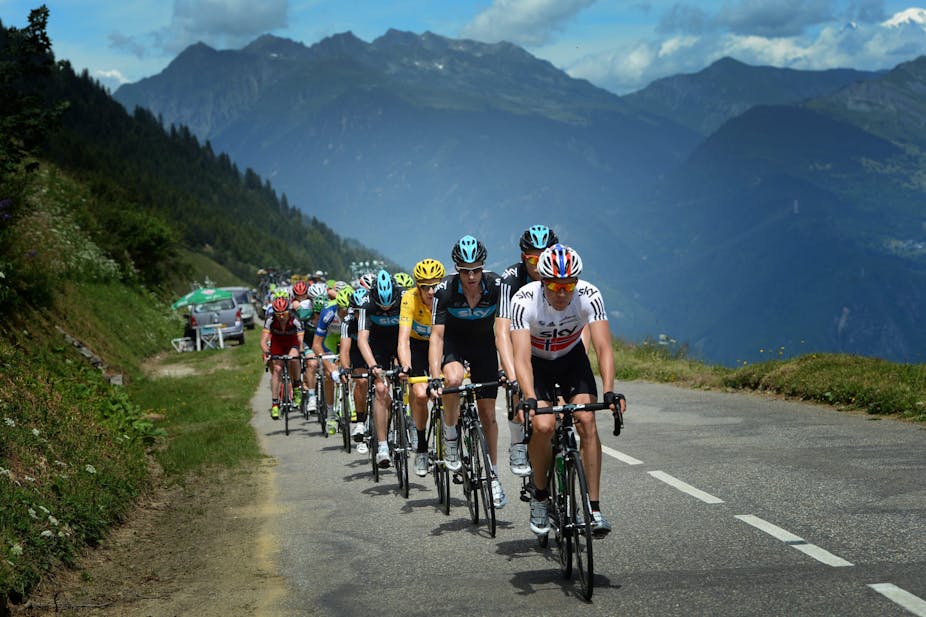
As the Tour de France enters its final week, riders have already negotiated some of the toughest climbs in Europe, and have some major climbs still to go. So what makes some of those riders successful while others crumble?
This year’s Tour includes 25 mountain passes or mountain-top finishes that are classified as Category 2 or harder (Category 1 or hors category).
For those that don’t know, climbs are categorised from easiest (Category 4) to hardest (Category 1) based on gradient and distance, with the extremely tough hors category climbs being considered beyond categorisation.
The climbs include some of the most iconic mountains in the Tour de France, such as the Col de la Croix-de-Fer, Col de la Madeleine and the Col du Tourmalet – all of which are higher than 2000m above sea level and involve more than 19km of climbing at an average gradient greater than 6.2%.
As with each year, these climbs will be extremely important to the ultimate outcome of the race and dictating who stands on the podium in Paris on July 22.
So why are mountains any more decisive to the overall outcome of the race than the long and very intense flat mass-start stages?
Many of these mountains passes are greater than 10km long, with an average gradient of 5-10%. The average power output required to stay with the leading group of riders during the 30-to-60 minutes climbing these mountain passes can be upwards of 450W.
As I’ve written previously, the average trained recreational cyclist may be able to hold this power output for a maximum of only approximately 30-to-120 seconds.
Such high power outputs are required to overcome the high resistive forces experienced by the riders.
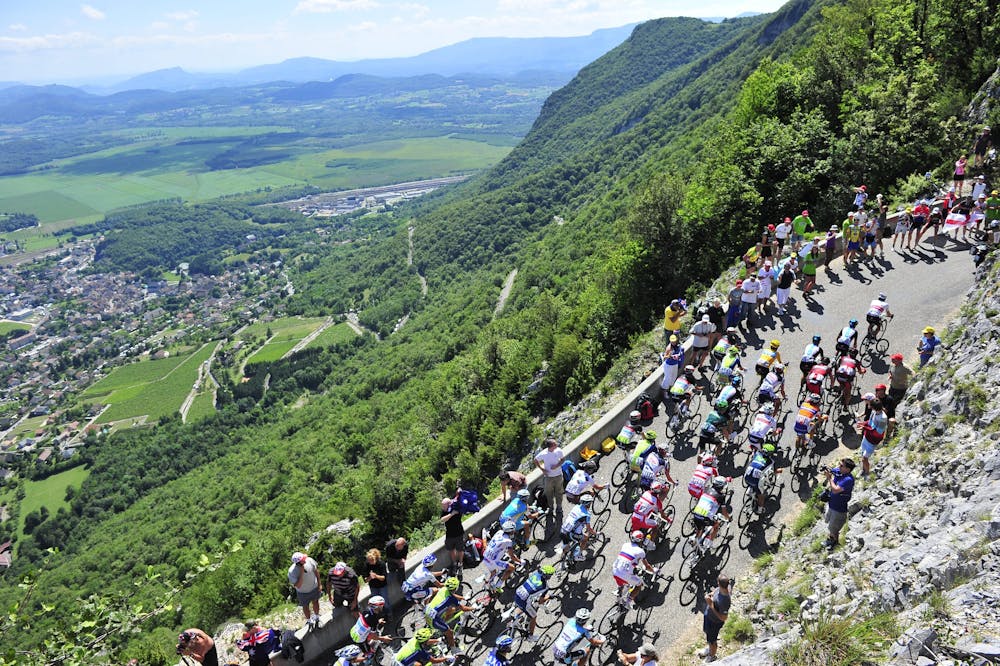
When riding in relatively flat stages, cyclists are required to overcome significant wind resistance.
As a result, the absolute power output of the rider relative to their aerodynamical drag appears most meaningful to performance, especially when riding alone (such as during an individual time trial or breakaway).
It is for this reason that so much time and effort is spent on advancements in cycling equipment (such as helmets, bicycles, wheels, and rider positioning) to improve cycling aerodynamics.
Gravity sucks
When riding uphill the cyclists not only have to overcome wind resistance, but also gravity. Consequently, the mass of the cyclists (and bicycle) begins to play a much more important role in dictating speed.
It’s for this reason that the power output of the cyclists relative to their body mass (know as their power-to-weight ratio) is so important to performance in the Tour’s mountain stages.
At an average power output of 450W, a typical 74kg cyclist would be able to produce 6.08 W/kg (watts of energy per kilogram of weight). But if this cyclist were to maintain the same power output at just 5kg lighter they would produce 6.52W/kg.
That may not seem a great deal higher but could mean the difference between staying with the lead riders and being dropped on the climb.
Some of the fastest times ever ridden up some of the Tour’s most famous climbs such as Alpe d’Huez were thought to be completed at average power outputs as high as 6.9 W/kg.
Based on these data it may seem intuitive that the easiest way to improve uphill cycling performance is to reduce body weight to improve a rider’s power-to-weight ratio. But it’s not that easy.
When dropping body weight, cyclists often reduce fat but also muscle mass – they therefore lose the ability to maintain high absolute-power outputs.
This is most obvious when watching lighter road cyclists. They may be extremely fast in the mountain stages due to very high power-to-weight ratios, but they lose significant time in the flat time trials, which require very high absolute-power outputs.
That could be seen in last year’s Tour when second-placed rider Andy Schleck – at 1.86m and weighing just 68kg – was extremely fast in the mountains but lost to Cadel Evans on the penultimate day, on the individual time-trial stage of the Tour.
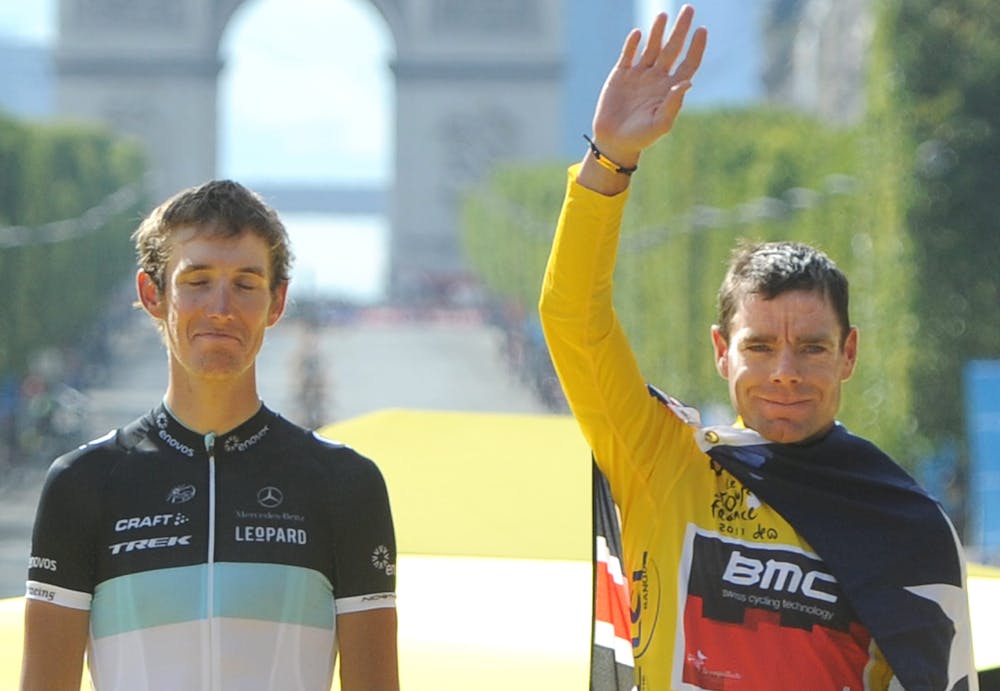
For Tour contenders, it’s therefore a very fine balance between being light enough to climb the mountains quickly and being powerful enough to ride fast during individual time trials.
There are, however, other methods that can be adopted to maximise power-to-weight ratios. Most obvious is to reduce the weight of bicycle, which can improve the power-to-weight ratio given cyclists are essentially required to carry their bikes up the hill.
But with the recent rapid advancements in bicycle technology most professional road bikes are now very near the legal limit of 6.8kg set by the sport’s international governing body, Union Cycliste Internationale (UCI).
Interestingly, this legal limit is the same for all cyclists irrespective of the cyclists’ body weight and as a result the lighter, less powerful riders may be at a slight disadvantage.
An alternative method that may reduce weight and improve the cyclists’ power-to-weight ratio is to manipulate diet and hydration status.
Research has shown cyclists may voluntary dehydrate by more than 2% during prolonged stage racing, which would theoretically improve uphill cycling ability.
Assuming the same 74kg cyclist can still maintain 450W, such dehydration would result in an increase of 0.12W/kg. But it should be noted that dehydration, especially beyond 2-4%, can significantly increase thermal strain and influence exercise capacity.
It is therefore unlikely that this cyclist would be able to maintain the same power output, especially during prolonged mountain stages such as those in the Tour, lasting between four and six hours.
Indeed, uphill riding is considerably slower than riding on the flat – with speeds averaging around 20km/hr at a grade of 9%, compared with 45km/hr on the flat. As a result, the effectiveness of convective and evaporative (i.e. sweating) cooling can be reduced.
This is extremely important to performance during the hot summer days during the Tour de France. Excessive dehydration can reduce the ability to dissipate heat, reduce performance, and possibly place the rider at increased cardiovascular risk.
While a number of methods may assist in minor improvements to one’s power-to-mass ratio, the rider that wears the maillot jaune when leaving the mountains in this year’s Tour will have undoubtedly performed the incredible amount of training necessary to improve their absolute power.
Indeed, an improvement in maximal power output of just 15W would give our imagined 74kg rider a similar improvement in power-to-weight ratio as losing 2.5kg. Being a successful hill climber is therefore not as simple as being as light as possible.
A grand tour winner has to be light, strong, fatigue-resistant, extremely powerful and, of course, lucky enough to avoid all the crashes on the way to the finish line in Paris.
Further reading:
Suffer score: how demanding is Le Tour de France?
Le Tour de France is set to roll, so what makes a perfect bike wheel?
High-end bikes for sale … but what are you really buying?
Cadel Evans and other machines: the science of the Tour de France time trial
Science of elite cycling: Tour de France (stage 1 to 11)
Science of elite cycling: Tour de France (stage 12 to 21)