
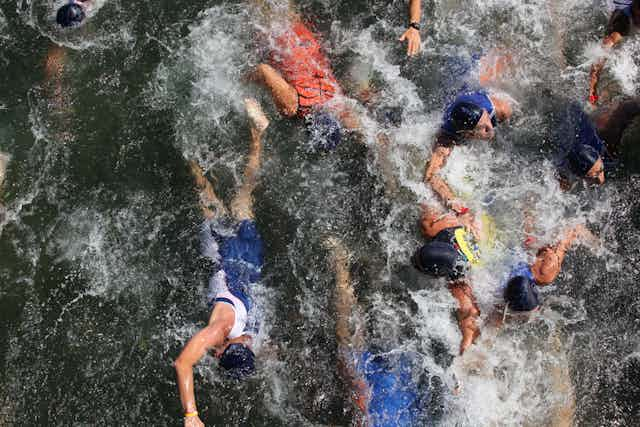


Introduced into the Sydney Olympics in 2000, triathlon has become one of the most popular Olympic sports. For Australia, it’s one of our most successful, with our women claiming one gold, two silvers and one bronze since inception. Triathlon takes in swimming, cycling and running - but if you’re going to win, which sport should you focus on?
The largest of London’s Royal Parks, Hyde Park, is playing host to the 2012 Olympic Games triathlon with the women’s race being held tonight (AEST) and the men’s race on Tuesday night. The park is divided in two by the Serpentine river, where the events commence with a 1.5km swim that will take the leaders approximately 18 minutes to complete.
After exiting the swim, athletes will make their way through the transition area to collect their helmets and bikes for the 43km cycle leg. The London course is slightly longer than the normal 40km and takes the athletes past Buckingham Palace seven times.
At the end of the cycle leg, the athletes will again enter the transition area to discard their helmets and don running shoes with elastic laces before commencing the final leg – a 10km run.
Some 55 men and 55 women from 39 countries will battle it out for a medal. In a sport comprising three different disciplines and taking less than two hours to complete, what will separate first place from last?
Is one of the disciplines more important than the others? Is there room for tactics? What external variables may influence the results?

The importance of the individual discipline to the end result depends on the length of the triathlon. In the longer distance triathlons - such as a half ironman and ironman - the swim comprises only 10% of the overall time. Drafting isn’t allowed on the bike - which means riders can’t sit behind one another and save energy - so the swim has a lot less influence on the end result than the cycle and run legs.
But in an Olympic-distance triathlon where elite athletes are allowed to draft on the bike and the swim comprises about 16% of the overall time, it is usually the fastest swimmers and runners that have the best overall performance. In fact, speed over the first couple hundred meters of the swim is a very good indicator of overall race finishing position in elite triathlon.
Swim intensity is also important. Studies have shown that swimming at only 75-80% of your maximal effort actually yields a faster overall triathlon time than when the swim is performed at maximal effort. This is due to a lower heartrate and oxygen consumption, and better efficiency on the cycle leg.
Swim intensity can be reduced by improving technique or by drafting behind another swimmer. Drafting reduces frontal resistance and allows the athlete to swim at a faster speed for a given energy expenditure, conserving energy for the cycling and running legs.
Wetsuits can also reduce swim intensity and are allowed when water temperature falls below 20°C. At this time of year, the Serpentine sits at around 18-20°C. Not only do wetsuits help maintain body temperature, they also increase buoyancy, enabling athletes to sit higher and in a more horizontal position in the water.

But the benefits of a wetsuit depend on swimming ability. Wetsuits give poorer swimmers a greater advantage than better swimmers as better swimmers naturally sit higher in the water and have reduced frontal resistance. So if the temperature of the Serpentine allows wetsuits, athletes will be exiting the water a lot closer together and forming much bigger groups on the bike.
One big difference between the elite race and age-group race (there are only elite races at the Olympic Games) in an Olympic distance triathlon is that the elite athletes are allowed to draft, or sit directly behind one another on the bike. The age-groupers, on the other hand, need to maintain a 7- to 12-meter gap (depending on the race) between their front wheel and the rear wheel of the front cyclist.
Drafting reduces oxygen consumption by up to 20% and by decreasing energy expenditure, improves both cycling and subsequent running performance. Because drafting is legal, it is unlikely that a break-away group will occur during the Olympic triathlon. Groups that form after the swim leg will probably stay together for the entire cycle leg. For best subsequent run performance, athletes will try to cycle at a relative low intensity with consistent power output.
The winner of the men’s and women’s Olympic Games triathlon will most likely come from athletes in the front group off the bike. Running ability is so similar between athletes that it is highly unlikely an athlete from a chasing pack will be able to close the gap and claim victory. A clean and fast transition is paramount for a good start to the run, and in the last 1km of the bike leg, athletes will be jostling for front position.
After a 1.5km run and 43km cycle, these exceptional athletes will then run at a speed that most people would struggle to maintain during a lap around the local footy oval, completing 10km in around 29 minutes for the men and 33 minutes for the women.
Athletes standing on the medal dais at this year’s Olympic triathlon will be outstanding swimmers, cyclists and runners. The key to Olympic glory is to have no weakness.