Universities and macro-economists still haven’t found a way to solve the crisis of economics that was triggered by the global financial meltdown says economist Martin Wolf.
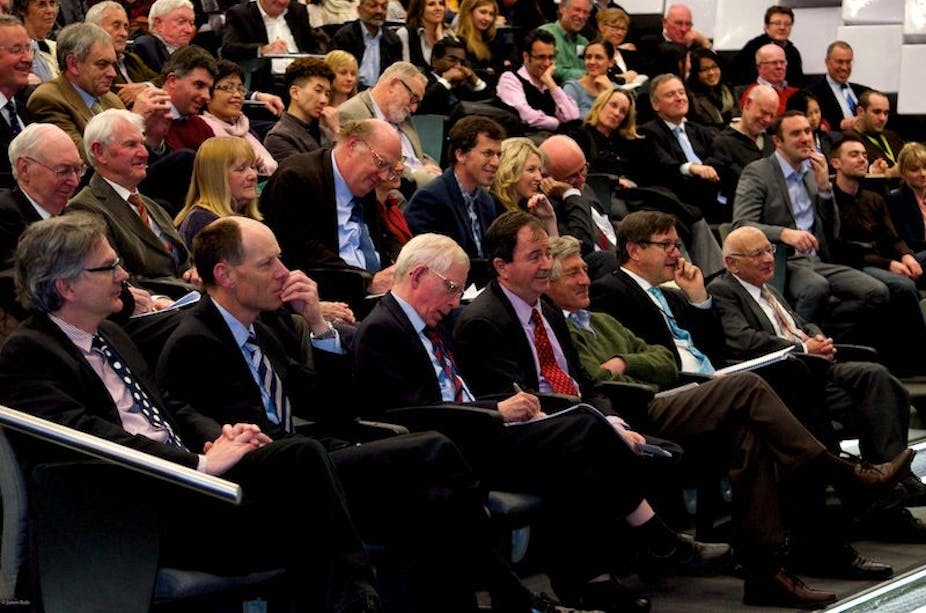
Speaking to an audience of economics students at the University of Melbourne, Mr Wolf said the real world debate on economics and the global financial crisis was one between Keynesians, Monetarists and Austrians, none of whom were seriously represented in contemporary economic discourse.
“One of the most interesting things that happened in this crisis is we all went back and resurrected economics which the academic community had basically buried,” Mr Wolf said.
“A lot of people who came out of doctoral programs over the last 20 years had no way to actually think about the crisis because there was nothing they were taught that could explain why it might happen, or how it might work.
“When we hit the crisis, an event that shouldn’t have happened as it were, we suddenly found ourselves all going back to economists who had been dead for decades.”
Mr Wolf said economists didn’t know what to do about the mismatch between the rigorous academic framework of economics and the heuristics of applied policy work.
“I don’t think it’s a simple answer, but I think that branch of economics is in pretty serious crisis, as in the thirties.”
Mr Wolf acknowledged that many economists and journalists missed the triggers for the financial crisis, but said as a result we now lived in a time where everyone was aware that economic and financial forces were important in changing the way the world works.
He said in the past there were a small number of influential voices covering economics for major newspapers, creating a bottleneck.
“Now, any academic who’s worth anything to anybody can create their own blog, and if they’re any good they will get quite a following.”
Last night Mr Wolf delivered the Corden Lecture at the University of Melbourne, discussing the lessons to be learnt from the global financial crisis.
He described the world as living in a “contained depression”, and said while it was not likely future crises could be prevented, it was possible to make the financial system more robust by ring-fencing investment banking arms from retail banking operations, as was currently proposed by the UK’s Vickers Commission.
Gary Myers
logged in via LinkedIn
Austrians ? Has their economy had a sudden dip of which I am unaware ? Perhaps the proponents of Austerity haven't managed to get a collective name yet. Still it makes being confused with Australians a bit more tolerable.
Kate Finlay
Clerical Assistant
I think that was a reference to the Austrian School of economic theory.
I have a problem with the following comment of Mr Wolf's: “Now, any academic who’s worth anything to anybody can create their own blog, and if they’re any good they will get quite a following.”
I would politely suggest that being successful with a blog is not a reliable measure of an academic's worth as an economist.
Dale Bloom
Analyst
There were some academics who have claimed that they did see a bubble developing in the US economy, and impending catastrophe.
This is an example:
http://www.academicearth.org/lectures/origins-of-financial-mess
More importantly, what do economists see for Australia?
Kate Finlay
Clerical Assistant
Rather than ask 'what do economists see for Australia' shouldn't we first work out why only a handful of economists (out of the hundreds or thousands around in the world) actually made public predictions the GFC would occur; determine the common thread of their modelling, education, or approach to the field which caused them to make those predictions; and THEN ask what THAT precise mechanism or training sees for Australia?
Given the recent track record of the economics profession I wouldn't be leaning on their general 'expertise' now.
Linus Bowden
management consultant
Dale a stopped clocked in right twice a day. Truth is the entire academic macroeconomics profession should be taken out the back and put down.
Alan Buchbach
Geo
http://mises.org/daily/1670 - Monday, November 08, 2004 by Stefan Karlsson
Only the School of Economics referred to as the 'Austrian School' predicted the GFC. The author of this article is quite correct when he says they aren't well represented among mainstream economists, they are the smallest (although fastest growing) school of economic thought.
If you are interetested in an easy-to-read and more importantly easy-to-understand set of Austrian economic principles in practice I would suggest Frederic Bastiat's economic sophisms.
http://www.econlib.org/library/Bastiat/basSoph.html
He discusses a number of subjects in story teller fashion from tariffs and protectionism to balance of trade and tax collection.
Dale Bloom
Analyst
It could be that some journalists are just as good as full time economists.
It was noticed by a US journalist that the recent increase in the number of jobs in the US just matched the increase in the US population for that period.
Added to this, most of the jobs created were actually low income jobs that wouldn’t pay for the extra infrastructure costs for the increase in population.
I haven’t heard an economist mention this.
Roxane Paczensky
Registered Nurse
Actually Steve Keen, a Minsky man, predicted it first and has an award to prove it. He started writing about it in 1995!
http://rwer.wordpress.com/2010/05/13/keen-roubini-and-baker-win-revere-award-for-economics-2/
Revere Award Citations
Steve Keen (1,152 votes)
Keen’s 1995 paper “Finance and economic breakdown” concluded as follows:
The chaotic dynamics explored in this paper should warn us against accepting a period of relative tranquillity in a capitalist economy as anything other…
Read moreMike Stuart
jaffle-maker
Economics is a behavioural science. It is in no way supposed to predict the future. If anyone could consistently and reliably predict the future they sure as hell wouldn't be jumping up and down letting everyone know about it because there would be infinite sums of money to be made - not discounting the millions that are made but this is a separate issue. Economists are not necessarily financiers. The GFC was a direct result of a inflated property prices driven by an impotent regulatory market in…
Read moreAlan Buchbach
Geo
Steve Keen's paper in 1995 did not predict the GFC. His first prediction was made in Dec 2005. More than a year after the article I cited was published, Nov 2004.
But the point I was making, is not that Stefan was the first person to pick up on the bubble, but that the Austrian theory of the business cycle identifies that a bust was necessary given the articifial boom driven by government intervention in the market place (due to misallocation of capital). It is the only school of economics to accurately and consistently explain every major event of the last century & to have predicted them in advance.
James Haughton
Social Policy Researcher
Hardly accurate. Austrians in the 1930s and 1940s were convinced that Keynesian policies would deepen the Great Depression and destroy the world's economy. Instead Keynes' insights led to the long post-war boom, still the best performing era the world economy has ever enjoyed.
Alan Buchbach
Geo
How are you measuring "best performing era" in that statement? In terms of
real wage growth and related increased standard of living, the period from
1815 and 1914 was the greatest period of economic growth in recorded
history.
It is worth noting that it was due to those Keynesian policies that instead of
Read morea relatively minor recession and rapid recovery, the great depression lasted
as long as it did and grew as deep as it did. Policies that, I should add,
greatly resemble those being…
Grant Musgrove
Director
Bravo Mr Wolf, the real cause of the Great Recession was the dismantling of economics training from a variety of perspectives. Units in economic history, schools of economic thought etc were dismantled following a hugely successful assault by the then conventional "wisdom" of the seductive absolute predictions of econometric neoclassicism. Schools of economics need to celebrate diversity, history and innovation while being humble in the face of complexity. Dogma is dangerous.
Spiro Vlachos
AL
Why is econometrics neoclassical? Is econometrics not used in the analysis of historical data used in economic history?
Linus Bowden
management consultant
I have undergraduate majors in both economics and history, and a graduate degree majoring in econometrics and finance. And yet, I have no idea what you are claiming.
"the seductive absolute predictions of econometric neoclassicism."
Whattha?
Ngoc Luan Ho Trieu
logged in via Facebook
Economists need to free themselves from the shackles of conventional economics which is based on assumptions that are easily failed by the forces of the market, or by just simple reasoning of a logical mind. Starting with market prices, economists often fail to explain daily price movement of a simple product like vegetables in an isolated market with current academic economic wisdom so I, realistically, would not blame them for their inability to produce firm acceptable prediction for the recent GFC. A new theory on market prices is a must. The new theory -free from the burden of unrealistic assumptions on consumers' and producers' behaviours- may be able to bring economic science to the status of other sciences.
David Arthur
n/a
What the hell is this bollocks about universities not training economists adequately?
Every one of those little scuz-buckets I ever encountered simply saw a B.Ec. as their meal ticket for life - their minds were closed long before they got to Uni.
Mind you, the absence of critical thinking - especially self-critical analysis - is one of the defining characteristics of the economics "profession" overall. Do their grossly over-inflated salary demands have anything to do with all the hands down their trousers?
mark mc dougall
educator
When economists are driven by profiteers looking to plunder the economy, its no wonder theres a few blind spots. The GFC occurred when there was no further way (yet conceived) to extract future profits from existing mortgages/CDO's.