
Victoria needs flexibility to get through the next drought

The notion that Australia is the driest inhabited continent on the planet has created a persistent stereotype. Recent weather shows it to be misguided. It suits embarrassed planners, myopic politicians and those peddling the next round of “drought-proofing” policies to point to the myth of the dry continent…

Kk6nc3jx-1360560950
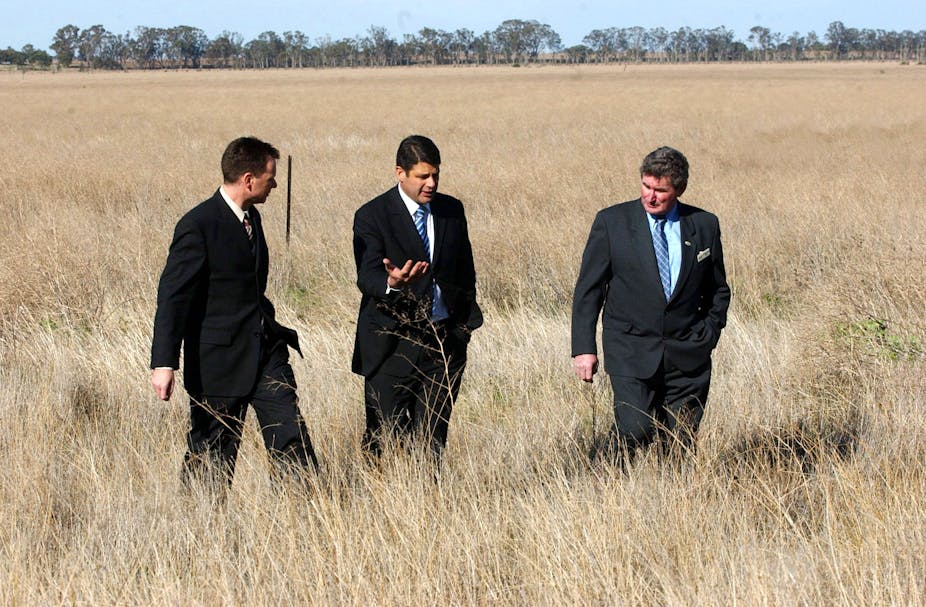
Last time around, the Victorian Government made too many decisions predicated on a stereotyped idea of Australian drought. AAP Image/Julian Smith

The notion that Australia is the driest inhabited continent on the planet has created a persistent stereotype. Recent weather shows it to be misguided.

It suits embarrassed planners, myopic politicians and those peddling the next round of “drought-proofing” policies to point to the myth of the dry continent, but in reality Australia’s rainfall and water availability is highly variable.

The challenge we face is not just dealing with drought, but how to handle enormous fluctuations in water availability and to cater for the risks and uncertainties involved.

Victoria provides a good example of how variability can prove troublesome for the institutions we have created to manage the supply of water. As John Quiggin succinctly put it “the policies of the Victorian government have been more consistent [than the Commonwealth]. Unfortunately, however, they have been consistently misguided”.

Victoria’s governance systems do not have the adaptability that’s required to manage variable water supplies. Climate change is likely to further expose their deficiencies.

One of the peculiar features of Victoria’s irrigation sector was that much of it grew to favour perennial activities, like horticulture and dairying. This is partly due to the type of entitlement and allocation system that was developed.

Specifically, Victoria managed the water it held in storage relatively conservatively – banking next year’s water before accessing this year’s.

That conservatism worked well in terms of providing a sense of security about water. But shoring up water counts for little when the produce has to be sold at a loss. The significant contraction in the number of dairy farms witnessed in northern Victoria, even during wet years, is evidence of the critical importance of output prices – not that water planners pay much attention to this.

Nonetheless, the commitment to perennial agriculture on the basis of valuable but ill-defined “flow-on” benefits to communities lingers today. Routine announcements about the so-called “value” of these sectors to the Victorian economy are used to rationalise immodest calls on the public purse during times of water shortage – or to sponsor foolhardy development in times of plenty.

On the urban front, the focus has been justifiably directed at Melbourne’s water demands and the impacts of a growing population. Regional communities still face problems when water becomes scarce, but these are usually subsumed by the policy options selected for Melburnians.

When the last drought occurred the then Labor government followed a two-fold approach that was similar to those used in other jurisdictions. This involved water restrictions and expansive advertising campaigns – dressed up as “education” – that were designed to demonise outdoor water use.

The second element of the policy approach was a swathe of infrastructure projects, hastily brought forward to augment supply and ease public worries Melbourne would run out of water.

An inconvenience for the Victorian government at that time was the national commitment to ensure that any water infrastructure projects passed a basic benefit-cost test. When some of these projects proved difficult to justify, various forms of voodoo economics were invoked.

The upshot is that Melbourne now has an expensive desalination plant, a pipeline joining urban water supplies to comparatively low-value agriculture in the north, and a community with some segments that are passionate about water-saving at almost any economic or social cost.

So how well will Victoria cope with the next drought?

As witnessed with the previous drought, the most successful coping strategies are tied to a decision makers’ capacity to be flexible to differing levels of water availability as new information emerges over time. It does not pay to guess too far into the future about the length or severity of drought, and over-reliance on historical data can make decision makers look foolish.

Economists sometimes call this a “no regrets” approach – choosing approaches that make good sense now, but not rushing ahead such that options close off too quickly or involve heavy and potentially unnecessary costs in the future.

An example of this approach is the current physical interconnection between Melbourne and agricultural water supplies in the north of the state. If used appropriately with water markets, this type of infrastructure has much to offer for Melburnians, farmers and environmental interests.

For example, a variety of market instruments can be used to distribute the risks and consequences of drought, ensuring that those who can afford to go without are well-rewarded, while those who need it can continue to have access to the resource.

In the last drought, dairy farmers used the market to sell water rights, employing the proceeds to stay in business. The purchasers of water, often horticulturalists, were also able to continue to produce in spite of the severity of the conditions.

However, this trade was restricted to agriculturalists – politicians get nervous about water traded to cities and the environment.

This is unfortunate, as to get the most out of these types of markets, all water users should be in the market. Higher diversity of users leads to more innovative trades.

Unfortunately, the Victorian government has shown no appetite for this kind of change. One of the first actions of the current Minister for Water, Peter Walsh, was to place a drought threshold on the use of the north-south pipeline that virtually takes it out of the market equation for Melburnians.

Less publicised were the immediate costs to Melburnians, and the flow-on consequences for farmers, who in the longer term could sell their water or use options contracts to cushion their businesses against drought.

The Victorian government’s rationale for restricting trade is apparent concern for the parties involved. But this misplaced nervousness about trading water assumes that the government knows when the next drought will occur, how long it will last and the cheapest way to see it through.

By almost any measure, the evidence does not support this idealistic view of government. It does not bode well for a flexible approach to drought in the future.

Join the conversation

11 Comments sorted by

  1. Mike Hansen

    Mr

    "Melbourne now has an expansive desalination plant"

    that was a real head scratcher until I twigged. Should that be

    "Melbourne now has an expensive desalination plant"

    report
  2. John Newlands

    tree changer

    Victoria could have killed two birds with the one stone by co-locating the Wonthaggi reverse osmosis desal with a nuclear power station, thereby utilising waste heat and eliminating either Hazelwood or Yallourn brown coal fired plant. At some point we'll need to assess whether the 'offset' wind farms really do save the full amount of CO2 from the electricity used.

    It's noteworthy that Melbourne survived for about two centuries without tapping into Murray-Darling Basin water. Perhaps this is not a forward step. Along with the fashionable solar panels suburban homes should have 30 kL rainwater tanks. That just leaves the problem of finding water for farming in the near 50C summer heat.

    report
    1. David Jones

      Engineer

      In reply to John Newlands

      No John, reverse osmosis does not use heat. It uses high pressure pumps to force seawater through filters. Nuclear energy would just make the problem worse as it uses even more cooling water than coal generation.
      Fashionable rainwater tanks have been demonstrated over and over to be a very expensive way of getting water.
      A purely pragmatic solution to Melbourne's water problem would have been to buy back the water rights from irrigators in Gippsland. The irrigation water used is a close match in volume to the maximum output from the desal plant. Most of the irrigation water is used for dairy pasture to produce milk product of which the majority goes to export markets. The approximate value added is about $200 per Ml for dairy production. The cost of the desalinated water is about $5000 per Ml (assuming it was run at capacity, much more if used less) Essentially, what has been set up in Victoria is a massively expensive dairy export subsidy programme.

      report
    2. Mike Hansen

      Mr

      In reply to David Jones

      Where does the $5000 per ML (I assume that megalitre is the unit your are using) come from David?

      The only figure I could come up with is $1600 per megalitre. This comes from the Libs so I assume it is worst case.

      "On average, the retailers pay Melbourne Water 70¢ a kilolitre. But the opposition's figures show that once the desalination plant is operating, it will cost Melbourne Water $1.60 to buy a kilolitre of water."

      http://www.theage.com.au/victoria/state-election-2010/water-bills-to-double-again-20101030-17899.html#ixzz2LE9GfsXL

      report
    3. John Newlands

      tree changer

      In reply to David Jones

      I'm making two assumptions
      1) Wonthaggi has suitable seawater immersion cooling so no evaporation is needed for most of the heat exchange ie no cooling towers
      2) multiflash distillation MFD could be used for some of the desalination using waste heat, perhaps with reverse osmosis RO in a hybrid system.

      Example of seawater cooling; Northern power station, Pt Augusta.
      Example of MFD; Shoaiba combined power plant, Saudi Arabia.

      report
    4. David Jones

      Engineer

      In reply to Mike Hansen

      Mike Hansen, my figure of $5000 per Ml is just a rough number based on widely quoted costs of around $700 million per year and the rated output of 150 Gl per year, giving $4667 per Ml. This is a very rough number as all I know of the real costs are what is reported in the press (hardly reliable). However with reported capital costs of somewhere between 3.5 and 5 billion, it seems a reasonable number.
      What Melbourne water pay would depend on many things but remember that even if the Wonthaggi plant was working at capacity all year, it would only produce about 40% of Melbourne's current requirements. On that basis, my $5000 /Ml and your $1.60 /kl are not so far apart.
      The upper case M is the international standard prefix for Million (Mega). You often see mW used in press coverage of power stations etc. which is pretty amusing (or sad) for anyone who understands how SI units work.

      report
    5. David Jones

      Engineer

      In reply to John Newlands

      John, that makes more sense than I understood from the original comment. However, MFD is even more capital intensive than RO I believe. That would be very bad for a plant which may get only intermittent use. Never mind the cost of the nuke.
      I suspect the amount of water involved in the desalination is tiny compared to what is used for seawater cooling unless you have a very high discharge temperature. Have a look at Northern PS on Google Maps. The combined intake and discharge channels are about 200m wide and Northern is a relatively small PS. Newport PS in Melbourne also has a 100m wide discharge channel, known to fishermen as "The Warmies". I could not imagine such a thing being built through the dunes near Wonthaggi.

      report
    6. David Robinson

      Environmental scientist

      In reply to David Jones

      Don't know where you are getting your figures from for fashionable water tanks or was that just a throw away line. Based on my own experience our 9000 litre water tank cost us about $3000 to install and plumb into the house. Over the last four years it has provided us with about 90% of our households water or about 90 Kl/year. Using the $5000/Ml as a benchmark cost the cost per Ml for water supplied from our tank (factoring the savings on our water bill)drops below that figure after four years…

      Read more
  3. Chris Owens

    Professional

    The question of water requirements for Victoria and Melbourne in particular will never be resolved whilst we have a ponzi based population policy. The population of Victoria has increased by 1.8M since construction commenced on the Thompson Dam which was supposed to drought proof the state.

    The first issue to be resolved is: what is an acceptable carrying capacity for the land, factoring in expectations of climate change, peak oil, phosphorus availability, retention of habitat to be retained, etc.

    To continue on blindly as we are doing is a definition of stupid.

    report
    1. Trevor S

      Jack of all Trades

      In reply to Chris Owens

      "To continue on blindly as we are doing is a definition of stupid."

      I blame the Voters.

      report