


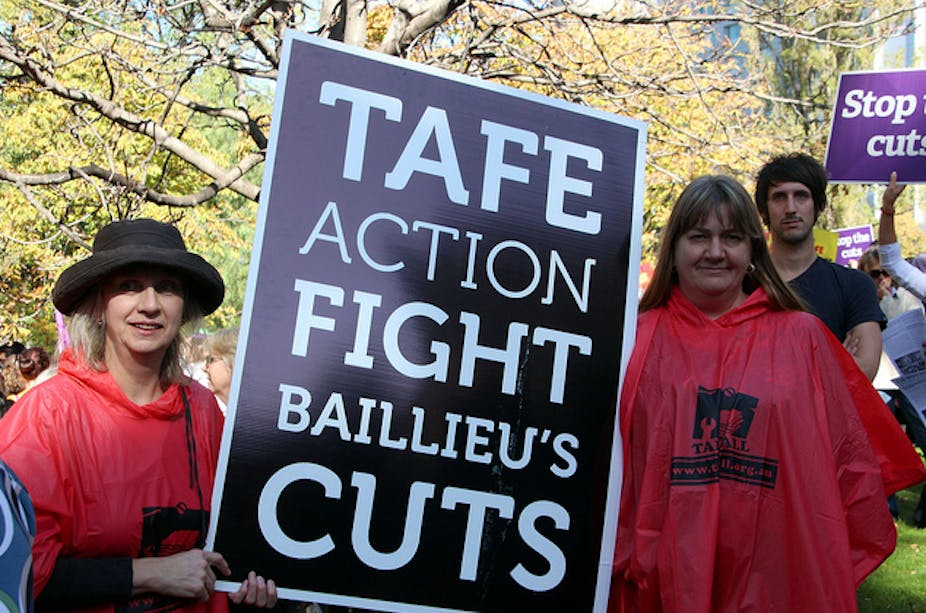
For years, those concerned with vocational education and training have worried about how to lift the public profile of TAFEs. But what has taken many years for some – without much success – the Baillieu government in Victoria has done in a matter of weeks.
The state government’s cuts to TAFE in the May budget has put vocational training front and centre of public attention. All the while demonstrating a surprisingly deep well of public regard for these educational institutions.
There have been literally hundreds of media reports on the funding cuts worth $300 million, in all forms of media – metropolitan, regional and national.
At first, even the Victorian higher education minister Peter Hall was opposed to the cuts and considered resigning in protest. Although he is now vigorously defending them as reforms that make TAFE “better”.
So how has TAFE come to this point in Victoria? And are we likely to see similar “reforms” adopted elsewhere?
Cut to the bone
To give you an idea of what will happen to TAFEs under the cuts, the University of Ballarat TAFE restructure consultation paper revealed that changes would leave the university $20 million in debt by 2013, reduce its total TAFE activity by 30-40% and reduce services throughout the rest of the university.
The changes have also meant that Victoria’s only Australian sign language course will go.
In fairness, these changes haven’t all been down to the Baillieu Coalition government. It inherited “skills reform” from its Labor predecessor, which opened up public funding of vocational educational and training provision to all comers. Since then there has been an explosive growth in Vocational Education and Training (VET) – and with it the call on funding – following the “uncapping” of enrolments.
While training enrolments in skill shortage areas such as carpentry, plumbing, civil construction, aged care and nursing went up 10% over the past couple of years, programs in fitness and sport coaching went up by up to 4000%. This, the government has argued, is why the funding was unsustainable.
Rorting rife
The government also says that the system has been shamelessly rorted with enrolled students being paid to undertake training, multiple enrolments to boost payments for training, abuse of the the Recognition of Prior Learning assessment to obtain the 100% subsidy and the offer of free gifts such as iPads for students to enrol.
Providers have also been granting diplomas on the basis of 60-80 hours work even though the Australian Qualifications Framework requires about 600–800 hours for a diploma.
The government has vowed to crack down on the rorting but there are two details which have been ignored. First is that the explosive growth in fitness training and sports coaching has taken place in the private not public sector.
Second, every single identified instance of out and out rorting and illegality has been by private providers (although Hall has pointed to legal though dubious practices by public TAFEs, as well).

In that context, cutting TAFE funding by $300 million and placing TAFE funding on the same basis as funding to private providers as a response to the evident problems with “skills reform” in Victoria is counter-intuitive.
The Victorian government is essentially compounding a mistake with another mistake.
Other states to follow?
Other states are undertaking their own processes of “skills reform”, as part of national arrangements, which will see market reforms, a greater role for private providers and access to public funding.
They have been closely watching and deconstructing the Victorian process precisely because it provides a great template in how not to reform vocational training.
After all, this open slather has resulted in a budget blow-out, a misallocation of funding to low priority training and millions of dollars of profit from the public purse to private providers, as well as debasing qualifications. Not to mention a public system which is now destabilised with big gaps likely in provision and stranded public assets.
South Australia launches its own more market oriented system on 1 July and shows every sign of having drawn rational conclusions. It will limit places rather than prices to avoid runaway growth in its forthcoming training market, as it strives to avoid the problems that have plagued Victoria.
The Australian reported that Elaine Bensted, chief executive of TAFE South Australia, said she’d been “horrified” by the funding rates provided by the Victorian government and that South Australia’s rates would be far more generous.
The state will also limit the number of providers with access to the funding through an “onerous” application process. Victoria has 536 colleges approved to teach government-funded courses, after the number of private providers snowballed from 200 to 430 in three years.
Bensted has also said South Australia had received 200 applications but had so far approved just six providers, six weeks out from launching its own training market. South Australia also intends to cap publicly funded enrolments in disciplines showing signs of outlandish growth, such as the 20-fold increase in fitness instructor enrolments in Victoria.
The Deputy Director-General of Training and Tertiary Education Queensland Deb Daly has also vowed “not do what the Victorians did”. She said Queensland wants to avoid cost blowouts that necessitated rapid changes, unlike Victoria which has overhauled its skills system three times since last September.
Is there a Plan B?
You would think that, given the furore that’s erupted and rumblings that regional Coalition members are none too happy, the Bailieu government might be working on “plan B”.
Apparently not. The government is standing firm in public and aggressively defending its budget measures. The Victorian opposition too seems to be staying well away.
The game changer may well be the Commonwealth government, which has in its purse some $435 million in funding for Victoria under the VET National Partnership Agreement brokered at the Council of Australian Governments in April, an agreement to which Victoria is a signatory.
Following an “emergency meeting” with TAFE leaders, Commonwealth minister Chris Evans said that the Victorian government had failed to adequately address the Government’s concerns. He posed the question most people are asking:
How do you grow quality training and cut $300 million out of TAFEs?
It seems this question really has no credible answer.
This piece was co-authored by Brendan Sheehan and Leesa Wheelahan
Brendan Sheehan is a Melbourne policy consultant and former Skills Victoria executive. He publishes The Scan every week which reports on developments in tertiary education in Australia http://the-scan.com/.
Leesa Wheelahan is an associate professor at the LH Martin Institute at the University of Melbourne.