

Want safer cycling? Don’t dismiss dooring

Every year, more Australians – particularly in cities – are riding to work. More cyclists means fewer cars on the road, less congestion, less pollution and fewer health problems. But every year more people are injured riding bikes, many of them following crashes with opened car doors. Are we doing enough…

Qhxjg8z5-1336541230
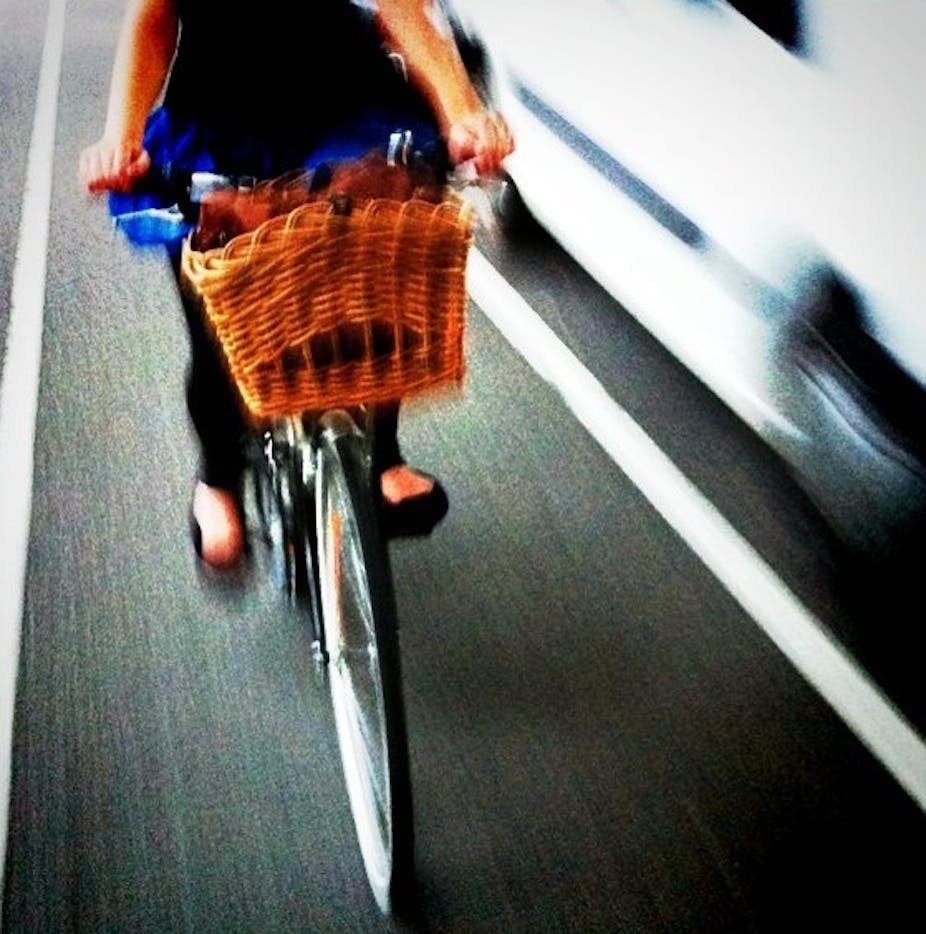
Care and consideration make the road safer for everyone. Enforcing the law helps too. Fernando de Sousa

Every year, more Australians – particularly in cities – are riding to work. More cyclists means fewer cars on the road, less congestion, less pollution and fewer health problems. But every year more people are injured riding bikes, many of them following crashes with opened car doors. Are we doing enough to keep cyclists safe?

Officially known as “cyclist-vehicle door opening crashes” (but usually called “dooring” or being “doored”) these crashes happen when the door of a vehicle that is parallel parked on the side of the road is opened into the path of an approaching cyclist. The cyclist collides with the door, falls off their bike, and is sometimes then in danger of colliding with moving traffic. In Victoria, one person has died in a dooring incident.

Who’s getting hit by doors, and how much does it hurt?

Between 2000 and 2010, both police and hospitals reported an increase in dooring crashes in Victoria. The police reported 1,088 cyclist-door crashes, with an increase in these crashes of 125% from 2000 to 2010.

Of these crashes, 82.8% were during the week, 81.1% during daylight hours, and many in peak travel times (8-10am 18.7%; 5-7pm 22.2%).

Hospitals reported 401 cyclists presenting to hospital after a crash with a car door. Of these, 65.8% were males, and 70% were aged 20-39.

The body region most commonly injured was the shoulder (16%). Seven cyclists (1.7%) sustained an intracranial injury. Most cyclists were treated and discharged (83.8%), with 16.2% admitted to hospital.

In Victoria, this crash type affects adults almost exclusively: police reported 99.1% of cyclists involved were aged 16 years of older. All hospital presentations were cyclists aged 15 years and older.

This is also a mainly metropolitan crash type. The majority of police-reported cyclist-car door crashes occurred in the Melbourne CBD (22%) or metropolitan Melbourne area (73%).

Cyclist crashes with unexpectedly opened vehicles doors can be fatal. In March 2010, James Cross, a 22 year old arts-law student at Monash University, was killed as the result of a car door crash. James was riding along Glenferrie Road in Hawthorn when a driver unexpectedly opened her vehicle door in front of him. James hit the door and was thrown from his bike and hit by a truck in an adjacent lane.

Will fixing parking help?

The two main contributing factors in cyclist-car door crashes are the environment: road design, and the way road users (particularly drivers) behave.

Road design is a significant factor in cyclist-car door crashes. On many roads with a bike lane, when a driver suddenly opens their door there isn’t enough space for a cyclist to safely swerve without moving into the adjacent vehicle lane.

There are engineering solutions that could reduce or eliminate these crashes: wider bike lanes, angle parking or reconfigured bike lane/parking bays that position the bike lane away from parallel parked vehicles.

But redesigning roads can create new issues. For example, in Albert Street, East Melbourne, the bike lane was moved from the drivers' side of parked cars to the passenger side. This has eliminated cyclist-driver side door conflict. But it has increased cyclist-pedestrian interactions, as all vehicle occupants now have to cross the bike path to reach the footpath.

There is no single engineering solution for all sites. To increase cyclist safety while still making it easy for cars to drive and park, we need a comprehensive review of current parking options. Most importantly, any changes to parking must be accompanied by appropriate education for drivers and cyclists.

How to improve the situation: drivers

Driver behaviour is a significant factor in cyclist-opened vehicle door crashes. The most obvious and direct solution is for drivers to always check for cyclists before opening any vehicle door. To change the habits of many drivers will require extensive investment in behaviour change and driver education campaigns.

One way to stop such habits from forming is to train new drivers to interact safely with cyclists. We could take some lessons on driver training from countries with high cycling participation rates, such as Denmark and the Netherlands.

When drivers are parallel parked they should stop and check for cyclists, then wait for a gap in cyclist traffic before opening any doors.

When you’re getting into or out of the car, you should:

  • open the door as little as necessary, and shut it as quickly as possible
  • open the door with your left hand; this makes you twist in your seat and head check for cyclists before opening the door
  • always walk around your vehicle by walking towards the traffic: this will increase the likelihood that you will see a cyclist
  • tell your passengers to get out on the curbside
  • pack your belongings in the left side of the car so you don’t have to open the driver side rear door to get to them.

If you’re driving your car past parked cars and cyclists, you can help too. If you give cyclists at least a metre clearance, they will have some space if they need to swerve to avoid an unexpectedly opened vehicle door. “Leaving a metre” makes sure cyclists have a safe space around them whether there is a bike lane or not.

Avoiding tinting vehicle windows also helps cyclists to observe driver/passenger behaviour and gives them time to respond sooner.

Improved vehicle technology could also help. To date, the majority of vehicle technology and safety features have focused on vehicle occupant functions and protection. More could be done to protect people outside the vehicle. Manufacturers are now developing sensors to detect other vehicles in the vicinity. This could be extended to alert drivers of cyclists, motorcyclists and pedestrians. Vehicle technology that improves the safety of all road users is immeasurably more important than technology that allows a vehicle to self-park.

How to improve the situation: cyclists

Of course there are things cyclists can do to protect themselves too:

  • Always ride within your bike handling skills – make sure you always have control of the bike.
  • Travel at a speed that allows safe braking or direction change.
  • Be vigilant about drivers/passengers opening car doors; check for heads through rear and side windows and side mirrors.
  • Increase your visibility by using front lights, especially at twilight and on overcast or rainy days.

Finally, the role of enforcement is essential in creating a safe space for cyclists. The current rule in Victoria is that “car drivers and passengers must not cause a hazard by opening their car door”. The current maximum penalty for this offence is three penalty units. The current infringement able to be issued on the spot by police is one penalty unit. Currently one penalty unit is valued at $122.14 (until 30 June 2012). This is one of the lowest penalties in Australia. In NSW and Queensland, the maximum penalty is 20 penalty units and in South Australia, drivers incur 3 demerit points.

In addition to the low penalty, there also seems to be a reluctance to enforce penalties for this offence. When James Cross was killed, the officer who attended the crash scene told the state coroner that “her ‘bosses’ at her station informed her that a charge against [the driver] would not be authorised”.

If the existing laws regarding driver behaviour are not currently effective or not actively enforced, it is essential that these laws are reviewed to ensure that cyclists are judicially protected.

Join the conversation

70 Comments sorted by

  1. Tom Nockolds

    Project Manager

    Want to reduce dooring? Don't dismiss infrastructure

    This is a good article from Marilyn on some of the behavioural changes that could contribute to reduced incidence of dooring in our cities. As the article rightly points out, there are two main contributing factors to these sorts of crashes: "road design, and the way road users behave" - and the article goes a long way towards explaining how to resolve *just one* of these main factors and in doing so is running the risk of "dismissing" infrastructure…

    Read more
    1. Derek Bolton

      Retired s/w engineer

      In reply to Tom Nockolds

      I agree.
      Many councils have taken to marking cycle lanes which double as car parking. These are wider than is needed for a parked car, but often only by about a metre or less. Not only does this invite dooring, but many drivers park anywhere inside the line, often leaving no cycle lane at all.
      A simple modification would help in a couple of ways: another line to indicate the edge of the parking area. This would often be only half a metre to the left of the existing line, so the gap between them would not constitute a cycling lane, but I feel it would make the drivers more aware of the potential presence of cyclists. It would also help to stop drivers walking straight out in front of cyclists when returning to their cars.

      report
    2. Paul Richards

      strategic foresight

      In reply to Tom Nockolds

      "some lessons from Denmark and the Netherlands but fails to mention ................ improving cyclist safety is to build separated cycling infrastructure." - Tom N.

      Tom - I agree, however this article shows a clear bias toward one type of infrastructure and attitude. In the article we cyclists are told;

      "How to improve the situation: cyclists" as if any cyclist in traffic is unaware already!

      We do have infrastructure, but it is biased on a 1950s paradigm that is long dead. New York, London…

      Read more
  2. Dave Smith

    Energy Consultant

    Who is liable when an accident happens? Is it the car driver? Their insurance company? The local council? A few high profile cases involving thousands of dollars in damages would help to change behaviour.

    report
  3. Angelina Russo

    Associate Professor of Communication at RMIT University

    "tell your passengers to get out on the curbside"

    I seem to recall that taxi drivers in the US don't allow you to get out on the street side of the vehicle.
    Many of the incidents I've almost been involved in as a cyclist have been the result of taxi occupants swinging doors open wherever the taxi might stop. I now watch all car occupants at traffic lights, in case they decide to get out of the car at the lights instead of a drop off point further on.
    It isn't easy being on the road as a cyclist…

    Read more
    1. Donncha Redmond

      Software Developer

      In reply to Angelina Russo

      It's also worth noting that, here in NSW at least, taxis contain a notice that says that the passenger is responsible for any accident as a result of opening their door.

      report
  4. Richard Monfries

    logged in via Twitter

    All of the above.
    Improved cycling infrastructure - check.
    Awareness education in the form of behaviour change programs (for car drivers & cyclists) - check.

    Yet the hardest nut to crack over this growing issue of more frequent cyclist/motorist negative interactions is that hoary old chestnut - rights and responsibilities.

    As a cyclist, and the smallest vehicle on the road, I have the right to be protected form the behaviours of other - bigger - vehicle (multi-wheeled) users. I also have…

    Read more
  5. Jason Brown

    logged in via Facebook

    How I avoid dooring is probably the very thing that annoys drivers most about cyclists. I assert control over the lane. I move out from parked cars and into the traffic stream. It's legal, at least in NSW, to do so - even if it does annoy drivers, I'm not going to smash into someone's surprise door and maybe bounce off into the traffic.

    This isn't a solution for everyone. You need to be fast, confident and a little brash to do it, but it makes sure you're not hit by inattentive drivers.

    Of…

    Read more
  6. John Berry

    Director

    I have to agree with all the above comments.

    As a car driver and a newish cyclist I'm looking at both sides and am starting to wonder if an actual licence for bikes wouldn't be a good idea. Or a certificate of competence, or something.

    Pure awareness would have an effect on dooring I'm sure, but I wonder how many other types of accident we could reduce by education through certificate. Younger bike riders especially have no idea that cars really do have "blind spots" and will sometimes sit…

    Read more
    1. Jason Brown

      logged in via Facebook

      In reply to John Berry

      The majority of local councils already run cycling competency courses, and they do include sections on how to ride in traffic, so it wouldn't be too hard to implement. But enforcement, now enforcement is a different thing altogether.

      I'm more in favour of that than I am of the inevitable (and tedious) call for rego plates on bikes that gets trotted out in comment areas. *That* is unworkable and largely useless.

      report
    2. Richard Monfries

      logged in via Twitter

      In reply to John Berry

      Hey John

      Check out Austcycle http://www.austcycle.com.au/ , backed by the Amy Gillett Foundation among others.

      I've just embarked on training to become a certified Austcycle teacher, and it's been fantastic to share a few pearls of wisdom gained from 30+ years on a bike with newcomers to The Revolution!

      report
    3. Paul Richards

      strategic foresight

      In reply to John Berry

      I can not agree with anyone who thinks that a - cycle licence - and throwing responsibility for being hit or doored on to a cyclist is at all realistic. Our cites are biased and our reading of "traffic law" is biased toward the current vehicle infrastructure. The law is black and white, the car drivers are at fault.

      This level of thinking is about as far from the humanised form of cites previous generations designed as we could get. All we need to do is put motor vehicles in there proper place, instead of coming up inept solutions that completely ignore brilliantly successful solutions found in Europe.

      Why is it a cyclist fault is someone opens a door on them?
      Why do you need a cycle licence because of an infrastructure bias toward motor vehicles?

      Please do your due diligence before commenting.
      Here is a good starting point.
      http://www.youtube.com/playlist?list=PL1BE9A8FAB3FDA95D

      report
    4. Jason Brown

      logged in via Facebook

      In reply to Paul Richards

      I don't think that's quite what the OP is saying - but close. Riders have a part to play in preventing accidents, and while they cannot prevent all doorings, they can ride defensively as a means of avoiding accidents, which I think was the thrust of the competency and training course suggestion.

      Yes, a driver is almost always at fault in doorings, but nevertheless, confident skilled riders *can* sometimes make doorings less likely.

      report
    5. Jason Brown

      logged in via Facebook

      In reply to Jason Brown

      and please note, I only said "almost always" because, while I find it hard to come up with a scenario in which the rider is at fault, I'm sure there are *rare* scenarios where it's not the driver's fault. Such as, perhaps, night-time doorings when the rider hasn't been carrying lights

      report
    6. Paul Richards

      strategic foresight

      In reply to Jason Brown

      "I don't think that's quite what the OP is saying"

      No however she has gone soft on this real issue of 2 tonnes of steel vs 10-20 kg, there is no excuse for defending motor vehicles against cyclists. Humanising cites needs to be done and she clearly thinks it is failing by her comments;
      "But redesigning roads can create new issues................
      increased cyclist-pedestrian interactions, as all vehicle occupants now have to cross the bike path to reach the footpath."
      Pedestrians are at risk from poor infrastructure as well as cycles, and in Europe cyclists and pedestrians mix without issues.

      This video shows what we have lost, our cites were built like this. Most of us do not even realise the difference between a Street and a Road anymore or never have know the difference
      http://youtu.be/DgOFYVXzEVE

      report
    7. Paul Richards

      strategic foresight

      In reply to Jason Brown

      Jason - in law the driver dooring a cyclist, lit or not is at fault. No exception.
      I admit carrying this type of bias once, but have now studied the issue of "Humanising Cities" and have a different perspective. A good place to start is this set of videos;

      http://www.youtube.com/playlist?list=PL1BE9A8FAB3FDA95D
      My favourite is this design - "Junction design the Dutch - cycle friendly way"

      We literally have been living this Utopian US Motor Vehicle Paradigm since the 1950s and it is about time we went back to the infrastructure that was "Australian Cities" for most of our history.

      We are fed a steady diet of "spin" from the motor vehicle lobby like this;
      http://goo.gl/vFucw

      Naturally we do not see the truth.

      report
    8. Jason Brown

      logged in via Facebook

      In reply to Paul Richards

      I am aware of that, Paul. I *am* a cyclist. I'm not talking about the legal liability, I'm talking about very rare instances in which in *fact* if not in *law* the rider is at fault. Cyclists can be idiots too, and there are very, very rare scenarios in which cyclists might cause or "invite" (for want of a better word) an accident.

      I thought that was relatively clear, but obviously not

      I also agree that humanising cities would be marvellous, I really do. But that's a long-term solution and…

      Read more
    9. Paul Richards

      strategic foresight

      In reply to Jason Brown

      Jason - the whole point of the law is to show clear "responsibility".
      If you were talking about an accident you would be right.
      Dooring is preventable, the driver checks before creating a dangerous situation.
      I am pleased you are aware of how do avoid idiots in cars who open doors. But personally, I have know plenty like you with injuries and compensation payouts from insurers to say your mindset is wrong on the issue. In law and reality, dooring is no different to than a driver at a stop sign…

      Read more
    10. Paul Richards

      strategic foresight

      In reply to Jason Brown

      Jason - that is a cop out.

      From my perspective you have read little of the on going town planning that is rolling out regardless of what the pre generation y believe. As for the "law', that is neither pragmatic or idealistic.

      It is interesting I can understand your perspective, but you can not grasp the "humanising of cites" and the motor vehicle industries campaign against it.
      But are content with tweeking, here and there, or business as usual.

      report
    11. Jason Brown

      logged in via Facebook

      In reply to Paul Richards

      Paint me however you want Paul, you know in the end it's just a strawman of my position.

      report
    12. Paul Richards

      strategic foresight

      In reply to Paul Richards

      What the? There is only two positions, for the vehicle lobby or against it. That is no straw man issue.
      That is fence sitting.

      report
    13. Jason Brown

      logged in via Facebook

      In reply to Paul Richards

      WRONG.

      This is not a black and white issue - nothing ever is. Such un-nuanced thinking is truly absurd.

      My position recognises that there are good arguments on both sides and that a compromise needs to be reached, and that compromise cannot be found immediately, and that it may, in fact, never be found. Yours, it appears, is the Bush Doctrine of "you're with us or you're against us"

      report
    14. Paul Richards

      strategic foresight

      In reply to Jason Brown

      I understand bias like this, but there can simply be no compromise on human life and the risk a tone of metal posses to pedestrians and the public. There are no grey areas but those encouraged by sixty years of utopian motoring dream sold to the public.

      report
    15. Jason Brown

      logged in via Facebook

      In reply to Paul Richards

      "the risk a tone[sic] of metal posses to pedestrians and the public"

      With that risk comes benefits. If you don't recognise this, then you're as blind as any other extremist.

      In addition to being a cyclist, I'm also a driver.

      I *need* my car because my partner is disabled. She cannot walk any appreciable distance and public transport options are woefully inadequate. Without it, We'd be forced to take taxis everywhere, or be confined to a small range of our local suburb. This is a benefit…

      Read more
    16. Paul Richards

      strategic foresight

      In reply to Jason Brown

      "This conversation is over" that's ok. I am disappointed you chose to fall for the"fear"the automobile lobby put out.

      "There are great benefits, social and economic, that come from well-ordered motor transport" Jason we are one mind on this and I challenge anyone to show me that the utopian dream exists in any Australian city.

      For that you will have to go to the Netherlands Model started in the mid 60s, and that is a place you fear to go.

      But hey that's your journey and thankfully it…

      Read more
    17. Jason Brown

      logged in via Facebook

      In reply to Paul Richards

      Wait a minute. Just one more.

      You take my outlining of some potential benefits of car ownership and spin that as my falling for propaganda from the auto lobby? Because no-one could possibly arrive at these conclusions logically, it has to be some kind of manipulation by the dark powers of big auto?

      Did I read that right?

      If so, you're also a conspiracy theorist, as well as being a denier of compromise. You're a frootloop, Paul.

      YES, cities need to be improved. We are, it seems, in agreement…

      Read more
    18. Paul Richards

      logged in via Twitter

      In reply to Jason Brown

      Jason - thanks for the reply.
      I will not rise to the "fruitloop" comment you are entitled to the vernacular. I respect the language of older Aussies and get what you mean, I have been accused of being "green" and "socialist" as well. So that is fine, very wrong but still no drama. My world view is not as narrow as those labels imply.

      Our conversation has been one sided because as there has been a failure to grasp or comment on the European Model for transport infrastructure.

      If that offends…

      Read more
    19. Jason Brown

      logged in via Facebook

      In reply to Paul Richards

      "I respect the language of older Aussies and get what you mean"

      Whoah there tiger. What's that meant to mean? Who do you think you're talking to exactly?

      Unwarranted assumptions on top of black-or-white thinking, strawmen and conspiracy? Are you going for the full set?

      report
    20. Paul Richards

      logged in via Twitter

      In reply to Jason Brown

      Jason - no comment on the actual subject.

      Disappointing, but understandable. Humanising of cities encompasses, Form-based codes for buildings and that would be a leap to expect the discussion to go to that.

      Form based codes mean, you and your disabled partner would not need to travel far to find a medical professional or facility, now essential in all Australian cities. Which circles back to transport infrastructure.

      report
    21. Jason Brown

      logged in via Facebook

      In reply to Paul Richards

      Paul, I don't know if you've noticed, but my last few post have not been about the original topic. That was dealt with some time ago. I agree on the aims - more livable cities - but differ on the achievability of those aims in a short time in Australian social conditions. End of story. Argument over. WE'RE DONE there.

      No, my recent comments have been about your stunningly bad advocacy. You've argued almost exclusively with logical fallacies, from Black vs White, through Strawman, through assigning motives to me which I do not hold and you cannot possibly know for sure, calling me a victim of propaganda, dodging my questions in response and, weirdest of all, calling a mid-30s British male an "old australian" and "jingoistic".

      It's laughable, Paul, it really is. But you've given me a nice topic to blog about, so thank you.

      report
    22. Paul Richards

      logged in via Twitter

      In reply to Jason Brown

      Jason - bad advocacy, interesting.

      I have been having a dialog with you after you terminated our conversation, and I quote;
      " ..This conversation is over.. "

      I make no apologies for the call that your mindset was that of a baby boomer. Re read what you have written and tell me car advocacy is not the domain of the older thinker set in their ways? Sounding like Jeremy Clarkson is nothing to be ashamed of it is a legitimate position. Jeremy regularly takes the piss out of car owners with his…

      Read more
    23. Jason Brown

      logged in via Facebook

      In reply to Paul Richards

      And there's that problem again. The black & White fallacy

      According to you, I'm arguing from a position of "car advocacy".

      I'm doing nothing of the kind. I'm a cycling advocate that happens to recognise that cars have a place, like it or not, in transport strategies. I want higher adoption of cycling, and I want better provision for cyclists, and I want cities to be better places to live. I want to see a permanent end to traffic jams and rush hours, and yet in your mind, this is "car advocacy"?

      http://yourlogicalfallacyis.com/black-or-white
      http://yourlogicalfallacyis.com/strawman

      All I'm doing, I repeat, is differing from you on how much can be achieved and how soon.

      Basically, Paul, arguing with you is like playing chess with a pigeon.

      If you're an advocate for cycling, you're putting me off the entire thing. Stop being such an arseclown.

      report
  7. Adrian Tritschler

    logged in via Twitter

    I've had a huge increase in the number of left hand doors thrown open in traffic. Drivers either can't be bothered finding somewhere to park or don't care, when the traffic slows to a stop the passenger just throws the door open and gets out -- typically at train stations, shops or traffic lights. Usually followed by the car passengers screaming abuse at the cyclist to "watch where they're going."

    report
    1. John Harland

      bicycle technician

      In reply to Adrian Tritschler

      You have some chance of training drivers to keep a lookout before opening doors. The chance of training all passengers is remote and they will often open the door before the driver is aware. (and that includes taxi drivers, I can tell you from my own being there)

      It is noteworthy that the only time I have been caught by a lefthand door it was the person who usually drove the car who opened it without looking. It was not simply an unaware innocent. The lefthand mirror is not adjusted to allow a…

      Read more
  8. Tom Anderson

    Chemical Engineer

    As a commuting cyclist, I found by far the best way to "improve the situation" is to ride more than a door's distance from any parked car. If the road infrastructure does not allow this, of course it should be changed. In the meantime I'd suggest cyclist find another route. If you must cycle within a door's distance, then keep your speed below 15km/hr.

    Surly this is a lot safer than taking your focus off the traffic by trying to stare into the vehicle of every parked car you pass?

    As an aside, I'd love to see some statistics from Melbourne on the number of accidents from car doors vs the number of accidents caused by tram tracks...

    report
  9. Spiro Vlachos

    AL

    I am often having to dodge people removing their children from their vehicle on the street side of the vehicle, both on my cycle and in my car. It is the drivers responsibility that all occupants of the vehicle are clear of oncoming traffic. If a vehicle causes harm to an individual removing children, themselves or anything else out of a vehicle, that individual is at fault and would have to compensate the owner of the oncoming vehicle for any damage. The road rules describe this as obstructing oncoming traffic. I know this because I had opened my door once in a shopping centre carpark (no oncoming traffic?) and an enormous 4wd wagon appeared in the park next to me and got stuck into my door. I was at fault. My insurer made me pay the excess and paid out the owner of the other vehicle.

    report
    1. Paul Richards

      strategic foresight

      In reply to Spiro Vlachos

      Spiro - that is a welcome comment.
      Real world experience of how the law sees the issue. Many motorist feel they have rights they do not have. I empathise with you being bullied by a 4WD who took this issue to an unnecessary extreme and typical of the bias we encourage in our urban environment.

      As cyclist, awareness of this type of mindset keeps us safe and experience re-enforces it daily. But it is little comfort when sprawled out on the bitumen, that you were in the right. It would be much better if the transport system reflected the reality of our growing cites and made them more human again. Instead of being biased to a tonne of metal or more.

      report
  10. John Smith

    Manager

    The one problem with articles such as these is they focus on the macro and don't address the main issue. The more cyclists are on our roads, the more peoples awareness of us will grow. Ask any non cyclist why they don't ride and you know what the answer will most likely be. We need safe overtaking laws now. No overtaking cyclists in roundabouts. The ability to go over solid lines (when safe) to overtake cyclists. We need to change the common perception that cycling is unsafe by making it SAFER. Infrastructure will come quicker if the administrators SEE a need a need for it rather than "build it and it will come.

    report
    1. Paul Richards

      logged in via Twitter

      In reply to John Smith

      Mark - you nailed that it.

      The Netherlands have proved that principle works, so we do not even risk anything implementing the Jan Gehl model of "humanising cites. The American's have gone further and recognised the European model of building infrastructure as well, you may find some reading on this subject interesting. At worst it will give you keywords to do research on the subject, it really is being done here by planners, it just goes unannounced.

      Buildings and our Cites need to change also;
      http://en.wikipedia.org/wiki/Form-based_code
      http://goo.gl/UPTtz

      Humanising Cites Video List;
      http://www.youtube.com/playlist?list=PL1BE9A8FAB3FDA95D

      report
    2. John Smith

      Manager

      In reply to Paul Richards

      How you deal with high volumes of cyclists in built up cities like Copenhagen, Sydney or Melbourne is one discussion. Making sensible road laws that protect cyclists EVERYWHERE is more important and needs to be sorted now.

      report
    3. Paul Richards

      logged in via Twitter

      In reply to John Smith

      Mark H - agreed, one issue here is the sheer volume of vehicles. In the Netherlands last I looked the year round commuter figures were over 44% and they have snow!

      This video illustrates why we are behind, but the good news is the model is there in Europe to copy.
      http://youtu.be/aK-ESyajHLY

      As for sensible road laws, if you take the time to read the road traffic acts and I have read those of WA, SA, and Victoria. You will find the laws are not the issue. The cyclist of the last two centuries…

      Read more
    4. John Smith

      Manager

      In reply to Paul Richards

      Paul, are you serious???

      Believe it or not I do actually read the road rules.

      Rule 144 Keeping a safe distance when overtaking
      A driver overtaking a vehicle—
      (a) must pass the vehicle at a sufficient distance
      to avoid a collision with the vehicle or
      obstructing the path of the vehicle;

      How can you say the road rules are not the issue when they allow a car to overtake a bicycle as close as they want provided they don't cause a collision? As for Shane Warne, are you seriously saying he was unaware it was illegal to block an intersection with his car and then deliberately drive his car into a cyclist when he tried to get past? Get real.

      report
    5. Paul Richards

      logged in via Twitter

      In reply to John Smith

      "Paul, are you serious??? Believe it or not I do actually read the road rules. Rule 144 Keeping a safe distance when overtaking A driver overtaking a vehicle" - Mark H.

      Really, so what is the issue?
      Yes, if an officer of the law is biased and sees 2 cm as appropriate there is an issue, which is my point.
      The mindset of the public, including law enforcement is the issue. We don't need new legislation, we need a new direction and outlook toward motor vehicles.

      Currently there are far to…

      Read more
    6. John Smith

      Manager

      In reply to Paul Richards

      Paul, you may not mind cars missing you by inches at speed but I do and I suspect so do all the cyclists who have been hit by cars who misjudged it. Shane Warne was not charged, fined or, to the best of my knowledge, even spoken to by the police over that incident so exactly was the law "applied" to him?

      report
    7. Paul Richards

      logged in via Twitter

      In reply to John Smith

      Mark H. - Where did you read I don't mind being missed by centimetres?

      That is a blatant misrepresentation of my point.

      The point is write new laws by all means.
      But when it comes to applying them, the same group will make the judgement and write the fine.

      In other words no law needs to change, it is the mindset of the idiot behind the wheel and the fine writer. As it stands now if somebody hits a cyclist by coming close, and the full weight of the current law will fall on them when…

      Read more
    8. In reply to Jason Brown

      Comment removed by moderator.

    9. Paul Richards

      logged in via Twitter

      In reply to John Smith

      Mark - thanks for trying.

      Stange as it seems we are all on the same side, and if you take anything from this remember if you are going to strengthen our laws, try and grasp the - "Driver Default application of law the Netherlands uses.

      report
    1. Michael Fink

      logged in via Twitter

      In reply to Tom Young

      Brilliant, Tom. One of those 'why didn't I think of that?' ideas that seem so obvious in retrospect.

      Your picture doesn't show the other side of the car, but I presume you'd envisage lights on both sides blinking?

      Given most modern cars already use their indicator lights whenever a car has been remotely locked or unlocked I can't see why any driver could reasonably complain about such a design, and it would be relatively cheap and easy for every car manufacturer to implement.

      report
    2. Tom Young

      architect

      In reply to Michael Fink

      Thanks Michael for the thumbs up.

      My only scruple about the idea is privacy. It's definitely got a privacy dimension to it.

      report
  11. Michael Fink

    logged in via Twitter

    A couple of observations from a cyclist who rides every day in inner Melbourne.

    1. Cycling today versus 20 years ago
    I feel a lot safer riding now than I did twenty years ago, as a presumably 'immortal' twenty year old riding to uni.

    I think this is probably due in roughly equal measure to improved infrastructure and to vastly improved consideration from the overwhelming majority of drivers.

    But when I head further out into the suburbs the experience is often much more terrifying. I suspect…

    Read more
  12. Greg J. Bamber

    Professor, Department of Management at Monash University

    It is an excellent article. Thanks Marilyn Johnson; well done !
    Observations from a cyclist who rides most days in Melbourne: Many of the current 'bike lanes' are not adequate. As pointed out, they are in the dooring zone for parked cars. Further, many drivers obstruct these 'bike lanes', including when they park. The worst offenders seem to be drivers of taxis and trucks. This is despite the fact that driving is generally their occupation, so they should have received more training than other drivers and should know better! Nevertheless, I have never seen any evidence of the police prosecuting or even warning against such bad practices.
    Copenhagen-style bike lanes are much safer and preferable since they are clearly separated from the drivers e.g. by a small kerb. This prevents drivers from obstructing such bike lanes. We should be campaigning for more such bike lanes!

    report
    1. Paul Richards

      strategic foresight

      In reply to Greg J. Bamber

      Greg - it is good to have a positive comment about "Copenhagen". Both Denmark and the Netherlands transport infrastructure is also based around "form based" architecture and automatic driver fault in a traffic incident with pedestrians or cyclists. On many levels their culture has transport right, and they serve as a brilliant model for us.

      Because this article is based on the dooring issue and law, there has been a running battle here with those who want tougher laws.

      Marilyn's article puts…

      Read more
    2. John Smith

      Manager

      In reply to Paul Richards

      Paul, Never did I oppose the principle of Strict Liability so stop talking rot. I opposed your argument that we don't need new laws to protect cyclists and that all we need is strict liability like your beloved Netherlands. Strict liability is fantastic AFTER a cyclist has been hit but it will do nothing to change the bad behavior motorists display in this country. This is not Copenhagen and we are never going to have separated bike lanes on all public roads in this country. We need laws to protect our right to our space on the road. The rules we are under at the moment are all about how motor vehicles interact with other motor vehicles so stop this nonsense about our laws being biased towards cyclists. All cyclists need law reform now and zealots like you arguing against that for a system that only apportions blame after the event helps no one.

      report
    3. Paul Richards

      strategic foresight

      In reply to John Smith

      "Paul, Never did I oppose the principle of Strict Liability so stop talking rot." - Mark H

      If you say you did oppose the priciple of "automatic driver fault" or strict liability, ok. I was really including your reaction with Jason's, "but if the cap fits" ...

      "I opposed your argument that we don't need new laws" - Mark H.

      As some cyclist have draconian approach to laws it would be wrong of me to asume you did. But now your position is firm, and a legitimate view, even if it disagrees with…

      Read more
  13. Judith Olney

    Ms

    I would like to see cyclists taught how to ride on roads and bike lanes, preferably when they are very young. We need much more driver education, but we also need some politeness back on our roads and cycle paths.

    In my town we have dual pedestrian and cycle paths. Some of these paths are very close to traffic, and if one is forced off the path they are in the traffic stream.

    Cyclists are often extremely rude to pedestrians, particularly those that are either very young (in prams), or elderly…

    Read more
    1. Paul Richards

      strategic foresight

      In reply to Judith Olney

      Judith O - I agree with your observations. It is disappointing to know some cyclists bring the "driver culture" to the cycle path, but this goes to my argument we do not need new laws but a new mindset.

      Our traffic culture is poor and and truly an un-evolved set of values goes with it. No amount of punitive measures will matter if there is no will to enforce them.

      I recommend we adopt the European principle of "automatic driver fault" or Tort - Strict Liability
      "The law imputes strict liability…

      Read more
    2. In reply to John Smith

      Comment removed by moderator.

    3. Judith Olney

      Ms

      In reply to Paul Richards

      I don't believe we need a change in the law, I believe we need a change in attitude, and education.

      I know it is a little old fashioned, but I was taught to respect all people, when driving, when riding my bike, or as a pedestrian. I was taught to look out for the safety of others, and be aware of those around me. I was also taught to be responsible for my own safety as much as possible, and err on the side of caution.

      It is a sad indictment of our society, when respecting other road and dual use paths users, or indeed other people in general, can only be gained under threat of prosecution.

      report
    4. Judith Olney

      Ms

      In reply to Paul Richards

      I see a lot of value in your argument Paul, and agree there needs to be a change in mindset. I think this goes a whole lot deeper than simply how we use our roads and paths.

      The video was very interesting, and the ideas are certainly worth looking at, thank you for posting it.

      report
    5. Paul Richards

      strategic foresight

      In reply to Judith Olney

      Judith - pleased you can see the benefit of cultural change.
      Our cycle paths definitely suffer the dehumanined affect of the cites we have builf since the 1950s.
      I know we would behave better in many spheres of society if we fixed this issue on our roads.

      There has been opposition against the idea of "automatic driver fault" which is understandable, "mindset" or cultural change means admitting we have poor values. No one wants to admit flaws in their values or culture.
      It requires walking though parts of our interior that are nasty, being honest, not easy and life's core challenge.

      That video is the tip of the issue around "humanising cites" started by Jan Gehl in the 1970s in Copenhagen.
      He has restructured cites around "form based" architecture. Transport is intergal to "humanising" our cites.
      You might find these videos interesting on this list; http://goo.gl/jb5e3

      report
    6. Paul Richards

      strategic foresight

      In reply to Judith Olney

      Hi Judith - more on humanising cities and the changing attitude to those walking and cycling. Add the Tort Laws "Strict Liability principle" with the imposition of liability on a party without a finding of fault and we have the start of cultural change.

      "Strict liability" has created a good driving / cycling community in European countries that have used it to protect pedestrians and cyclist. It discourages reckless behavior and needless loss by forcing potential defendants to take every possible precaution. It also has the effect of simplifying and thereby expediting court decisions in these cases, currently the Police in Australia have to take on an issue.

      New York Times - May 25 2012
      http://goo.gl/mWU7t

      report
  14. Alan Tonkin

    Retail Sales

    G'day folks
    It seems that car manufacturers aren't drawn into the conversation. An observation. Car companies seem to like to get involved in cycling - be it through advertising in cycling magazines, sponsoring events, sponsoring cycling teams or branding a line of bikes.
    I ponder if those in the cycling community that enter into such relationships with car companies do so for purely economic reasons or do they see forming such relationships as an opportunity to be a vehicle for change in the interests…

    Read more
  15. James Steward

    logged in via Facebook

    The simple solution is to mandate no parallel parking, and it be replaced with reverse in angle parking.
    No door zone to avoid for cyclists.
    Vehicle occupants have safe exit/entry to their vehicle.
    Vehicle operators can more easily see to drive out of the parking space safely.

    report