
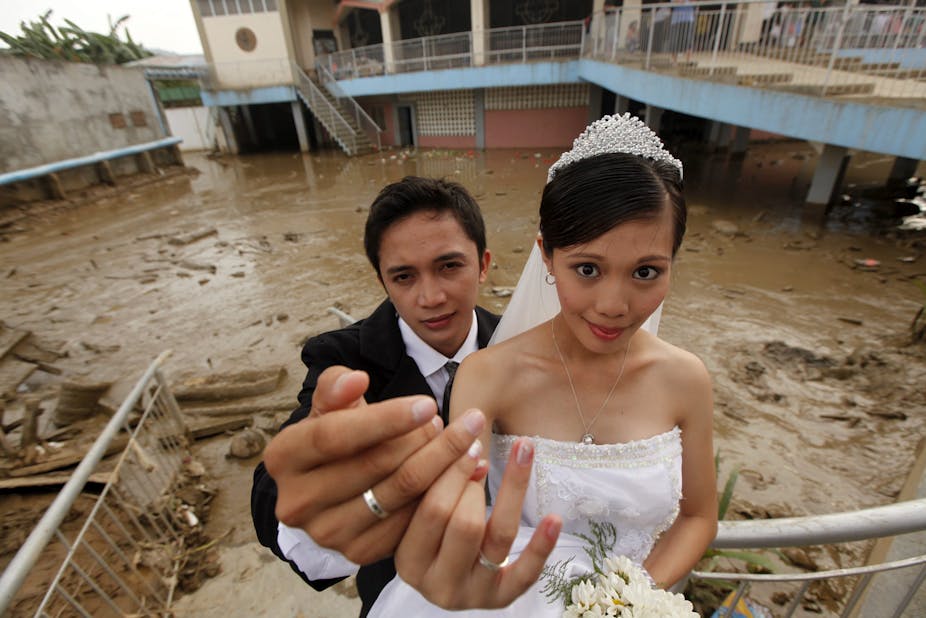
Climate change will lead to significant human displacement. The Intergovernmental Panel on Climate Change (IPCC) and other groups warn that the effects – including rising sea levels, heavier floods, more frequent and severe storms, drought and desertification – will cause large-scale population movements. How can we help these displaced people? I believe an international treaty could be the answer.
It’s important to take account of the different contexts and forms that climate change displacement may take. As Oli Brown of the International Organization for Migration has said, we need “international recognition of the problem, a better understanding of its dimensions and a willingness to tackle it”.
Existing law does not adequately provide for climate change displaced persons (CCDPs). There has been no coordinated response by governments to address human displacement due to climate change. And given the nature and magnitude of such displacement, ad-hoc measures may lead to inconsistency, confusion and conflict.
This can by addressed by collaboration among the international community. There seems to be a common interest in reaching a resolution, either by providing adaptation assistance or pre-emptive resettlement.
How a treaty could work
Parties to a treaty would be both developed and developing states. It would encompass those displaced internally and those who cross international borders. Most displacement will take place within a state.
The International Council on Human Rights Policy notes that “the most dramatic impacts of climate change are expected to occur in the world’s poorest countries”.
Assistance for those displaced internally would be shared by the home state and the international community. For those who have migrated across state borders, the treaty would outline the obligations of the CCDP and both the home and “host” states.

Significant numbers of people are likely to be displaced by climate change. Given that, en-masse designations of the status of climate change displaced persons through a process of request and determination by state parties and the treaty organisation is more workable and more appropriate than the individual satisfaction of definition-based criteria.
In the event of international displacement, the treaty would not compel state parties to the treaty to accept CCDPs. State parties may choose to enter bilateral displacement agreements between “home” and “host” states.
Keeping people at home
Any treaty would first contemplate providing pre-emptive assistance; then, if necessary, resettlement. It would prioritise those most at risk from the impacts of climate change. Providing assistance under the treaty could then be described as “anticipatory adaptation”.
Any treaty would largely operate prospectively, rather than reacting to a situation. Assistance to CCDPs would be based on a “bottom-up/top-down” assessment of their environment’s susceptibility to the effects of climate change. Ultimately, it would look at the likelihood of a place becoming uninhabitable.
The aim of the treaty, above all else, would be to enable people to stay in their homes as long as possible and, failing that, to move in a planned manner over time.
Determining whether people are displaced by climate change
A treaty would acknowledge problems in determining the impact of climate change on the displaced. It would also consider to which extent humans have contributed to a particular climate change event.
The treaty could adopt a “very likely” standard (greater than 90% probability) to identify “climate change events” as caused by human-induced climate change. Such a standard would provide increased certainty and targeted resource allocation, vital in the context of a treaty that could potentially apply to hundreds of millions of people.

Adopting a “very likely” standard means requests from state parties that might set the treaty in motion would overwhelmingly be about slow-onset, gradual displacement. This kind of displacement is more likely to be seen as a result of anthropogenic climate change than a sudden disaster.
Seeking progress where we can
It’s clear that there are obstacles to treaty-making. In terms of the UN Framework Convention on Climate Change (UNFCCC), the current negotiating process is unlikely to make significant progress. First the positions of major developed and developing states and their relationships with the climate must change. As has been noted, “since an agreement among the major emitters is unikely anytime soon, we should seek progress where we can, through whatever means and in any forums that are available”.
If the climate change problem is broken up and addressed in pieces, then it may be that any climate change displacement treaty could form one element of such a climate change governance approach, or part of any climate change “regime complex”.
A final point: in the Andes, if warming trends continue, many tropical glaciers may disappear within 20 years. This threatens the water supplies of over 70 million people. Bolivia’s ambassador to the United Nations, Pablo Solón, asks this question: “What do you do when your glacier disappears or your island is under water?”
One solution is a treaty for climate change displaced persons which sets out a framework for the collaborative provision of pre-emptive adaptation assistance – and, if necessary, relocation before glaciers melt and before islands are under water.
David Hodgkinson leads an international project team drafting a treaty for climate change displaced persons.
James Jenkin
EFL Teacher Trainer
Is it unlikely countries will sign up to a treaty until they can see the predicted effects of climate change - disappearing glaciers, displaced populations - and can measure how it affects them?
A country wouldn't sign any other sort of treaty - say on extradition or cybercrime - unless a tangible problem already existed.
David Arthur
n/a
The Good News, James, is that human-caused climate change has contributed to to the severity of famines, droughts and floods over the last couple of decades, so there's already ample evidence to motivate signing such a treaty.
Marc Hendrickx
Geologist
Sorry DA but there is no evidence to support your statement. None at the level of confidence required by David. Don't take my word for it, here's the headline from the most recent edition of Nature on the issue (quite odd that the author above missed citing it given its relevance link below):
"Extreme Weather: Better models are needed before exceptional events can be reliably linked to global warming."
"So lawyers, insurers and climate negotiators are watching with interest the emerging ability…
Read moreDavid Hodgkinson
Associate Professor, Law School at University of Western Australia
Thanks, James. Treaty making, of course, is hard. The focus of the treaty we propose, however, does not require state parties to accept those displaced by climate change. Rather, the focus of the treaty is the collaborative provision of pre-emptive assistance - to enable people to remain in their homes for as long as possible, and to move safely within their own countries. It's concern is what we call 'anticipatory adaptation.'
David Arthur
n/a
Thanks Marc.
I read David Hodgkinson's article as suggesting that an individual event be attributable to human-caused climate change with probability exceeding 90% for the proposed treaty to be applicable.
Elsewhere in these comments, I expand on this position, an expansion with which you agree. In my response to James Jenkins, I point out that human-caused climate change has CONTRIBUTED to the severity of extreme weather events.
What I should have stated is that human-caused climate change has CONTRIBUTED to the frequency and severity of extreme weather events and climate anomalies. The word "CONTRIBUTED" does not need to imply 90% probability of causation to be applicable.
Marc Hendrickx
Geologist
"The treaty could adopt a “very likely” standard (greater than 90% probability) to identify “climate change events” as caused by human-induced climate change."
This level of confidence not likely to be attainable, as such this issue as described above remains of academic interest only. More promising would be a treaty that provided for people displaced by weather disasters regardless of the cause.
Mike Hansen
Mr
I agree Marc. People affected by climate change are not going to wait for an official attribution study to be signed off before they start moving. In some cases the cause may be indirect - e.g. drought in one part of the world causing higher food prices in another.
Grendelus Malleolus
Senior Nerd
"This level of confidence not likely to be attainable, as such this issue as described above remains of academic interest only. More promising would be a treaty that provided for people displaced by weather disasters regardless of the cause."
I agree - displacement requires action rather than debate about the cause. There are some subtle circumstances where I can see some variation on that - after providing assistance it will be worthwhile examining whether the reason for displacement will be sustained (I am thinking here of extended drought - and whether it will remain). A weather drought event may differ in duration from a climate drought even, but in either case you are correct, the initial humanitarian response should be immediate and comprehensive and supported by international treaties.
David Arthur
n/a
I have a great problem with the suggestion that there be a "trigger point" of 90% certainty that a disaster has been initiated by human-caused climate change. Such a clause would be tantamount to manufacturing a criterion; climate change is a natural response to inadvertent human alteration of the atmosphere's composition.
Rather than a treaty concerned with defining and assisting a category described as Climate Change Displaced Persons, it would make a great deal more sense to have a treaty that deals humanely and effectively with people displaced by all environmental changes.
This would include, for example Haitians whose homeland has been degraded by the large-scale deforestation of that half of the island of Hispaniola.
Marc Hendrickx
Geologist
yes, see my comment above.
John Coochey
Mr
Now and how many climate refugees would there be? I seem to remember some IPCC figures to the effect that we should have had millions of such refugees by 2010 and to date we have not had one! Is that ninety per cent probability?
John Coochey
Mr
Further research gave this rather cool site
http://asiancorrespondent.com/52189/what-happened-to-the-climate-refugees/
It deals with how the UN disappeared 50 million refugees when they did no appear and then botched the cover up.
Grendelus Malleolus
Senior Nerd
Interesting Article John - using gross population change as a measure is unfortunate - It is not possible to distinguish from that data whether there was movement to those places from other more-at-risk places, or more pointedly, if there was internal migration from one part of the country to another. I'm not suggesting it has happened, just that gross population data is only a good measure over longer periods - not 5 year gaps. It also is uninformative about what kind of mitigation or adaption approaches may have been put into place (if any) by the governments listed.
John Coochey
Mr
Here is another link on the attempt to cover up earlier alarmists pronouncements.http://www.climatedepot.com/a/10602/Oops-UN-caught-scrubbing-50-million-climate-refugees-prediction--then-botches-the-disappearing-attempt
David Hodgkinson
Associate Professor, Law School at University of Western Australia
Thanks, John. Migration experts generally agree that most people displaced by climate change will remain within their home states and, in the event that those so displaced do cross a border, the view of refugee lawyers is that they would not be the subject of protection under the 1951 Refugee Convention.
Comment removed by moderator.
Linus Bowden
management consultant
The days of multilateral treaties as saviour are long gone, especially when it comes to migration matters (and even climate change itself, for that matter). Australia is better off planning for any needs our Pacifiic neighbours might have n the future. And as others above said, the focus should be on need following some event. Pinning your multilateral treaty onto some committee making what can only ever be arbitrary declarations of causation is doomed from the word go. Oh, and you'd better make sure you have the Australian citizenry onboard first this time.
John Coochey
Mr
Well maybe a clause of the treaty should be that you cannot improve your quality of life above that it would have been had you not needed to become a refugee ie no economic migration disguised as something else or more simply if you move from a third world country you go to a third world country.
Grendelus Malleolus
Senior Nerd
Nice John, and thus remove any incentive for people to work or contribute and in the process guarantee they become dependant...
Linus Bowden
management consultant
It is far better if we deal with the situation in our own region on our terms. I think the Australian public has moved on from the days of deferring to never-ending committees of faceless foreigners telling us what to do.
David Hodgkinson
Associate Professor, Law School at University of Western Australia
Thanks, Linus. In terms of our region, provision of adaptation assistance and any relocation of those likely to be displaced would be the subject of a negotiated bilateral agreement between Australia and the relevant state made under the aegis of the treaty. The treaty would not compel state parties to accept those displaced - or likely to be displaced.
John Coochey
Mr
I am afraid I do not see what point you are trying to make here.
Grendelus Malleolus
Senior Nerd
John you state "maybe a clause of the treaty should be that you cannot improve your quality of life above that it would have been had you not needed to become a refugee"
Take as an example an Islander who may become a refugee accepted by Australia - in their home country they were a simple fisherman living a subsistance lifestyle. Your clause effectively precludes them from undertaking any kind of work at all and earning an income since that may well improve their quality of life.
It is a moot point since it is inconceivable that any state would willingly includea clause that effectively creates a dependent population.
John Coochey
Mr
Not necessarily you assume Australia or another developed country accepts them, They could go to another third world country. We currently have asylum shoppers travelling around the world looking for the best deal, there is no need to make the situation any worse than it is.
Bob Ashworth
logged in via Twitter
Oh the irony of Euro-Aussies taking about limiting immigration. Let's make your rule retrospective!
Michael Brown
Professional, academic, company director
In climate science it is always important to discriminate between research papers based on modelling, and papers based on real world data. Fortunately there is plenty of good news from the world outside the modellers' offices - you say "many tropical glaciers may disappear within 20 years" but the facts are that in the Himalayas at least, there's been no net loss of ice in the last decade. See: http://www.telegraph.co.uk/earth/earthnews/9071908/Melting-glaciers-on-the-Himalayas-not-contributing-to-sea-level-rise.html
Our focus should remain on addressing the real effects of the current extreme weather events rather than worry about the theoretical future.
Mike Hansen
Mr
You did not read to the end of the article that you linked Michael? Did you stop when it told you what you wanted to hear?
The last paragraph
"The study shows 148 billion tonnes of ice, or about 39 cubic miles, was lost annually between 2003 and 2010.
This equates to some 1,000 cubic miles of ice disappearing between 2003 and 2010 – enough to cover the US in one-and-a-half feet of water.
"Our results and those of everyone else show we are losing a huge amount of water into the oceans every year," he said. "People should be just as worried about the melting of the world's ice as they were before."
John Nicol
logged in via email @bigpond.com
Mike, I think the "last paragraph" refers to the ice over the whole globe. Michael is talking bout the Himalayan glaciers alone.
John Nicol
Nick Kermode
logged in via email @hotmail.com
Sean, that is one of the most classic cherries mate, and making small changes such as converting "negligible" to "no" makes your comment look extremely agenda driven. Have a read of
http://www.skepticalscience.com/Do-growing-glaciers-disprove-global-warming.html
and references within. Take particular note of the World Glacier Monitoring Service's graph showing total mass balance of monitored glaciers. You will be happy to know that it entirely based on real world data not models.
John Nicol, it reflects very poorly on you defending someone with such a poor argument. He not only has cherry picked the volumes of science on glaciers, he has even cherry picked and misrepresented the article he referenced and then dressed it up as "plenty of good news"!!!! Utter nonsense as per usual.
John Nicol
logged in via email @bigpond.com
Thanks for your comment Nick Kermode. However, I don't think saying something one has said "reflects very badly on you" or that something is "Utter nonsense as per usual", is the friendly approach one expects on a forum such as this which is supposed to be about intellectual discussion.
Havng said that I would like to pose some questions:
A recent comment by an Australian Climate Scientist included the statement that:
Read more“Examples of abrupt climate shifts are the 1470 years-long Dansgaard-Oeschger…
David Arthur
n/a
Gday John Nicol: "A recent comment by an Australian Climate Scientist included the statement that ..."
Do you know which Australian Climate Scientist released that comment? If so, why not provide an adequate reference?
You go on to write: "I find it quite amazing that these major climate change events have obviously taken place without the presence of significant anthropogenic carbon dioxide. Yet among the writings of climatologists whose focus is upon the effects of CO2, I can find no attempt to relate to similar natural causes, "
As I've explained to you several times past, the Little Ice Age may well have been a harbinger of what would have been the onset of the next glaciation, but for human activity.
Understand this: OVER THE LAST 300 YEARS, THE LARGEST PERTURBATIONS TO EARTH'S CLIMATE HAVE ALL BEEN HUMAN. Relative to anthropogenic causes, non-anthropogenic ("natural") have been negligible.
David Arthur
n/a
Mr Nicol writes: "The rapid warming which took place in the latter part of the 19th century was in fact faster than that from 1979 to 1995," adding "This is an undeniable fact which receives little to no attention." Perhaps it receives little or no attention because, far from being an undeniable fact, it is patently false.
Mr Nicol adds that "A similar period of only slightly less significance took place from about 1920 to 1940 – no comment there either."
I understand this period of warming to have been in response to anthropogenic CO2 emissions, unmodified by the accumulation of sunlight-reflecting air pollution which afflicted the world from WW2 to the anti-acid rain and anti-leaded petrol actions of the 1970's and 1980's, but before the takeoff of highly polluting Chinese industry and its enabling counterpart, the use of high-sulfur fuel oil in the global shipping boom that has accompanied China's industrial rise.
David Arthur
n/a
Michael, sorry to disappoint you, but I think you should know that the reason high Himalayan glaciers have not been losing mass (and Karkoram glaciers have actually been gaining mass) has been intensification of Asian monsoon.
Similarly, East Antarctic ice cap was gaining mass in the 1980's and 1990's due to increasing precipitation supplied by increased evaporation off the Southern Ocean.
Since then, however, continental East Antarctica has been losing ice mass again, despite further increases in precipitation, due to accelerating glacier flows exceeding increased snowfall.
We may reasonably expect a similar fate for Himalayan glaciers as warming continues.
Mark O'Connor
Author
The notion that the citizens of richer countries, and of countries where fossil fuels have been used more extravagantly, should help pay for those displaced by climate change is hard to resist. it tugs at common humnity and at our sense of justice.
Yet this article misses two important points. First Australia is itself in the front line for climate change. Much of Brisbane for instance, and Western Sydney, may go under water. And as a government report showed, there is no guarantee we will be…
Read moreJohn Coochey
Mr
The imminent sea level rises would explain why Tim Flannery the Chief Climate Commissioner has not one but two waterfront properties on the Hawkesbury.
Grendelus Malleolus
Senior Nerd
*yawn*
Why don't you find out if it is more than the 1m above expected rise within Flannery's lifetime? Oh, wait, the Australian already did that and had to apologise for the exercise of revealing the location of Flannery's home. By all means explore Flannery's exaggerations but please don't bother with this tired old canard John.
Sean Lamb
Science Denier
"A final point: in the Andes, if warming trends continue, many tropical glaciers may disappear within 20 years. This threatens the water supplies of over 70 million people."
No it doesn't. Sydney doesn't have a glacier yet it somehow manages to scrap together water enough for 5 million.
There is no intrinsic link between glaciation and levels of precipitation - or rather there is, but the level of precipitation is the issue, not whether it is frozen or not.
Grendelus Malleolus
Senior Nerd
Precipitation - or lack thereof is the issue for communities in the Andes. Take La Paz as an example. Average precipitation of under 600mm per year with the balance of their water supply drawn from glacial meltwater. If the glaciers are melting at a rate faster than new snow is being packed down in the high glacial valleys.
In short, it doesn't rain much already so they use streamflow to supplement. If that goes, they run short.