

We were wrong: IMF report details the damage of austerity

In a rare volte-face, the International Monetary Fund this week admitted that it grossly underestimated the impact of the austerity regime it advised Europeans to adopt. A paper authored by IMF chief economist Olivier Blanchard found that every dollar that governments cut from their budgets actually…

Qf6y4ssr-1357778894
In a recently released report, IMF chief economist Olivier Blanchard admitted that implementing austerity in Europe was a mistake. AAP

In a rare volte-face, the International Monetary Fund this week admitted that it grossly underestimated the impact of the austerity regime it advised Europeans to adopt.

A paper authored by IMF chief economist Olivier Blanchard found that every dollar that governments cut from their budgets actually reduced economic output by $1.50.

The IMF forecast originally that economic activity would be reduced by only $0.50 for every $1.00 fiscal spending cut. Now this is not the IMF’s official position, mind you. But Blanchard, as chief economist, makes the IMF look shame-faced. Indirectly, at least.

Predictably, this has given considerable ammunition to critics of the bitter austerity prescription that has characterised European governments’ fiscal policies.

Economics is known as the dismal science. But for the IMF’s critics, this egregious forecasting error — upon which so much policy advice was built — is more than a crime. It’s a mistake.

The fact is that economics is much more of an art than a science. Econometricians can factor in x amount of data into a model to show outcome y. Like actors, who are only as good as their scripts, economists are only as good as the data they input.

Go forth and multiply

How did the IMF get it so wrong? Multipliers. Specifically, the wrong ones.

Although the 18th-century physiocrat, Quesnay, formulated the basis of multipliers in economics, John Maynard Keynes is generally credited with the conceptual modernisation and application of the “multiplier effect”. Briefly, every dollar that’s spent increases aggregate demand, as that same dollar is spent again and again and again. It’s this fiscal multiplier that the IMF employed to measure the likely effect of budgetary spending cuts.

Fawlty forecasting

To understand multipliers, here’s a brain teaser for you. Imagine we’re in the 19th-century equivalent of Fawlty Towers.

His Lordship arrives at a hotel and requests a room.

“Certainly, m’lord,” replies the manager.

But the man wants to see the room first. He puts his coat in the cloakroom and goes upstairs to take a shufty. While he’s gone, the manager steals £5 from his wallet. He then runs down the street and pays off the, er, lady of the night, to whom he owes five quid.

Said lady then hoofs off to the butcher’s to pay off her £5 worth of sausages. The butcher, in turn, heads over to the baker, where his account is in arrears to the tune of a fiver. The baker pays his £5 to the milkman. And the milkman heads to the hotel to pay the manager the £5 he owes on the room he rented there the last time he met up with the shady lady.

Then the manager replaces the £5 he stole from the toff’s wallet. His Lordship decides the room is not at all like Hampton Court Palace and leaves.

So, goods were produced. Services were rendered. Debts were paid. There were economic outputs. GDP — in theory — increased. And all due to one lousy £5 note. That’s a multiplier for you.

One more thing: in all instances, credit was extended. You could consider the aristocrat the government. Or a bank. Except, unlike governments, banks don’t give away money; they rent it out.

Meanwhile, back at the IMF…

Blanchard calculated that the IMF utilised a multiplier of 0.5. In reality, it should have been 1.5. In the IMF’s defence, Blanchard argues that the Fund underestimated the extraordinary financial circumstances of the European economies. In other words, the IMF was too optimistic about the impact of austerity measures upon GDP, and did not expect the effect upon unemployment would be so severe.
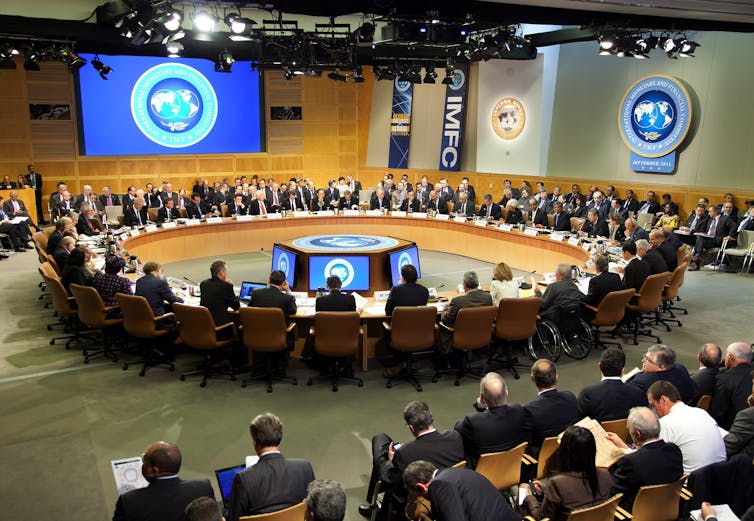
The IMF has admitted that its pursuit of austerity was misguided. AAP

In a sharp response to critics, Blanchard’s report also notes that: “Some commentators interpreted our earlier [findings] as implying that fiscal consolidation should be avoided altogether. This does not follow from our analysis. The short-term effects of fiscal policy on economic activity are only one of the many factors that need to be considered in determining the appropriate pace of fiscal consolidation for any single economy.”

In other words, Blanchard doesn’t find that fiscal consolidation is the incorrect prescription, but that individual economies need to find the correct policy mix to ameliorate the worst effects of fiscal discipline.

Casino capitalism

Blanchard’s paper shows that the OECD, the EU and the Economist Intelligence Unit all got their forecasts wrong. The IMF was just – well – even less accurate.

But that merely reinforces the point that economics is an art. But a black art, rather than a bad art. Consider the Reserve Bank’s last three interest rate cuts: did you pick them? How about the Australian dollar exchange rate over the last quarter? Or Apple’s share price?

If so, what are you doing here? Why aren’t you playing the global casino? You should have five Bloomberg screens in your living room, a pile of cash a kangaroo couldn’t jump over, and a super-yacht in Antibes.

The difference between private firms and international organisations such as the IMF is that the Fund is not attempting to profit from its forecasts. More accurately, it makes policy prescriptions and offers technical advice. In this instance, it recommended fiscal consolidation.

flickr mammal

Now, I fully expect the harbingers of austerity doom (Krugman et al ) to come out of the woodwork any minute now, although they have not been returning phone calls since the Eurozone failed to implode, as predicted. And, despite serious, long-term problems, Greece has not departed the Eurozone either. This prediction by Citigroup in 2012 should leave you rolling in the aisles:

“Greece WILL leave the eurozone on January 1, 2013.”

About as accurate as a Mayan calendar.

More seriously, the anti-austerity advocates appear to have no real concern for the longer-term consequences of indebtedness. At a certain point, fiscal deficits and sovereign debt become structural (the deficits and debts cannot be eliminated without profound alterations to the structure of public spending, borrowing, the balance of payments and the taxation base).

Which means governments can choose:

(1) Austerity via fiscal spending cuts;

(2) Tax hikes for you, the over-burdened citizen; or

(3) Both.

Whichever way you cut it, your children, your grandchildren – in fact everybody, except Gérard Depardieu, obviously – will be paying more tax and receiving less publicly-funded welfare as governments pursue aggressive debt-reduction strategies.

A return to first principles

A cornerstone of good governance should be a commitment to sound fiscal outcomes. But something happened on the road to sound credit and responsible fiscal policy. Does anyone seriously argue that increasing fiscal deficits and ballooning sovereign debt is not the road to serfdom? By maxing out your credit cards, you are merely postponing the inevitable day of reckoning (yes, I know Washington does nothing but debt, but the US is in a unique position).

True, there is clearly a role for governments to intervene to boost demand via deficit spending during periods of recession. That’s long been the Keynesian prescription.
flickr Gwydion M Williams

But most governments ignore the other half of Keynes’ sage advice: namely, saving fiscal surpluses during periods of prosperity to ensure fiscal stability during recession, even as the public sector borrowing requirement increases. And not squandering precious surpluses on pink batt programs (Australia), moat-cleaning (Britain), Facebook-addicted civil servants (“Facebook: it’s French for Work”), and middle-class welfare, corporate welfare, farm welfare and subsidised property bubbles (everyone).

The problem is not liquidity

Austerity be damned. We are still absolutely awash with liquidity. There is more than adequate liquidity in the global financial system at present. The US Fed’s QE3 program will add another $US1 trillion to the debt coffers.

But there’s liquidity – and there’s credit. It’s just that financial institutions aren’t investing in anything other than blue chips and A-rated bonds. Global venture capital plunged 33% in 2012, a disastrous result on the back of a weak 2011. By contrast, global M&A was up in 2012.

So businesses aren’t raising seed capital; IPOs don’t happen; innovations go underfunded; R&D dries up; prospective products remain vapourware; and workers don’t get hired. There’s your lack of a multiplier effect writ large.

Forget IMF forecasts. The crux of the problem remains the vulnerability of the global financial system and its reluctance to lend freely, exacerbated by the fact that global interest rates, for the most part, remain too low to warrant risky lending.

And there’s bad news and worse news. It came out of Basel early this year, courtesy of the Bank for International Settlements (BIS). The much-trumpeted Basel III accord, which sought to place banks’ underlying cash and short-term asset base on a much firmer footing, has been watered down and delayed. Instead of blue-chip assets, financial institutions will be able to maintain or increase their leverage and fractional reserve lending using much lower-quality assets – like those dreaded mortgage-backed securities — that got us all here in the first place.

Someone at the IMF should write a paper about it.

Join the conversation

23 Comments sorted by

  1. Chris Booker

    Research scientist

    re: pink batt programs - I'm not sure how the Australian data stack up, but here in New Zealand the money spent on pink batts would be recovered and more from health savings and less time off work/school, so it's actually cost beneficial. The Australian situation would probably be more about reducing heat indoors, but you know, it's not like there's record high temperatures going on or anything...

    report
  2. Iain Wicking

    Director

    I find it all perversely amusing. Mainstream economics is a joke as it is built on a philosophical house of cards. It ignores the social and political structures in society and assumes that we are all well informed drones that make highly rational decisions - of course we don't. It also projects the notion that all public expenditure is high irrational and bad while private debt is completely rational - hence the explosion of private debt and decline in public infrastructure.

    The debate over…

    Read more
    1. Suzy Gneist

      logged in via Facebook

      In reply to Iain Wicking

      I agree, time to admit the system is fundamentally flawed and move on, rather than make small adjustments and continue business as usual. Iceland seems to have figured out how to move on.

      report
    2. Iain Wicking

      Director

      In reply to Suzy Gneist

      Yes. The Icelanders did the 1930's thing and closed the their financial system down. Cleaned it out and reset it. It's all about power. The banks have bought it in terms of having the politicians in their back pocket. The same situation applies in Australia if the system goes bad. The politicians will bail the banks out we the public will pay.

      report
    3. Robert Tony Brklje

      retired

      In reply to Iain Wicking

      Actually it is all done to simple mathematics.
      Numbers that are accurately calculated are accurately tabulated, the problem arises that in forecasting they are often on negative side while other numbers opposing those are guesses.
      For example a business could half it's service and support budget, it knows the exact value, half of what it is currently spending, however it has no means of measuring the impact.
      Economists will highlight the saving and focus on it and downplay the impact because it…

      Read more
    1. Doug Hutcheson

      Poet

      In reply to Richard Hockey

      Not a hope! He is too busy firing people, to reduce public spending. What a gawd-awful way to run a State!

      report
    2. Doug Hutcheson

      Poet

      In reply to Doug Hutcheson

      We should point out that Richard and I are referring to the far-right-wing premier of Queensland, Australia, who likes to promote his image as Campbell 'Can Do' Newman. He won the state election last year by a huge landslide (78 seats vs 7 for the (now) opposition Labor Party) and proceeded to gut the Public Service. With his vast majority, he feels he has a mandate to wreck the State economy, under the mantra of Small Government. His first act was to close the Climate Change office, which fits with his Tea Party political view.

      report
  3. Leo Kerr

    Consultant

    What a joke - I'll stick to reading tea leaves - seems to come up with more accurate predictions than these highly paid incompetents.

    report
  4. Firozali A.Mulla

    PhD

    Great that they speak now the truth but read on We have yet to go far in employment data. The number of Americans filing new claims for unemployment benefits rose last week, the Labour Department said on Thursday, but details of the report suggested the jobs market continued to grow at a moderate pace. Other data suggested the economy remained on a steady growth path, with sales at wholesalers rising by the most in more than 1-1/2 years in November, keeping inventories balanced. Initial claims…

    Read more
    1. Iain Wicking

      Director

      In reply to Firozali A.Mulla

      All the global financial management and regulatory institutions are subservient or interlinked to the global banking system, the large Western Banks and the US Dollar system..

      report
    2. Richard Plumridge

      Student

      In reply to Iain Wicking

      If the IMF is "subservient" to the global economic system it's only because the IMF helped create it. To call it a liberal institution would be accurate, but to call it a "puppet" would be misinformed. By tradition, the IMF has been headed by a European with the US the largest single voting bloc holder. Since the end of the Bretton Woods system, the IMF has had little interest in the US dollar.

      report
  5. Chris Saunders

    retired

    The IMF itself claims that the stimulus spending of the Rudd government during the financial crisis does not rate as profligate. Also, I do take exception to your referral to the pink batts program with the link leading to the report of the death of a central coast worker. This is not an example of black art economic argument, but a terrible personal tragedy. I ponder at your doing that; I find it cruel and deceptive.

    report
  6. Eddy Schmid

    Retired

    Ian Wicking,
    Spot on. All these alleged 'experts' always laying down the law and telling us what to do, then when the proverbial hits the fan, 'OOPS, SORRY, we were WRONG'.
    Wow, lovely, I'm sure all the folks kicked out of their homes, jobless, homeless and wondering where their next meal is coming from accept such apologies without rancour.

    report
  7. Peter Ormonde

    Peter Ormonde is a Friend of The Conversation.

    Farmer

    Will wonders never bloody cease!

    For 30 years - no more - the IMF has been slamming the brakes on miscreant economies until the sparks are spitting... most notoriously driving a swag of the economies of SE Asia into an uncessary recession during the 1990s.

    It has not been about "concern" for the "out-of-control" economy or its people - it's about global stability and keeping everyone in line. It is the administrative wing of the world finance market. And it provides life support but not…

    Read more
    1. Iain Wicking

      Director

      In reply to Peter Ormonde

      The IMF and World Bank have been the shocktroops of the world's bankers and privatisation its bible - after all Friedman and Monetarism is a piece of economic religion. The objective being to crash economies, destroy social programs and pick up the assets cheap.

      report
  8. Ivan Quail

    maverick

    As David Suzuki pointed out last year (Legacy) We westerners consume 20 times more per person than the average Chinese and 60 times more than the average Bangladeshi!

    Our whole Economy is built on exponential growth. What we call a standard of living is in fact a standard of wastage.

    If the rest of the world is going to live to our standard then we need another 3 planets like ours to sustain and support it.

    The planet grows 1.5 times more food than we need for the current 7B population…

    Read more
  9. Ngoc Luan Ho Trieu

    logged in via Facebook

    A dollar cut in fiscal spending reduces economic output by half a dollar! Say no more! IMF must be employing non-economists in their economic department.
    As for Australia, we could have been a much better fiscal position now if a GST-like tax on mineral export was introduced at the same time with the GST (that is no GST exemption for revenue from the export of people's mineral resource). Part of that additional tax revenue from the recent mining boom could have been invested in income generating assets for future generations, the rest can be used to finance the improvement of economic infrastructure and the health system, the alleviation of the economic burden on non-mining sectors due to the Dutch disease, and most of all to finance the long-awaited ambitious educational revolution required to lift Australia's industrial productivity and trade competitiveness in the world market.

    report
  10. Geoffrey Harold Sherrington

    Boss

    Thank you, Remy.
    As one of the best economic performers in the World, according to our Treasurer, Australia stood to make a killing from the plights of other countries at the start of what is now called the GFC. I was gobsmacked that some of our high GDP per capita, low foreign debt and booming mineral prices could not combine to make us a lender to other countries, on very favourable terms. A few quick ins and outs of neo-usury, if you like.
    Instead, we blew it. We wasted millions on an ersatz austerity scheme.
    Can anyone tell me how or why this was justified? I must say I get sick of hearing the excuse "It's a hangover from the GFC." Was there no country in a spectrum of countries that was, by balance, better for the GFC, which seems to be something of a theoretical construct rather than an actual event that would case illness if left untreated here?

    report