

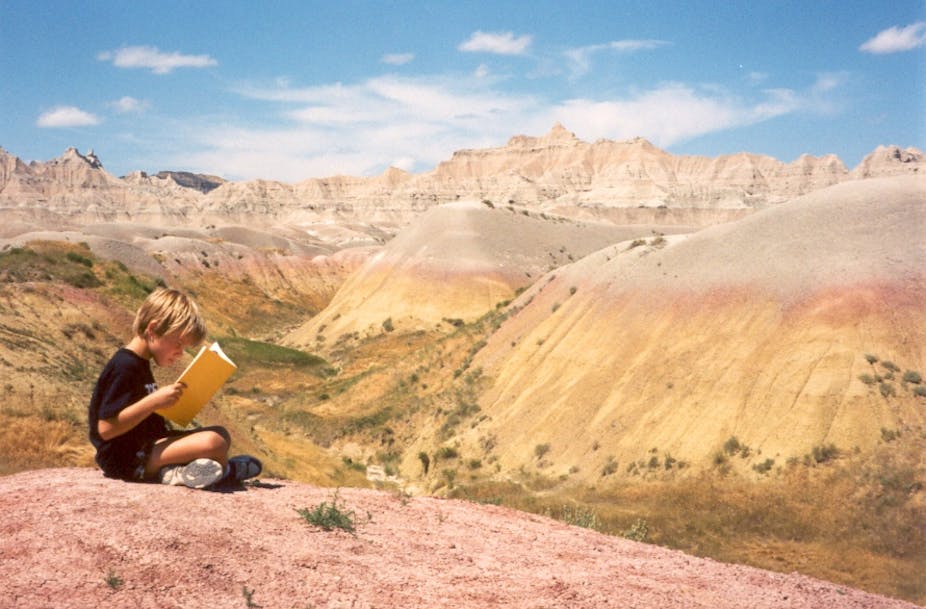
Weighing the environmental costs: buy an eReader, or a shelf of books?

Bookshelves towering floor to ceiling filled with weighty tomes, or one book-sized device holding hundreds of “books” in electronic form: which one of these options for the voracious reader creates the least damaging environmental footprint? There is no easy answer to the question, dependent as it is…

899x4kb8-1343024852
The jury is still out over the environmental impacts of eReaders versus paper books. Julie Falk

Bookshelves towering floor to ceiling filled with weighty tomes, or one book-sized device holding hundreds of “books” in electronic form: which one of these options for the voracious reader creates the least damaging environmental footprint?

There is no easy answer to the question, dependent as it is on personal environmental values and a reader’s reading habits. eReaders tend to be popular not only amongst voracious readers but also amongst occasional readers, who might previously have only owned a handful of books, complicating the question further.

Regardless, more can be done to improve the environmental performance of both eReaders and paper publications.

The environmental consequences of pulp and paper manufacturing are well documented, even though the worst excesses are now corrected. But at least once the paper is made and the book published, there are no significant further negative impacts and the carbon is captured.
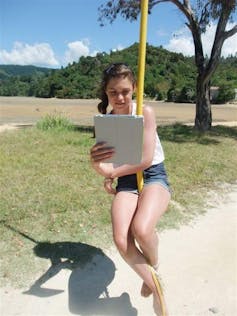
eReaders have a higher environmental cost per unit – but unlike books, you can get by with only one. Christchurch City Libraries

There are higher environmental costs involved in manufacturing an eReader unit compared to a unit of paper, and there are on-going operational effects. However, one eReader can hold any number of eBooks, newspapers and magazines – which means that eReader users purchase fewer printed publications.

Trying to environmentally promote or denigrate – depending on your point of view – one form of reading over another is inevitably controversial, and perhaps futile. It is not just about numbers, such as tonnes of CO₂, raw materials and waste, but also about human behaviour and interpretation of the impacts.

For example, is the logging of (mostly plantation) trees of greater environmental significance than the extraction of limited resources of rare earth metals? Is it more important to consider the greenhouse effect of CO₂ emissions rather than the health effects of air and water quality? These are just a few of the many environmental issues involved.

Much of the discussion about eReaders versus paper books has taken place with the best of intentions and indeed makes the most of available information. But the fact remains that reliable information at the required scale (both micro and macro) is not available, and probably never will be because of the cost of acquiring that information in light of how quickly it becomes redundant.

The few areas where commentators are in agreement are that:

  1. eReaders will continue to increase their share of human reading needs regardless of environmental considerations – few people will make purchases based on environmental credentials;

  2. Paper based reading will continue to meet a significant proportion of reading needs;

  3. The more eBooks read on a single eReader, the greater the potential offset vs paper books. Depending on who you believe and what is being compared, that might be 20-100 paper books for equivalent CO2 emissions, or 40-70 paper books taking into account other impacts like fuel, water, minerals and human health. But that does not mean either has an impact that is good – both can improve; and

  4. the lowest long term environmental impact remains sharing paper books, buying second hand books and borrowing books from a library (provided you catch public transport there). While a feel good option, this is an unlikely game changer.
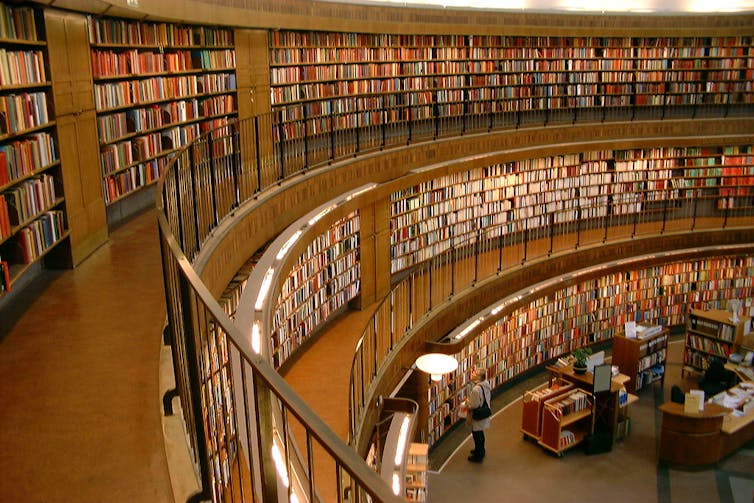
Borrowing from libraries, sharing books or buying second-hand minimises the environmental footprint left by your reading habits. Marcus Hansson

Inevitably the eReader and paper books (both including newspapers and magazines) have their environmental pluses and minuses. These cover the cradle to grave elements: sourcing and extraction of raw material sources; processing materials and manufacturing products (including byproducts and disposal); distribution and retailing; end user uses (including maintenance and replacement); disposal; and transport at all stages.

Each of these elements has within it considerations of sustainability, energy consumption (source of fuel and production of emissions), health and environmental hazards, air and water pollution, and waste disposal.

Then there are further individual human behaviour variables such as how the eReader or paper book is used, frequency of use, frequency of replacement (including planned obsolescence) and recycling/solid waste disposal.

For example, any environmental benefits arising from using an eReader and not buying paper books are likely to vanish if, like many of us, people give in to the temptation to update their reading device every year or two – long before it stops working.

A full Life Cycle Analysis of books versus eReaders might be desirable but is difficult and potentially misleading. These analyses rely on averages or a range of performance inputs and outputs. For the consumer it is difficult to evaluate all the issues let alone compare the different approaches to reading.
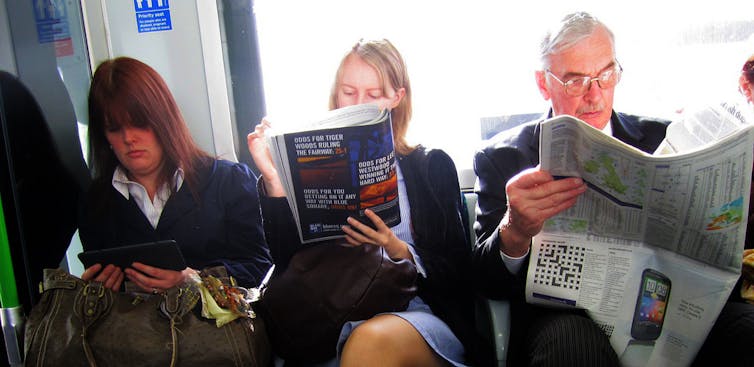
Both eReaders and paper publications are likely to be part of our reading future. Annie Mole

The future will have both eReaders and paper publications. Rather than comparing one with the other for the “best” environmental credentials, it would be better to aim at improving the environmental performance of each.

We should require manufacturers to strive for the smallest possible footprint in a sustainable cradle-to-grave operating environment. If manufacturers transparently demonstrate they are meeting this objective, then consumers have the option to prefer their products. Responsible environmental behaviour by consumers is a further critical element in maintaining a sustainable reading environment.

Nonetheless, sharing a book appears to be the best way to ensure you minimise the impact of your reading habits.

This article was written with the assistance of Dr Bruce Allender, Microscopist & Environmental Specialist at Covey Consulting.

Comments welcome below.

Articles also by This Author

Sign in to Favourite

Want to follow The Conversation?

Sign up to our free newsletter to get the day's top stories in your inbox each morning, with a special wrap on Saturday.

Spinner
Help us have better conversations — donate

Join the conversation

62 Comments sorted by

  1. Margaret Rose STRINGER

    retired but interested

    I find it difficult to think of reading in the context of the environment - call me irresponsible...
    Having recently purchased an eReader with reluctance, and then only because a family member gave me most of its cost for a birthday present, I've used it only occasionally. Good on 'planes but.
    I just can't go past my 1,000 or so beautiful and loved books, some of which belonged to my father. That doesn't do much more than identify me as an old codger, I suppose.
    I reckon I can be proud of the degree of attention I now pay to the environment - more than many, less than some. But second-hand bookshops are chaotic; libraries unsatisfying; borrowings only OK to test out titles. Thus am I obliged to admit that I'm going to continue buying books till I kark, and that's all there is to that.
    :-D

    report
    1. Gerard Dean

      Managing Director

      In reply to Margaret Rose STRINGER

      You may well be proud of the attention you pay to the environment Ms Stringer, but once you said the word "'planes", you betrayed your real attitude to the environment.

      Are you aware of how much of earth's non renewable resources human air travel sucks out of old mother earth? Each A380 Airbus is made aluminium, steel, copper, silicon, carbon fibre, plastic, and a myriad of other materials and chemicals. Every part utilises tonnes of coal, oil, bauxite, rare earths, ores and minerals that are…

      Read more
    2. Margaret Rose STRINGER

      retired but interested

      In reply to Gerard Dean

      Ah, Mr Dean - how much do I love being lectured about things of which I am all too well aware...? - not a lot.
      However, putting irritation aside: when you can suggest how an almost-70-y-o widow living in Sydney, bereft of the company of her soulmate and without a friend or family member within cooee, is able to attain the company of either in Melbourne without taking a 'plane to do so... why, then I shall accept your finger-wagging unhesitatingly.
      No luggage, Mr Dean - not being a Managing Director, and obliged to live on the age pension, I am able to make only a very occasional day-trip down south. And, of course, not being a Managing Director means that the joys of holidays and academic conferences are lost to me.
      No: I just muddle on in my ancient and foolish way, boasting vaingloriously of being proud of my environmental attitude.
      It must be wonderful to find oneself in a position to point out the obvious to others: how I envy you!

      report
    3. Gerard Dean

      Managing Director

      In reply to Margaret Rose STRINGER

      Ms Stringer

      You have entirely missed the point of my comment.

      I didn't say you should not fly at all, in fact I think it is wonderful that you take the time, expense and effort to fly and visit your family. Although I am sick of international travel, my wife and I have just returned from Europe where we visited our daughter who is studying in Austria and I attended several far less pleasant business meetings. It is a joy to see her exploring the world and stretching her horizons, my only…

      Read more
    4. Gerard Dean

      Managing Director

      In reply to Alex Cannara

      Mr Cannara

      Do you fly and use a computer or Ebook Mr Cannara?

      Because if you do, how do you ethically and morally justify your simultaneous use of the earth's irreplaceable AND your condemnation of those who also wish to use these same resources in the pursuit of their business?

      Gerard Dean
      Glen Iris

      report
    5. Margaret Rose STRINGER

      retired but interested

      In reply to Gerard Dean

      I see how silly I was to attempt to take issue with you, Mr Dean: you are obviously not a man to be trifled with.
      Still, I don't believe I can meekly accept your identification of my "double standards"...
      On the other hand, a Managing Director who flies around the world to entrench the money-making process (and to visit his family), whilst pontificating about our destroying the world in this very manner, should probably be accorded all due credibility - were it not for the double standards of which you accuse me.
      But we have both digressed radically from the issue at hand: books or ebooks?
      In fact, it's not really a topic for environmental argument, when there are so many, far more easily addressed and acted upon things we can do, as you point out, "to harnes the resources of the world for the good of mankind".
      <gasp!> I wish I'd said that...

      report
    6. Alex Cannara

      logged in via Facebook

      In reply to Gerard Dean

      Rotflmao, Gerard. To you, it's Dr. Cannara.

      I've apparently used more computers and written more software and consulted on more computer networks than you seem to have a pinhole's view of.

      Excuse my dumb American attempt to match your supercilious remarks, Gerard. And, by the way, reread what I said to see my words were not ."condemnation "
      ;]

      report
    7. Gerard Dean

      Managing Director

      In reply to Margaret Rose STRINGER

      I must admit you aren't so bad at this as well, Ms Stringer.

      Please, don't get me wrong about my sweeping statement about harnessing the worlds resources for the good of mankind. This philosophy is great for us humans, but it is sucking the earth dry.

      On the issue of the money-making process - designing and building and exporting drive me, not money (much to my wife's distress)

      And, finally, back on the topic of Ebooks. Ebooks are arguably the lowest impact high technology product provided…

      Read more
    8. Margaret Rose STRINGER

      retired but interested

      In reply to Gerard Dean

      Sighh...
      I do wish you'd get off the flying thing.
      Since getting my ebook I've made one flight to Melbourne.
      My lower back now being much worse, it looks very much as though that might be the last, regardless of the fact that just about everyone I know is down there.
      Fact remains that the ebook made it easy to read during said flight, as I remarked.
      Suppose I've learned that I must never include any kind of light remark in postings of this nature: there is always going to be someone like Mr Dean to pick up on it and FLOG IT TO DEATH.

      report
    9. Alex Cannara

      logged in via Facebook

      In reply to Margaret Rose STRINGER

      Not to worry, Margaret. The bar to entry in these discussions is quite low! Planes are always full now, so very efficient.

      report
  2. Andrew Fry

    Pilot, Lecturer

    Consider Fred, an enthusiastic ebook reader user - perhaps Fred downloads 1000 books, saving (say) $5000 and somewhat less than 1000 books worth of carbon. Fred's $5000 must go somewhere (it is practically unknown for people to say "I've saved $5000 so I'll cut back to 4 days per week.") Whatever Fred spends it spent on, the $5000 will involve activity and almost certainly carbon.

    Use electronic media for what they do better - being "green" is surely an ill-considered excuse.

    report
    1. Michael Silverton

      logged in via Facebook

      In reply to Andrew Fry

      <i>Whatever Fred spends it spent on, the $5000 will involve activity and almost certainly carbon.</i>

      Not really true. He may, for instance, use it to change over to "Green" electricity.

      report
  3. Forth Sadler

    logged in via Facebook

    I tend to use both e-books and paper. A lot of non-fiction or older books simply aren't available in electronic format so I will continue to own a few bookcases full of books for the forseeable future. I don't own a dedicated e-reader though. Device convergence means that my phone is also my music player and my e-reader. At this stage I'm admittedly inclined to update the device every couple of years as my contract expires, mostly because the development of low-power processors means that the phone that was super fast and smooth two years ago is now a cranky sluggish beast due to ever increasing demands and expectations. As displays, processors and batteries continue to improve I'd expect more people to start to look at phones more as portable media devices which happen to be able to make calls...most of my communication happens through text and online media these days anyway.

    report
  4. Gil Hardwick

    Anthropologist

    When you do a very great deal of reading and writing, professionally as well as for leisure, about the last thing on your mind is the environment. Concern for the environment is reflected in how much you use your printer, whether to print an article or simply read it on screen.

    The governing principle right now is the simple fact that most academic and professional reading is done on screen. My own view is that's good, for many and various reasons mostly concerned with convenience, weight, cut and paste options, all that stuff.

    In counterbalance, there are now vast collections of used books available online for a song, academic classics not long ago sold for $180 (and still that price new) now to be had for $20.00 ex libris.

    Best of both worlds right now.

    report
    1. Margaret Rose STRINGER

      retired but interested

      In reply to Gil Hardwick

      Gil, where can you buy good second-hand books online that aren't rendered prohibitively expensive by their shipping costs?
      Gen-yoo-wine question: hoping for an answer...
      And btw, you're entirely correct regarding printouts. For me, most of the decisions relevant thereto are closely related to whether making the text size bigger turns an article into something that takes an hour to scroll through and is actually tiring to the eyes to pan across.
      :-\

      report
    2. Margaret Rose STRINGER

      retired but interested

      In reply to Jane Rawson

      Ah yes, AbeBooks... Have bought from them comparatively often, Jane; but my last experience was one in which my purchase was through them to a UK provider, who sent a paperback shrink-wrapped - no, shrink-shrinked, I would say... I had to actually tear the plastic envelope off, along with which came most of the book cover's top layer. And my email of <cough!> strong protest brought me absolutely zilch by way of reply from either company.
      We old codgers don't forgive all that easily...
      ;-)
      However! - thank-you with all my heart for being so kind as to offer help. Dare I add that we old codgers don't forget, either?

      report
  5. Peter Macinnis

    logged in via Facebook

    Just another aspect to the equations: I am about to head off to tropical places to scramble up the odd volcano and generally lay about. As a writer, I have three second drafts to read in the laying-about time, and they are going as double-sided hard copy (I need to write on them), and I need some older (mostly 19th century) books to read for upcoming projects.

    I will be carrying 2 print books, 3 mss, and a packed tablet with Kindle for Android and three different PDF readers. All together, about 400 titles will go with me.

    The carbon cost of carrying all those as paper would be huge. Yes, in the totality of things, the transport-of-books factor is probably a small one, but it's still there.

    report
  6. Meg Thornton

    Dilletante

    After many years of havering about whether or not to buy an e-reader, I finally got myself one earlier this year. A little no-brand thing, which is currently still loaded with most of the original 100 Project Gutenberg Australia freebies it came with, as well as the PG ebooks I've downloaded myself, and a growing amount of fan fiction I've downloaded from AO3 (Archive Of Our Own - a fan-run and fan-designed multi-fandom archive of fan fiction).

    Normally, if I want to read fan fiction, I have…

    Read more
  7. Fred Pribac

    logged in via email @internode.on.net

    Thank you for an interesting article Dr Rainey. But I am dissapointed that you backed away from any quantitative analysis.

    What you have done is point out an itch but not helped us to scratch it!

    report
  8. Anthony James

    Lecturer with the National Centre for Sustainability at Swinburne University of Technology

    Thanks Tom, great article, for your coverage of a) the myth of electronic/online technology being inherently more sustainable than paper use, and b) the ultimate futility in comparing environmental impacts across 'domains'. Doing so is useful to a degree, as you suggest, but does not render absolute conclusions. In that sense, i agree with your conclusion in this article, but for one point ... Minimising the 'footprint' of the various means of doing things can in fact make things worse, if we maintain…

    Read more
  9. Jack Arnold

    Director

    Thank you Tom for a thought provoking article containing a wonderful library pic (drool!!!) Oops ... my bibliomania is showing ... again!!

    The 'younger generations' predominantly prefer using screens for study & this must have impacts on both academic publishing & teaching styles, particularly for decrepit academics still using the first draft of their 1960s lecture notes.

    Education will now come to involve more simulations & analysis than just reading because in science at least 'doing' is the major component of learning.

    report
  10. Alex Cannara

    logged in via Facebook

    The last sentence is the key. And "one eReader can hold any number of eBooks" illustrates the fundamental flaw in eReader or iGadget environmental snobbery.

    The article alludes to, but doesn't quite highlight that having a block of anything representing multiple blocks of other, physically-distinct things (e.g. books) incurs the fundamental weakness of choke-point systems. An eReader can't be shared. 100 books can be shared with 99 other people, or just sit, sequestering carbon (if you like…

    Read more
  11. Jodie Lia

    Ecologist

    Something that factors in pretty high for me when choosing to read on a screen or as print is the hideous amount of time I alread spend in front a computer screen.

    As a result of intense computer usage and reading hundreds of papers online during my uni honours year a few years ago my eyesight suffered swiftly where "above perfect" vision made way for prescription glasses in less than a year.

    I am very much in favour of taking the more environmentally friendly path but at risk of my eyesight worsening (and I do so enjoy the ruggedness of novel at the beach/camping/hiking) - I choose paper books.
    P.S. I still read digitally for work/study purposes...it's all about balance!

    report
  12. Tom Danby

    Sales Manager

    I distribute books, so I have been following the e-book dialogue with interest. And what concerns me is that we are not comparing apples with apples.
    At least 80% of the population do not use bookshops. Though of course, many of these are very book literate and do use public libraries, or shop at newsagents and chain stores.
    So the problem is that download data does not match print book sales - the channels overlap to some very small degree only.
    Hence the issue of environmental costs gets muddied too. Some big book buyers are buying e-readers, but many many more non book buyers, or low book buyers are buying e-readers. We are infact adding to the nett environmental costs with e-readers.

    report
  13. Colin MacGillivray

    Retired architect

    To give up owning books I suggest you move house a few times.
    Before the move look at each book and ask- Will I read this again? Will anyone else? Is there later and better information (I read non fiction)? When I moved three years ago I took about 25 books- mostly gifts.
    My guess is that in 50 years all "print" media will be on e devices which will be thin, floppy and cheap.

    report
    1. Peter Macinnis

      logged in via Facebook

      In reply to Colin MacGillivray

      Colin, that's another aspect of the book-transport portion of the hidden carbon footprint. When we downsized five years ago, I personally moved more than 6 or 7 tonnes of books . I classified them, boxed them, carted them to the garage in the new residence (luckily about 2 km away)--and all of that cost energy. I'm still working on the winnowing, in the hope that our children won't face the quandary we did a few years back. The next move will be to the Waiting-for-God place, and I don't imagine I will have a 5m x 5m room for books there.

      report
    2. Alex Cannara

      logged in via Facebook

      In reply to Colin MacGillivray

      We've had "thin, floppy & cheap" media for a long long time, remember? But now try and read it.

      Even Apple has just demonstrated the intentional disconnection from the past by changing the iPhone accessory interface. All that stuff iPhone folks bought to plug in/on -- now useless.

      But a book? Well, we do seem to get less literate each year, but if we keep a paper dictionary...
      ;]
      And, libraries love to get boxes of books when we move, or just get too many new ones. Hmmm, I wonder if we should part with grandpa's 1911 Encyclopedia Brittanica? It doesn't need a battery and its interface still 'works!

      report
  14. Rachel van Someren

    logged in via LinkedIn

    I prefer paper books myself. If I see a review of a book that looks interesting, or want to continue reading a series in sequence, I put a hold through the library, and use interlibrary loans if it isn't available through my library network. Most fiction I just pick from what is on the shelves at the time.
    If I think the book is one that I will refer to again, or want to be able to loan to friends, I will buy it after I have read it.
    One reason that I want to retain paper books is to ensure that…

    Read more
  15. Trevor S

    Jack of all Trades

    "But at least once the paper is made and the book published, there are no significant further negative impacts and the carbon is captured."

    I kind of faltered when I got to that part...

    How does a book get from Amazon in the UK/USA to me, for example ? or from the printers in Singapore to the distributor ? via the wharf, on a truck, to a warehouse (made of steel and concrete presumably) with people driving back and forth to work there.

    What about storage ? for example in the photo in the…

    Read more
    1. Alex Cannara

      logged in via Facebook

      In reply to Trevor S

      But Trevor, a book is a lasting thing that can serve many people. An electronic device, like the ones stuffed away in your closets, basement or attic, fail the liongevity test.

      Being an electronic engineer, UI can testify, under oath, that planned obsolescence is part of product marketing. Product marketing influences design. Just look at what Apple has done to their customers who bought lots of gear to plug into the iPhone's 30-some pin socket.

      What happens to a computer that can no longer…

      Read more
    2. M. Fioretti

      logged in via Twitter

      In reply to Alex Cannara

      "The book remains as it was for decades, even centuries. The eGadget doesn't."

      this assertion doesn't make much sense. More exactly, it's irrelevant. May I suggest reading of my posts on this topic, to get more perspective: http://stop.zona-m.net/tag/ebook/

      In short, e-books (the actual FILES, because that's just what an e-book is: a file) can last and be readable for centuries, if they only are in open formats.

      The eGadget is designed for obsolescence. Sure. So are reading glasses. They…

      Read more
    3. Alex Cannara

      logged in via LinkedIn

      In reply to M. Fioretti

      All it takes to destroy an eBook, or hundreds of eBooks on an eGadget, is a system error -- software -- or a hardware error, or the simple reality that flash memory storage isn't itself for ever, and is especially limited if files are added & deleted often. You may not even know the system is doing that, when you download another new eBook.

      Then again, remains the ever-present reality:100 books -- simultaneously sharable with 99 people; 100 eBooks -- oops.

      report
  16. Alison Tennent Dennehy

    logged in via Facebook

    I'm will continue to buy books. I may, at some point buy an e reader too, but will still be buying my books, which I can drop without fear of breaking them, accidentally lose while still being able to afford to replace them, never run out of batteries, don't need chargers and electricity, and unlike e-readers the carbon footprint they make when purchased is the only footprint they will ever make. That's without even touching upon the batteries and constant upgrading of technology, in a few years (or less), most people with e readers will purchase the newest version. My books will never go out of date.

    Regardless, with my compost, low water consumption washing machine, water tank, recycling, non-phospate detergent, mainly chemical free house, low chemical shampoos and the myriad of things I do for the environment, I will continue to buy books, unhesitatingly and without a moment's guilt. Feel free to disagree with me, I will feel free to ignore.

    report
    1. Alison Tennent Dennehy

      logged in via Facebook

      In reply to Margaret Rose STRINGER

      One of my greatest pleasures is to read in the bath. Cannot see me managing that with an e-reader, particularly since I have been known to drop them... My mother once, when giving me a book, wrote inside it "Please do not bathe me, I am quite clean". No particular reason for telling you this, it just amused me.

      report
    2. Margaret Rose STRINGER

      retired but interested

      In reply to Alison Tennent Dennehy

      Woulda still been one of mine, were it not for the fact that the bath in my flat of 16 years is so shallow that the only human who can lie covered in water therein is a child of no older than 3.
      Before my husband and I moved in here, we always ensured that wherever we lived had a BIG bath. With this place, the priority was life tenure.
      So my books are read in the comfort of my recliner chair, with my cat also ensconced. I'm going for the Typical Boring Old Codger award...

      report
  17. R_Chirgwin

    logged in via Twitter

    Tom,

    A hidden cost in the e-book reader is the infrastructure needed to deliver book to reader - something that's very hard to assess. The general "rule of thumb" in the IT industry is that data centres now consume about 2 percent of the world's electricity - but working that out for (say) Kindle is far beyond me...

    There have been some life-cycle comparisons in Scandinavia comparing e-readers to newspapers. In those studies, the different media were roughly par. Given the much longer life of a book (compared to a newspaper) I wouldn't be surprised if a proper quantitative analysis came down on the side of paper.

    If the two came out equal, I personally would still prefer paper, merely because that way, copyright industries don't get to turn property (a book) into a license they can revoke.

    report
    1. Alex Cannara

      logged in via Facebook

      In reply to R_Chirgwin

      Just FYI, the act of receiving a typical email on one's PC or iGadget is equivalent to driving an SUV a block. That counts the network and server/receiver power consumed, but not the efficiencies of the devices themselves. So transferring a full book to a device is a largish energy event.

      And, as the networks have become more used, faster devices have been added, which consume more power per bit transferred. So there's a real price being paid for the various conveniences of connectivity. And, that's subsidized wherever Internet sales aren't taxed as they would be if in stores,

      report
    2. R_Chirgwin

      logged in via Twitter

      In reply to Tim Scanlon

      Tim,

      "Most" is a slippery concept. Yes, regarding the companies you name. What of the rest of the data centre market? Once it's left (say) Amazon, an e-book will pass through many other facilities on its way: perhaps a content distribution network, certainly your ISP's facility, an Internet transit provider's facilities and so on.

      report
    3. Alex Cannara

      logged in via LinkedIn

      In reply to Tim Scanlon

      One of the fallacies of "renewables" used for marketing purposes, such as Apple's:

      " Apple announced that it plans to power its North Carolina data center using 100 percent renewable energy by the end of this year."

      is what they don't say. Apple cleared 100 acres of forest. A sizable road improvement was made. The center is claimed to largely support Siri -- a truly needed service to mankind.
      ;]
      And, apart from killing trees to put up solar panels, a net addition to global warming, they…

      Read more
  18. paul magnus

    logged in via Twitter

    OK how about libraries of ebooks... that would be even better!

    report
    1. Alex Cannara

      logged in via LinkedIn

      In reply to paul magnus

      Well, no, they have to be charged & ready at all times, and charging is wasteful, especially when not used immediately.

      And, the library has to spend $ for new eReaders every time obsolescence occurs?

      Note, the US Library of Congress has to not only hold books, but tapes, discs, CDs, DVDs, etc., and has to maintain all their related playback equipment, regardless of how old. What they do every day regurgitates all the technical obsolescence generated by marketing folks pumping out 'new' and 'better' products over the last few decades.

      And one still can't share the multiple eBooks on a reader.

      report
    1. Alex Cannara

      logged in via LinkedIn

      In reply to M. Fioretti

      Unfortunately, M., the fellow at that link shows he doesn't know much about electronics or obsolescence, when he says "eBooks are just computer files"..

      Indeed they are, and just as Word .doc files and Acrobat .pdf files require different software, there's no guarantee that a vendor who sells readers and ebooks will want to make it easy for folks to buy these "files" from a competitor.

      We've even had the QuickTime, FlashPlayer, MediaPlayer, etc. wars. Paper books & audio books have only the issue of language. Multimedia is fine, except when your hardware hasn't the proper software and lacks access to a licensed player.

      It's wise to remember that consumer electronics companies are in the business of making $, beyond all else. If a market forces them into good standards for us, great. It doesn't always, however.

      And, there always remains the limitation of eBooks regarding sharing the volumes "files" one has downloaded -- many files, 1 reader at a time.

      .

      report
    2. R_Chirgwin

      logged in via Twitter

      In reply to M. Fioretti

      The simple reason that nobody mentioned the other limitations of e-books is that the article was a discussion of the environmental debate.

      If the debate were about the whole world of e-books, my position is much simpler: since I dislike property (a book) being turned into a temporary and revokable license (the e-book), I decline to buy them; end of story.

      However, rights are easily discarded when there's a good cargo cult to follow.

      report
    3. Alex Cannara

      logged in via LinkedIn

      In reply to M. Fioretti

      Well, M. I missed that you and the site you link to fior support are one & the same! With ads for productds even!

      How scientific! How honest.

      But you hurt yourself by not understanding and printing it for all to see:
      I said:
      " And, there always remains the limitation of eBooks regarding sharing the volumes “files” one has downloaded — many files, 1 reader at a time."

      You said...
      "That is true only when the files are locked with DRM. This is, indeed, a big problem"

      Which misses the point. The eBook is one device. It and it's contents, can't be simultaneously shared. If it were a book server with network connection, then indeed multiple other machines could access & read whatever books it contains. But eReaders aren't that.

      Your bookshelves and our library's are almost that, up to the limit of their copies per book.

      You have some IT knowledge, but you miss the basic engineering knowledge to be able to honestly appraise a device's merits for us all.

      report
    4. M. Fioretti

      logged in via Twitter

      In reply to R_Chirgwin

      "The simple reason that nobody mentioned the other limitations of e-books is that the article was a discussion of the environmental debate."

      Exactly the point I made in that post of mine. It is wrong to not consider certain limitations, just because you are talking environmental issues.

      If you want to compare environmental impact, you cannot ignore certain *limitations* of both paper and digital books. But both the author and most commenters so far seemed to me to have missed these connections…

      Read more
    5. M. Fioretti

      logged in via Twitter

      In reply to Alex Cannara

      "Well, M. I missed that you and the site you link to fior support are one & the same!"

      That's only your fault. I always logged in here with my Twitter account, which has the same logo at the top of my website, whose "About" page says who the author is.

      "With ads for productds even! How scientific! How honest."

      Puah. See below

      "But you hurt yourself by not understanding and printing it for all to see:"

      If the fact that I didn't phone you personally before posting (to suggest looking…

      Read more
    6. Alex Cannara

      logged in via LinkedIn

      In reply to M. Fioretti

      Wow M. this is a sensitive subject for you! But you seem to have missed downloading the eBook on diplomacy and easily tell others what to do, or not do: "That's only your fault." ...you should have simply ignored my posts"" and so on with pomposity befitting someone who expects others to check: "my website, whose About page says who the author is." Really M?

      So let's go with your next statements: "I take this as an acknowledgment that you have given up defending all your other claims (file…

      Read more
    7. Alex Cannara

      logged in via LinkedIn

      In reply to M. Fioretti

      " Bigger house to hold thousands of books + necessity of higher salary to pay for it = likely commuting etc" to use regular books? Really? Wow, whoda thunk!?

      Then again, it's harder to lose a big house than a little eReader, eh?
      ;]

      report
    8. M. Fioretti

      logged in via Twitter

      In reply to Alex Cannara

      "you seem to have missed downloading the eBook on diplomacy and easily tell others what to do, or not do... Just don't expect others to immediately agree they're the 'right' way to read."

      It never was about the 'right' way to read. Let everybody decide which way they prefer, as long as they base their decision on complete, correct information. I only stepped in because:

      1) you have started with statements that objectively are and remain either dumb or irrelevant, when not plain wrong. As proven…

      Read more
    9. Alex Cannara

      logged in via LinkedIn

      In reply to M. Fioretti

      Yes M. eReaders can allow notations via special typing syntax, we all know how that works in numerous document-systems, even in Word. That's not the point. That form of annotation is editing and not as convenient as simply writing in the margin of a paper book.

      Note how "dumb" your answers above are, when confronted with: "You can't share the reader with another, while reading", you avoid answering and move on to annotation.

      It's also interesting to see how conveniently selective you are…

      Read more
    10. M. Fioretti

      logged in via Twitter

      In reply to Alex Cannara

      it's not a matter of "courage". Apparently, I should have been more explicit. OK.
      Here is what my "So long" of yesterday means:

      1) I have already left here enough explanations, for all the _other_ readers of this page, of why they should evaluate carefully everything you've said here about e-books and e-readers. That's the ONLY reason why I've stepped in.

      2) If OTHER readers and or the authors were interested I'd have no problem at all to continue the discussion here (*). But apparently, nobody else cares. That's OK, but...

      3) Continuing to argue with you _only_ it's really, really, really worthless. Therefore, so long.

      (*) whoever wants to continue the conversation outside this thread is of course welcome to contact me via the several links already present in this page.

      report
    11. Alex Cannara

      logged in via LinkedIn

      In reply to M. Fioretti

      You're certainly a candidate for Saint, M! You bear our lowly knowledge with such 'grace'.
      ;]
      For anyone interested in a nice discussion of the problems eBooks present the publishing industry, libraries and the mass distributors like Overdrive, and the folks looking for monopolies, like Amazon, see the Economist, 28 July, "Literary Labours Lent". Digital media allows digital control, unlike anything humanity has experienced.

      report
  19. Sarah Thornton

    logged in via Facebook

    Wow, some passionate debate there.
    Anyhow, as someone who has to watch their budget, I buy my books second hand. I own several hundred books and only a handful were bought new. But this semester I am taking a sustainability course and suddenly had a niggling doubt about the environmental impact of my book consumption. It was good to read this article and see the comparison.
    I have an 2 ereaders as well, one is a Toshiba Pocket PC, circa 2003, fits in the palm of my hand, and a no-brand 7", both…

    Read more
  20. Joseph Ting

    logged in via Facebook

    Other than e-texts, the easy distractibility and unengaged thinking encouraged by real-time access to emails, Face book, twitter, texting, social media, movies, music and games on the same screen-reader poses a grave concern to children. This tempting range of attention-extinguishing demands delivered to a single screen alters neuro-cognitive processing and is capable of permanently changing the way children read and think. Although the Web tantalizes children with a prime view of the burgeoning cyber world, it would be unrealistic to expect children to be selective in the content they choose to explore in-depth or to exercise control in reading thoughtfully rather than skimming superficially. Whatever we do to manage this information superabundance, the cyber world resists thoughtful reasoning. The only viable solution is to master, rather than be lorded over by, superfast information portals. Even adults, let alone children, will find disciplined restraint difficult.

    report