When wages negotiable, women readily make pay deals

Women are more likely negotiate pay deals if a prospective employer indicates wages are up for discussion, a new study has found. Men have traditionally been seen as more willing to tackle pay talks than women in the past, contributing to the gender wage gap. The study, titled Do Women Avoid Salary…

Hd4cjgnz-1353997284
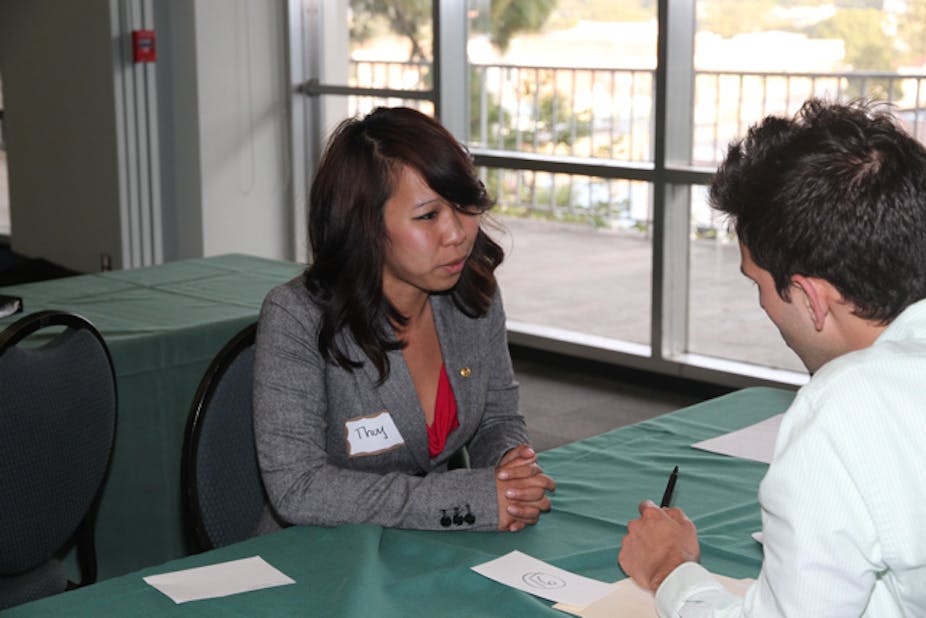
Women are more likely to tackle pay talks if an employer makes it clear the salary is negotiable. http://www.flickr.com/photos/usfbps

Women are more likely negotiate pay deals if a prospective employer indicates wages are up for discussion, a new study has found.

Men have traditionally been seen as more willing to tackle pay talks than women in the past, contributing to the gender wage gap.

The study, titled Do Women Avoid Salary Negotiations? Evidence from a Large Scale Natural Field Experiment and published by the National Bureau of Economic Research, also found that men are more likely than women to initiate salary discussions if the job does not explicitly say that the pay is negotiable.

Researchers from Monash University and the University of Chicago examined job applications from almost 2,500 job-seekers in the US for two admin jobs, one of which listed pay as negotiable and the other did not say.

Over 10% of men initiated pay discussions for the job that didn’t mention whether the salary was negotiable or not, compared to 8.2% of women.

When the pay was listed as negotiable, 23.9% of women started pay talks, compared to 22% of men.

“We report two main findings. First, we find that men prefer workplaces where negotiations are ambiguous, and in such environments they negotiate more than women,” the study said.

“Second, we observe that there are no statistically significant gender differences in the willingness to negotiate wages.”

The researchers concluded that minor changes to job ads or contracts could have big implications for the gender mix of applicants.

“By merely adding the information that the wage is ‘negotiable’ we successfully reduced the gender gap in job applications by approximately 45%,” the authors wrote.

One of the study’s authors, Dr Andreas Leibbrandt from Monash University’s Department of Economics, said in a statement that willingness to negotiate pay was not the only factor contributing to the gender salary gap.

“More research is certainly necessary to improve our understanding of the role of negotiations in workplaces, and we hope that our study motivates further research on negotiations in labour markets,” Dr Leibbrandt said.

Diann Rodgers-Healey, Adjunct Professor at James Cook University and Executive Director of the Australian Centre for Leadership for Women, said the study underlined that “women wait rather than initiate [pay talks], whereas men do that as a matter of course.”

“If workplaces are going to move toward gender equality, they need to take this on board that this is the catalyst for women to go on and negotiate pay,” she said.

“We need to be looking at what we can do to encourage talented women into workplaces.”

Dr Rodgers-Healey urged employers to conduct pay equity audits using the Workplace Gender Equality Agency’s Pay Equity tool.

Sign in to Favourite

Want to follow The Conversation?

Sign up to our free newsletter to get the day's top stories in your inbox each morning, with a special wrap on Saturday.

Help us have better conversations — donate

Join the conversation

5 Comments sorted by

  1. Spiro Vlachos

    AL

    It would be difficult here in Australia to conduct individual wage negotiations when employers are unable to legally offer individual agreements. It would be interesting to know if the availability of individual agreements also reduce the gender participation gap. Maybe any future changes in workplace legislation to allow individual contracts should legally require that employers enter into regular wage negotiations with the employee.

    report
  2. Dale Bloom

    Analyst

    “We need to be looking at what we can do to encourage talented women into workplaces.”

    I'm totally mystified by this.

    The Health Care and Social Assistance industry has 79% females, and the Education and Training industry has 70% were females.

    So I can’t understand why it didn’t say “We need to be looking at what we can do to encourage talented men and women into workplaces.”

    report
    1. Craig Minns

      Self-employed

      In reply to Dale Bloom

      Women participate in paid work at about 3/4 the rate of men (65% participation rate for women, 80% for men). That suggests that 50:50 representation of women on boards would be a significant overrrepresentation and yet another exampleof feminists demanding that women should be treated better than men. Already at uni there are nearly 2 women for every man and there is no sign of feminist educators seeking to redress this gross imbalance. Where is the Sex Discrimination Commissioner's condemnation of such obvious discrimination?

      report
    2. Dale Bloom

      Analyst

      In reply to Dale Bloom

      Craig Minns
      I would agree there is a lot of information being left out in these types of articles, creating misinformation and a false portrayal of women.

      The information that 43 % of women work part time, and women working part time get more pay than men on average, and women working full time work less hours than men etc, etc, etc.

      report
  3. Craig Minns

    Self-employed

    Let's have a bit of reality here.The study found that a tiny minority
    (10%) of men are willing to initiate pay negotiations and a slightly smaller minority (8.2%) of women did the same.

    On this is built a huge edifice of supposition leading to the conclusve statement that:
    "If workplaces are going to move toward gender equality, they need to take this on board that this is the catalyst for women to go on and negotiate pay,”.

    Seriously?

    report