
Who is damaged by the current superannuation system?

Media stories about possible changes to superannuation tax concessions generally focus on the “dangers” of reducing the unfair benefits of better off super contributors. Most stories come from financial journalists who voice the views of the finance industry, or offer opinion pieces from the various…

Jyxf26yj-1360557069
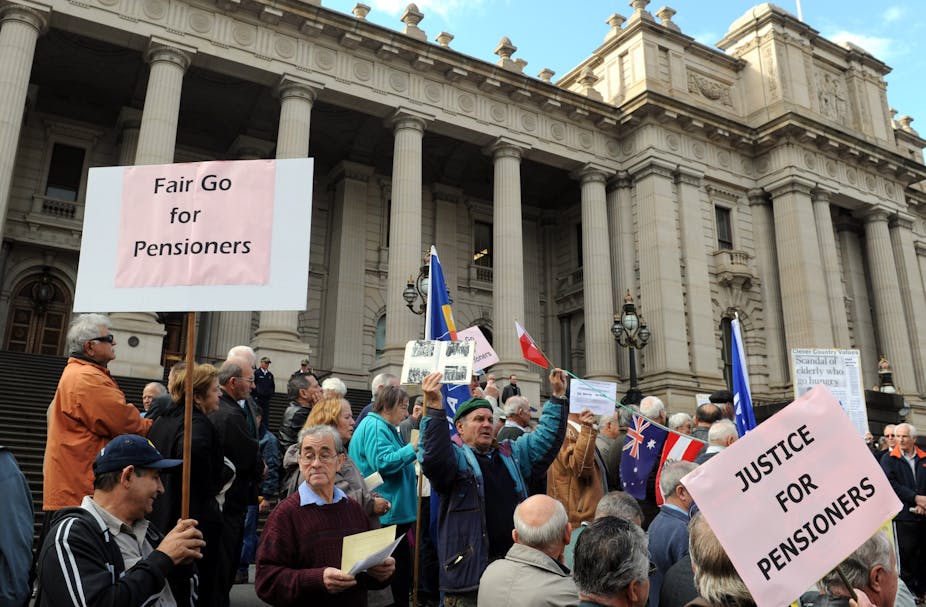
The current super debate overrides any serious focus on how women carers are disadvantaged and the adequacy of the age pension. AAP

Media stories about possible changes to superannuation tax concessions generally focus on the “dangers” of reducing the unfair benefits of better off super contributors. Most stories come from financial journalists who voice the views of the finance industry, or offer opinion pieces from the various financial institutions that benefit substantially from the current system.

There is little, if any, coverage of some very respectable alternate views, such as from the Henry review, the Australia Institute and much of the welfare sector. Therefore there is little or no media discussion of the harm of both reduced spending options and the current badly distributed tax concessions.

An article written for The Conversation by John Passant last week ran against the tide and stated the case clearly.

“But when it comes to the really rich (mainly men) suckling on the teat of government through disguised spending programs like superannuation tax concessions, Labor hasn’t yet decided what to do, despite knowing of the problem for at least three years.”

Superannuation tax concessions cost $30 billion last year in forgone revenue. According to the Treasury in its recently released Tax Expenditures Statement, that figure will skyrocket to $45 billion in 2015/16. The concessions are threefold – low tax rates on contributions to superannuation funds, low tax rates on fund earnings and by and large no tax on retirement streams paid to superannuants when they turn 60."

My first concern is that the loss to government income of less tax paid by higher income earners means less money in the kitty for other programs. One third of the income foregone would easily cover the Gonski education reforms, or the National Disability Insurance Scheme, for instance, without seriously affecting most recipients’ retirement income, just high income earners.

However, another major problem in the longer term is that the super debates override any serious focus on the health of the second pillar of the system, the adequacy of the Age Pension for those who have little or no access to the benefits of the tax concessions.

These include many women who contributed via care for others. These face serious retirement income problems as are described in the Australian Human Right Commission report Investing in care: Recognising and valuing those who care, which recommends:

“Reforming the current system of retirement income and savings, including the age pension and superannuation that is tied to paid work, to account for the inequity of retirement incomes and savings that leaves many women in poverty in older age, especially women who are or have been unpaid carers.”

Their problems arise partly because superannuation’s basic design reproduces the inequities of the distribution of earned income. Compulsory contributions as a set percentage of pay, means the “savings” will reflect the frequency of contributions and their amounts.

The more time in paid work and the higher the pay received means the range of savings will reproduce the relative inequalities of labour force participation and rewards. This has obvious gender implications as women tend to earn less when in jobs and take more time out of paid work as well, so end up with substantially less.

These differences are inevitable in an employment-based system but the real problem is the design of the accompanying tax concessions which penalise lower and no income earners and very generously rebate the well-off. Until recently the flat 15% tax regime overtaxed low income contributors and still overtaxes their fund earnings.

It will cost about $1 billion a year to refund their overpayment, but the Coalition may cancel the repayment. The maximum refund to the three million-plus low earning workers is $500 per annum, which suggests some may be owed many times the amount for past overpayments.

The government doubled the tax on the top 1% earners but Treasury in its most recent Tax expenditure statement warned over the course of the next four years, concessions on superannuation may cost taxpayers more than $150 billion. Last year it cost $30 billion, around the same as the aged pension.

There would be ample funds available, were the current concessions to be reversed, to make sure we can meet the needs of the ageing population who have little or no savings in superannuation and also may not own their own homes. Many of these will reach “retirement” in the next couple of decades, including many single women coming out of marriages.

Their savings and super balances will be very limited. Over the last decade there has been considerable easing of the means test so people with quite high incomes can get a part pension and some concessions, but there has been only one real rise in the pension level itself. There has been no discussion on long term adequacy, except by super funds scaring people into contributing more to their super.

The promotion of the Age pension on its own as inadequate, goes with the wider view that we are responsible for our own retirement income. There may be some interest in offering long term carers some extra government contributions, as proposed in the Investing in Care report, because they are seen as worthy.

However, others who don’t fit that description are right off the policy agenda. The focus on inadequacy is occupied by the punitive levels of Newstart type payments, with pensioners seen as better off. However, in the longer run, as our population ages, we need some serious discussion on long term adequacy.

There are a series of policy questions that should be on the present election agenda. Should the government look at offering some extra retirement subsidies to compensate low and no income earners for being overtaxed on contributions and earnings over the past 20 years?

Does the range of unpaid contributions, more often made by women, deserve some financial recognition if these limited their paid work and savings? How do we ensure that the basic retirement pension offers a decent living standard to those mostly dependent on it alone?

In the current political debates on retirement incomes, the main voices being heard are primarily the self interested and the powerful.

Join the conversation

25 Comments sorted by

  1. Andrew Gaff

    logged in via LinkedIn

    While I understand the broad outline of the debate here, part of the trouble I have is that I don't know the tax concessions which are regularly referred to. An outline of the technical detail would be helpful, if possible, and would help make sense of figures like $30b annually.

    I recall part of the rationale for concessions originally was to encourage people to fund their own retirement by making superannuation an attractive option. I can understand that this can be taken too far if uncapped, and used as a way of circumventing income tax and other taxes on earnings.

    report
    1. Aleksandra Hadzelek

      Lecturer in Social and Political Change at University of Technology, Sydney

      In reply to Andrew Gaff

      Like Andrew, I didn't know what tax concessions were until I read this article. I follow the news quite regularly and consider myself a person generally aware of major social issues, both in Australia and overseas. But it appears that, as Eva suggests, this issue has been discussed in the media as a purely financial one, rather than one with massive social implications. Thank you Eva for drawing my attention both to the issue itself and the skewed media reporting of it.

      report
  2. Michael Brown

    Professional, academic, company director

    This pretty complex but the 30 billion figure is a theoretical calculation with no releavance to the real world. The government's tax expenditure statement says quite celarly: "Tax expenditure estimates are not strictly additive because the removal of one concession will affect the utilisation of other concessions for accounting and
    behavioural reasons, and tax expenditure estimates will tend to overstate the budgetary impact of removing concessions as the estimates do not take account of behavioural…

    Read more
  3. Dania Ng

    Retired factory worker

    Prof Cox has repeatedly argued for women's 'independence' from bourgeoisie and patriarchal social structures, such as the family. And here we see how she complains about women being left out by a labour marked which she, through her feminist advocacy over the years, has helped bring about. Women (as with men) are expected to stand on their own feet, when in fact the whole of our society is built upon the idea that the family is its most basic social and economic institution. 'Men earning more than…

    Read more
    1. Robert Attila

      Business Analyst

      In reply to Dania Ng

      Exactly, unlike Asia, the west is fast becoming a self centred culture with an exaggerated emphasis on the need for 'choice'. Although the real aim is not choice since that has always existed, but for avoiding responsibilities.

      report
    2. Robert Attila

      Business Analyst

      In reply to Dania Ng

      Eva has no come back to your reasoned insights.

      History repeats....

      report
  4. Peter Evans

    Retired

    As someone over 60 with a modest superannuation pension the greatest concession is the tax rebate on other income I earn. This significant raises after tax income for a retiree with a small income outside super. Once I turn 65 of course I would (if my income was small enough which it isn't) also be able to claim a small aged pension and associated benefits like a Health care card. Like others I have an incentive to reduce income to get that small pension. The super pension being tax free does not count towards the means test.

    report
  5. Babette Francis

    Coordinator of Endeavour Forum

    Eva Cox correctly points out that it is women who have spent years of their working lives in unpaid carer roles, either raising children or caring for elderly parents or both, who are disadvantaged by the current superannuation system.

    However, the disadvantage needs to be addressed at the start of women's working lives, not at the end, i.e. their child care role needs to be financially recognised just like the child care work of an employee in a creche. It is illogical to pay a wage to a child…

    Read more
    1. Robert Attila

      Business Analyst

      In reply to Babette Francis

      I agree & disagree.

      There is far too much social security. Think in basic terms - principles. Why should the tax payer give any woman or man $ they havent earned? SS is meant foir emergencies not lifestyle choices. If govts stopped interfering in the natural order of commerce then people wouldnt have to work over-time, or have both spouses work, & go into debt.

      Social security is not sustainable. Stealing from the so called rich is not only immoral but has never worked in the past. raising…

      Read more
  6. Lincoln Fung

    Economist

    I think the author should have a look at the article by well respected economist Judith Sloan on the Australian yesterday, in terms of her analysis of and comments on the methods that used in coming up that figure and the the underlying assumptions.
    There is a strong culture of envy and hate of well off in some circles of the Australian society and a tendence to grab other's income as much as possible.
    Serious scholars should be factual rather than using sensational figures out of dodgy methods without questioning the reliability of those numbers. The simple fact is that some numbers even from Treasury cannot be assumed to be reliable. Just consider the differences between actual MRRT collection in the first 6 months and the Treasury various projections which is topical at the moment.
    Ideology does not necessarily advance research.

    report
  7. John C Smith

    Auditor

    It was Haw-Keat and their advisors (I am sure there was only one advisor) who conned the poor workers with the promise of the biggest pie in retirement; a pie bigger than what they earned. I am sure before putting around 10% away they would like to have some world basics with that 10% compulsory super contribution. Such things as a dwelling, a partner, a baby, overseas trip etc. etc. But you are forced to let someone rob 10% or so of your hard earned money. The Treasury estimates are rubbery like…

    Read more
    1. Stephen Prowse

      CEO at Wound CRC

      In reply to John C Smith

      Michael Brown hits the nail on the head, without compulsory super, people will not save for their old age and the government will carry all the cost which it cannot afford. Some fine tuning may well be warranted at the top end but there are many not particularly wealthy people who have saved through the current system who can now retire independently of Government; surely this is the aim the the scheme. Removal of concessions means less saving and more people on Government pensions. All the Government and others seem to see are $$$ and how can I get my hands on this now; either to fund NDIS (an important investment) or for individuals to pay for a new car, house or holiday.

      report
    2. John Passant

      Graduate Teaching Fellow

      In reply to Stephen Prowse

      Even if it is true that some people would go back to the pittance that is the pension, so what? Many of those currently receiving excessive superannuation tax benefits - the rich - won't be eligible for the pension. Second the cost of keeping people off the pension through the tax concessions seems to be larger, on Treasury tax expenditure figures, than having them on it. Third if the rich shift their money into other tax advantaged regimes (e.g. negatively geared rental properties) the answer is to abolish all the tax rorts for the rich.

      report
    3. John Passant

      Graduate Teaching Fellow

      In reply to Stephen Prowse

      And finally, why not a steeply progressive and comprehensive tax system to pay for adequate pensions, public education a universal health care system and the like.

      report
    4. Stephen Prowse

      CEO at Wound CRC

      In reply to John Passant

      A rort is a scam, fraud or financial impropriety. Making superannuation contributions within the law is not a rort. The current superannuation system has allowed many elderly Australians to retire and live independently of Government aged pensions. Most of these (myself included) are not in the very wealthy category. I prefer not to have to rely directly on Government funding as I get older. I suppose it is a ideological position where some have an expectation of entitlement from Government and others do not.

      I have no problem with a steeply progressive and comprehensive tax system to pay for adequate pensions, public education a universal health care system and the like. Until we get that I aim to save within the legal framework pay my own way and do not want to have to live on a pension.

      Finally, superannuation is not a cost, it is forgone revenue.

      report
    5. Robert Attila

      Business Analyst

      In reply to John Passant

      "Rorts for the rich"?
      Define 'rich' & rort.

      I find it offensive to be called rich & rorting just because i took the risk & bought properties, then renovated them by my own hands after hours, day & night, & every weekend for 7 yrs straight. Not to mention all the other life hurdles & sacrifices i had to endure from childhood. NG had no part in the decision, my family from E.Europe as r all Asians highly home focussed.

      You obviously have no idea what happens in the REAL world so best if you…

      Read more
    6. Stephen Prowse

      CEO at Wound CRC

      In reply to Robert Attila

      and in addition Mr Passant, please declare your position; are you to be the recipient of a lifelong indexed, Commonwealth Superannuation Scheme pension?

      report
  8. Stephen Prowse

    CEO at Wound CRC

    What I find puzzling about this article is that it seems to confuse and conflate two issues. The first is the inequities in supporting people on low incomes. Both major parties seem determined to remove support for people on low incomes. Reversing this trend is important. The question is how this should be paid for and there are a variety of avenues to achieve this of which reducing superannuation benefits is just one.

    The second issue is; does the superannuation scheme provide too high benefits…

    Read more
    1. Robert McDougall

      Small Business Owner

      In reply to Stephen Prowse

      it may do, if the funds used today create "infrastructure" that increases the ability of the Government to provide pensions and cover that cost over the long term. the trick of compounding interest so to speak.

      report
  9. John C Smith

    Auditor

    .
    Last, a personal advice to Super addicts. Do not put all savings in to hog’s trough, throw some on the ground like small investments (guarantee they will grow more and can be used at any time), use some to breed; one for mum, one for dad, one for the country and the last for retirement. You might retire with millions of dollars but something with the same DNA on retirement is worth more than anything.

    report
    1. Robert Attila

      Business Analyst

      In reply to John C Smith

      Very true, while their are benefits of super, ie, not having to spend countless hrs researching suitable investment options, & convenient insurance, the returns r by their nature somewhat hamstrung by rules & regs so they play it safe by investing in blue chip shares only.

      I have invested what little i can into other areas in an attempt to capture any up-droughts, & to spread the risk.

      report
  10. Comment removed by moderator.