Who’s afraid of big, bad coal? Al Gore’s ‘climate reality’ is a pointless fairytale

With the momentum of his Inconvenient Truth gradually fading, Al Gore has launched a new climate change action campaign – the Climate Reality Project. The centrepiece of the campaign is a day of action called the “24 Hours of Reality”. Like so much in the climate communication sphere, it’s the kind…

Juampe_lo_pez
Al Gore’s launched a new campaign, but is anybody listening? Juampe López/flickr

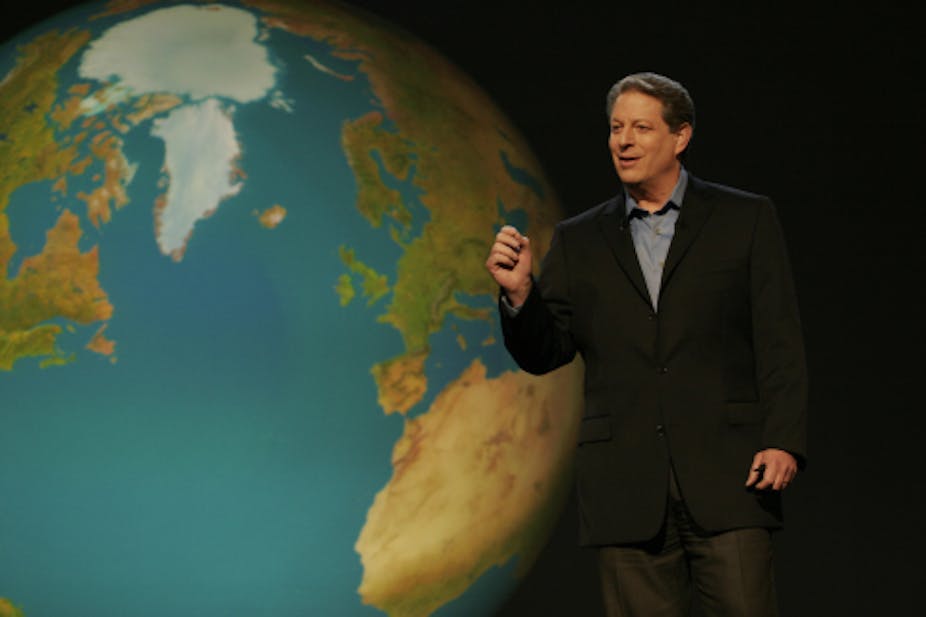
With the momentum of his Inconvenient Truth gradually fading, Al Gore has launched a new climate change action campaign – the Climate Reality Project.

The centrepiece of the campaign is a day of action called the “24 Hours of Reality”.

Like so much in the climate communication sphere, it’s the kind of campaign that will do a lot for those who want to do something about climate change, and little for anyone else.

Where is the mechanism here that will finally get the unconverted or the hostile to agree with the need to take action on climate change?

There isn’t one.

Talking to those in the tent isn’t necessarily a problem. There are certainly times when you need to drum up the enthusiasm of the base.

But there is one aspect of the campaign that does need to be critiqued: the mindless and counter-productive demonisation of “Big Oil” and “Big Coal”. This echoes a regular refrain of The Greens here in Australia.

It’s as if somewhere out there “Big Oil” and “Big Coal” equivalents of Mr Burns, Mr Potter, Blofeld, Siegfried of KAOS and the Pentavirate are cooking up campaigns not to provide electricity and transport solutions, but to destroy humanity.

Ridiculous.

Those who got into the coal and oil industries did so for the simple goal of making a profit by providing us with the energy we need for the modern economy. They didn’t do it to be evil. They don’t want to destroy the world. They are not the nefarious oligarchs that so many would have you believe.

Yes, we now know that the carbon pollution produced by the coal and oil industries is a big problem for society. We all need to wean ourselves off such carbon intensive energy.

But we’re not going to do it by misrepresenting people’s intentions and calling them names. We’re not going to do it by punishing people who acted in good faith.

We’re only going to convince people to change by lining up their profit motive with everyone’s need for a low-carbon economy.

Yes, that’s right. We need to support the fat cats, just as we need to support anyone else in transition.

We need to encourage those who invest in coal and oil to move their money to less carbon-intensive investments. Incentive, not invective.

These captains of industry are not our enemies. They need to be our allies in de-carbonising the economy.

Yet while the talk of “Big Oil” and “Big Coal” continues, those who are less favourably disposed to change – perhaps because it’s easier right now not to do the planning, not to take the next step – are able to portray the climate action movement as actually more worried about the “Big” (as in “Big Business”) than the “Oil” or “Coal”.

So what should you do? Here are three things you can do now:

  • Assume good faith amongst those who advocate different things to you. They may be motivated by profit, but that doesn’t mean they’re evil. ‘Profit’ does not equal ‘evil’.

  • Challenge conspiracy theories, whether of the left or the right. Just as much as we need to reject the idea that “Big Coal” wants to destroy the planet, so too should we reject the clownish idea that scientists are corrupt plotters seeking totalitarian world government, or better yet, the forces of darkness. We’re just not. If someone is nominally on your side (ie, you want the same outcomes or you’re in the same political party), then you need to challenge their conspiratorial thinking more, not less.

  • Remember the goal. This is about limiting and (eventually) reversing climate change. Other fights, from name-calling squabbles to building a social democratic utopia, must be put to the side.

And one final note to the hippies on Al Gore’s campaign: saying that the campaign will allow “the world to join hands” is like an anti-shibboleth, marking your community as one many wouldn’t want to join.

We don’t have to touch each other to solve climate change. We don’t even have to like each other.

Join the conversation

43 Comments sorted by

  1. Eli Court

    logged in via Twitter

    You make some good points here Will and Rod. I agree that people 'got into the coal and oil industries did so for the simple goal of making a profit by providing us with the energy we need for the modern economy'.

    But the fact is that now, faced with the necessary reform of those industries, some of those people are resorting to deception and unethical behaviour to maintain their profits. In any industry, such behaviour is unacceptable. But when the consequence is delaying (perhaps beyond the point of recovery) action on climate change with all the flow on effects for people around the world, it becomes more than unacceptable. It becomes immoral.

    I think this is the point that Al Gore is making, albeit in a way that may alienate people who are in those industries and not engaging in such behaviour, and in a way that may be counter-productive.

    report
  2. Seamus

    logged in via Twitter

    Way to build a straw man here guys. Gore is not suggesting a New World Order type conspiracy hatched by a super-villain from a James Bond movie.

    Should we ignore the millions that "Big Oil" and "Big Coal" have spent on advertising, PR, and lobbying efforts to muddy the debate around Climate Change? You don't really make any good case for it, beyond scoffing at the "hippies" on the Al Gore campaign and taking a cheap shot at the Greens.

    Why should we assume good faith on the part of those who have actively campaigned against taking action on climate change?

    Forming policy to combat climate change is more than just a technical scientific issue, and the idea that this can be separated from a broader political critique is extremely naive.

    report
    1. Will J Grant

      Researcher / Lecturer, Australian National Centre for the Public Awareness of Science at Australian National University

      In reply to Seamus

      I agree - we certainly shouldn't ignore the money people have spent to muddy the debate.

      But we shouldn't delude ourselves as to why people would spend that money. They're spending it to protect their money, pure and simple. And they'll keep doing that for ever.

      Does it make more political sense to punish them for that, to try and get them to stop protecting their money? Or does it make more sense to work with that instinct, and make protecting that money environmentally responsible?

      I'd say our suggestion is the far more realistic one.

      report
    2. Eli Court

      logged in via Twitter

      In reply to Will J Grant

      Yes, we must regulate to make sure that you can't make money by continuing to contribute to climate change, and you make lots of money being part of the solution.

      But the problem is that some members of the industry are doing their best to prevent that regulation. Naming their game for what it is is one way of winning that battle to make such regulation come into existence.

      report
    3. Byron Smith

      PhD candidate in Christian Ethics at University of Edinburgh

      In reply to Will J Grant

      I agree that pointlessly provoking an opponent reduces the likelihood of a good outcome to the discussion (though it can feel good for a little while to have had a rant).

      However, is there is discrepancy between the claim in the article that major oil companies "acted in good faith" and not in order "to be evil" and the admission in the comments that "They're spending [money on misinformation campaigns] to protect their money, pure and simple."?

      Why is it not evil to try to protect one's money through lies and obfuscation? Isn't that what the current Murdoch crisis is all about - the pursuit of profit leading to unethical and illegal behaviour? Good motives don't justify lies or the destruction of scientific trust, nor do they justify the pursuit of a course of action that will have serious negative consequences for millions or even billions of people. The profit motive is not morally neutral, especially when it is presented in such "pure" form.

      report
    4. Will J Grant

      Researcher / Lecturer, Australian National Centre for the Public Awareness of Science at Australian National University

      In reply to Byron Smith

      I truly don't disagree with your argument Byron. I think that protecting one's money through lies and obfuscation is reprehensible behaviour, even more so when the future of the planet is at stake.

      What I would say though is that we need to end our myopic focus on the crime alone, and start paying attention to the causes of that crime.

      report
    5. Byron Smith

      PhD candidate in Christian Ethics at University of Edinburgh

      In reply to Will J Grant

      Thank you for indicating your agreement. I agree that changing the economic incentives needs to be part of the picture (and the focus on pricing carbon indicates that this is already a significant part of most activists' agenda - including Mr Gore).

      Do you agree with my final sentence? If so, then there will be more to shifting behaviour than shifting the bottom line.

      Although it is still too early to judge the ultimate effects, do you think that the current scandals involving News Corp might indicate…

      Read more
    6. Will J Grant

      Researcher / Lecturer, Australian National Centre for the Public Awareness of Science at Australian National University

      In reply to Byron Smith

      Absolutely, I agree that calling out lies is a critical part of the overall campaign. Not only does it make such industries more accountable, it also rewards the good (ie, more ethical, more environmentally and socially responsible) ends of the industry.

      On your final sentence - whether the profit motive is morally neutral or not - I'm not certain I can easily comment without much more thought.

      Is it wrong for a self-employed craftsperson to try to get the most from the sale of the table they…

      Read more
    7. Byron Smith

      PhD candidate in Christian Ethics at University of Edinburgh

      In reply to Will J Grant

      Yes, that nicely illustrates my point: that the analysis of the profit motive requires a sensitive and careful ethical analysis and cannot simply be placed into the "neutral" (i.e. ethically irrelevant) basket.

      I am glad that we seem to be substantial agreement.

      report
  3. Michael Ashley

    Professor of Astrophysics at University of New South Wales

    Will and Rod,

    You ask us to assume good faith from the companies that are making profits from fossil fuels. Yet there is good evidence (see, e.g., Oreskes & Conway) that at least some of these companies are deliberately funding efforts to spread lies about the science. I'm sorry, but that is evil in my book.

    report
    1. Will J Grant

      Researcher / Lecturer, Australian National Centre for the Public Awareness of Science at Australian National University

      In reply to Michael Ashley

      Again, I agree that many are involved in reprehensible behaviour, spreading lies and FUD. But again, the best way to stop this is to understand why they're doing it and to change the incentives.

      What is more likely to stop this behaviour? Calling it out, time and again, and punishing with social stigma? Or being grownups, and shifting the incentives?

      report
    2. Michael Ashley

      Professor of Astrophysics at University of New South Wales

      In reply to Will J Grant

      Will,

      I can see what you are getting at, and agree that influencing fossil fuel companies through their profit motive may be the most pragmatic approach. However, your essay goes further than that and asks us to believe that the fossil fuel companies are acting in good faith. They aren't. The way they are funding lies about the science is evil, and I think they need to be called out on this "time and again". If they don't like the social stigma attached with funding lies, then they shouldn't do it.

      report
    3. Will J Grant

      Researcher / Lecturer, Australian National Centre for the Public Awareness of Science at Australian National University

      In reply to Michael Ashley

      No, not quite. We argued they acted in good faith getting into the industry - providing us energy in exchange for them making a profit. There is still much of what they do that is a 'good faith' bargain with society.

      Yes, there are certainly many examples where they haven't acted in good faith since then. I agree, these should be called out. Spreading lies when the future of the planet is at stake is reprehensible.

      But decades of psychological research have shown us that positive inducements work far better than punishments in changing behaviour. Punishing through social stigma does very little for our cause (I don't care whether they like it or not), and distracts us from the real issue.

      report
    4. Michael Ashley

      Professor of Astrophysics at University of New South Wales

      In reply to Will J Grant

      Another point: while financial incentives will certainly lead to changing the behaviour of the fossil fuel companies, we will never be able to implement such incentives without the political will to do so.

      And this requires pressure from the voters. Which is precisely what Al Gore's new initiative may achieve.

      So I don't think you should write off Al Gore's contribution to the debate. Without his "An Inconvenient Truth" there would be much less public understanding of the issues.

      On another point, you are setting up a strawman when you say that people believe that "Big Coal" and "Big Oil" are motivated by a desire to destroy the world. Surely no one actually believes that?

      However, I think a lot of people would agree that "Big Coal" and "Big Oil" are so focused on short term profits that they don't care about or don't understand the enormous long-term damage they are doing to the environment. I regard that behaviour as evil and morally repugnant.

      report
    5. Will J Grant

      Researcher / Lecturer, Australian National Centre for the Public Awareness of Science at Australian National University

      In reply to Michael Ashley

      I'm certainly not writing off Al Gore's contributions, particularly An Inconvenient Truth. I don't think the coming campaign will do much, but I'd be happy to be convinced otherwise.

      And yes, I whole heartedly agree that political pressure is what is needed in this, and anything that builds that pressure is good. But we need to remember what that pressure is for. To get the necessary change, the political pressure has to be greater than or equal to the solution costs. My argument is that reducing…

      Read more
  4. Felix MacNeill

    Environmental Manager

    Sorry, but I don't think this article, as presented, contributes anything positive to the debate.

    Do I detect the beginings of a new McCarthyism where we prove our rationality by bashing 'greenies' or 'hippies'? That sounds very helpful: let's just shoot the messengers because everybody is having a sulk about the bad news.

    You accuse Al Gore of being 'ridiculous' but engage in a willful and pollyanna-ish ignoring of the significant, clear and active disinformation run by people like ExxonMobil…

    Read more
    1. Will J Grant

      Researcher / Lecturer, Australian National Centre for the Public Awareness of Science at Australian National University

      In reply to Felix MacNeill

      First, an admission: our use of the word 'hippies' was churlish and juvenile.

      But please - as we argued - assume good faith on the behalf of your opponent, including me in this case. My comment in response to Byron was far from disingenuous. I meant what I said.

      Again, we're not ignoring disinformation and lies - our argument is that the best way to solve the real problem - climate change - is to go to the cause of the lying rather than the lying itself.

      report
    2. Felix MacNeill

      Environmental Manager

      In reply to Will J Grant

      Sorry, Will, but the mud has already been thrown and you threw it.

      Take a look around you at the ugly hysteria being brewed by many different sources - not least the industries mentioned in your article - particularly the name-calling and attacks against groups like the Greens, who may not be perfect but remain the one group that has resolutely addressed the problems we face. In the light of that situation you have a responsibility to be far more measured and balanced in your comments.

      report
    3. Will J Grant

      Researcher / Lecturer, Australian National Centre for the Public Awareness of Science at Australian National University

      In reply to Felix MacNeill

      Ok, imagine the word 'hippies' isn't there.

      Do you dismiss the entire argument on the basis of one word? Do you dismiss my rejoinder to your points above?

      We don't want to miss out on a solution to climate change because of a myopic focus on the wrong targets. And that, I believe, is a substantive critique of many in the climate action movement.

      report
    4. Felix MacNeill

      Environmental Manager

      In reply to Will J Grant

      Will, this is so contorted a misrepresentation of what I said - so bad an example of putting words into someone else's mouth that - that it is hard to know where to begin responding.

      At no stage did I say that we should not adopt the simple approach of grabbing a market driven solution to the problem. Last time I checked it was the Greens who pushed hard for just such a process and worked through a long committee process, making significant compromises in order to get jst such an outcome. So don't accuse me or the Greens of dismissing an argument or missing a solution.

      And to ignore the clear and demonstrated malice of elements within the coal, oil and mining industries is politically naive in the extreme. That is all I was saying and, I believe, all that the Greens have said. It was you who chose to slip in the 'It's as if' line about Mr Burns, etc. cooking up plots.

      Setting up straw men then knocking them down is undegraduate rhetoric at its worst.

      report
    5. Felix MacNeill

      Environmental Manager

      In reply to Felix MacNeill

      I don't know if anyone is stil following this post, but I'm going to do something wierd and reply to myself...

      I'm sorry to have been so stroppy, but I think there are fundamentally important issues at stake here and this article is seriously misguided.

      First and foremost, there is the fact of denialism. You can accuse me of paranoia but I think the evidence is unequivocal: denialism is real, it has been a conscious tactic and it has been consciously funded by organisations like ExxonMobil, Koch…

      Read more
    6. Will J Grant

      Researcher / Lecturer, Australian National Centre for the Public Awareness of Science at Australian National University

      In reply to Felix MacNeill

      I think your points are relevant Felix, and truly (as I've said in many other responses to comments here), I don't believe bad faith behaviour should be rewarded or ignored.

      But rather than restate my position yet again (see my other responses), I'd like to try and reframe your thinking on denial and denialism.

      Firstly, denialism exists, and is a significant problem for solving climate change.

      Secondly, denialism is clearly funded by vested fossil fuel industries.

      I'm sure you agree up to here…

      Read more
    7. Felix MacNeill

      Environmental Manager

      In reply to Will J Grant

      Would respond, but the system won't allow me to open your full comment.

      report
  5. Sherry Mayo

    logged in via Facebook

    I agree that the behaviour of some of these companies is reprehensible, but there is value is what Will and Rod point out. At the end of the day it is much more about their profits than some deeply held belief, and that once they are finally dragged kicking and screaming into a position where they have to start doing the right thing, you may find they actually accept this is the new way of things and move remarkably quickly.

    They certainly will be making plans for how to move to cleaner coal burning/carbon capture etc at the very same time that they are lobbying against the carbon tax. These business types aren't stupid and they know the business environment could easily change to one where they have to get on board with cleaner energy.

    report
  6. Mark Duffett

    logged in via Facebook

    "...able to portray the climate action movement as actually more worried about the “Big” (as in “Big Business”) than the “Oil” or “Coal”."

    They are also able to do this because there's some truth to it.

    I've had myriad discussions on energy options, online and elsewhere. Over the course of these, it's become apparent that, when all the rational arguments are stripped away, at the core of many espousers of renewable energy and opposers of nuclear energy (usually the two are synonymous) is a deep…

    Read more
  7. wilma western

    logged in via email @bigpond.com

    Amazed at the reaction to this article. Name-calling , stereotyping , conspiracy theorising plus debates over the definition of evil don't help whether it's by Gore or his critics. Ironically, some companies who own coal fired power stations or oil wells have also invested in clean energy projects - the strategy of not putting all the eggs in one basket. This doesn't stop them from using the toughest hard nosed bargaining /propaganda to get best $ from buy-out or continued operation. . Here in deeply conservative South Gippsland many farmers and true believers of the National Party don't respond to debates - they seem emotionally wedded to denial.

    report
  8. Chris Sanderson

    CEO

    That’s not the issue. One issue is that the fossil fuel and related industries, facilitated by Howard, write our govt’s policies on energy and climate change. The ABC’s documentary ‘The Greenhouse Mafia’ exposed this corruption of democracy.

    Books by Guy Pearse (High & Dry’ and Clive Hamilton (Scorcher) documented the senior executives in both the industries and the govt bureaucracies, who take advantage and write policies to suit their financial interests rather than the future of mankind and…

    Read more
  9. Tim Niven

    logged in via Facebook

    Whilst I appreciate the central point of what you're saying, I have to respectfully say I think you've made the case very badly.

    It is important and worthwhile to shift the focus to the pragmatic question of trying to get vested interests and "the unconverted or the hostile" to work with the rest of us to solve our common problem.

    In the article you tell us (you "tell" us, you don't "argue") that vested interests have acted in good faith. Which is clearly false (as you've agreed in the comments…

    Read more
    1. Will J Grant

      Researcher / Lecturer, Australian National Centre for the Public Awareness of Science at Australian National University

      In reply to Tim Niven

      Thanks Tim - that was a really insightful reading.

      I believe the core of the issue here lies in the interpretation of the critical sentence "We’re not going to do it by punishing people who acted in good faith."

      For many who have commented I think this has been somewhat of a red rag, as if we are naive to - or excusing of - the bad faith manner in which many coal / oil companies have acted in spreading lies and FUD about climate change. We're not. Coal / oil companies have clearly acted in reprehensible…

      Read more
    2. Tim Niven

      logged in via Facebook

      In reply to Will J Grant

      Hi Will,

      I can imagine plenty of problems arise in (mis)interpreting a short article like this, and I understand that can be frustrating and apologise for any misunderstandings.

      My reading is that you want to argue that we should "work with" vested interests, and not preach unconstrucive rhetoric to the choir - so we need constructive, engaging discourse. Somewhat analogously, we need to engage people on the other (our) side of the fence who might fall into the "mindless demonisation of Big Oil…

      Read more
    3. Felix MacNeill

      Environmental Manager

      In reply to Will J Grant

      Will, I for one (and I think this is true for all the other postings here) never suggested that "it is simply not possible for coal or oil companies to have acted in good faith" - once again you are putting words into people's mouths!

      I am yet to see any actual evidence presented of the 'framing' you claim has been made by 'the climate action movement' - all I've seen to date is a fair and accurate naming of destructive behaviour, not a blanket attack on everyone in an industry.

      And you have failed…

      Read more
  10. wilma western

    logged in via email @bigpond.com

    phew! Good to see a smidgen of conciliation at last. How far would the multi-party committee have got in negotiating carbon pricing policy if it had started off like this? The original article was hardly an example of effective communication if the aim was to engage a wider Australian audience .

    report
    1. Will J Grant

      Researcher / Lecturer, Australian National Centre for the Public Awareness of Science at Australian National University

      In reply to wilma western

      Hi Wilma,

      Yes, I'm glad we're able to find some common ground ;)

      Just to clarify, the article is not an attempt to engage a wider audience - our goal for all of us who want climate action to consider our messaging.

      report
  11. Chris Sanderson

    CEO

    Hi Will,

    It feels to me as though you guys are mainly interested in having an intellectual debate about the problem rather than actually doing something to solve it.

    We have a situation in Australia right now that is reminiscent of how the English neo-con equivalents at the time supported appeasement of Hitler’s Nazi fascists in the lead-up to the last world war.

    It also feels like you don't understand that the human race is actually at war (as yet undeclared) right now trying to reduce emissions…

    Read more
    1. Will J Grant

      Researcher / Lecturer, Australian National Centre for the Public Awareness of Science at Australian National University

      In reply to Chris Sanderson

      Hi Chris,

      I understand your sentiments - we're certainly in the midst of a very serious situation that requires a massive effort across society.

      Yet I have serious problems with the metaphor of war.

      We all know that what we need to do to solve climate change is dramatically reduce global carbon emissions. We can (obviously) achieve this a variety of ways, but the simplest - and importantly, fastest - solutions have to be those that are politically possible. We can imagine mass shut downs of coal…

      Read more
    2. Michael Ashley

      Professor of Astrophysics at University of New South Wales

      In reply to Chris Sanderson

      Hi everyone,

      I've been impressed at the interesting comments (and responses from Will) to this article. If only all climate discussions were this civil. It is particularly impressive that Will has been willing to concede (I hope that he agrees) that his original article did make the case rather too strongly.

      One point: Nature doesn't care what is politically possible. Politicians (and others) are fond of saying "we can't possibly do X, it is never going to happen".

      Nature isn't going to respond to this by saying "OK, you drive a hard bargain, I'll give in and reduce the warming by 50%".

      Nature is entirely impervious to politics.

      report
    3. Will J Grant

      Researcher / Lecturer, Australian National Centre for the Public Awareness of Science at Australian National University

      In reply to Michael Ashley

      Thanks Michael ;)

      That's certainly true, nature doesn't care one jot. I think we're all on the same page here on that. It's probably why we're all so passionate about finding a solution.

      Did we make the original argument too strongly? Possibly. It's clear our rhetoric has inflamed passions; we could probably have written it in a more gentle way. ;)

      Yes, if we were to write it again tomorrow we'd probably write the article in a different tone. But we'd put forward the same central argument. We…

      Read more
    4. Felix MacNeill

      Environmental Manager

      In reply to Will J Grant

      You could, of course, have tried presenting your case openly and calmly from the start, adult-to-adult, with the evidence up front, as I thought was in the spirit of this site.

      I worked and studied for twenty-five years in the learning and development field and I'm thoroughly familiar with the concept of and evidence of the power framing. I'm also aware of it's limitations in the face of brute facts, such as denialism.

      But you only raised the whole framing concept honestly much later, as an explanation…

      Read more
  12. Chris Sanderson

    CEO

    Will, I think we’ll have to agree to differ. Clearly war is a nasty business.

    In this case however, there are no deaths involved, in fact they are saved by simply a focus of resources and political will that results from adopting a warlike footing.

    I’m sure you will recall how the US after Pearl Harbour, turned their economy into a war footing very rapidly as did the UK once Hitler invaded Poland.

    If you read the climate literature, you will find an increasing number of writers are adopting…

    Read more
    1. Will J Grant

      Researcher / Lecturer, Australian National Centre for the Public Awareness of Science at Australian National University

      In reply to Chris Sanderson

      Cheers Chris.

      I know that lots of people are using the war metaphor - and your suggestion of the retooling of the US economy in the Second World War is my favourite version of it. It's a great way of talking about how we can turn our economies around really quite quickly.

      And I'm entirely with you on the urgency of the situation - I have regular conversations with climate scientists here at ANU... some of whom are really not optimistic about the situation. Some see it as entirely touch and go, even if we act immediately.

      But my reason for avoiding the war metaphor is based on that urgency - I don't believe that it will (because of the reasons I noted above) actually engender change very quickly. But probably the best solution is to agree to disagree on this, and use any metaphor that will convince people as quickly as possible ;)

      report