

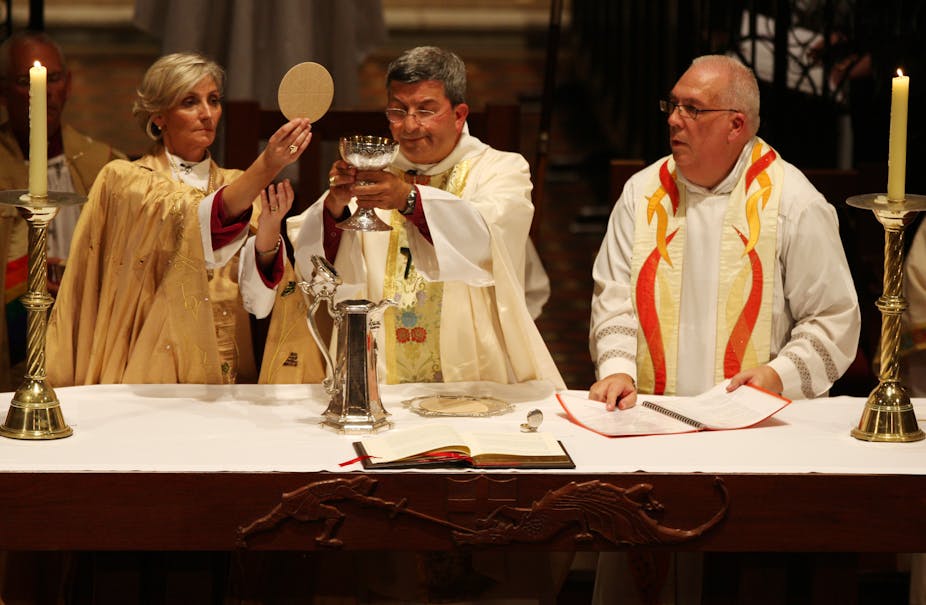
Twenty years ago, Anglicans in Australia and England independently passed legislation to allow for the ordination of women as priests.
Now the Anglican Church of Australia has just appointed its fourth female bishop, while the Church of England has narrowly failed to adopt legislation that would allow for the country’s first female bishops.
Currently women can become priests but not bishops throughout England. By contrast in Australia it’s up to the individual diocese, so in some parts of the country women are able to be neither bishops nor priests and in others they can be both. And while 74% of the members of the English General Synod – the Church of England’s parliament – voted in favour of female bishops, a similar vote in the Australian General Synod would struggle to pass.
How is it, then, that women can be bishops in Australia but not England?
A history of confusion
Anglicans have been debating the ordination of women for over a century. The issue arose as part of debates about gender that dominated late nineteenth-century discourse in Britain and its colonies.
If women could be admitted to universities, could they study theology? If women could vote and stand for public office, could they take part in the councils of the church? If women could be lawyers and doctors, could they be priests and bishops?
Ever since these question were raised, Anglicans have struggled to agree on precisely why women should continue to be barred from ordination.

Opponents argue that Jesus appointed only male disciples as his apostles, while St Paul instructed women to be silent in church, and told wives to submit to their husbands. Women are therefore prohibited from exercising authority over men in the church.
A growing number of Anglicans have claimed that new understandings of scripture and tradition actually require the church to ordain women, following the pattern of earlier revolutions on issues such as slavery.
Some Anglicans have asserted that the Anglican Church simply does not have the authority to permit women to be deacons, priests or bishops. Change would require agreement from at least the Roman Catholic and probably the Eastern Orthodox churches.
Others point to historic innovations authorised by Anglican monarchs, parliaments and synods, such as the ordination of married clergy, or reform of the liturgy.
The Australian church
In the 1970s, women were accepted as priests by Anglicans in Hong Kong, the United States of America, New Zealand and Canada. In each case the decision was made by an assembly of laity, clergy and bishops through legislation.
In the Church of England consensus built gradually in the 1970s and 1980s. In 1992, England’s General Synod adopted a Measure permitting the ordination of women as priests (but not bishops) with the requisite support of two-thirds of each of the synod’s three Houses - bishops, clergy, and laity.
This measure provided for the ordination of women in all parts of the Church of England, though a parish could refuse to have a woman appointed as its priest.
In 1993, the General Synod made further provision for those who could not accept the ordination of women in the form of an Act of Synod. This Act, still in force, requires the appointment of male bishops who do not support the ordination of women to act as “episcopal visitors” on the request of parishes who will accept neither a female priest nor a male bishop who ordains women. Around 2 to 3% of English parishes have taken up this option.
In Australia the largest diocese, Sydney, has consistently opposed the ordination of women on the grounds that the Bible does not permit women to exercise authority over men in the Church.
On account of Sydney’s size, its opposition made it almost impossible to achieve a two-thirds majority of laity, clergy and bishops in Australia’s General Synod to allow the ordination of women as priests. Moreover, there was widespread disagreement in Australia about what legislative change (if any) was required before women could be ordained.
In 1992, the impasse was broken by the carriage of legislation in the Australian General Synod that, in a diocese which chose to adopt the law, removed any legal barrier that might exist to ordaining women. Since then, 18 of Australia’s 23 dioceses have adopted that law and proceeded to ordain women as priests.
The move to women as bishops
Once women were ordained as priests, the question of their eligibility for appointment as bishops was raised. The theological arguments were essentially the same as those for and against women in the priesthood, except that the significance of the change was higher on account of the degree of authority exercised by a bishop.
As the Anglican Communion is held together by bonds of fellowship, expressed by the collegiality of its bishops, and not by formal ties of law, Anglicans recognised that each member church would make its own decisions in its own time.
North American Anglicans began consecrating women as bishops in 1989, followed by New Zealand in 1990. By 2012, women had been appointed as bishops in places as diverse as Cuba and Swaziland.
Meanwhile, both the English and Australian General Synods continued to wrestle with the issue of whether women should be able to become bishops.
In Australia, legislation for women as bishops failed to achieve a two-thirds majority in each of the General Synod’s three Houses in 2004. Passage of legislation seemed impossible for the foreseeable future.
But in 2007 a surprising legal ruling by the church’s Appellate Tribunal declared that by removing legal barriers to women being ordained priest in 1992, the church had removed any barrier to their ordination as bishops without the need for any further intervention.
In 2008, the first two Australian female bishops were consecrated, one in Perth and one in Melbourne, followed by a third in 2012, with a fourth to be ordained in Brisbane in 2013.
Two worlds, the same church
Thus, while the theological issues are identical, history and governance has created different situations for Anglicans in Australia and England.
Australian Anglicans have never adopted legislation specifically providing for women as bishops, yet there will soon be four female bishops here. Women still cannot be ordained as priests or bishops in some dioceses.
In the UK, female priests have been allowed but not women bishops – an absence that is felt all the more acutely because the church is so closely linked to the state, with bishops sitting in the House of Lords and a female monarch as the church’s Supreme Governor.
The challenge for Anglicans is to live with this diversity. Whether in Australia, England, America or Africa, they must come to terms with what it means for the church that women can be ordained in some places and not others.