Why older motorcyclists are at higher risk of serious injury

Older motorcycle riders are up to three times as likely to be seriously injured in a crash as young adults, according to new research from Brown University in the US. The study, published in the journal Injury Prevention, used cross-sectional data from the National Electronic Injury Surveillance System…

G23wgrrv-1360281265
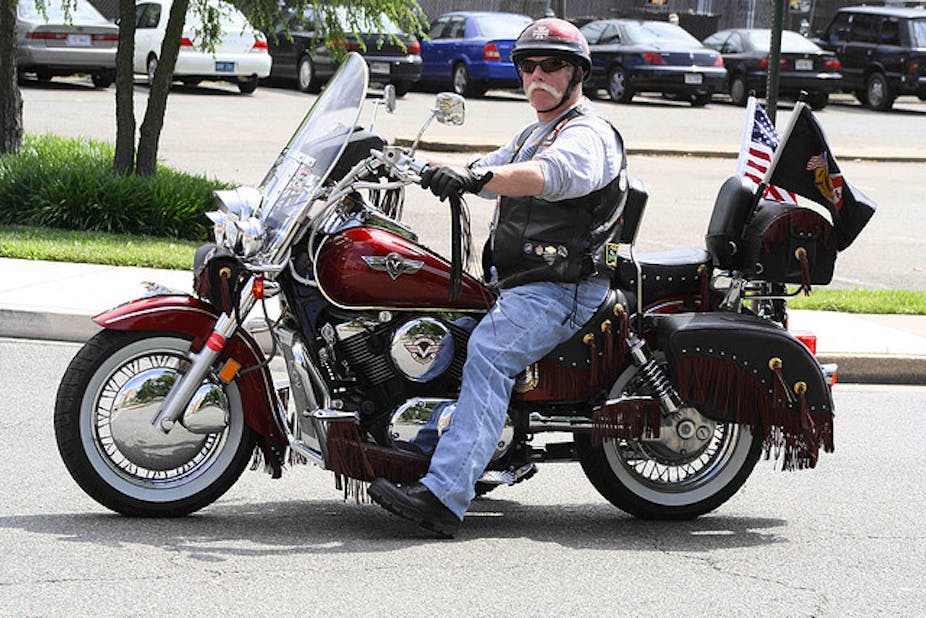
Older riders are up to three times as likely to be seriously injured in a motorcycle crash as young adults, the study found. Elvert Xavier Barnes Photography, http://www.flickr.com/photos/perspective

Older motorcycle riders are up to three times as likely to be seriously injured in a crash as young adults, according to new research from Brown University in the US.

The study, published in the journal Injury Prevention, used cross-sectional data from the National Electronic Injury Surveillance System-All Injury Program to assess emergency department-treated injuries from motorcycle crashes in the US from 2001 to 2008.

The researchers also found a demographic shift of motorcycle riders in the last couple of decades, with an increasing older population both riding motorcycles and being involved in crashes.

The study suggests the severity of injuries may be due to the changes to the body that occur with age.

“As the body ages, bone strength decreases, subcutaneous and visceral fat (organ fat) distribution may change, and there is a decrease in the elasticity of the chest wall, factors which may lead to more severe injuries after exposure to trauma,” the authors wrote in their paper.

While the study did not indicate the types of motorcycles involved in crashes or circumstances surrounding the crashes, the authors of the study said that previous research suggests older adults are more likely to purchase motorcycles with large engines than young adults are.

Between 2001 and 2008, the number of fatal motorcycle injuries among those 60 years and older increased from 4.46% to 10%, the US data showed. Similarly, the proportion of fatal injuries sustained by those 40-59 years increased by 6.12%, while among individuals aged 20-39 years the number decreased from 58.4% to 46.84% between 2001 and 2008.

“Fractures were the most frequently occurring injury in all age groups; however, location of fractures differed. Older adults and middle age adults had a significantly higher proportion of upper trunk fractures, while younger adults had a higher proportion of arm fractures,” the paper said.

Caroline Finch, Head of the Australian Centre for Research into Injury in Sport and its Prevention, said the results are not surprising.

“One of the reasons we see an increase in the number of older people riding motorbikes is because as people get older and adopt a different lifestyle, because they no longer have to look after children or work, they have the ability to buy a bike as they’ve always wanted,” said Professor Finch, who was not involved in the US study.

“The issue is that for many of these people, especially those who rode a motorbike while they were young, they revert to their younger habits and are less accepting of newer regulations which require riders to wear helmets, because it might ruin their hair, or affect the feeling of being free.”

“Unlike America however, Australians have a much stronger acceptance of helmets, wearing appropriate clothing while motorbike riding, and community awareness,” she said.

“While we do follow a similar U-shaped trend, where accidents are much more probable among young motorists and older motorists, it is not to the same extent as America.”

Professor Finch added that while there are strategies to decrease the number of injuries and fatalities among young motorists in general, more needs to be done to target older motorists.

“As well as the need to think about additional strategies to decrease fatal instances in older motorists, we could also look at improving roads, riding conditions and road behaviour.”

Sign in to Favourite

Want to follow The Conversation?

Sign up to our free newsletter to get the day's top stories in your inbox each morning, with a special wrap on Saturday.

Help evidence based journalism become the norm and donate

Join the conversation

25 Comments sorted by

  1. Phill Herbert

    Self funded

    Oh goo-bars. I rode motorcycles for 25 years and hung up my leathers in '95. I have been eying some machines lately with the intent of hopping back in the saddle. I know it hurts hitting the road, now I know that such a scenario would potentially be too painful to bare...party poopers!

    report
    1. Eddy Schmid

      Retired

      In reply to Phill Herbert

      Phill, share your views, should I ever come into the ready stuff, would not hestitate to grab myself a BMW 650 single, at the first opportunity.

      report
  2. Jamie McIlwraith

    Journalist

    Good piece indeed. As it says the authors didn't compile data on motorcycle types, but I do think they're a major factor. The combination of very heavy, large powerful modern bikes and fading reflexes and skills is made worse when you consider that some of these older riders last rode bikes a decade or two back when bikes weighed half as much and had much less power than the modern machines.
    As a keen but cautious 59-year-old motorcyclist, I often laugh at the people who see my 750cc machine as…

    Read more
  3. Eddy Schmid

    Retired

    As a lapsed motorcyclist of 27 years experience starting at the ripe old age of 11 years, it's clear to me the folks involved with this research couldn't be bothered to delve into it deep enough and prtobaly only used the U.S. study adding their own personal comments.
    IMHO, not a very accurate publication at all.
    I've ridden everything from a belt driven automatic scooter built in the 50's, (yep way ahead of the stuff produced today) to the what was then, the ultimate Kawasaki 900 cc four cylinder…

    Read more
    1. Eddy Schmid

      Retired

      In reply to Eddy Schmid

      OOPS, pressed the wrong button and my post was posted before completion.
      I was saying the authors did not really look into this issue at depth, because stating that motorcyclist of those days were reluctant to observe todays' laws. Which is IMHO, a load of crap.
      Motorcyclists of those days, valued their skins intact much higher then todays, and we rode accordingly, (I'm still alive and well at 63 years of age).
      I always laugh, when I see today's younger riders riding their bikes with thongs on…

      Read more
    2. Sunanda Creagh

      Editor at The Conversation

      In reply to Eddy Schmid

      Hi Eddy, thanks for commenting. Just to clarify, this is a news story by a journalist about a study by US researchers who used US data. Caroline Finch is an Australian professor who is reflecting on the US study and giving her opinion on how it may relate to Australia.

      report
    3. Gerard Dean

      Managing Director

      In reply to Eddy Schmid

      Mr Schmid, you bought tears to my eyes when you mentioned the mighty Kwacka Nine. The Kawasaki 900 four cylinder was the first superbike for the average bloke.

      How well I remember the traffic light drags along Dynon Road when the Kwacka Nines lined up on their way home from work.

      Gerard Dean

      report
  4. Sue Ieraci

    Public hospital clinician

    Blunting of reflexes, muscle strength and balance are definitely responsible for a range of injuries in elderly men - from falling off the roof, out of a tree, off a ladder.

    The combination of available time and dangerous toys can be a menace. I'm sure motorbikes are overshadowed by ladders, though. Don't let an old bloke near a ladder on his own.

    report
  5. Bazza Hodge

    Statistics Blackbelt

    Imagine motor bikes have not been invented yet. Then some bright spark suggests fitting an engine to a push bike so it will go 160 km per hour, and that she will use this device to ride in heavy traffic in all weather.

    Firstly the inventor would be accused of having a death wish.

    Secondly the various Road Traffic Authorities would ask how it was going to satisfy car safety standards, where are the seatbelts, airbags, crumple zones.... Can you show us the crash test data?

    Clearly motorbikes…

    Read more
    1. Aden Date

      Manager of the Guild Volunteer Hub at University of Western Australia

      In reply to Bazza Hodge

      If they've survived in the evolutionary pool this long, one can only assume that riding a motorcycle has certain qualities that have allowed it to flourish in the pool! Perhaps such a thing would die out now, were it to be re-introduced -- like the foxes the Brits brought over for hunting.

      I'd say it's still in the gene pool because of some Freudian "death wish," or perhaps more simply - a good 'ol fashioned love of dangerous fun. Motorcyclists may have a shorter half-life, but damn, we can cram a lot of living in to that little timeframe.

      Also, to your quip about EDs, rehab, and, while we're at it: The Morgue. Most accidents the motorcyclists were not at fault, and an overwhelming number of motorcycle-related deaths are due to left-turning vehicles failing to observe motorcycles as they pull in to traffic. If blame is proportional, anger should be directed at lazy motorists in lala-land in greater proportion than alert and conscious motorcyclists.

      report
  6. Nev Norton

    Farmer

    It was only a few years ago when my son was racing Moto x (chip off the ol block) that I seriously got interested in racing again, our club had a 45yo to not out category, I watched these guys ride and they seemed to just cruise around not get to much air or go nearly as hard as the open class riders, I thought to myself that seems ok I could handle that, then I got to talking to a couple of guys I knew who's boys also raced, they had taken it up again, at least for a short while, one broke his hip, from a simple high side spill, the other broke his leg and 3 ribs from a bad landing over a jump. That convinced me, one of the guys summed it neatly by saying at our age you don't bounce like the young guys, things just break.
    I still ride a MX bike, but just sedately, mostly, around the paddocks.

    report
  7. Mark Amey

    logged in via Facebook

    “As well as the need to think about additional strategies to decrease fatal instances in older motorists, we could also look at improving roads, riding conditions and road behaviour.”

    I can give you a strategy that's kept me off motorcycles in my 50s..my wife keeps saying . "No, No, No, No, No Bloody way, NO, No, No!"

    report
  8. Mark Davis

    Lecturer in Publishing and Communications, University of Melbourne at University of Melbourne

    To those here considering getting back into bikes, go for it. Do a training course. You'll never look back. I started riding at 17 and well into middle age now, have never stopped. No major accidents despite a thirty year string of high-powered sports bikes. And to the nay-sayers, yes bikes are a bit silly. Ain't it great!

    report
    1. Mike Cowley

      logged in via Facebook

      In reply to Mark Davis

      Heartily seconded. Thirty years of riding, never owned a car, still not dead.

      report
    2. John Phillip

      John Phillip is a Friend of The Conversation.

      Grumpy Old Man

      In reply to Mark Davis

      Totally agree, Mark. Got back onto a Triumph twin after twenty years off bikes. Did a fantastic course through one of the training schools in Brissy, learned a hell of a lot (wish I'd done one decades ago) and haven't looked back. Fantastic to be back on a bike :)

      report
    3. peter mackenzie

      Transport Development and Road Safety Researcher

      In reply to John Phillip

      To Mark, Mike and John,
      Glad you did training, had no major accidents,pleased your still alive and not looking back.

      But of course that's only part of your riding experience. Even if you don't botch something up, aren't aggressive or reckless, sooner rather than later, some other road user is going to try and take you out.

      So how often and how many times have you had to avoid the mistakes of others, and use the ungentle art of evasion to avert a crash (ie how many near-misses)?

      In road safety, we often base our risk levels on crashes and police apprehensions, 'cos we have poor date on unsafe incidents.

      So it would be interesting to hear of your experiences.

      report
    4. Mark Davis

      Lecturer in Publishing and Communications, University of Melbourne at University of Melbourne

      In reply to peter mackenzie

      Hi Peter,

      Avoiding/evading the mistakes of others happens all the time. But I can't remember the last time this turned into a near-miss situation. Best advice I was ever given when I first started riding: ride like everyone else on the road is trying to kill you. I ride using a 'system', which is about regulating your road position, speed etc to best advantage at all times, knowing where every nearby vehicle is and what they're doing, always having a plan B and space you can move into, and so…

      Read more
    5. John Harland

      bicycle technician

      In reply to Mark Davis

      I find it more helpful to regard other road users as essentially nice people but totally out of their depth and needing help to understand what is happening around them.

      I communicate in the conceptual equivalent of very simple single syllables, making it as clear as I can through road position and other cues. Also give them as much help as I can in judging the traffic around them, particularly where I am and what I am doing, or am intending to do.

      report
    6. peter mackenzie

      Transport Development and Road Safety Researcher

      In reply to Mark Davis

      Thanks Mark and John for your follow-up comments. I haven't ridden for more than 30 years, so it is interesting to hear from your experience.

      I have found that my mixed experience from cycling (again not for 30 years), motorcycling and driving buses, in particular has helped with my defensive driving.

      I have still had 2-3 near-misses in the last several years, but like you, use a range of actions to minimise those very unfunny situations. I would have to say the two people who created those…

      Read more
  9. Gerard Dean

    Managing Director

    Good stuff to see an article on motorcycling.

    Firstly, the line, ' Unlike America however, Australians have a much stronger acceptance of helmets,' doesn't mention the small fact that it is the law to where a helmet in all states of Australia unlike the USA. Furthermore, the law is rigorously applied in Australia, also unlike that in the USA.

    Secondly, there is another reason for the increase in accidents to older riders that is not touched on. The 70/80's motorcycle boom has provided a large…

    Read more
    1. Gerard Dean

      Managing Director

      In reply to Gerard Dean

      Sorry, the 'where' should be 'wear'. I blame the fact that I have not had my morning coffee yet.

      Gerard Dean

      report
  10. Gordon Claridge

    Ecosystem Services Manager

    Is it just me, or has the author shown a preference for an "interesting" variety in terminology over accuracy and meaning, alternating "number" and "proportion" as if they are synonymous?

    "Between 2001 and 2008, the number of fatal motorcycle injuries among those 60 years and older increased from 4.46% to 10%, the US data showed. "

    A percentage is not a number. It is a proportion, i.e. x out of every 100.

    "Similarly, the proportion of fatal injuries sustained by those 40-59 years increased by 6.12%, "

    Yes, that's a proportion - and this is the only meaningful data in the paragraph. Then we have:

    "... while among individuals aged 20-39 years the number decreased from 58.4% to 46.84% between 2001 and 2008"

    No, that "number" is a proportion.

    For an "editor" of a publication supported largely by universities, and one which puts itself forward as quality journalism, this isn't acceptable.

    report
  11. John Harland

    bicycle technician

    Three times more likely to be injured if they crash.

    But are they as likely to crash.

    The percentage of older riders crashing has gone up - against what? Overall motorcycle crash figures, presumably. But what direction have those overall figures trended?

    Also, how has the proportion of older riders changed in the overall motorcycling population?

    What data do we have on the kind of riding each group does? What kinds of roads are each group riding predominantly, and how familiar are they with those roads?

    Are we comparing older people falling off big motorcycles on highways with an average slewed by young women riding little scooters and getting caught in tramlines at low speeds in town?

    It's a great article to get the prudes and wowzers tut-tutting about old blokes on motocycles, but I don't feel at all enlightened by it.

    report
    1. peter mackenzie

      Transport Development and Road Safety Researcher

      In reply to John Harland

      Good Questions John - ones I was about to ask, so thanks.
      I think the item is simply trying to say that if your are an older rider, and if you are in a crash, (and you are not killed), then you are three times more likely to suffer serious injury.

      “As well as the need to think about additional strategies to decrease fatal instances in older motorists, we could also look at improving roads, riding conditions and road behaviour.” (Prof Finch)

      Yes we do! (we being the authorities responsible).

      "What data do we have on the kind of riding each group does? What kinds of roads are each group riding predominantly, and how familiar are they with those roads?" (John H).

      And yes we need a whole lot of data on those and other questions before we can improve the situation - is anybody dojng that?

      And thanks for the item.

      report
    2. peter mackenzie

      Transport Development and Road Safety Researcher

      In reply to peter mackenzie

      Sorry meant to add - improving road behaviour needs to include all the motorists and other road users who continually put motorcyclists at risk (whether a crash results or not). Not just motorcyclists themselves - which may be what Prof Finch meant, but that can't be deduced from the text..

      report