Wind could trump coal power by 2030: experts

Around 4 million wind turbines, the majority located over water, could deliver half of the world’s power demand according to researchers from Stanford University. In a new study exploring the potential of wind power, the researchers developed a sophisticated weather model to work out if there is enough…

Wj7vqz54-1347336538
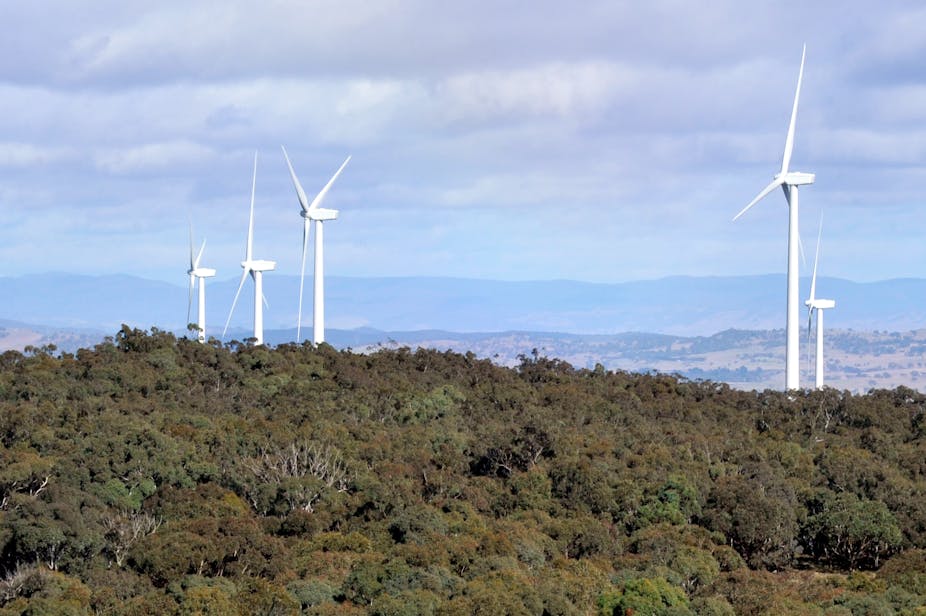
Researchers from Stanford University say there’s enough wind potential to serve the world’s energy needs by 2030. AAP

Around 4 million wind turbines, the majority located over water, could deliver half of the world’s power demand according to researchers from Stanford University.

In a new study exploring the potential of wind power, the researchers developed a sophisticated weather model to work out if there is enough wind power on Earth to satisfy global human energy demand.

The findings, published in PNAS, reveal despite the finite limits of wind power, it could easily satisfy global energy demand by 2030.

“We’re not saying “put turbines everywhere,” but we have shown that there is no fundamental barrier to obtaining half or even several times the world’s all-purpose power from wind by 2030. The potential is there, if we can build enough turbines,” said Mark Jacobson, professor of civil and environmental engineering at the University of Delaware.

Two previous studies have said wind power potential falls short of such a goal partly because of turbines stealing too much wind energy from other turbines, however the Stanford researchers say their computer model provides a more sophisticated look than previously possible.

“Modelling the climate consequences of wind turbines is a complex science,” Professor Jacobson said. “This software allows that level of detail for the first time.”

However Gus Nathan, director of the Centre for Energy Technology at the University of Adelaide, said the main challenge was not the availability of wind, but rather the cost of integration into the supply-demand system.

“Cost-effective energy storage and/or management systems are presently a greater barrier than resource availability,” Professor Nathan said.

But John Andrews, associate professor of Mechanical Engineering at RMIT University said the study is a significant one, and adds to other research from Stanford showing that after applying strong energy efficiency measures across all consuming sectors it is technically feasible for economically competitive renewables to meet the entire global energy demand.

Professor Andrews said given uncertainties concerning the continued use of coal and natural gas with carbon dioxide capture and storage, and the great risks associated with nuclear fission reactors, there are strong arguments that the only truly sustainable way to meet 2050 targets for reducing emissions by 80% is through a strategy based predominantly on energy productivity and renewables.

“Wind power at good sites is already competitive with coal-fired power generation at relatively low carbon prices,” Professor Andrews said.

He added that the next step needed was for researchers to apply Stanford’s wind energy model to particular countries to establish the best wind regions within those countries.

Sign in to Favourite

Want to follow The Conversation?

Sign up to our free newsletter to get the day's top stories in your inbox each morning, with a special wrap on Saturday.

Become a friend of The Conversation and donate

Join the conversation

50 Comments sorted by

Comments on this article are now closed.

  1. Tony Xiao

    retired teacher

    Aside from the costs of integrating wind-power into the system, the Chinese experience with wind power has some power analysts convinced that too much wind power is a serious threat to grid stabilty and have recommended that wind power should be limited to 5-10 percent of total grid power.
    And for the sake of grid stability, about one third of China's wind generators remain unconnected to the grid.
    However, there has been a case in Inner Mongolia where wind generated 18.7 percent of total grid power without any negative effect.
    With the existing technology, notions that wind generation could make up half or more of the power grid total would be a grid controller's worst nightmare and a substantial threat to grid stability and hence a threat to supply continuity.

    report
    1. William Ferguson

      Software Developer

      In reply to Tony Xiao

      I don't think grid instability from renewables is going to be the problem that a lot of people think it will. There are dozens of storage mechanisms from small to large scale that are either available now or will come to market within the next 12-24 months that are cheap, clean (or relatively so) and long lasting.

      The cost of some of these is fast approaching the point whereby there could be run as a commercial energy arbitrage between peak / off-peak wholesale power prices. At that point you essentially have no peak/off-peak and arguments about grid stability and renewable being useless when the sun doesn't shine or wind doesn't blow turn into questions about how much fat/margin the community has in its grid storage.

      report
    2. Jonathan Maddox

      Software Engineer

      In reply to Tony Xiao

      Certainly wind power requires special management which is different from that of a grid without it. But recommendations to limit it to just 10% penetration are contrary to experience in many places. 50% penetration is unproblematic as demonstrated last week in South Australia. Higher penetrations are also acceptable with broad regional interconnections, large-scale pumped hydro storage, curtailment or dispatchable loads.

      report
    3. Jonathan Maddox

      Software Engineer

      In reply to Tony Xiao

      I would appreciate it if you could substantiate the assertion that "for the sake of grid stability, about one third of China's wind generators remain unconnected to the grid."

      I would be surprised to learn that this is anything worse than a temporary mismatch of investment : turbines completed early while capacity upgrades and new interconnections are still being built to accomodate new generation.

      report
    4. Chris O'Neill

      Telecommunications Engineer

      In reply to William Ferguson

      "There are dozens of storage mechanisms from small to large scale that are either available now or will come to market within the next 12-24 months that are cheap, clean (or relatively so) and long lasting."

      OK. We have nothing to worry about and in 24 months this issue will disappear from the news.

      report
  2. John Coochey

    Mr

    Yes and if we had enough mules running on treadmills and enough food to feed them and people to remove the poo we could power all our energy needs. The issue is at what cost and why bother? I have posted on this blog only to have the question removed at least five times asking if anyone can rebut or for that matter confirm Lomorg's statement that Europe is spending $250 billion a year which by the end of the century will have inhibited temperature rise (presumably using IPCC modelling) of .05 degrees C! Hardly worth it. There has been another calculation that if we accept the 2.5 C tipping point (which I understand is a purely arbitrary figure so everyone is singing from the same song sheet) then the billions spent in Europe have pushed this back by 22 minutes. Informed comments please!

    report
    1. Grendelus Malleolus

      Senior Nerd

      In reply to John Coochey

      Posting this comment on so many different article threads is very much like spam. And, just because it is a thread about environment, climate or energy does not make you comment relevent.

      report
    2. John Coochey

      Mr

      In reply to Grendelus Malleolus

      When someone answers it I will not need to answer it anymore will I?

      report
    3. Grendelus Malleolus

      Senior Nerd

      In reply to John Coochey

      "or that matter confirm Lomorg's statement that Europe is spending $250 billion a year which by the end of the century will have inhibited temperature rise (presumably using IPCC modelling) of .05 degrees C! Hardly worth it."

      I can confirm that Lomborg called for Europe to SPEND $250 billion a year on a range of measures:

      "Levy a worldwide carbon tax of $7 per metric ton, raising $250 billion annually, of which $100 billion would be targeted for green energy R&D; $50 billion for adaptation measures; $99 billion to inculcate environmentally sensitive development practices for poor nations; and $1 billion for research on geo-engineering schemes like manmade volcanoes."

      report
    4. John Coochey

      Mr

      In reply to Grendelus Malleolus

      Thankyou for your comment but what has that got to do with the question?

      report
    5. Grendelus Malleolus

      Senior Nerd

      In reply to John Coochey

      I'm trying to find out if you asserting Lomborg said what you say he did is correct or not - do you have a reference for the quote?

      Difficult to confirm if we don't have the source.

      report
    6. John Coochey

      Mr

      In reply to Grendelus Malleolus

      The source of the quote is completely irrelevant v the content. Can you confirm or deny? It was published on the Bolt Report which is easily available via Google. But the source is essentially irrelevant it is the question and the answer (if available ) which is the issue.

      report
    7. Grendelus Malleolus

      Senior Nerd

      In reply to John Coochey

      The source is entirely relevant since I order to answer your question I need to be able to read the original statement by Lomborg in its context, not as filtered by any other source.

      report
    8. Grendelus Malleolus

      Senior Nerd

      In reply to John Coochey

      Lomborg: "what if we could make solar panels and win turbines so they are cheaper than fossil fuels, then we have solved global warming and would not need to be doing this thing (a carbon tax)" then he used the line you indicated about Europe spending $250 billion on a carbon price for minimal effect.

      Lomborg's position was very clear that we should invest in renewables such as solar and wind. He stated this explicitly - and indicated that this is preferable to a carbon tax in addressing climate change.

      Do you agree with Lomborg that investing 250 billion each year in Solar and Wind is a good idea?

      report
    9. John Coochey

      Mr

      In reply to Grendelus Malleolus

      If it will only result in an inhibition of temperature of one twentieth of a degree at the end of the century I take that question as rhetorical. How about you?

      report
    10. John Coochey

      Mr

      In reply to Grendelus Malleolus

      The link has now been posted so you have no excuse, no matter how vacuous, for not answering the question.

      report
    11. John Coochey

      Mr

      In reply to Grendelus Malleolus

      Actually I have just re watched the Sunday broadcast and I think you are misrepresenting what Lomborg said. His point was that in the event of renewables becoming cheaper than carbon fuels then the whole subject would become a non issue because people would buy the cheaper energy. Which seems eminently sensible as we are being told constantly that this is just around the corner so their should not be a problem should there? But then again tomorrow never comes.

      report
  3. Gerard Dean

    Managing Director

    Sorry!

    Run that by me again. Didn't our Prime Minister just perform a monumental backflip by backing out of her promise to close big, dirty coal burning Hazelwood. Add to that, the enviromentalist's poster nation, Germany has started building 20, read twenty, coal fired power stations including good old brown coal burners. They used cheap carbon credits from the dysfunctional and rorted European ETS and cheap Polish coal to trump wind turbines.

    I will be back!

    In the meantime, Mr Coochey, hold the fort, because soon enough Messr's Hansen and good old Doc Harrigan will happen along with their especially insightful comments.

    Gerard Dean

    report
    1. John Coochey

      Mr

      In reply to Gerard Dean

      Yes but you have forgotten that when these twenty coal fired stations are completer (backed up by French nuclear when needed) Germany has no plans to build any more! Why would they with current growth and energy demands?

      report
    2. Gerard Dean

      Managing Director

      In reply to John Coochey

      You are right, but China and India have plans for over 1000 coal fired plants by 2030. That is a lot of coal and it is a lot of windfarms to replace that coal.

      Gerard Dean

      report
    3. Tony Xiao

      retired teacher

      In reply to Gerard Dean

      please disregard my comment if you were not meaning 'new' coal-fired plants

      report
    4. Gerard Dean

      Managing Director

      In reply to Tony Xiao

      Will check it out for you Tony!!

      Back to building my V12 engine.

      Gerard Dean

      report
    5. Gerard Dean

      Managing Director

      In reply to Gerard Dean

      Hey Tony

      A quick "Troll' on the net netted these, however there are articles that do project the number of new plants will exceed 1000 for China and India. I will keep looking.

      'Coal Dependent Future 'By Susan Watts, BBC Newsnight, science editor 9th March 2005

      ..... fuels its relentless growth today. Eighty per cent of China's electricity comes from coal, and there are plans for 544 new coal-fired power stations to meet an insatiable demand for energy.

      "Coal-fired power in Asia will rise to 1,464,000 MW in 2020 up from 918,000 MW this year." and "Coal-fired power plants capacity to grow by 35 per cent in next 10 years" ( Power Engineer - Focus On Coal.)

      Gerard Dean

      report
    6. Gerard Dean

      Managing Director

      In reply to Mike Hansen

      I know me, Mr Hansen

      Good to see you are sticking to the facts, as you always do.

      Just in case you forgot, this article is about some academics who claim we can replace coal fired electricity by 2030 as long as we introduce 'strong efficiency measures'

      Just imagine Americans wearing 'strong efficiency measures'. They will vote out their local congress representitive if the price of gas rises or corn falls more than a percent or two.

      And the funny bit. the report refers to work done by Standford University, well known for its sustainable campus lifestyle. Even you should be able to work out I am being ironic.

      Standford University, like the State of California is a huge sinkhole for the earth's resources.

      Ignore them and they will go away - in their SUVs

      Your old mate

      Gerard Dean

      report
  4. Gerard Dean

    Managing Director

    Well, well, well! They say you should always read the fine print. I did and look what I found.

    Small print: "after applying strong energy efficiency measures across all consuming sectors it is technically feasible for economically competitive renewables to meet the entire global energy demand."

    So, implementing 'Strong efficiency measures', is how Standford University justifies their statement that contradicts virtually every energy authority, who predict coal burning will rise for decades…

    Read more
    1. Jonathan Maddox

      Software Engineer

      In reply to Gerard Dean

      California's "big appetite" is already smaller than that of the rest of the USA in most sectors; its per-capita energy consumption is more comparable to a European country.

      California has one of the most efficient electric sectors on the planet thanks to a decades-long policy, starting in 1974, of rewarding utilities for improving their customers' results (the deregulated period 1996-2001 notwithstanding).

      Efficiency measures in transportation are much harder to push from a political POV because of California's historic "car addiction" (created in the 1940s with the privatisation and destruction of public transit systems and reinforced by the subsequent construction of freeways at public expense), but even so, the State of California actually leads the way in automotive emissions controls as well.

      report
    2. Jonathan Maddox

      Software Engineer

      In reply to Gerard Dean

      Germany is not planning to increase its consumption of coal. Coal consumption in that country has been decreasing for 20 years and will continue to fall as the renewable sector grows.

      report
    3. Gerard Dean

      Managing Director

      In reply to Jonathan Maddox

      Just how is Germany's coal consumption going to fall when they are building 20 new coal fired power plants?

      report
    4. Gerard Dean

      Managing Director

      In reply to Jonathan Maddox

      I am not sure if the California you are talking about is the same California I have to visit occasionally. The place is a sinkhole for the earth's resources.

      No matter how efficient California makes its power generation, the ever growing population and their ravenous appetite for goods, services and energy will more than offset the gains.

      And you got it in one on the cars. They may lead the world on emissions controls, but that is it,

      Remember, the learned folk at Stanford University said we need,' strong efficiency measures' to allow renewables to take over coal generation. SImply saying that California has a 'car addiction' is not a strong measure.

      Gerard Dean

      report
    5. Grendelus Malleolus

      Senior Nerd

      In reply to Gerard Dean

      Gerard, building new plants does not equate to "using more coal".

      For example, can you tell me if these are new additional plants, or plants built to replace old ones?

      If that is the case, are the new plants a more efficient design?

      If so, logically it follows that new plants with a more efficient design, replacing plants that are to be decommissioned, will result in a lower use of coal?

      I'm assuming that case - but perhaps you could confirm whether the total sum of coal production capacity will increase, and/or increase efficiency.

      report
  5. Philip Dowling

    IT teacher

    So how long will these windmills last in a constant stream of high humidity salt-laden air?
    I note that this contradicts the argument in George Monbiot's "Heat".

    report
    1. Jonathan Maddox

      Software Engineer

      In reply to Philip Dowling

      Monbiot's book was a close examination of least-cost abatement, focused on Britain, with the constraint of a desperately short timeframe. This study is looking at the theoretical maximum energy which could be derived for human use from the power of the wind using conventional wind turbines, worldwide. Different questions, different answers.

      report
  6. Gerard Dean

    Managing Director

    Oh dear, it get's worse!

    “Wind power at good sites is already competitive with coal-fired power generation at relatively low carbon prices,” Professor Andrews said.

    So, if this is true, why did Angela Merkel, Chancellor of Germany decide to build 20 new coal fired power plants. After all, Germany also manufactures wind turbines and has strong planning laws that over ride local objections to their siting. Given Germany's 'commitment' move to 100% renewables by 2050, surely wind was the obvious…

    Read more
    1. Jonathan Maddox

      Software Engineer

      In reply to Gerard Dean

      As you are well aware Mr Dean, intermittent generation requires dispatchable backup if it is to contribute much to running an industrial economy with any significant round-the-clock demand. Increasing dispatchable fossil-fuelled capacity (and replacing older plant which cannot easily ramp to accommodate demand swings) allows increasing penetration of intermittent renewables even as actual consumption of fossil fuels declines.

      In the long run, Germany does not plan to get all its renewable power…

      Read more
    2. Gerard Dean

      Managing Director

      In reply to Jonathan Maddox

      So, why doesn't Merkel use DESERTEC or wind or solar or biogas?

      Because it cannot provide the power that the German industrial juggernaut demands at the price that allows their exports to remain competitive. In 1990 Germany exported a little over 20% of GDP, by 2011 exports grew to 45% of GDP.

      That is astonishing. The economic growth and wealth generated by the Germans is holding the European Community together. Without her, Greece, Ireland, Spain and Italy would have rolled years ago.

      Talk all you want, but Germany has to get huge amounts of energy from somewhere. And that somewhere is good old Polish coal and cheap European ETS Scam, sorry, Scheme carbon credits.

      Gerard Dean

      report
    3. Jonathan Maddox

      Software Engineer

      In reply to Gerard Dean

      Um. Wind and solar and biogas ARE being developed, breakneck, not "by Merkel" personally but absolutely by Germans. DESERTEC is a longer-term project, by necessity, but it too is being taken very seriously.

      Carbon credits aren't energy.

      Also please don't keep quoting "Germany is building 20 new coal-fired power plants". That's a very liberal interpretation of the facts.

      Here is a list of other new coal-fired projects in Germany, shared on a previous thread by one of our estimable colleagues…

      Read more
  7. Leslie Newsome

    Senior Lecturer in Psychology (retired)

    Everyone has forgotten (or not heard about) the Solar Chimney (It's a huge tower surrounded at the base by a giant translucent skirt (Google "Enviromission for an on-line image and details). Such devices would be ideal for this country's barren outback and can produce many megawatts of power day and night. A few of these may be all we ever need. Further, sheep and cattle can be safely grazed under the skirt, and all the methane released by animal farts would go "POOF" up the chimney and add energy to spin the turbines at the base of the tower - everything gained and nothing lost!

    report
    1. Gerard Dean

      Managing Director

      In reply to Leslie Newsome

      Sorry Leslie

      My old man always said, 'nothing comes for free'. Free power doesn't exist. Everything costs including research and development, planning, capital raising, building, installation of equipment, commissioning, infrastructure such as transmission lines and transformers and control gear and ongoing maintenance and repairs.

      Perhaps the problem is that the chimney is unproven or risky. No venture capitalist will put in the money, no power company will consider it if they can obtain windpower…

      Read more
  8. Alex Cannara

    logged in via LinkedIn

    As a Stanford grad and having argued along with others against these kinds of odd assertions, this is a disappointingly unscientific assessment.

    Windmills require ~700 tons per peak MW installed of materials processed via fossil fuels -- coal, oil, iron ore, limestone, cement, aggregate, concrete and so on.

    They also require installation & maintenance roads, carefully disguised by a low-angle photo in this article. Here's a better reality...
    www.keepersoftheblueridge.com/environmental-impact

    Read more
    1. Jonathan Maddox

      Software Engineer

      In reply to Alex Cannara

      Alex, this is FUD.

      The numbers you quote (tonnes per MW capacity etc) may well be correct, but they do not add up to a convincing argument that investment elsewhere is going to have a better return, in energy or in money.

      *Many* energy technologies are in development, *many* are getting cheaper (basically, almost all non-fossil energy sources are getting cheaper while fossil fuels get more costly) but right now, wind is the cheapest.

      It's a bit laughable to call out the decommissioning costs…

      Read more
  9. Robert Hargraves

    logged in via LinkedIn

    A new book (about thorium energy) contains a quantitative analysis of unsubsidized wind power costs and CO2 reductions. In the US wind power costs 20-30 cents/kWh at wholesale, at least 4 times the cost of coal, gas, nuclear, or hydro power. Specific project cost examples are presented. Ideally the intermittency of wind power could be backed up with hydro (as in Denmark) but in practice fast-ramping natural-gas combustion turbines are required. Because NGCTs have a 30% electric/thermal conversion efficiency, the net CO2 emissions are more than emitted by full time combined cycle gas turbines, which have an efficiency of 60% but do not ramp up power fast enough to back up wind power. You can read the relevant pages of the book at "Look inside" at the website http://www.thoriumenergycheaperthancoal.com

    report
  10. Mark Harrigan

    Dr

    I do not think the latest paper by Prof Jacobson quite says what the article claims.

    Prof Jacobson, along with Deluchi, has been publishing for quite some time on the potential of renewables, espeically wind and solar, and has shown that there are no THEORETICAL barriers to supplying the current worlds demand for power generation ( rom memory about 15 TW - and that doesn't include powering transport - an important requirement if we are reduce emissions - so I don't know on what basis they project…

    Read more