

A flawed carbon pricing scheme lets states dump climate action

In the past few days we have seen two states, Victoria and Queensland, announce cut-backs on action to reduce greenhouse gas emissions. They have been able to justify this by pointing out, correctly, that their actions would not cut Australia’s overall greenhouse gas emissions beyond the national target…

Hyqk7kxk-1332808918
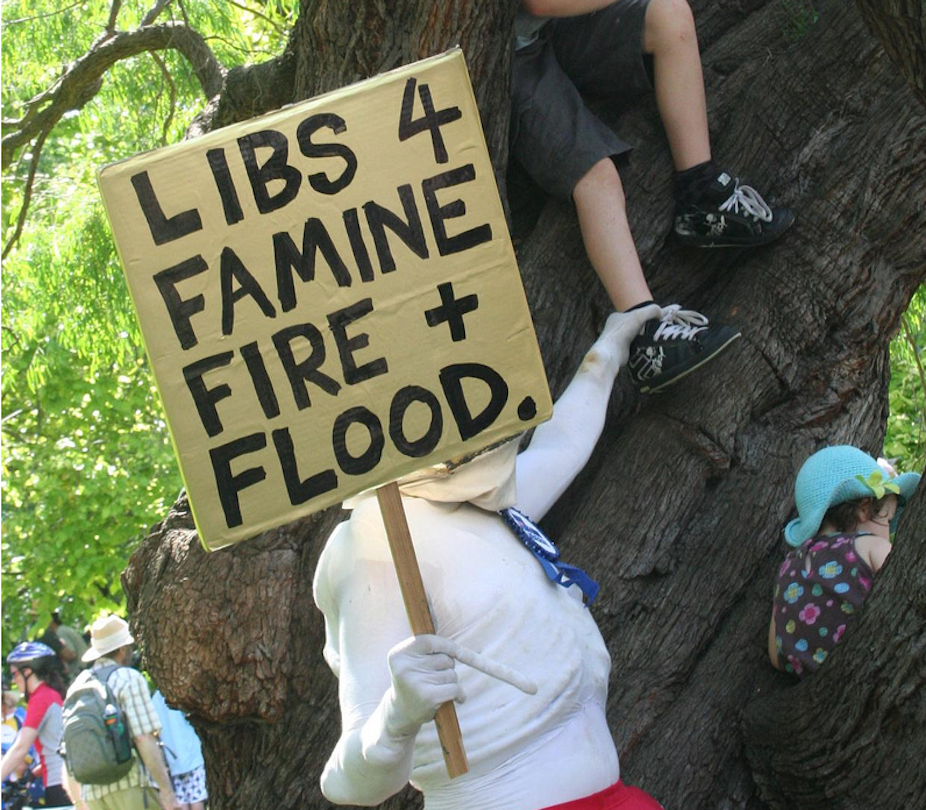
State governments are walking away from emissions reduction, but it’s thanks to poor policy from the ALP. Takver/Flickr

In the past few days we have seen two states, Victoria and Queensland, announce cut-backs on action to reduce greenhouse gas emissions. They have been able to justify this by pointing out, correctly, that their actions would not cut Australia’s overall greenhouse gas emissions beyond the national target.

The Commonwealth Government’s Clean Energy Future scheme design is flawed. I, along with Richard Denniss from the Australia Institute, the Voluntary Carbon Markets Association and others have been pointing out this flaw and showing how it could be fixed, for over three years.

The problem is that if a state government, council, business or household voluntarily cuts its emissions beyond what it is legally required to do (for example, under building energy regulations), this simply frees up more permits for other emitters to use, so their efforts don’t cut the total amount of carbon emissions. But Canberra econocrats and politicians have simply turned deaf ears.

The frustrating thing is that this flaw is easily fixed. In fact, the Commonwealth Government has actually addressed this issue for forestry and agricultural activity through its Carbon Farming Initiative. Extra permits are issued for the carbon stored: these permits can be sold or retired, and count as “real” abatement. But the government has been determined in its resistance to applying a similar approach to energy efficiency, renewable energy, low emission energy and most waste management.

The solution is simply to put in place a mechanism so that when anyone – state governments, local councils, businesses and households – cut emissions voluntarily beyond what they’re required to do by laws, the appropriate number of carbon permits is cancelled.

State governments, councils, households and most businesses won’t normally be involved in the carbon trading scheme, but their extra effort does cut Australia’s overall greenhouse gas emissions. This should be reflected in the market: the total number of permits available should be reduced by an amount corresponding to the abatement they have voluntarily achieved. This reduces the number of permits available to other emitters, effectively tightening the national cap in proportion to the amount of voluntary abatement.

Why isn’t it possible for emissions reduction to operate this way? The rationale for this policy failure has never been made clear. One possibility is that policy makers felt that an extra mechanism would contaminate and complicate the theoretical “elegance” of their carbon trading scheme.

Another is that the government knows there is a lot of low-cost abatement available from sustainable energy and waste, and it wants to include the contribution of this abatement as part of achieving its target. If there is no mechanism to account for and recognise state government abatement, the Commonwealth government can claim those reductions as its own.

Yet another possible reason is that econocrats and politicians just don’t understand how to design a policy to mobilise community action on cutting emissions. Whatever the reason, the folly of this approach is now being seen: it has provided a convenient excuse for state governments to back away from action on climate.

The failure doesn’t just affect state government action. Already many businesses and local councils that are cutting emissions have been forced to turn away from supporting local emission abatement, to buy overseas carbon permits. They can’t use Australian abatement (from energy or most waste) projects to offset their emissions because they do not meet carbon accounting standards. So they would risk prosecution by the ACCC if they did try to take credit for supporting local abatement action. How perverse.

In turn, this means investment in local abatement industries and projects has been diverted overseas, just when we need to build this capacity. It also means we’re missing out on jobs growth and economic development. How bizarre.

It’s not too late to fix this problem. The mechanisms created for the Carbon Farming Initiative, Renewable Energy Target and proposed National Energy Saving Initiative can be adapted to track voluntary action that cuts emissions from energy and waste. Then well-intentioned local councils, businesses, and households could get due credit for their abatement efforts, and state governments would no longer have an excuse to avoid their responsibility to cut emissions. And a powerful new mechanism that empowers the community to cut emissions harder and faster would be unleashed.

All that’s needed is the political will and a bit of common sense.

Join the conversation

17 Comments sorted by

  1. Fred Pribac

    logged in via email @internode.on.net

    Thank you for insights on this issue. I'm now looking forward to tracking any discussion that follows on from your article (or at least the comments that pertain to the message and not the messanger).

    report
  2. David Arthur

    n/a

    The Clean Energy Futures "package" (aka dog's breakfast) is all about centralised command and control: "WE will decide what emissions are cut in this country, and the manner in which they are cut here."

    Emission Trading Schemes consist of some centralised authority deciding in advance the volume of carbon emissions that will be permitted, then flogging the permits for whatever they can get for them. How does this differ from running a black market in some scarce sought-after commodity?

    Anyway…

    Read more
  3. John Nicol

    logged in via Facebook

    1. Since the total output of carbon from Australia is less than the ADDITIONAL annual output from the developing China, it is only a symbolic gesture that Australia has introduced a carbon tax. This should so obviously be delayed until the rest of the world takes some action which of course as time goes on, appears to be less and less likely.

    2. If Australia stopped producing ANY industrial carbon dioxide tomorrow, the carefully determined figures from the IPCC, indicate that at most, we could reduce the temperature of the globe in 2100 by 0.02 degrees centigrade which is immeasurable as a world temperature. If we reduced it by 20% it would only be reduced by 0.004 C.

    3. Do we need to put our economy at a gross disadvantage relative to the rest of the world, to achieve what is realistically, a zero outcome and if so, why?

    report
    1. David Arthur

      n/a

      In reply to John Nicol

      1. Since the total output of carbon from Australia is more than zero then it is vitally important that Australia starts pricing fossil fuel use high enough to get people looking for alternatives. This should obviously be underatken as rapidly as possible so that, by the time the rest of the world takes some action, Australia will be in a position of having some expertise and technology to market overseas.
      Regardless of how big China is, and how much it may be currently emitting, it is observing…

      Read more
  4. Ross James

    Engineer

    I see three problems with us trying to cut emissions.

    Firstly, while we have a growing population (the need for which I don't understand), we are unlikely to see significant reductions. The first effort to reduce emissions is surely to reduce damand, not increase it with population.

    Secondly, emission reduction has to be at a global level. It's no use Australia achieving reductions, only to have them re-appear overseas. That's exactly what the scheme is doing - pushing Australian manufacturing into less efficient areas.

    Thirdly, while I support the concept of low emission technology, there is still no real scientific evidence that it whould have any infkuence on climate - it's still hypothesis that doesn't match real data (a couple of weeks ago they even changed the historical data to try to get a better fit - this isn't good science).

    report
    1. David Arthur

      n/a

      In reply to Ross James

      I see three benefits with us cutting emissions.

      Firstly, irrespective of what population we may have, we'll not be needing to import petroleum, and our exports will not be penalised for being produced using high-emission techniques.

      Second, emission reduction has to be done by each and every nation. The benefit of Australia achieving emission reductions is in the expertise that is developed in the course of so doing. Just as our exports will be penalised if they are produced using high-emission…

      Read more
  5. Derek Bolton

    Retired s/w engineer

    This was a major problem with the Rudd scheme because it set such tight lower limits on the numbers of permits that would be available for years to come. My understanding of the Gillard version is that the authority that sets the permits each year will have much greater freedom. This means that unanticipated reductions that have occurred through actions of individuals, corporations and states will allow the numbers of permits to be dropped faster and thereby maintain the price. OK, there's a little delay, but it could work.
    Do I have something wrong here?

    report
  6. stib

    logged in via Twitter

    "…All that’s needed is the political will and a bit of common sense."

    …ah, now _that's_ going to be a problem.

    report
  7. Gavin Moodie

    Principal Policy Adviser

    I sympathise with the author's frustration. I suggest the main obstacle to adopting his proposal now is its political complexity rather than any technical objection or obtuseness by Australian Government policy makers. Were the Australian Government to propose his sensible suggestion now it would open debate on other less desirable changes, such as lowering the carbon floor price because Europe's price has fallen, etc.

    Politically it may be wiser to implement the scheme as legislated and consider Pears and Denniss' proposal with other changes that may arise from, say, the first 6 months of the scheme's operation. That should be just doable before a federal election in late 2013.

    report
  8. Dave Smith

    Energy Consultant

    Anybody who seriously wishes to cut carbon emissions (as opposed to just grandstanding or greenwashing) can simply buy up and hold emissions permits. Because these permits cannot now be rescinded by polluters, total national emissions must reduce by a corresponding amount.

    Any council/household/business who believes they have an effective project to cut emissions can undertake that project and then buy+cancel emissions permits with the money they save on their energy bills (or, strictly speaking, the money they save on the carbon price element of their energy bills).

    report
    1. David Arthur

      n/a

      In reply to Dave Smith

      No, not anyone.

      Those of us who happen to have enough money available only.

      report
    2. John Nicol

      logged in via Facebook

      In reply to Dave Smith

      Dave, do you seriously believe that buying credits through the totally corrupt international market will ACTUALLY reduce the output of carbon dioxide?

      How is it measured?

      Who is measuring it?

      Who is checking on the measurements?

      Does the UN have some international auditor?

      What does each cuntry doto ensure that permits sold by businesses, banks etc in their country actually give value for money?

      Who are they kidding?

      Do the permits cover immediate reductions or only aspirations to reduce?

      report
    3. Dave Smith

      Energy Consultant

      In reply to John Nicol

      John,

      I was envisaging a purchase of Australian permits, not international permits .

      report
  9. Ross James

    Engineer

    I can't even contemplate the cost to taxpayers to administer such schemes. The possible corruption, legal battles, paperwork, etc. If I recall correctly, Europe had to shut its scheme down for a time due to huge corruption. It's out of our pockets and into huge government bureaucracy. There are only two winners out of this - government and the banks. There are big losers - we the taxpayers, who pay the increased price of everything - the money doesn't come form nowhere. And all for nothing.

    report
    1. David Arthur

      n/a

      In reply to Ross James

      I don't know why Ross's comment is getting negative ratings; all he's doing is pointing out a few of the flaws of emission trading schemes.

      There's a vastly superior option, and that is to simply put a consumption tax on fossil fuels (the root cause of CO2 emissions), use the revenue thus obtained to cut all other taxes so everyone can invest in emission-reducing equipment and technology as and when it best suits their own circumstances.

      Each year, the rate of the consumption tax is increased…

      Read more
  10. Sue Morrison

    Environmental management student, UNE

    There is at least one existing mechanism by which voluntary abatement DOES count in relation to renewable energy.

    National GreenPower Program Rules V.7 Jan 2011:
    "Aims - To facilitate the installation of new Renewable Energy generators across Australia beyond mandatory renewable requirements."

    When consumers (or councils or businesses) purchase accredited GreenPower this puts a requirement on electricity providers to purchase an equivalent amount of renewable energy (RE), over and above the…

    Read more
  11. Piers Verstegen

    Director, Conservation Council of WA

    This article makes some very good points and I agree with all of them, except the implication that a solution is easy. In theory yes, but how do you measure additionality across millions of people, businesses, local authorities etc. undertaking additional voluntary action. At what point do we deem that my daily cycle to work is additional voluntary action or a price sinal response to avoid the carbon price? Is a local government project to use geothermal energy for heating a swimming pool simply…

    Read more