
For the past few weeks, billboard posters across Doha have promoted the International Climate talks with the < 2°C logo – a reference to the ambition of maintaining average global temperatures less than 2 degrees centigrade above pre-industrial levels.
Given current CO2-equivalent emissions, and the rapid economic growth in developing countries, many now suggest the 2°C goal is proving increasingly unlikely. Within this far reaching agenda, > 2°C might also prove a critical, and perhaps equally challenging target.
The talks took place in the type of desert urban environment that should sharply focus our attention on the energy intensive methods for cooling buildings which have become common place across the world today.
In Doha, as it is in Australia and much of the world, the “standard” temperature for office spaces has become 22°C. Shopping malls are invariably cooled to lower temperatures in a climate where even small increments > 22°C can make a dramatic difference to the amount of energy required for air-conditioning the country’s buildings.
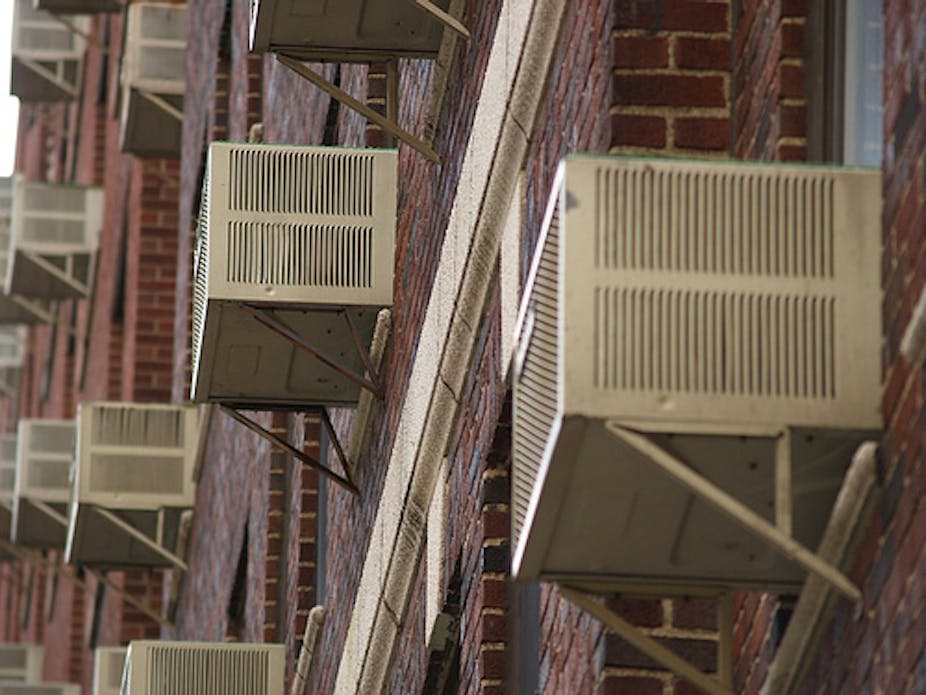
In less than a generation, air-conditioning has allowed life on the edge of the desert to become far more comfortable. But as cities across the Gulf continue to expand and build rapidly, the cooling of indoor spaces is a major contributor to energy consumption patterns that far exceed per capita levels in most other parts of the world.
In recent summers, with outdoor temperatures reaching 45°C or more, electricity production across the Gulf has barely kept up, with significant outages occurring across a number of GCC states.
Given that some estimate air-conditioning now accounts for around 70% of built environment electricity consumption, it is not surprising that Kuwait, UAE and Qatar have all featured in the top ten of electricity consumers per capita, as ranked by the International Energy Agency.
But in Qatar a number of important initiatives are now addressing the challenge of reducing the carbon footprint of buildings. Much like Soviet style central heating, Qatar Cool now pumps chilled water from a centralised cooling plant via a network of pipes to commercial, industrial and residential buildings. Operating efficiencies and reduced costs are among the proclaimed benefits.
Similarly, the Gulf Organisation for Research & Development has been set up with the remit of developing more environmentally responsible construction and design practices for both Qatar and the Gulf region. In recent years, a number of buildings have also achieved either Gold or Platinum LEED certification, an internationally recognised system developed by the US Green Building Council.
But in what is a distinctly different approach, Doha’s Msheireb project, a $5.5 billion urban development programme, looks beyond the now familiar supply side, high-tech approach to sustainability by revisiting Qatar’s cultural past as a platform for a design principle that uses traditional, low carbon approaches to indoor, outdoor living.

Tradition-based climate responsive designs and materials, together with shade catchers, cooling water, vegetation and various fanning devices are among the strategies being deployed to help reduce reliance on energy intensive methods of cooling.
Where this ambitious venture, due for completion sometime around 2016, becomes particularly intriguing though is the way it raises important questions about the norms and standards which have coalesced around bodily comfort. It promises to offer an alternative to the thermal monotony of indoor spaces that is now prevalent in cities across tropical and sub-tropical regions today.
As summer approaches in Australia, such questions once again become prescient. For multiple reasons the topic of air conditioning rarely gets the critical attention it warrants. While earth hours mark the switching off of lights across the office towers of our major cities, little or no public attention is given to the darkened spaces inside that are all too often cooled by inefficient HVAC systems that unnecessarily blanket whole floors with chilled air.
When I walk through Sydney’s retail district, passing by numerous bins for recycling, I wonder why it is acceptable that entrances to shops and malls blast out chilled air, seemingly oblivious about their wasteful use of energy. And why is it that millions of office workers now work in spaces where they have little or no control over their thermal envelope, due to the installation of centrally controlled systems?
Air conditioning is one of those areas where the ability for people to make choices, or to enact a desire to live more sustainably has been severely comprised, if not removed entirely.
Myriad challenges face us if we are to counter current trajectories concerning air conditioning usage, and leaving it to the architectural profession alone will never be enough. A public debate needs to be opened up concerning AC, such that we can reduce our dependency on the air conditioner, reduce/penalise wastage, and create more flexible thermal envelopes that respond to, and build on, local climatic and cultural conditions.
Our norms and expectations about comfort and how these reflect and create daily habits are pivotal here, and altering these is the critical path to change.
But increasing numbers of Australians now spend much of their day working, being entertained and even sleeping in spaces where their sense of comfort has been predetermined by someone else or by some international standard.
If Australia is to address the environmental consequences of air conditioning in a meaningful way, the new brown economy of desert heritage that is emerging in places like Doha might well provide an unlikely source of insight for going green.
Comment removed by moderator.
William Bruce
logged in via Facebook
AOk.
Why don't we allow FREE Govt/Council approvals for all "energy upgrades" to existing buildings?...or even no approvals for many upgrade categories?
In Oz so often we use AC when we ought be just opening windows and/or using blinds etc.
I presume many people would prefer natural breezes or just ventilation in buildings much of the time. We ought only turn on AC in buildings when necessary. Also attenuating AC systems is so often poor and this wastes heaps of power.
Tim Winter
Associate Professor, Institute for Culture and Society at University of Western Sydney
Jane, indeed the theme of clothing is an important one - and nice article you found.
Here in Doha Arab dress, most notably the dishdasha has its seasonal variations. Not only are they loose fitting, but thin cotton versions are summer attire, and woollen dark colours are worn in the cooler months. Of course shopping malls and offices at 20 degrees C all year round negate such logics. The same applies in Southeast Asia - where loose fitting clothes, particularly shirts and all in one garmentss - are rooted in the climatic context.
Comment removed by moderator.
Vanda Hamilton
logged in via Facebook
Forgetful Orange, 26 degrees is not hot. You should be able to work in that sort of temperature. I think the problem is more that you didn't have moving air in your office. This is a big fault in most office buildings.
I work in an old church hall with no heating or air conditioning. I also live in an old flat with no air conditioning. Both places can be very uncomfortable once the temperature gets above 30 degrees. Using a fan helps a lot at work, while at home I have windows open at all times…
Read moreComment removed by moderator.
Dejan Tesic
Former Lecturer at Charles Sturt University
Well, Japan seems to be doing the right thing - they've a rule that prohibits the use of air-con in offices if the temperature is 28 degrees or lower. http://blogs.wsj.com/japanrealtime/2011/06/15/this-summer-28-is-the-magic-number/
From personal experience, in the UAE shopping malls one needs a jumper (while it's about 50 degrees outside).
Felix MacNeill
Environmental Manager
The Japanese idea of 'cool business/warm business' is well worth exploring - where they simply set the thermostat a few degrees higher in summer and a few degrees cooler in winter - this saves significant money and emissions and probably, if anything, is healthier.
Of course they back it up by not wearing suits and ties in summer. Given that eschewing formal attire is unlikely to end civilisation as we know it, it seems a very modest non-sacrifice to make.
Then again, I'm a grumpy old man who lived most of his life without air-conditioning - at the risk of sounding like an old Geordie, I don't recall that my childhood was particularly deprived because it was a bit hot in summer and a bit cold in winter.
Forgetful Orange
logged in via Twitter
Would it depend on humidity?
The air conditioning in our office building was faulty recently, I think it was 26/7c. Many times it made me drowsy and I usually felt sweaty and definitely couldn't work as effectively. I had to get a personal or a large fan but there's no doubt my company was not getting the best out of me.
There was no way I was going to work even a few minutes of overtime as the heat persisted on into the evening. I couldn't wait to get out of there.
It effects certain body types (particularly overweight) more I would say. But this problem has to be accounted for, yes? In an office where the workers need to concentrate, problem-solve & sit confined to a desk for long periods of time, saying "get used to it" in >26c heat, is a significant problem.
Chris O'Neill
Telecommunications Engineer
"Would it depend on humidity?"
Of course it depends on humidity. I recall reading many (many) years ago a graph showing the comfortable zone that was dependent on temperature and humidity. Above 22-23 deg C, the maximum comfortable humidity started to decrease and dropped to some low level like 20% when the temperature reached 25 deg C. (25 deg C was the maximum comfortable temperature but only at low humidity.)
John Newlands
tree changer
I think our leaders could create an example by setting the thermostat to 26C in various houses of parliament. Note the wearing of dark suits even in hot weather. That's not leadership it suggests that AC is a reward for 'making it'.
No doubt if time-of-use smart meters become widespread those deemed frail will get all the aircon they want. As with medical marijuana in the US I suspect this will be exploited. If wet bulb temps exceed 38C then productive work will be impossible without refrigerative and dehumidifying aircon. More power draw.
Those who say PV will power aircon should note hot conditions often persist well after dark. Again the grid. I believe the answer is a low tariff for say 500w for thermal comfort. Wise people will have a small insulated room without plasma TVs. Stay in that room when it is over 40C or below 10C and use the low powered heating or cooling appliance.
Thomas Marshall
Postgraduate Student
If you think a solar generator can't generate power 24/7 you have a narrow view of what a solar generator is. The technology is there and it's not very hard.
Chris O'Neill
Telecommunications Engineer
"If wet bulb temps exceed 38C then productive work will be impossible"
If wet bulb temps exceed 38C then people will start dying.
"Those who say PV will power aircon should note hot conditions often persist well after dark."
That's often true in places like Melbourne where hot weather is caused by air coming from the interior of the continent. However other places, like Brisbane, are usually heated by direct sunlight so they could achieve much more benefit from direct PV powered aircon.
Chris O'Neill
Telecommunications Engineer
" The technology is there and it's not very hard."
"Not very hard" doesn't mean the same as "not significantly more expensive than the alternatives".
That said, PV generation can achieve an awful lot without non-endpoint storage.
Jane Rawson
Editor, Energy & Environment at The Conversation
John, regarding your comment on dark suits, I couldn't agree more! Bring back the seersucker, I reckon http://www.thedesimag.com/2011/05/25/summer-is-all-about-seersucker/
Dale Bloom
Analyst
The Heat Index has been used to calculate risk based on atmospheric temperature and humidity.
High humidity combined with hot air creates a very high risk.
As for people wanting below 26 oC to work in, what sooks.
Are they also affraid of their mother, or something under the bed, or something in the closet.
Peter Valentine
Associate Professor Environmental Science at James Cook University
It's complicated. Here in northern Queensland people once built beautifully adapted homes that were high-set, had verandahs all round and functioned with breezeways and throughflow allowing all year comfort without airconditioning. Such houses are rare today (we built our present version 22 years ago) and instead the suburbs are now Melbourne brick bungalow style, low set and fully sealed on tiny plots of land devoid of breezes. AC is continuously needed for comfort but in these congested spaces…
Read moreChris O'Neill
Telecommunications Engineer
"On the plus side, most of the new suburbs have wall to wall solar panels, a significant offset."
I would have thought that in Queensland at least, there is a significant opportunity for using the excess power from solar cells to power a house's aircon during the day. Queensland's government has cut the feed-in tariff right back so you'll be better off using your own electricity yourself when possible.
Thomas Marshall
Postgraduate Student
I realised climate change was a threat when I was a teenager, so my adult life has been marked by eliminating unnecessary emissions. I don't have a car, and I've never used air conditioning. We can't afford it.
Older people who have had air conditioning at work for decades seem to shy away the most from facing the changes they need to make. They had already formed their habits before they realised those habits were unsustainable. Now, turning off (or even down) the air conditioning appears to be off the agenda - even in an architecture firm designing houses to be more sustainable.
The shift in attitudes and habits needed to kick air conditioning and car use are huge where they are already entrenched. The challenge is in demonstrating that we don't need those things.
Elizabeth Blades-Hamilton
Social Analyst
@ Thomas Marshall.
Sweeping statements about 'older people' having 'formed their habits' are not really helpful. Being in this bracket I take exception to being lumped in with that.
I have suffered years and years in air-conditioned workplaces, often requiring a jacket or cardi indoors when outdoors is 30+ degrees, especially when I lived and worked in WA.
I wholly agree with you Thomas, air-con is not always necessary. I lived in WA for over 20 yrs with no air-conditioning at home, only fans when very hot. Sustainable building design that takes account of climatic conditions would be a good start, i.e. no black tile roofs!
However I think you may also find that manyyounger people, who have grown up in air-conditioned comfort, may also need to be re-educated :0
Thomas Marshall
Postgraduate Student
I see your point, I did generalise. I just feel that for me it has been an advantage to enter adult life with prior knowledge of the lifestyle changes that need to be made for the future. The people at work who insisted on air conditioning all happened to be older. It made it hard for me to cope with such low temperatures in summer at work when I had to go home to sleep in 30 degree heat. Even in poorly designed buildings we can cope, but it doesn't help.
Leonie Price
logged in via Facebook
I spent a week in Singapore a few months ago. And froze. How is that possible in the tropics! The air conditioning in the office block and hotel was so low that I was wearing cardigans the entire time. In a meeting I was in we were passing around an electric hand warmer so our fingers didn't cramp from the cold.
I would go for walks in the beautiful warm tropical weather to defrost.
Upping the standard to 24c would make sense.
Chris McKay
Storyteller
Good piece. In Australia there's also been growing bodies of 'desert knowledge' involving CSIRO and CRCs in recognition that more of us around the world will be living in that sort of climate in the future.
On another note, people in air conditioned offices have been proving for years they're incapable of making good decisions for the 'outside world', so turning off the AC may well turn a few brains on.
Tim Winter
Associate Professor, Institute for Culture and Society at University of Western Sydney
Chris if you are able to send me more details about that i'd be interested to learn more. Tim
Chris McKay
Storyteller
Great. Well I came across it in this book called Dry Times http://www.publish.csiro.au/pid/6070.htm
I think it was work done with the Desert Knowledge CRC, which is now defunct. These days I think it has evolved into Ninti One, which seems to have a focus on economic participation in the desert http://www.nintione.com.au/
Kathryn Healey
logged in via LinkedIn
The problem is one of comfort, psychrometrics, design standards, and expectations. If you suggest to your mechanical services engineer that the temperature set point be raised, you'll hear many reasons why it won't work - the air flow will be too low, the humidity will be too high, or you'll need to install reheat which defeats the purpose altogether. If you let people open the windows, they'll forget to turn the air conditioning off and you'll waste even more energy. These things are all true to…
Read moreCatherine Scott
Senior lecturer
We don't have air-conditioning - I've been reading about climate change since the early 1970s and made the decision to avoid contributing as much as possible. (The next door neighbours, in contrast, have a unit the size of a GE jet engine that services their whole house and wrecks our sleep).
By means of vegetation, blinds, shade cloth and insulation our house remains at least 10 degrees cooler than the outside temp on hot days. Visitors come in and say 'Oh, you've got air conditioning' and we…
Read moreComment removed by moderator.
Brent Hoare
logged in via Facebook
Great article Tim, would be very interested to learn more about your work on alternatives to AC in SE Asia.
I'd like to suggest that we urgently need to add the climate impacts of the leaked refrigerants we use for the air conditioning of our buildings and vehicles to the list of purposes for which a public debate needs to be opened up concerning AC.
Atmospheric concentrations of the most common refrigerant HFC R134a are growing at over 10% p.a., and every kilogram of this gas equates to between…
Read moreTim Winter
Associate Professor, Institute for Culture and Society at University of Western Sydney
Hi Brent
Thanks for your comments. And good points made. You have a much better handle on the figures than I, so that was helpful to read. The one word that raises so many questions is 'choice' - we are a long way from putting realistic choices in place around AC and its infrastructures. Too often the debate is reduced to customer choices and the notion of shifting behaviours, but this is of very limited value given we live in environments where various technological infrastructures have or are…
Read moreBrent Hoare
logged in via Facebook
Thanks Tim, will send an email. Certainly agree design consideration are fundamental, and consumer power to influence the choices made at the individual level are limited. Mobilising concern on these issues is very difficult, but policies from major corporate end user groups such as the Consumer Goods Forum and their refrigerants policy has a lot of potential. And consumer pressure may well be important in holding these organisations to their commitments.
The Greenpeace International 'Cokespotlight…
Read morePeter Green
I.T. Consultant
The problem is one of attitude. Freezing inside buildings in a heat wave, or wearing shorts and T-shirt in winter, are examples of absurd human thinking, but they are almost endemic in western societies. In regard to air conditioning, we seem to have a population that apparently 'loves' summer, yet spend their every moment in an air-conditioned house, air-conditioned office, air-conditioned shopping centre, air-conditioned car or air-conditioned train, constantly trying to escape 'summer'. One finds the same fuzzy thinking when the subject of sustainable population is raised.
Tim Winter
Associate Professor, Institute for Culture and Society at University of Western Sydney
Hi peter, fully agree. and to add to that, what is most concerning is how the same norms and expectations are now solidifying in Asia - where urban populations are obviously so much higher. hundreds of millions are still to move to cities in China and India and with pollution being an enduring problem sealing yourself off from the outside world has multiple appeals. Not least status - urban middle class culture is now very much about living in cooled spaces, working, shopping, travelling and sleeping. Shifting norms, values and habits is as much as a challenge as it is to design the built environment more appropriately.
Chris O'Neill
Telecommunications Engineer
Just today I walked past a neighbours house along the street and the wall aircon (which faces North BTW) was on from before 9 am until after 5 pm (in Melbourne). It wasn't particularly warm most of the day but the previous night was relatively warm except for a few of the early hours when it easily cool enough but at an inconvenient time for most people.
That house could have avoided using the aircon for so long if it had had the ability to ventilate overnight using a fan or fan/duct system that uses a tiny fraction of the energy used by aircon.
But very few houses have that capability. Very few people think about this. Partly because the "experts" appear to be ideologically opposed to "forced" ventilation.
Tim Winter
Associate Professor, Institute for Culture and Society at University of Western Sydney
Indeed Chris, nice example, repeated over and over. As you say expert knowledge industry in this area tends to too easily fall back on international standards, and technical prescriptions of occupant comfort for both residential and commercial architecture. The huge industry that is air conditioning - is of course heavily invested in the delivery of chilled, dried air. A high value market has been created around thermal comfort - such that everyday expectations have shifted accordingly. The idea of 'need' warrants much closer attention than it is typically given here.
Peter Green
I.T. Consultant
It also doesn't help that, on the whole, houses continue to be designed for aesthetics (beauty in the eye of the beholder) rather than thermal efficiency. And I note that the Qld government is scrapping its sustainable housing requirement.
There needs to be attention to thermal efficiency at the street layout stage. For example, Penrith has main streets running E-W, with building blocks running N-S. This makes it about impossible to design a passive thermal house, given that this is most easily achieved when the floor plan is elongate E-W.
Harvey Westbury
Not being a dinosaur
Price rises for electricity will undoubtedly change our behaviour; it has at our place.
Kaan Kemal Solmaz
logged in via Facebook
Free advise given on climate control systems in the UK. Vat free air conditioning.
<a href=" http://www.zerodegreeac.com/">Air Conditioning service London</a>