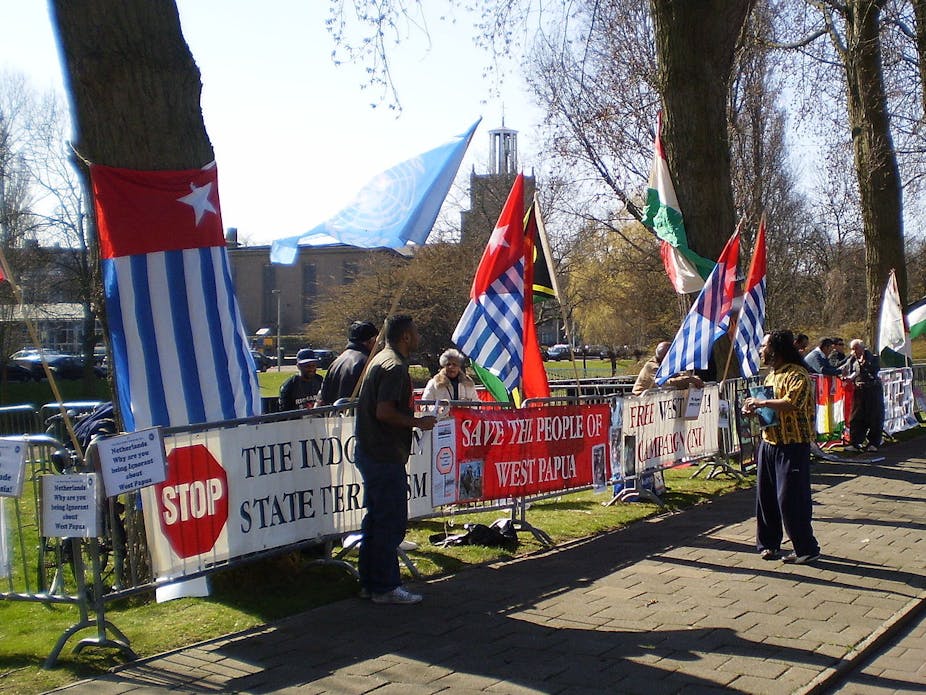
Allegations that Australia is funding death squads in West Papua have brought the troubled province back to Australian attention.
Blanket denials by both Indonesian and Australian governments – standard policy for such reports in the past, no longer cut the mustard.
The players respond
The killing of Papuan activist Mako Tabuni by Indonesian police was for Jakarta a legitimate operation against a violent criminal shot while evading arrest. That Tabuni bled to death from his untreated wounds while in police custody did not rate a mention.
The Australian response was more measured. Foreign Minister Bob Carr took the allegation that Tabuni had been assassinated seriously because the partially Australian funded and trained elite anti-terrorist organisation, Densus 88, was accused of playing a role in the killing.

For once there was a direct Australian connection to the human rights abuses that have been happening in West Papua for decades. Australian taxpayers may indeed be helping to fund Indonesian death squads. Carr called on the Indonesians to make a full enquiry into the affair.
The Indonesian response was to appoint Brigadier General Tito Karnavian as Papua’s new Police Chief. This sends the clearest possible message that Jakarta intends to deal with the Papuan separatists’ insurgency with lethal force, rather than diplomacy and negotiation.
Many activists have been arrested and a concerted effort is underway to break the back of the urban based, non-violent Papuan rights organisations, such as Tabuni’s KNPB (Komite Nasional Papua Barat).
Independence
Most Papuans would favour independence over Indonesian occupation. This is a recipe for ongoing military operations, repression and human rights abuse as the Indonesian military and police hunt down “separatists”.
This seems to suit most players. West Papua is the Indonesian military’s last zone of exclusive control after the loss of Aceh and East Timor. It’s a fabulous prize to control as extensive (legal and illegal) logging, huge mining projects and massive development funds provide rich pickings for those in control, while incoming migrants are drawn in by economic opportunities unavailable elsewhere. It is really only the Papuans who are suffering in this massive free-for-all.
The plight of the Papuans is slowly but surely seeping into the global consciousness. While modern technology allows West Papua’s riches to now be exploited, it also allows the stories and images of Papuan suffering to emerge. Increased Indonesian militarisation and repression only exacerbate this trend.
A new East Timor?
This is the same trajectory that East Timor’s long struggle for freedom followed: an overwhelmingly dominant military on the ground but a growing sense of outrage within the international community, especially in the Western nations. This led Indonesia to be treated almost as a pariah nation and underpinned East Timor’s rapid shift to independence in the wake of Suharto’s fall.
While no other nation supports West Papuan independence, except Vanuatu sporadically, and the rule of the Indonesian state appears unassailable, a dangerous dynamic is developing.
As the situation in West Papua deteriorates, human rights abuses will continue, with the very real prospect of a dramatic increase in violence to genocidal levels.
The ingredients are there: stark racial, religious and ideological differences coalescing around a desire for Papuan resources and Papuans’ land, on one hand, and independence on the other. Indeed many Indonesians, as well as the Indonesian state, already view Papuan separatists as traitors.
This should rightly concern Australians: we are in a quasi-military alliance with Indonesia through the 2006 Lombok Treaty. We are a player, albeit minor, in these events. When there is a divide in the opinion of the political, military and bureaucratic elite, and that of the wider population, as occurred in Australia over Indonesia’s occupation of East Timor, the majority view tends to eventually prevail. And the majority view, formed by such programmes as the ABC 7.30 report, is moving to one of sympathy for the Papuans and antipathy towards Indonesia for what many see as a re-run of East Timor’s disastrous occupation. This does not bode well for relations between the two countries.
Words or bullets?
Indonesia runs the risk of having its widely heralded democratisation process stained by the Papuan conflict. There is also the fact that while West Papua remains a military zone the Indonesian army will continue to be unaccountable and largely outside of civilian control, stymieing anti-corruption efforts not just in Papua but through out the country. The consequences for the Papuans are abundantly clear: no basic rights and a life lived in fear.
While there are no quick or easy solutions to this conundrum, one choice is manifestly clear: does the answer lie in more words or more bullets?
Jakarta has so far rejected meaningful dialogue in favour of a beefed up security approach. Australia, and Australians, should forcefully criticise this as being against our own, and Indonesia’s (let alone the Papuans’) long-term interests.
If the West Papuan conflict continues to follow the East Timor trajectory this problem will continue to grow, relations will become strained and tensions rise. It’s worth remembering that Australia and Indonesia very nearly came to blows over East Timor. Let’s learn from the past and encourage, and promote, meaningful dialogue between all parties.
Bruce Moon
Bystander!
Jim
I'm saddened by what you write.
I'm saddened because the West Papuans will never be in a position to articulate their own view as did the Timorese. They neither have the education, nor the comprehension of local and global geopolitics to be able to garner support from entities outside the local region.
I'm saddened also because like it did in so many other island communities, Indonesia is continuing its transmigration policy and acting as an imperialist overlord to the detriment of the wellbeing of the West Papuan society.
I'm saddened also that from the way you describe matters, Indonesia is pursuing a totalitarian approach to West Papuan affairs.
And, I'm really sad that Australia will (again) turn a blind eye to this situation.
Thanks for the article.
Glen Daly
Retired
Various Australian governments have been crawling to the Indonesians for years.Their support for the sham plebiscite in West Papua prior to the formal Indonesian takeover is a good example.
Indonesia has no intrinsic right to be in West Papua. The indigenes are a different race and culture.The fact that the Dutch had a colony there is immaterial.
It is well past time that the Australian government recognized the thuggish nature of our Northern neighbours (including but not confined to Indonesia) and took the appropriate precautions and actions.
Black Knight
writer
First step for a healing solution should involve letting some light in - by way of international media coverage, and other forms of human rights monitoring.
Given past experience, I think some form of autonomy is a safer objective to support rather than radtical independence since this can result in much more loss of lives.
And there is a framework of sorts already in place for this in Indoneasian political forms (I am not really up on all the details).
I have wondered if the United Nations Declaration of Rights of Indigenous Peoples (UNDRIP) could assist Indonesia in moving to a peaceful resolution.
bernard mcclafferty
pest exterminator
This for bruce moon who claims the Indigenous West papuans are too stupid to want freedom or even know what that is!
I have read some mindless comments on what the Indonesians have done and are doing but this one from Bruce takes the cake.
It does not take a mental genius to know when your living under the genocidal rule of the Indonesians. When your countrymen are being killed and tortured by the day and your wife and children are raped & murdered by a pack of rabid animals in flashy uniforms, what else would you want but for this to end?
Freedom is what they want and if Bruce cant see this then he must be Indonesian or have vested intrests there.
Bruce Moon
Bystander!
I wrote...
"the West Papuans will never be in a position to articulate their own view as did the Timorese. They neither have the education, nor the comprehension of local and global geopolitics to be able to garner support from entities outside the local region."
I did not write that they are stupid.
Please take the time to digest what is written, not what you want to read.
Jack Arnold
Director
All the island of New Guinea should be a single sovereign state free from the impediments of Dutch colonial rule or Indonesian military abuse regardless of the many groups and languages that compose the population.
However, I fear that the enormous real & potential mineral wealth has attracted the interest of foreign owned corporations intent on exploiting this situation for minimum benefit of the indigenous peoples.
Black Knight
writer
I happened to be in PNG a few years ago and witnessed their celebrations for Independence Day. Much joyful celebration, despite all the problems they face. It provided a real contrast with the situation across the border.
But the chances of an independent state for the whole island are most unlikely. Some form of autonomy for Papau and interdependency within a regional confederation of some kind might be a better objective to support, but even that faces major obstacles.
However, there may be a shift in power relationships within this part of the world in this century - for better or worse.
Gary Foley
historian
West Papua was Australia's East Timor long before East Timor. Australians have always been very selective about whose struggles they bother to notice.
Black Knight
writer
Worth a read:
http://trove.nla.gov.au/ndp/del/article/47867811
John Harland
bicycle technician
Wasn't the invasion of East Timor tacitly approved by the Australian government to avoid having too many independent nations in the immediate region?
Until a later government decided that Australia had the chance to grab oil rights from the Indonesians.
Possibly the same kind of tacit approval of repression is happening here.
Black Knight
writer
Another very good account of Australia's policy to West Papua over 50 years and well worth taking the time to read.
http://freewestpapua.org/index.php/news/2013-fifty-years-on-australias-papua-policy-is-still-failing-1
Black Knight
writer
It is not sufficient for Foreign Minister Carr to raise the issue of Papuan human rights at meetings with his Indonesian counterpart if nothing else is done between meetings to encourage the Indonesian authorities to take ownership of the problem and to allow international media and human rights monitors into West Papua.
Indonesian is a signatory to the United Nations Declaration on the Rights of Indigenous Peoples (UNDRIP).
For a copy of the text see:
Read morehttp://www.iwgia.org/iwgia_files_publications_files…