Armageddon and its aftermath: dating the Toba super-eruption

No-one alive today has witnessed a volcanic eruption remotely as big as the Toba “super” eruption. But our ancestors may have done, tens of thousands of years ago, when northern Sumatra exploded, creating a caldera now filled by the largest volcanic lake on Earth, measuring 100km by 30km and 0.5km at…

Zn3x8gxr-1351484072
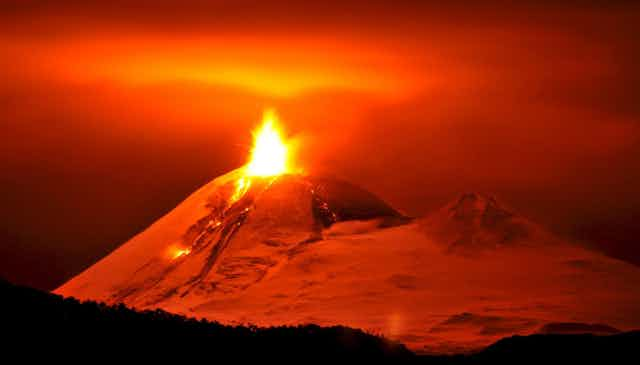
“There remains no consensus at the present time on the climatic or ecological impacts of Toba.” Victor Hazeldine/EPA

No-one alive today has witnessed a volcanic eruption remotely as big as the Toba “super” eruption. But our ancestors may have done, tens of thousands of years ago, when northern Sumatra exploded, creating a caldera now filled by the largest volcanic lake on Earth, measuring 100km by 30km and 0.5km at its deepest. But when, exactly, did it happen?

In a paper published today in the Proceedings of the National Academy of Sciences (PNAS) my colleagues Michael Storey, Mokhtar Saidin and I have finally pinned a date on the Toba super-eruption. It happened 73,880 years ago, with an uncertainty of just 640 years (with 95% confidence).

The eruption

This mega-colossal eruption was the third – and largest – in the last million years at Toba, and the most explosive on Earth for more than two million years.

More than seven trillion tonnes of volcanic material were ejected, of which at least 800km3 was spewed as ash across the Indian Ocean and the adjacent landmasses of South and Southeast Asia, covering several million square kilometres of the planet’s surface in debris.

The Toba blast pumped an equally staggering quantity of sulphurous gases into the atmosphere. The resulting chemical products were transported around the globe and are recognised as sulphate spikes in drill cores collected from ice sheets in Greenland and Antarctica.

The event dwarfs any other historical eruption, the largest of which was Tambora – also in Indonesia – in 1815. Despite being 100-times smaller in magnitude than Toba, Tambora led to a global drop in temperature of about 0.7 ºC and disastrous crop failures across the Northern Hemisphere the following year – dubbed “the year without a summer”.

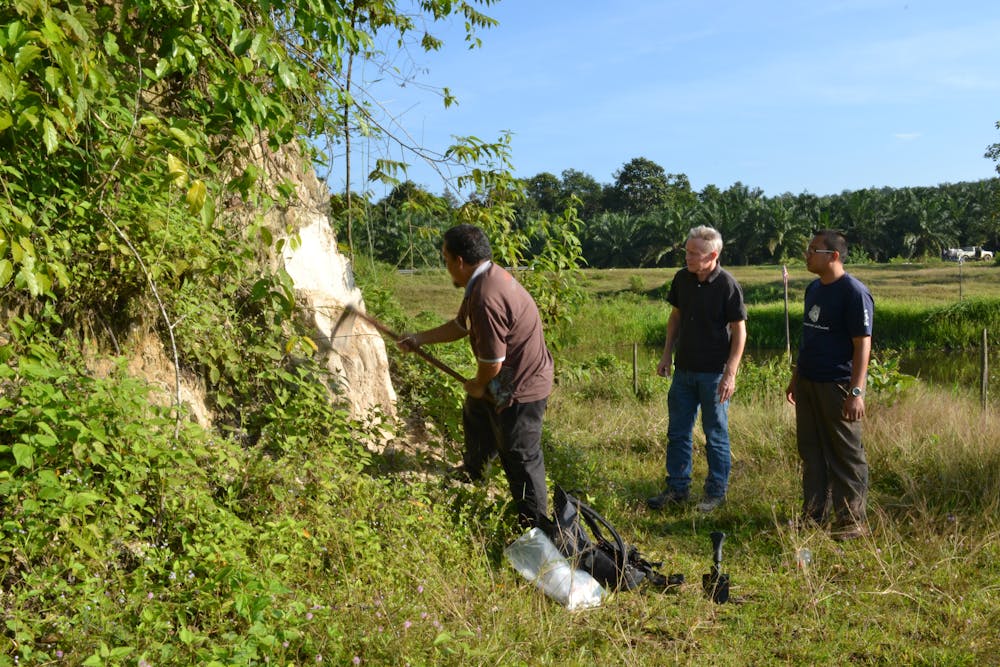
Mokhtar Saidin, Michael Storey and Shaiful Shahidan (left to right) sampling Toba ash in the Lenggong Valley. Centre for Global Archaeological Research, University Sains Malaysia

Given the monumental size of Toba, surely it must have had a correspondingly catastrophic effect on the planet’s climate, landscape, flora and fauna?

And could it have also altered the course of human evolution, reducing the population to such a small size than our ancestors were squeezed through a genetic bottleneck?

Such questions and speculations have provided fodder for researchers since geological evidence for the Toba eruption was first reported at the end of the 19th century.
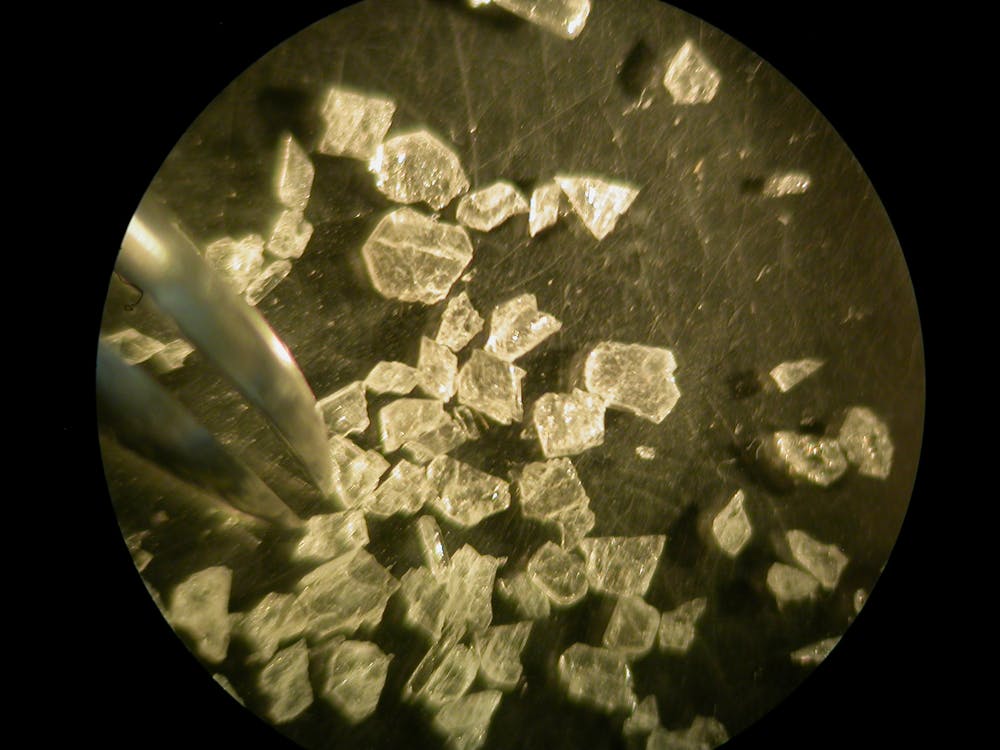
Individual sanidine crystals being selected for argon dating. Michael Storey

But, perhaps surprisingly, there remains no consensus at the present time on the climatic or ecological impacts of Toba, and this can be blamed, in large measure, on the fact that the exact date of this explosion had not been fixed to better than a few thousand years, at some point between about 70,000 and 75,000 years ago.

Such a wide margin of error meant that the Toba event could not be precisely aligned with the Earth’s climatic cycles, the comings and goings of animal and plant communities, the dispersals of our early ancestors out of Africa, or the disappearance of other human species in Asia and Europe.

How to date an eruption

My colleagues and I worked out the age of the explosion with high precision by dating crystals of the mineral sanidine using a state-of-the-art mass spectrometer at Roskilde University in Denmark.

Geochronologist Michael Storey measured the tiny amounts of argon gas built up inside the crystals since they were thrust out of the Toba volcano and deposited in adjacent Malaysia, where they now occur in thick beds of ash preserved in the valley bottoms.

In Malaysia’s Lenggong Valley, volcanic ash has buried stone tools that some archaeologists think were made by our early forebears, so our high-resolution age for the Toba eruption suggests that our ancestors were living in Southeast Asia before it erupted, more than 74,000 years ago.
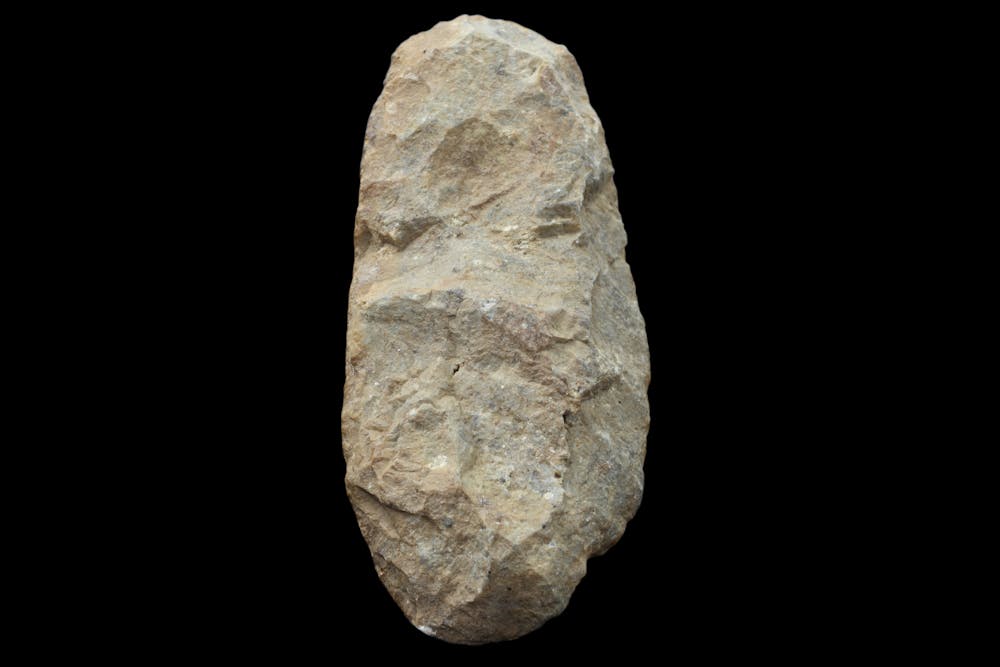
A stone tool buried by Toba ash in the Lenggong Valley. Centre for Global Archaeological Research, Universiti Sains Malaysia

Volcanic impact

So, can we now answer all of the questions that have eluded researchers for so long? The answer, sadly, is no, but we can establish whether this mega-eruption led or lagged some of the most pronounced oscillations in Earth’s climate system, known as Dansgaard-Oeschger events.

From temperature records extracted from the ice caps at both poles and from calcite formations in caves across Europe and Asia, we know that one of the longest periods of cold climate in the last 130,000 years began 74,000 years ago – when temperatures fell abruptly by several degrees centigrade – and ended 72,000 years ago.

The fall in temperature due to the eruption alone would have lasted no more than a few decades, but it may have accelerated or amplified a climatic cooling event already underway, providing positive feedback at a critical moment.

Although geologically brief, several decades of disruption to the climate and landscape could have had devastating ecological impacts, with potentially dire outcomes for humans living at the time of the blast.

The biota living in the vicinity of Toba would have been decimated over the 14-day duration of the eruption, and southeast Asia was then occupied by possibly four known species of human:

It could be that Toba played a role in shaping human interactions, extinctions and dispersals in Asia and Australia, and has left a legacy of the eruption in our genes.

Much remains to be understood about the aftermath of this exceptional geological event, but at least we now know when it happened – to within a few centuries – and can use its ash and chemical remnants to tie together diverse records of global climate, ecology and human evolution.

Sign in to Favourite

Want to follow The Conversation?

Sign up to our free newsletter to get the day's top stories in your inbox each morning, with a special wrap on Saturday.

Help us have better conversations — donate

Join the conversation

15 Comments sorted by

    1. Mike Marriott

      Library Manager

      In reply to Russell Walton

      Firstly, congratulations to the authors on this paper. I'm sure I and others appreciate its significance.

      The Toba near-extinction event has been hypothesized for some time, placed roughly +70,000 years ago. My understanding is that the materials ejected into the atmosphere created a volcanic winter as the average temperatures falling by about 3 degrees or so.

      So on a quick reading, these results would seem to align with the idea our species encountered a genetic bottleneck around a simular…

      Read more
    2. Russell Walton

      Russell Walton is a Friend of The Conversation.

      Retired

      In reply to Mike Marriott

      Thanks for the info. When I first took an interest in Minoan archaeology many years ago, the sudden collapse of the culture was a mystery--I think, from memory, Marinatos was the first archaeologist to make the connection with the volcanic eruption (and the Atlantis legend). Some archaeologists were sceptical, until a devastating tsunami caused by the eruption was suggested as the main cause of Minoan decline.

      report
    3. Jonathan Maddox

      Software Engineer

      In reply to Russell Walton

      You're talking about 5,000-3,000 years ago there, not 73,880 years ago. Another, less famous eruption, perhaps?

      report
    4. Ron Chinchen

      Retired (ex Probation and Parole Officer)

      In reply to Russell Walton

      Yes Santorini was a big one but probably only in the Grade 6 level about equivalent to Krakatoa. The biggest historically seems to have been the 1815 Tambora eruption that caused the 'year without a summer' world wide. That is apparently registered as Grade 7. Toba was a grade 8. Apparently each grading represents a ten fold increase in the material sent into the atmosphere

      report
    5. Russell Walton

      Russell Walton is a Friend of The Conversation.

      Retired

      In reply to Ron Chinchen

      Ron,

      In context the magnitude of an eruption is probably not the essential criterion, it's the environmental effects and their subsequent influence on particular species' evolution, or indeed on human civilisations.

      19th century and early 20th scientists were sceptical in regard to the influence of natural disasters on evolution, it was all too reminiscent of Biblical "catastrophism".

      report
    6. Ron Chinchen

      Retired (ex Probation and Parole Officer)

      In reply to Russell Walton

      I appreciate your point but the VEI grading (Volcanic explosivity Index...the richter scale of volcanoes) relates to the amount of material sent into the atmosphere and how high up it goes.

      For example a Santorini type explosion is believed to have sent tens of cubic kilometres of material in the air. A Tambora volcano sent hundreds of cubic kilometres in the air. A Toba explosion sent about a thousand cubic kilometres in the air.

      The extent of the material and the height that it reaches…

      Read more
  1. Peter Boyd Lane

    geologist

    Richard, I read (somewhere?) that this eruption may have reduced the global homo sapien population from one million to as little as 3000. Do you have a comment on this?

    report
    1. Ron Chinchen

      Retired (ex Probation and Parole Officer)

      In reply to Peter Boyd Lane

      Actually some specialists in this area suggest that the population of homo sapiens was reduced to as little as 1000 breeding pairs, barely sufficient to re-establish the species. The species is believed to have developed somewhere between 150,000 to 200.000 years ago, and maybe a little longer.

      Some suspect homo sapiens had initially expanded out during the last interglacial that lasted from about 130,000 to 114,000 years ago (a similar but warmer, wetter period to our own Holocene period which…

      Read more
  2. Paul Moonie

    PhD student, solar energy

    Fascinating article, thanks!

    report
  3. Richard (Bert) Roberts

    ARC Australian Professorial Fellow at University of Wollongong

    The idea of Toba causing a genetic bottlenck has been around for two decades, and is based mostly on mitochondrial DNA (mtDNA) data. These sometimes do -- but sometimes don't -- align with other kinds of genetic data, and the details of demographic contractions and expansions have become ever more complicated with two recent findings.

    First, there was the unexpected discovery of a completely unknown type of archaic human (the so-called Denisovans) living in the Altai Mountains of Siberia at about…

    Read more
  4. Alex Cannara

    logged in via LinkedIn

    Awww, Mammoth Caldera in Calif. was much bigger ~700,000 years ago and magma is back on its way up again! Yellowstone caldera is also bigger and could be a great set for the ultimate disaster movie (the one no one will ever live to see).
    ;]

    report
  5. Kim Peart

    Researcher & Writer

    Thanks Richard,

    for this excellent work revealing some rather sobering details about our place in the cosmos.

    I wonder if this knowledge will prompt an urgency to invest in a sustainable human presence beyond Earth, especially knowing Yellowstone could blow at any time.

    I hope we remember to invest in our cosmic survival insurance policy, while we still can.

    Kim Peart
    http://www.islandearth.com.au/

    report