
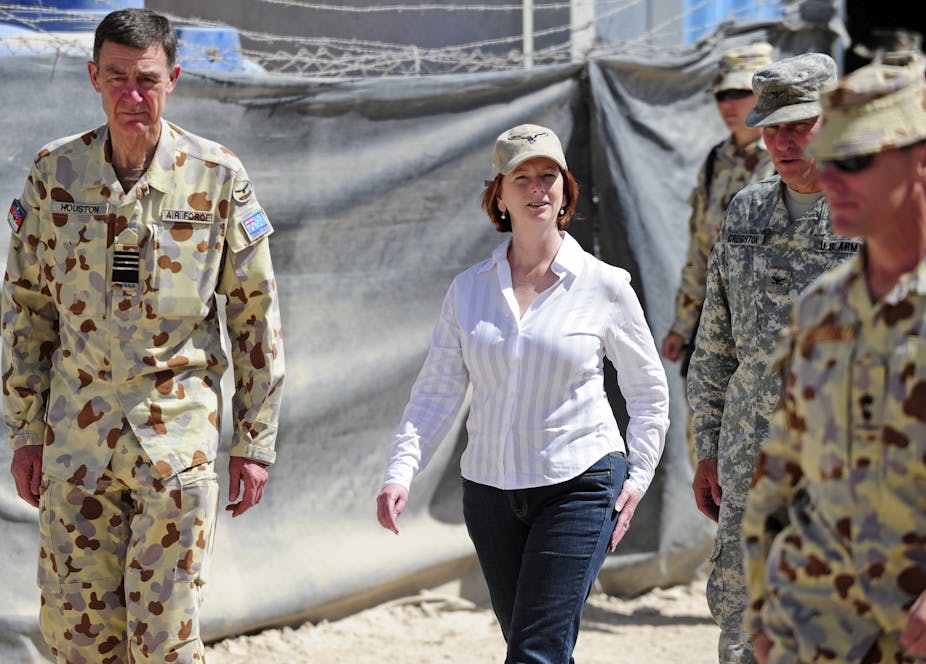
Defence force families in Australia are falling into poverty because military superannuation funds and pensions are not indexed at a fair rate.
Is this how we, as Australians, want to treat those who have risked their lives to protect the freedoms we cherish?
Will we face a situation where former soldiers and their families are living in penury during their old age?
Surely this violates the solemn covenant between those who volunteer to serve their country, and that country itself.
What does this mean?
Let us first look at how superannuation funds are affected by compound interest and the effective rate of return.
A superannuation fund has $100,000 capital in 1990. At a per annum rate of 2.75%, the nominal average rate of the Consumer Price Index (CPI), over 23 years the fund capital would be $186,630 in 2013. An example of a growth fund, say the Unisuper Growth fund aims to achieve a long term average rate of return of CPI + 5.6% pa. In 2013 the Unisuper Growth fund capital would be $632,506.
How does this affect military retiree pensions? The following graph highlights the problem.
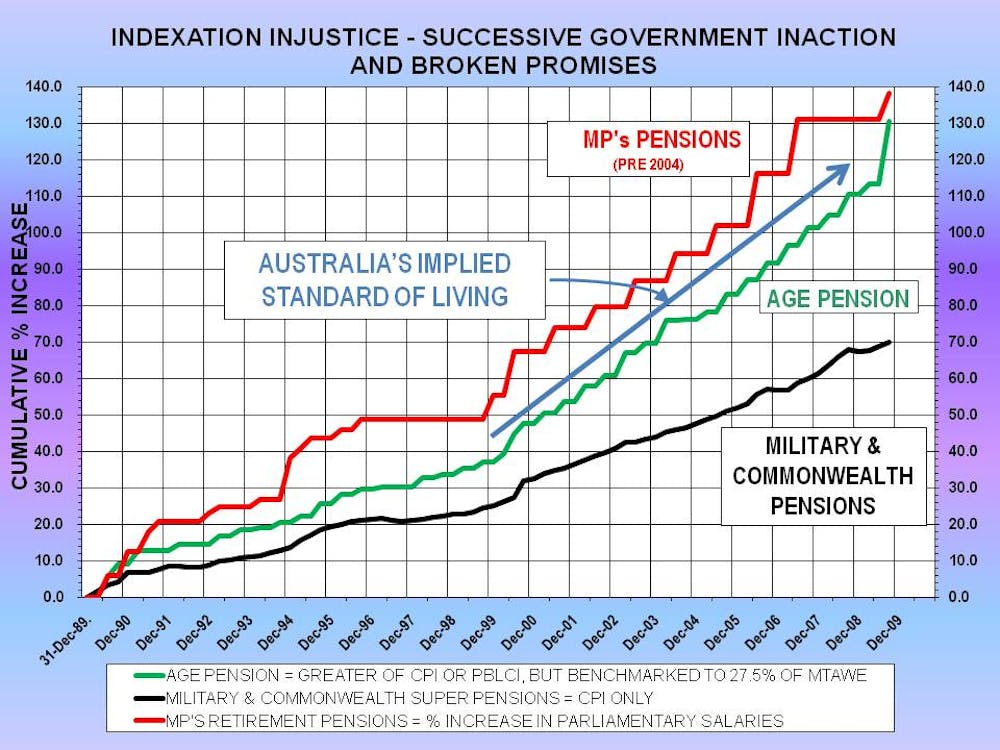
Military superannuation pensions are currently indexed by the CPI. The CPI was abandoned in 1997 for aged and other welfare pensions because it did not protect pension purchasing power.
Aged and other welfare pensions are effectively indexed annually by the largest of three measures including the CPI, the new Pensioner and Beneficiary Living Cost Index (PBLCI) or Male Total Average Weekly Earnings (MTAWE).
Aged, welfare and Member of Parliament (MP) pensions rose between 130% and almost 140% between 1989 to 2009.
Pre-2004 MP superannuation pensions have been generously indexed to the salaries of today’s MPs.
Military superannuation pensions rose 70% between 1989 to 2009.
This is not enough to keep up with cost of living increases.
The median Defence Force Retirement and Death Benefits Scheme (DFRDB) pension for a couple is under $20,000 and the mean is about $22,000. Both are taxable. The couples aged pension is about $27,500 (single about $18,500) and tax free.
Your superannuation fund not living up to your expectations? Simple choice – change funds. Military personnel and retirees cannot change superannuation pension funds.
Military superannuation is an unfunded liability, which means the government of the day only funds military retiree pensions. The total unfunded liability military superannuation debt is now more than $40 billion.
Playing politics
After years of campaigning by Defence retirees including Brigadier Neil Weekes AM MC (retd) and Air Vice-Marshall Peter Criss AM AFC (retd) a private members bill was put to the Australian Senate in 2010 by Liberal Senator Michael Ronaldson titled the Defence Force Retirement and Death Benefits Amendment (Fair Indexation) Bill 2010.
The Australian Senate rejected the Bill, with the Greens siding with Labor.
The Defence Force Retirement and Death Benefits Amendment (Fair Indexation) Bill 2010 would have fairly indexed a large proportion of military pensions. The bill included the provision for annual indexing using the largest of the CPI, PBLCI or MTAWE.
As far as I am aware, no offsetting saves [funds] have been put forward.
This legislation will therefore negatively impact the Commonwealth Budget
Labor Senator Kate Lundy has been outspoken in her personal support for improvements to defence pension indexation. Yet Senator Lundy toed the party line, voted against the bill and on 17 June 2011 wrote:
The government’s commitment to fiscal responsibility and to returning the budget to surplus by 2012-13 is and must be of paramount concern.
At this time, all new expenditure must be offset by savings over the forward estimates
The proposals for this bill do not satisfy this criterion
This bill is divisive. A major problem is that it unfairly applies to only a section of the Defence superannuants and debars over 7,200 current Military Superannuation Benefits Scheme superannuants, as well as the future beneficiaries of the MSBS—and, of course, all other Commonwealth superannuants, including those employed in the Department of Defence. This point was made in many of the submissions to the Senate inquiry, even those in support of the bill. The Australian Veterans and Defence Services Council, for example, noted that the bill was ‘a start’ but would not overcome the financial problems of all veterans.

On 23 July 2012 Mr Ross Bain representing Warren Snowden, Minister for Defence Science and Personnel wrote to Ken Marsh of the JustaFairGo campaign. The letter was a restatement of a tired unsustainable false argument that was resoundingly repudiated in a response that Ken Marsh sent to Warren Snowden on 28 July.
Warren Snowden apparently did not have the time nor inclination to respond to a letter about a matter of grave consequence for 80,000 defence families.
It could be argued that Labor and the Greens are caught in a tough situation. Do they take all steps necessary to return the budget to surplus by 2013 or do they take action to save military families that are now receiving pensions and support that place them in poverty?
This problem is not new. Governments since the mid 1970s have been promising to fix the problem so the Liberals and Nationals cannot now claim the high moral ground.
Australia’s shame
This matter should not be decided on party lines, nor should it be determined by the current state of the budget.
Immediate action should be taken in the Australian parliament to correct what can only be seen as one of the more shameful episodes in the ongoing poor treatment of the men and women of Australia who volunteer to defend their country.
The Australian political parties should be put under the spotlight by all media organisations and forced to declare their position before the next election. A written guarantee must be provided that the party will, within 100 days of taking government at the next election, legislate to fairly index military superannuation and pensions.
Australians must put an end to this shameful episode and demand that their politicians act responsibly.
John Coochey
Mr
One immediate issue is should any increases apply to those who have never heard a shot fired in anger and if so why should such increases not apply to Public Servants who may have?
Mark Gregory
Senior Lecturer in Electrical and Computer Engineering at RMIT University
Hi John,
Poor indexation of superannuation and pensions should not be permitted - does not matter who is involved. Military people sign on, do the training and prepare for war. Some are not sent overseas depending on their job. Does this make their contribution any less important? No. They are all part of the team and they all have families that depend on their sacrifice. It is important to remember that.
regards,
Mark
Gordon Wright
Computer Programmer
Hi John,
Normal Public Servants generally...
Do not train for battle in the harshest of conditions
Do not have their families uprooted every 3 years
Do not have extended period away from their families
Do not have so sign away their human and moral rights
Do not have to maintain their physical fitness
Do not put themselves in harms way
Are subjected to extraordinary diseases and mental health issues...
I could go on and on, but military service is unique. I signed up for, and contributed to, a superannuation scheme that promised to maintain my cost of living in retirement. Call it a condition of service. The government of both sides has failed to honour that commitment over the past 24 years. They treat the military as second-class citizens.
John Coochey
Mr
I spent nearly twenty years in the Defence Department and worked along side bureaucrats in suits and those in uniform. I am not sure which were the most useless. How would you treat pensions for Foreign affariies who spent time in war zones. I remember one woman in Navy Uniform who could not go to sea because of chronic sea sickness, why should her pension be any different from a civilian?
John Coochey
Mr
Oh come on on the physical fitness particularly for Navy, the RAN has not been to war since 1945 and the airforce not since Vietnam. I still remember when I was working closely with an RAN Captain trying to sort out contracting issue at HMAS Watson and was given part of a Navy Lieutenant as a PA come driver, she thanked me when I told her that I could get a cab if I needed transport, I told her she had more important things to do like shooting down Iraqi aircraft, she almost went green at the gills. On another occasion I was trying to sort out costings as Four Base Workshop Bandiana and had an infantry sergeant fawning for compliments because he had arranged fresh crushed orange juice at the Officers' Mess. Then we could go onto the photocopying machine at the Joint Services Staff College being maintained by an infantry sergeant, a trained killer.
Mark Gregory
Senior Lecturer in Electrical and Computer Engineering at RMIT University
Hi John,
we all have personal experiences that reflect our small world. You mention four base workshop? I did not see you there working with the asbestos in the tank turrets? Well I did, we all did because it was our job and other people in green depended on us doing the best job we possibly could.
Military staff are rotate in and out of roles, there is no disputing that. If this did not occur there would be problems. Are you suggesting we should have put the SAS into Afghanistan 7 years ago and left them there until the end without being rotated home?
I do hope you take a moment to sit back and look at what your saying.
regards, Mark
Gordon Wright
Computer Programmer
Less than one percent of military people spend time in nice offices in the Defence Department. The rest are front-line or potentially front-line. Mark's comment was that poorly indexed superannuation should not be allowed... even for public servants.
I take a slightly different tact. Over the years it has been the senior public servants that have spread dis-information regarding the true cost of proper indexation, without so much as a murmur from the rank-and-file. You only have to read Lindsay Tanner's book on the "dark arts" of government accounting to understand this point.
Instead of following a "what about us" idealogy, you should be exposing the lies and deceit that politicians use every day to prevent fair indexation for all.
Gordon Wright
Computer Programmer
I look forward to you picking up a rifle in the next conflict.
John Coochey
Mr
Well given that that plant was civilianised under the Commercial Support Program, an element of which was that the contractors had to come in twenty per cent under the military costings, refer CSP Manual, I do not think you have a strong case unless you suggest that the civilian contractors should also get military pensions.
Mark Gregory
Senior Lecturer in Electrical and Computer Engineering at RMIT University
Hi John,
after seeing colleagues die from cancer whilst I was at four base we encouraged staff to look for solutions to the problem and one young apprentice identified a new glass fibre sheet as an alternative to the asbestos sheeting used in the turret. We quickly swapped to this solution so you should be happy to know that the contractors that moved in when 4 base was sold off were and remain quite safe.
Your remarks about the demise of RAEME are not reasonable. If we move into a medium or large conflict the demise of the support corps could be the cause for defence failing after a few weeks.
Please consider the facts, it sounds like you need to sit down and learn a little about Defence and the large problem we have now if Defence was called upon for anything more than a low intensity conflict at the side of the US military.
John Coochey
Mr
Well given I am in my sixties it would be part of a militia but I did work on the weekends teaching Navy to actually hit something with their P35's and also trained them on other types of handguns which is particularly pertinent to asymetric warfare as Navy often get drafted in as REMF's and may not have issue firearms available.
John Coochey
Mr
Such as? We are so tied into the US supply lines that we would run out of key munitions in a few minutes of conflict. The ADF is very uniformed if that is a word in this context. For example the communications and even encrypto in Desert Storm was done by civilian contractors.
Seamus Gardiner
Citizen
By p35 you mean Browning 9mil? And by remf do you mean pogue?
We're you a small arms coach?
Taz Wilks
logged in via LinkedIn
John Coochey "Oh come on on the physical fitness particularly for Navy, the RAN has not been to war since 1945 and the airforce not since Vietnam."
Perhaps Iraq cannot be considered on the same scale as WW2 or Vietnam but my Son (RAN) might disagree, along with the many men and women of both the RAN and RAAF who served there, that they hadn't been to war; or for that matter the RAAF service men and women supporting our soldiers in Afganistan.
Taz Wilks
logged in via LinkedIn
We seem to be getting bit off topic with CSP related activity but there seems to be some inference that civilian contractors could do the job at lower cost than the military: to quote John "an element of which was that the contractors had to come in twenty per cent under the military costings".
I led a team that submitted a successful RAAF in-house bid in which one repair workshop that was tested was able to reduce it's cost by 46%. I continued to manage that organisation for the next couple…
Read moreBruce Moon
Bystander!
Mark
Thank you for describing this sad indictment on our politicians.
The central issue you highlight is that by any measures, military superannuants are being treated in a lesser state than all other superannuant groups.
Perhaps the most galling is that the same politicians that said no to the private members bill to instate fairness to this group on the basis of budget limitations also gave themselves a hefty pay increase. And, not one MP spoke against that 'reward' on the basis of anything - let alone budget limitations.
- - -
Another 'angle' to this matter is the resolve of the bureaucrats advising our pollies.
It is my view that pollies tend only to act on advice of their departmental chiefs.
It seems to me that the view/s of the bureaucrats in charge of the military super scheme need to come clean on how they are advising the pollies.
Cheers
Seamus Gardiner
Citizen
I admit I have a vested interest in this matter since i am about to discharge from the ADF and take advantage of the DFRDB scheme. Nevertheless, i feel that this issue is hampered in the article by use of overly emotive language.
Read moreThere are a number of ex-service persons who are reliant on a pension for funding some or all of their retirement. These people are at risk of financial disadvantage due to their pension not being indexed with CPI and the gap to the aged pension not being adequately…
Rod Banyard
Resource manager
Sean highlights the need for the full picture. I am surprised at the advocacy of the Conversation article, hardly what I would have expected from an academic explaining why an exservice person gets a pension smaller than the aged pension. Don't these people have the option of switching over? Has there been a breach of contract and these people are not getting wha they signed up for. I will need a lot more detail before I could be convinced this a matter of national shame.
Mark Gregory
Senior Lecturer in Electrical and Computer Engineering at RMIT University
Hi Rob, I'm a green Academic (retired after 12 years service) and I think the treatment of retired military is immoral. I'm sorry if this appears to be advocacy, but you will note that I have stated that all political parties are equally guilty when it comes to allocating blame.
regards, Mark
Seamus Gardiner
Citizen
Thanks for the reply, Rod
Read moreI think the main issue is for those servicepersons who were on an older scheme (DFRB) which ceased in 1973. They're the olds and bolds that you see in the media and they're the ones who are particularly hit by poor or absent indexing of their pensions - they're also the cohort who may have seen active service in korea and vietnam, if Australia has any 'shame' it's in poor treatment of this group.
I think the conflation of this with the two retirement schemes subsequent…
Mark Gregory
Senior Lecturer in Electrical and Computer Engineering at RMIT University
Hi Sean,
DFRDB and MSBS are indexed using CPI, this is the point of the article. The CPI is an inaccurate measure and the indexing mix was changed for aged and welfare pensioners many years ago.
The government is simply holding its breath and hoping that they can keep this matter hidden for as long as possible.
regards,
Mark
Seamus Gardiner
Citizen
Mark,
Thanks for the clarification, clearly superannuation law is not my strongpoint... nevertheless, I am be wary about massive government expenditure that would assist the needy and wealthy alike.
I'm all for increasing pensions for disadvantaged and needy ex-servicepersons but i don't see why people such as myself, who are not disadvantaged, need more handouts when the conditions of service (and subsequent pension arrangements) were clear to me when I joined.
Perhaps we could means test this increase, make it age (or disability)dependant, or limit it to those who served before conditions of service increased. I think there are better ways to spend revenue then to give it to the wealthy.
Seamus Gardiner
Citizen
mmm.... 'i am wary' not 'I am be wary'....
Mark Gregory
Senior Lecturer in Electrical and Computer Engineering at RMIT University
Hi Sean,
I agree with your sentiments to some extent and it is up to the government, the people we put our faith and trust in, to do something to resolve this matter. Currently, the situation is not good and getting worse for many military families.
I don't agree that military personnel should be penalised using the argument that military signed up and knew what they were getting into. Perhaps the military should go on strike to resolve this matter - they should do what any other public servant or industry group would do? That is not going to happen of course, because people who join the military do so, first and foremost to serve their country.
regards, mark
Kenneth Mazzarol
Kenneth Mazzarol is a Friend of The Conversation.
Retired
How soon do we forget. What we need is another crisis to bring this problem to a head, like the crises that took so many lives and made so many mental and physical cripples, not so long ago. The ones 'upstairs' where grateful then. How soon do we forget!
Chris Aitchison
logged in via Twitter
I agree with your premise that the indexing rate for military super is not on par with the rest of society, and I have skin in that with 10 years of unfunded military super indexing slower than it should :( But career Defence Members have one of the best super funds in the country.
But this fact requires some clarification: "The median Defence Force Retirement and Death Benefits Scheme (DFRDB) pension for a couple is under $20,000 and the mean is about $22,000"
This number is so low because…
Read moreMark Gregory
Senior Lecturer in Electrical and Computer Engineering at RMIT University
Hi Chris,
you're wrong. In 1992 my MSBS super when I retired was worth $100K. It is now worth about $160K. If it was in a standard growth fund it would be worth more than $650K. I changed to MSBS one month before I retired and you forget that I did not benefit from what you describe as multipliers. There were thousands of people like me.
The fact is MSBS only benefits people who were in it for their entire career and stay in the military for 20 years.
Am I to be forgotten? What about my family? Who is going to stump up the $500K that the government has robbed me of?
Chris Aitchison
logged in via Twitter
Hi Mark,
It is clear you are very passionate about this issue, but I am not disagreeing with you on the point that the indexation rate is low. I am happy to be wrong if you point out exactly where...
My point was the article did not point out that Military Super is very generous for career Defence members, and if a person has multiple careers then the responsibility for that person not living in poverty upon retirement cannot rest upon one employer - so I thought the headline was a bit disingenuous…
Read moreMark Gregory
Senior Lecturer in Electrical and Computer Engineering at RMIT University
Hi Chris,
Your argument is useful but incorrect. No super is funded on the basis that the indexation would be poor or non-existent. it was not then and is not now.
Unfunded liabilities is an issue that make matters worse. Many people have argued for a sovereign wealth fund to prevent the need for unfunded liabilities. If my super was not unfunded, I would have rolled it into another fund quick smart and would be looking at a tidy sum now.
My article is about the plight of the men and women who serve and their families. I did not mention my situation but used it merely to highlight the problem. For most retirees the situation is terrible. Remember we all have grandparents who served and we all have uncles and aunts that went to Korea, Vietnma, Malaysia and so on. What about the current generation who might serve for 10 years and see three or more conflicts?
Mark Gregory
Senior Lecturer in Electrical and Computer Engineering at RMIT University
I should say that as a young officer the pay I received was pitiful. It was a couple of years after I left the system that the pay was reviewed and nearly doubled.
Chris Aitchison
logged in via Twitter
"Assuming you were at todays equivalent salary of $50k (just making this up, but basically a corporal wage)"
Even my maths is out, you would have needed to earn $50k/year in 1992 dollars for 22 years to get $100k in funded super, which was probably a Colonels wage...
Mark Gregory
Senior Lecturer in Electrical and Computer Engineering at RMIT University
Hi Chris,
Please look at the figure of $100K as a round number that we can understand in today's world. What does the poor indexation mean to military retirees? This is the key concern that we should have.
regards
Mark
Chris Aitchison
logged in via Twitter
"If my super was not unfunded, I would have rolled it into another fund quick smart and would be looking at a tidy sum now."
Hi Mark,
My point is that if your super was real money, it would have been nowhere near $100k after a few years service. That number is not real. You can't say the government robbed you of $500k of interest on pretend money.
The $100k figure in 1992 that is now $160k is the value in the dollars of the day of the super if you retired at that point in time.
Military Super does not and never has worked like civilian super, and if it did I think that a case could be made that our Defence Force members would be worse off. Like I said earlier, military Super is quite generous for those who have a career in the military, and one of the reasons that military Super is structured as it is is to act as a retention tool to encourage people to stay in the military longer.
Chris Aitchison
logged in via Twitter
I absolutely agree with you here, Mark.
Mark Gregory
Senior Lecturer in Electrical and Computer Engineering at RMIT University
Hi Chris,
I suggest your remarks are wrong and not helpful. My super adequately reflected my rank and length of service. To try to argue otherwise is not correct and in some way tries to justify the governments pathetic position.
Again, I ask that the discussion focus on the 80,000 Australian families that have been left hung out to dry by successive governments. This is the real focus of the article and where we need to put our efforts.
Governments have argued over the past 20 years an unsustainable line that changing the indexation rate will adversely affect the budget yet they give themselves more at every opportunity.
Gordon Wright
Computer Programmer
You are forgetting three things.
Read moreThe condition of service was that the military pension was supposed to keep up with the cost of living. It does not.
Secondly, the pension is taxed (even after 65), which means that you still have to work until retirement, and during that time you lose most of the pension when it is added onto your income. This is called "clawback." Also the contributions are derived "before tax" so we do not enjoy the tax advantage of other workers. We do not have a choice of…
Chris Aitchison
logged in via Twitter
I'm saying that the $100k number was never a real number. MSBS does not deal in real numbers. For you to have had $100k in 'real' super in 1992 with a 'real' super fund you would have had to have earned $1.1m dollars before 1992.
If you do your calculations again, but compare where you would be today if you had a civilian super fund for your military career then I think you would find that you have been much less wronged than you claim.
I _agree_ that military pensions should be indexed in line with other pensions - and I think it strengthens your argument if you show that you understand the reasons why unfunded funds like MSBS that are calculated as a percentage of a members 'final average salary' are in the members favour, but cannot earn interest like a funded super fund.
Chris Aitchison
logged in via Twitter
Sorry, didn't mean to imply that CPI was fair. It isn't.
Ironically I am not a senior public servant or politician, but a computer programmer (like you it seems) that served 10 years in the Army with 5 in the Royal Australian Army Pay Corps, so I know the details of these things because I have explained them to soldiers hundreds of times over.
Just to clarify, I completely agree with the authors point that Military Super should be indexed at a rate that puts it on par with other pensions (ideally those of politicians). I disagree with the point that Military Super is not a good deal in general for those who choose the military for a career (apart from the indexing).
Mark Gregory
Senior Lecturer in Electrical and Computer Engineering at RMIT University
Hi Chris,
I'm sorry but I do not know anyone who does not think their super is a real number. I think your clutching at straws now and should consider the bottom line. The military are and always will be people who give of themselves in the defence of the nation and do so in the belief they will be looked after by the government and the nation. This has not happened and there are many examples (F111, Voyager) where people have had to fight through the courts to get a positive outcome.
Surely the government can do better now?
Chris Aitchison
logged in via Twitter
Sorry, maybe I worded that badly.
Miltary Super does not accrue interest like funded super because the number you get quoted in your annual reports is the value of an amount that has been promised to you in the future (eg 28% of your final annual salary * 30 years), not actual money with compound interest. It is fundamentally different. The former is often better than the latter, which is why I keep persisting with this thread.
I served overseas with the Army with the Royal Australian Armoured Corps, so I am in the group of people you are concerned about :) I thank you for your concern, and please believe me I completely support you in your argument that the indexing rate is too low!
Thank you for being so passionate on behalf of all people who are members of Military Super schemes.
Gordon Wright
Computer Programmer
Sorry for the insult as I rate senior bureaucrats and politicians just above used car salespeople, as we have heard too many lies and spin over the years. You are one of the good guys whose wife probably only opens the office door to chuck in a pizza every now and then.
Anyway the ADSO are already down the litigation path, and watch the feathers fly then. Most DFRDB recipients were happy to have the indexation corrected with no retrospectivity, but the argument has dragged on for too long, and the chance to have a quick solution has passed.
Alan John Emmerson
Former chief engineer , Civil Aviation Authority
The rationale for having a distinct and different retirement pay scheme for military personnel was thrashed out at the Jess Joint Select Committee Committee investigation of 1972/73.,brought on by the incessant argument by GPCPT Dixie Chapman
.
The principal reason for having such a scheme was said to be that the early compulsory retirement ages for rank put retired servicemen into into civvy street at a time when they were to young to stop working, but could not get jobs at the same grade as their previous military job.This is the same logical as is applied to parliamentarians..
Taz Wilks
logged in via LinkedIn
One thing about "unfunded" that hasn't raised it's head in this converstion that I can see is that in the 70s Whitlam took all of the funds from the funded DFRDB scheme and tranferred it to consolidated revenue; that is why military super is "unfunded". Isn't it time for Labour to give some consideration to the military for helping him to fund his wild spending. I don't know what the total value of that fund was at the time but anecdotally I believe it was significant.
I assume that he did the same with public servants super.
Gerard Gough
airman
Chris,
You're only reading the 'glossy' parts of the MSBS book when you point out how generous it is. Consider:
Compulsory personal contributions made by ADF members to their MSBS account are not able to be claimed as a tax deduction. Civilians in private industry may claim personal contributions to their own super.
Long-serving contributors to MSBS are stopped from making personal contributions when they reach their Maximum Benefit Limit (MBL).
Read morePerversely, the Rules of the MSBS Act state…
Chris Aitchison
logged in via Twitter
Hi Gerard, your points are exactly right.
MSBS is very generous in how it converts a lump sum to an indexed pension. It gives 1/12th of the sum per year, where as most funds would give around 1/20th.
I guess the MBL is to stop people dumping money into the fund just before they retire in order to take more than their fair share of advantage of this thing.
Jeremy Dawson
academic
Where you ask "What about the current generation who might serve for 10 years and see three or more conflicts? "
Given a typical working life of 30-40 years, should they expect their mililtary pension to provide more than 1/3 or 1/4 of their retirement income?
Mark Gregory
Senior Lecturer in Electrical and Computer Engineering at RMIT University
Hi Jeremy, thank you for pointing out a critical point.
For many, particularly the military members affected by this matter, they accrue their pensions when they're very young and may do several tours of duty over a 10 year period. The problem comes over the next 20-40 years and you would expect their pension to be commensurate at the least - and more than that achieved by an average person, because the pension should include a component that reflects service to country.
What is happening is that the super or pension is degrading over time, so that rather than it reflecting the true increases in cost of living.
Do you see the graph at the top of the article? Is it fair that a person who joins the military at 16 say, leaves at 28 and finds that by the time he is 60 that his super and pension have become less than 8% of accrued super when it should be about 25%?
Of course it is not fair. The point is the indexation rate is too low - and this must be fixed.
Jeremy Dawson
academic
Given some of your other posts, I suspect that you are now talking about "indexation" as part of the calculation of final benefit during the period between retirement and claiming the benefit (which may or may not include a pension).
There's a useful expression "swings and roundabouts". In the change of civilian schemes (CSS to PSS), the method of calculation of final benefit between retirement and claiming the benefit involves increasing a certain notional amount during that period. The method of increase changed from investment returns (CSS) to CPI (PSS). At the same time the notional amount of money involved changed from 12.5% of final salary, in the CSS, to between 16% and 21% of salary in the PSS. Anyone complaining about one of those changes should not forget the other.
Likewise anyone complaining about one aspect of the MSBS scheme should not forget the rest - in particular, the features (whatever they are) which makes the scheme cost 24.7% of employees' salary.
Jeremy Dawson
academic
I'm sorry, the above should read "... 12.5% of 'accumulated' salary, in the CSS, to between 16% and 21% of final salary in the PSS"
Rob Crowther
Architectural Draftsman
Pick a topic, any topic, and you will find a serviceman being ripped off.
I note a comment stated the DFRDB scheme was canned so people could not access it earlier. I noted at the time when it was brought in, politicians did not have their early access scheme taken from them. Was it Bill O’Chee? - 7 years in parliament and has a lifelong pension far in access of any serviceman.
Regardless of that, the services depend on sons following in the footsteps of the father. It’s a revolving door…
Read morePeter Evans
Retired
As a beneficiary of the Commonweath Super Scheme I agree the approach to indexation is poor but you have to look at the operation of these schemes as a whole. Overall they provide many benefits and guarantees that aren't available from commercial schemes. For instance my pension does not eat away at my lump sum at times like the GFC as would happen with a commercial super fund. Its very definition as a defined benefits scheme means these benefits are built in and not subject to normal commercial fluctuations. You must examine benefits as a whole not pick one poor element.
Gordon Wright
Computer Programmer
Military pensions were discounted by 2% between 1986-1989 during the recession, so your argument is flawed. I would much rather have been given a choice, and I would have chosen to put my money into a super fund over consolidated revenue anyday. Politicians cannot be trusted. The whole point is they lied about the DFRDB maintaining our cost of living, which was a condition of service.
Neil Harvey Weekes
Retired
Well done Mark. When we leave the Defence Force, assuming that we have served 20 years or more and are therefore eligible to receive "retirement pay", more commonly called superannuation, we are not allowed to roll our super into another fund of our choice, like most other Australians. Unlike other Aged Pensioners we continue to pay tax on our "super" and will do so until we die. In other words, even though we may have been retired for 20 years or more, we remain finacial slaves to the Government…
Read moreMark Gregory
Senior Lecturer in Electrical and Computer Engineering at RMIT University
Sir, I recommend to all Australians the campaign that you, Peter Criss and others are carrying out on behalf of the many members and their families who have been doing it tough for many years. I can only hope that the former members who now serve in Parliament can demonstrate some backbone and get involved with the campaign.
regards, Mark Gregory
Chris Aitchison
logged in via Twitter
Hi Mark,
I'm pretty sure I can prove that you are worse off under MSBS than you would have been if you had of had UniSuper as your super fund during your Military Service, but only by a relatively small amount.
Of course your cause is worth fighting for, but you made a comment that you feel you have been robbed $500k by the government and this must be a horrible feeling. I hope I can help rid you of some of that feeling.
Of course, the numbers are rough and pulled together from data you…
Read moreMark Gregory
Senior Lecturer in Electrical and Computer Engineering at RMIT University
Hi Chris,
I'm not sure what you're trying to do but it isn't helpful.
You have all the facts wrong. Salaries, super rates, indexation, and you forget the pay reviews that occurred over the past 30 years. Based upon your calculations people in the military would be paid at about half of what their pay is today.
The most important mistake in your argument is that you state, as if it is a fact, the government was loading the super to take into account future loss due to poor indexation. You stated…
Read moreChris Aitchison
logged in via Twitter
"The most important mistake in your argument is that you state, as if it is a fact, the government was loading the super to take into account future loss due to poor indexation."
I can't continue to explain why Military Super cannot be treated as funded super without radically changing the way it is calculated.
When the contribution rate for a 20+ year Defence member is 28% of their _final_ salary * years of service, do you really think it is reasonable that this be able to be treated like…
Read moreChris Aitchison
logged in via Twitter
Sorry, I just thought it was worth mentioning that it doesn't matter if the salaries were wrong - the calculations I did could just demonstrate two hypotheticals on those salaries. The control variable was the two different super funds. I gave a reference for the super rates, and the pay reviews over the last 30 years are irrelevant.
Chris Aitchison
logged in via Twitter
This review into Miltary Super addresses all of the controversial points in the article and this comment thread.
It has a very sensible and thorough analysis and some solid recommendations. It's recommendations has been ignored by the Howard, Rudd and Gillard governments unfortunately.
http://vvfsa.org.au/electronic_snafu_files/msr_report07.pdf
This source wasn't linked in the original article, I think that it should be.
David Plunkett
evil early retiree
Some bits of this are wrong or misleading.
Age pensions, etc, did not abandon CPI indexation because it failed to keep pace with the cost of living. Instead they formalised a long standing link to wages growth as a measure of community living standards, not cost of living. The argument is that community living standards are rising faster than the cost of living. A pension that is properly indexed to cost of living increases will retain its purchasing power, but may still fall behind overall…
Read moreMark Gregory
Senior Lecturer in Electrical and Computer Engineering at RMIT University
Hi David,
Your wrong. If you look at the evidence of the review carried out when Howard was changing the aged and welfare pensions you will see that a budget blowout was the major impediment to changing military pensions and super.
This is the reason given for the recent attempt at a positive resolution being denied by labor and the greens or did you not read the article beyond the heading?
Obfuscating by saying that people are taxed and then get a tax offset does not help. The military pensioners cannot get an offset can they? Well please think before you write.
There are just as many public servants that are caught up in some of this - not just the military. It is time that the matter became one that was a national priority to fix.
David Plunkett
evil early retiree
Sorry Mark, but no I'm not wrong.
My first point was NOT about decisions concerning military pensions and super it was about the rationale underpinning pension indexation to MTAWE. That was an argument about linking to community living standards, not "cost of living". You may be completely correct that it wasn't extended to military, etc, because of cost, but that's not my point. The issue here is that arguments about maintaining purchasing power are tied in to issues around CPI or PBLCI; arguments…
Read moreMark Gregory
Senior Lecturer in Electrical and Computer Engineering at RMIT University
Hi David, your own statement demonstrates why your wrong. The use of MTAWE as one of the three measures ensures that aged and welfare pensions not only maintain buying power but also take into account changes in average incomes.
Well, I have to say that the military pensioners should be afforded the same treatment. Unless I'm mistaken we all live under the same roof.
Regarding the tax and other rebates, the information at hand is that the military pensioners do not get the same treatment as…
Read moreDavid Plunkett
evil early retiree
Hi Mark, your own statement actually agrees with me. You've correctly identified two different concepts - maintaining buying power, and community living standards as measured using average incomes. CPI & (the better) PBLCI are about the former; MTAWE is used for the latter.
I look forward to your possible article about tax and other rebates. To assist you, might I suggest looking at sections 160AAAA and 160AAAB of the Income Tax Assessment Act 1936 and Part 8 of the Income Tax Regulations 1936. They contain the eligibility rules for the Senior Australian and Pensioner Tax Offset.
Mark Gregory
Senior Lecturer in Electrical and Computer Engineering at RMIT University
Hi David, great attempt to rewrite what I wrote, your in the wrong job, you should move into the Department of Premier and Cabinet as a speech writer :)
ok, so let me put it again. Indexation is all about maintaining parity with equivalent purchasing power. This purchasing power takes into account many factors and that is why in 1997 three measures were decided upon for aged and welfare pension recipients.
All I ask is for the same to be applied to military super and pensions and backdated to say 1945 - that would be an appropriate year in my view.
David Plunkett
evil early retiree
Speech writing? Bleah!
Indexation is all about maintaining some kind of link with a reference benchmark. CPI and PBLCI are about maintaining a link with so-called cost of living (although the ABS has for many years said that this is an incorrect use of CPI and produces the PBLCI as a better tool for this). MTAWE is being used as an attempt to maintain a link with a different concept - general community living standards. These are not the same things.
You can imagine an arrangement whereby…
Read moreChris Aitchison
logged in via Twitter
Hi David,
This site is a great forum for academics to publish articles in their areas of research and expertise. I am a regular reader of Mark's technology articles, enjoy them, and think they are generally great.
But I think an explainer on the Superannuation and tax laws in question would be of most value if written by authors whose academic expertise is in those fields.
Mark Gregory
Senior Lecturer in Electrical and Computer Engineering at RMIT University
An important new video on MSBS and the negative effect on all retired and serving military
http://www.youtube.com/watch?v=5bQQtk_LQOc&list=UU3IYlZM5m4CBr3NTTquArBw&index=4&feature=plcp
Chris Aitchison
logged in via Twitter
Hi Mark,
I'd be interested to know your opinion on the recommendations made in the Report of the Review of Military Superannuation Arrangements.
http://vvfsa.org.au/electronic_snafu_files/msr_report07.pdf
The recommendations seem very generous. I think it would be good to see them implemented, but I am not sure why more people haven't got behind it. What am I missing?
Mark Gregory
Senior Lecturer in Electrical and Computer Engineering at RMIT University
Hi Chris,
I will be following up this article again next month and I wanted to talk about the many reports that have been prepared over the past 30 years and why there is a lack of political will to do anything.
Though a quick look at the budget will tell you that government's over the past 30 years have let "unfunded liabilities" grow into a monster that may become too big to tackle if nothing is done soon.
We should remember the anger directed at John Howard for his "wasting" several years worth of budget surplus when he setup the Future Fund - well it is aimed at tacking the "unfunded liability" monster. I watch the Future Fund with some interest and was happy to see it did well this year. Pity there are many who like to see this country run a deficit as it just makes the "unfunded liability" problem grow.
regards,
Mark Gregory
Garry Volk J.P. (Qual)
logged in via LinkedIn
Garry Volk J.P. (Qual) • In mid-2011 I read with interest the comments from Mike Kelly MP in the Townsville Bulletin when he was called to order by AVM Criss AM AFC (Retd) and AM Newham AC (Retd) about his voting down the Private Members Bill on Military Superannuation. I then concluded that the bottom line was that the current discussion about the military service of an ex-military member /serving Politician (Kelly) was just the latest ‘spin’ to distract the public from the fact that military pensioners…
Read moreArnold van der Vegt
Supply Consultant
Garry you have outlined the situation succinctly, however there is another aspect that gets me which is my twenty years of service and whats it worth in relation to someone else. I joined the Airforce at the age of 16 as an apprentice. On graduating I furthered my studies at Newcastle TAFE and Newcastle University and managed to obtain a commission. I retired after twenty years of service (the catalyst was another posting and further upheaval of the family) and suddenly found that my DFRDB benefits…
Read moreJeremy Dawson
academic
You ask "Can anyone name any other super or retirement benefits scheme that has such penalties?"
Yes, the Commonwealth Super Scheme (pre 1990) has a penalty of 2% of the age 65 rate for each year you start a pension early, down to age 60, then 4% of the age 60 rate for each year below that.
The PSS scheme describes it's calculations differently, but starting at age 55 you get 83.3% of the age 65 rate, starting at age 45, you get 71.4% of the age 65 rate, for example.
This is perfectly normal, because you're receiving the pension for longer. The parliamentary scheme, and the DFRDB scheme (once you had reached a very you age like 42 or 45) were the exceptional ones.
Jeremy Dawson
academic
As I understand it the MSBS benefit involves conversion of a (notional) number of lump sum dollars into an annual pension, at factors varying from 1/12 at age 55 to 1/10 at age 65. These are already very generous, since the brochure given me about the PSS (which uses the same factors) says, as I recall, that the value of an indexed pension varies from 20 to 15 times, at those ages, for a married person (less for a single).
If they were indexed on a more generous principle, obviously the appropriate factors (to maintain an equally generous outcome) would be a lesser initial pension for a given notional lump sum.
Mark Gregory, on the other hand, seems to be arguing for a more generous treatment of military pensioners. In this connection it should be noted that the military MSBS scheme already is considered to cost 24.7% of employee's salary (based on the NECRs in the Matthews review, see http://www.finance.gov.au/superannuation/pension-indexation-review.html )
Mark Gregory
Senior Lecturer in Electrical and Computer Engineering at RMIT University
Hi Jeremy, thank you for your continued interest in this matter.
The Matthews review was very controversial and has many critics. There are links to websites provided in the comments - standto, australian defence association and so on where this review is much criticised and it appears from the number of politicians now supporting change that the review will soon be discounted.
One factor that you may not be aware of is that at that time and for many years defence and some public service wages were quite low compared to industry and the superannuation factors used were in part to offset for the low wages, not to provide a large superannuation or pension. Over the years the imbalance in wages has to some extent been ameliorated.
The issue with the superannuation indexing remains and hopefully will be rectified soon.
Ken Hockey
ex sailor
I served for 35 years after joining at 15. I spent 20 years of that at sea. I did EVERYTHING they asked me to do. I left the Navy 4 years ago and have worked on and off as a reservist since. In the four years since I left my pension is $500 per month less than it would be if indexed fairly.
The Labor Pollie Gary Grey says the reason we have lower indexation is to reduce our pension as it "is too high to start with" (less than his of course - conveniently forgotten) THEN he dares to stand on the…
Read moreRob Armstrong
logged in via Facebook
Ok, how many fellow service personal were pressured to sign over to MSBS and forgo DFRDB????
On re- entry a few years ago the horror stories I came across in regards to service personal being pressured to swap to MSBS is an absolute disgrace, they were not informed they could remain in DFRDB...MSBS is a joke, only works if you join young and stay until retirement.
Chris Standen
logged in via Facebook
Really John? RAN hasn't seen action since 45? I know some Korea, Vietnam and Gulf War 1 and 2 vets that would disagree.
Jim Hislop
logged in via email @hotmail.com
The ADF is there to protect our wonderful country and the DFRB/DFRDB/MSBS schemes are superannuation, not compensation for going on operations nor compensation for injuries. Page 76 of the Podger report states" Funded Scheme A superannuation scheme in which contributions(either members or employers or both) are held in a fund from which benefits are paid" I contributed to DFRB/DFRDB for 33 years but after PM Whitlam moved the DFRB funds into consolidated revenue and all future contributions from…
Read moreMike Brown
logged in via Facebook
I am an Ex R.A.N member and served for 11 years. I was given very little to no financial advice or information when it went from DFRDB to MSBS scheme; I chose msbs scheme as I was not sure how long I would stay in service. I have seen a lot of people quoting reports and such and military should get this or not get that. In the last 22 years since I left I have been able to transport any superannuation from 1 scheme to the next as I changed employers. My MSBS scheme I cannot pay into or transport…
Read more