Challenge 3: Balancing population growth and resources

Welcome to the State of the Future series. This series addresses 15 global challenges posed by the Millennium Project, an international non-profit think-tank collecting responses for 40 nodes worldwide. The Australian node is hosted by the Institute for Sustainable Futures at the University of Technology…

Tqdv2pbs-1338949625
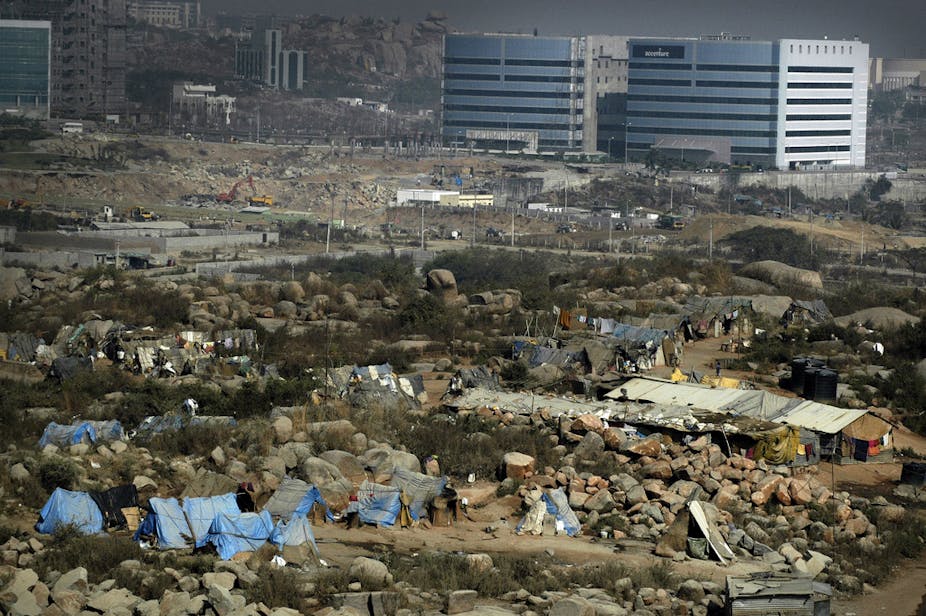
The population has the best chance of stabilising if we improve the lives of the poor and reign in excessive consumption of the wealthier. Flickr/DaveWilsonPhotography

Welcome to the State of the Future series. This series addresses 15 global challenges posed by the Millennium Project, an international non-profit think-tank collecting responses for 40 nodes worldwide.

The Australian node is hosted by the Institute for Sustainable Futures at the University of Technology, Sydney. UTS and the Conversation have assembled 15 articles by leading academics, each giving an Australian perspective. Together, they provide a fascinating snapshot of Australia grappling with a shifting future.


Challenge 3: How Can Population Growth and Resources Be Brought Into Balance?

The world’s population reached seven billion in October 2011. The sixth billion was reached in 1999 and it is significant that the seventh billion took the same number of years (12) to add as the sixth. This is relevant because prior to that there had been a progressive shortening of the time taken to add billions to the human population. The first billion was reached in 1804, taking many thousands of years of human evolution to achieve. Thereafter successive billions were added in 123, 32, 15, and 13 years respectively.

There has been a slowing down in the rate of population growth from a high of 2.1% per annum in the late 1960s to 1.2% per annum currently. This slowdown has occurred despite a significant decline in mortality which has seen global life expectancy at birth increase from 47.7 years in 1950 to 67.9 years in 2010. The decline has been driven by a remarkable decline in global fertility from 4.95 births per woman in 1950 to 2.52 births per woman in 2010.

The attainment of 7 billion world citizens is cause for both optimism and concern. Optimism derives from the massive achievement in bringing down global fertility in the last three decades. When I was working in villages in West Java in the early 1970s women were having close to six children on average and I must admit to not being at all optimistic about this being reduced significantly in the short term. Yet family size has been more than halved in a generation. Writers such as Paul and Anne Ehrlich in The Population Bomb were envisaging that the globe’s population may reach as much as 12 billion before stability but the United Nations in the early part of this century projected that it would stabilise at around 9 billion by 2050.

However, there are concerns. The United Nations has recently revised its stabilisation figure at around 10 billion in the latter second half of this century. Fertility decline, especially in Africa, hasn’t proceeded as rapidly as was anticipated. This must be a clarion call to redouble commitments to reduce poverty, extend education (especially of females) and intensify maternal, child, reproductive health, and family-planning programs – especially in Africa.

There are real concerns in terms of feeding perhaps an additional 3 billion world residents this century. Even now, between 850 and 925 million people experience food insecurity and undernourishment. In the New York Times Joel Cohen states that in 2009-10 the world produced 2.3 billion metric tons of cereal grains – enough calories to sustain 9 to 11 billion people. However, the distribution of that grain has left a significant part of the global population underfed.

Pressures on the environment are increasing exponentially as levels and modes of consumption accelerate. It is estimated that a seventh of the world’s population live without an adequate safe supply of water. In several areas climate change is anticipated to exacerbate those pressures. Yet stopping population growth should not be seen as a substitute for the necessity of reducing consumption in high-income countries and moving toward sustainable practices of resource use.

There are some striking changes occurring in the world’s population other than its inexorable growth. Ageing is not just an issue for OECD countries. A corollary of the massive decline in fertility means that growth of aged populations is more rapid in developing countries than in developed countries. In describing the global situtation, Joel Cohen has shown that whereas in 1950, globally, there were more than six children aged 15 or less for every person aged 65 or older, in 2070, the latter will outnumber the former and there will be only three working age people to every 2 people aged 65+.

In 2010 the world passed a significant demographic milestone when the balance between urban and rural inhabitants shifted, with more than a half of the world’s population now living in urban areas. Almost all of the net growth in global population for the rest of this century will be in urban areas of low-income countries. Rapid urbanisation brings with it many challenges.

Seven billion is an important milestone for our planet. The last century has been “the demographic century”, seeing more than 5 billion people added to the world’s population. We need to move as quickly as we can toward a stabilisation of the global population and this can be best achieved by improving the lives of people in low-income countries and achieving a more sustainable pattern of resource consumption, especially in high-income countries.

Comments welcome below.

Articles also by This Author

Sign in to Favourite

Want to follow The Conversation?

Sign up to our free newsletter to get the day's top stories in your inbox each morning, with a special wrap on Saturday.

Help evidence based journalism become the norm and donate

Join the conversation

23 Comments sorted by

  1. Alex Cannara

    logged in via Facebook

    Graph on p1 here should be a wake up. Will it be?

    AAAS Science 11 May 2012, p 740...
    "Recent Explosive Human Population Growth..."
    www.sciencemag.org

    report
  2. Gerard Dean

    Managing Director

    Living sustainably, whilst a noble goal won't float with us Westerners who love our energy intensive lifestyle such as international air travel for holidays and academic conferences.

    Living sustainably is tough. I lived sustainably when growing up on a farm in the Wimmera. I started work at 4 years old getting the wood and progressed from there. Milking cows, cutting and stacking hay, cutting and splitting wood, dragging feed around the farm on a tractor, turning the milk separator to get cream…

    Read more
    1. Alex Cannara

      logged in via Facebook

      In reply to Gerard Dean

      Dean, unfortuntaely, didn't countenance ocean acidification, which will trash food sup0plies for about 20% of all humans and much of the food the 80% who live near coasts depend on.

      The naive arguments about climate & sea rise via CO2 emissions fail the reality test of what 40% of all anthropogenic CO2 has,done and is doing in the seas. We could stop burning anything this moment and still find real tragedy looming within a decade.

      Comfortable lack of focus has a price we've yet to appreciate.

      report
    2. Gerard Dean

      Managing Director

      In reply to Alex Cannara

      Alex

      Just because Dean's Second Law of Sustainability says we will suck every hydrocarbon out of mother earth before we go sustainable, doesn't mean I like the idea at all. It will be a very dangerous world, not only from an environmental point of view, more like a scene from Mad Max.

      Having said that, I can see you are not from a farming background when you stated "We could stop burning anything this moment and still find real tragedy looming in a decade." If only it was that easy.

      If we…

      Read more
    3. James Jenkin

      EFL Teacher Trainer

      In reply to Gerard Dean

      Gerard, you make economic progress - where we don't have to get up at 4 and split wood, where we can specialise in something we like and we're good at, and where we have material comforts - sound like a bad thing!

      report
    4. Alex Cannara

      logged in via Facebook

      In reply to Gerard Dean

      Gerard, I love the web sites, where folks assume, assume, assume, then argue as if the "assumes" were true!

      I grew up in a truck-farming region of NJ, USA. And had mafia relatives too. So, indeed I understand the need for combustion fuels.
      ;]
      I was making the point that even if CO2 emissions all stopped, the airborne CO2 still dissolving into the seas will continue acidification the next 0.1pH to failure of the base of most of the seas' food chains.

      Now that'll be a food problem far bigger than running tractors on biodiesel.

      Actually,m one reason the Aussies & Czechs (and many others) are following China on the path to molten-salt reactors is that their hi-temp operation can make all the fuels we want, from CO2 in the air, and water ib the sea.

      And, Aussie lands being so vast, could indeed be watered via desalination and perhaps be the new breadbasket for the world. Folks are already considering that in Africa.

      report
  3. Dennis Alexander

    logged in via LinkedIn

    Thanks Graeme for a fairly balanced view of the issue. The graph Alex Cannara refers to suffers from necessary compression of the x-axis (timescale) given the period it covers. Your 123, 32, 15, and 13 years for the second to fifth billionth persons does provide a better sense of scale than the launch pad to which Alex refers - not criticising Alex or the Science Mag, just pointing out that graphs and scale sometimes need unpacking.

    "Fertility decline, especially in Africa, hasn’t proceeded as rapidly as was anticipated." besides being a clarion call to address poverty, aid from all sources must be decoupled from conditions imposing restrictions on birth control: the USA and the Vatican being the major offenders in this respect. With endemic warfare and implacable itinerant male employment, women being able to control their own fertility is a necessary adjunct to poverty alleviation in order to achieve lasting gains in welfare.

    report
    1. Alex Cannara

      logged in via Facebook

      In reply to Dennis Alexander

      Dennis, the graph is linear in years. Would you rather we have the y axis be linear too? That would truly be astonishing.
      ;]
      We have already increasing malnutrition worldwide, with over a billion so classified now. And that number is more then the total world population in the 16th century.

      It's intriguing to see how human nature tends to shut out realities for the sake of present comfort. Thus is tragedy engendered, whether Shakespearean or Roman.

      report
  4. David Nicholas

    Freelance Journalist

    The greatest danger and the most tempting is that the problem is so overwhelming that the developed world throws up its hands and decides does not do enough to answer the challenge.

    I noted that the Prime Minister several weeks back offered that we would/could/should be the food bowl for the world. Yes, that is noble thinking and a fine goal to work towards, if that was how our food producers also saw it. However, to do this, doesn’t it mean that the volume in food production requires that we…

    Read more
    1. Alex Cannara

      logged in via Facebook

      In reply to David Nicholas

      Very worthy points, David. We'll be shown true challenges by Ma Nature, before any politicians dare to act.

      We in the US, for example, were able to expand world hunger simply by subsidizing corn grown for ethanol distillation for a fraction of our vehicle fuels. We more than doubled worldwide corn prices and drove millions away from affordable corn products.

      Imagine, if as forecast, our midwestern grain belt begins to fail in its current production, or of lesser importance, our Calif. grape…

      Read more
    2. David Nicholas

      Freelance Journalist

      In reply to Alex Cannara

      Alex too true.

      I was anticipating another 50 years as the best of all possible worlds. But that the sense of being overwhelmed by the enormity of the problem to take action could be countered by finding a solution in the next five years in a concerted effort is expecting a bit much. But Mother Nature may help in the decision making and create an opportunity in ways we have not thought of. I look forward to challenged.

      Perhaps splitting large nations into smaller self-contained regions is an…

      Read more
  5. Gil Hardwick

    Anthropologist

    I'm very much inclined to agree with Graeme. The issue is not concerned with simply feeding people - in Australia we can do that before breakfast and then some.

    The very real concerns we have are with population impacts on society and on the environment. Farmers will not be simply working harder to produce more food, they will have to be better educated and compliant with a whole raft of new statutary requirements to protect biodiversity, soil fertility and water in a changing climate.

    My own…

    Read more
    1. Gil Hardwick

      Anthropologist

      In reply to Gil Hardwick

      As a footnote, to keep things in perspective, within the time frame Western Australia will have about 3.7 million people, up by 900,000 on our current 2.8 million. We are not talking billions, only millions. In the next 100 years our population will rise to about 5 million.

      While the world population will increase by about 28-29%, ours will increase by about 32%. That may sound like nothing to worry about, until we grasp the impact in this hot arid landscape. That's the issue for us here, and…

      Read more
    2. Alex Cannara

      logged in via Facebook

      In reply to Gil Hardwick

      "Fun" will be an interesting choice for our descendents to look back on us with. They may well have other words & thoughts about us.

      report
  6. Vivienne Ortega

    logged in via Facebook

    "Ageing is not just an issue for OECD countries. A corollary of the massive decline in fertility means that growth of aged populations is more rapid in developing countries than in developed countries". Why is ageing such an issue? The wealthiest countries all have an ageing population and it's a natural consequence of a successful health system and sustainable population size. Ageing is only a problem for growth-based economies that must keep raising funds to pay for all the needs of young people - such as schools, roads, child care, hospitals, infrastructure etc. Compared to the devastating threats of overpopulation, the "ageing" threat is not something to be feared, but to celebrate. Old people bring stability, wisdom, support for familiies and usually provide an army of volunteer workers. We can't keep populations young forever as all people age!

    report
  7. Mark O'Connor

    Author

    There's much to like in this brief analysis of the world's population situation. Yet I had two caveats.

    1. The conclusion that stabilising world population "can be best achieved by improving the lives of people in low-income countries" which persuading those in richer countries to consume more sustainably combines a number of good aims, and ends the piece on a suitable feel-good tone. But is it actually true? Depends a bit on what is meant. I wouldn't want to wait until the rich reduced their…

    Read more
    1. Alex Cannara

      logged in via Facebook

      In reply to Mark O'Connor

      Excellent points, Mark. In the USA, the influence of the combustion industries is amazing. And, the people it seeks to influence most are those whom it serves least -- lower middle class, part-time, or unemployed with limited skills.

      The Keystone pipeline is a typical example -- advertizing thousands of jobs. Then it was discovered that the "job" estimates were person hours, not people in jobs. But, the industry really wants to suck up Canadian tar sands, pipe it to our Gulf Coast, and refine…

      Read more
  8. Jenny Goldie

    editor

    This is a fairly good assessment though it fails to convey any urgency of the situation. If we are to lift the poor out of poverty while retaining some environmental integrity of the earth's systems, population growth rates not only need to come down to zero but need to go below zero. In other words, we need to have negative population growth. Demographic momentum will ensure births exceed deaths for some decades even when we manage to achieve global ZPG. We will not feed 10 billion people sustainably…

    Read more
  9. Mark Harrigan

    Dr

    Readers of this thread and this series may well be interested in the following

    http://www.nature.com/nature/journal/v486/n7401/full/nature11018.html

    and

    http://www.scientificamerican.com/article.cfm?id=is-earth-nearing-environmental-tipping-point

    The nature paaper is not the first study in this area (a seminal one in 2009 defined 7 "planetary boundaries" to preserve conditions in which humans can thrive -- and argued that the world has blown by three of those boundaries already.

    Whether or not we have already set in place the conditions to produce these tipping points is uncertain - what isn't uncertain is that this is a very real issue that our species faces this as a real problem and that our children alive today will have to deal with the problems if we don't take the issue seriously - which means not ruling out any option on ideological grounds and being willing to consider all possibilities - something that will be in itself incredibly difficult

    report
    1. Alex Cannara

      logged in via Facebook

      In reply to Mark Harrigan

      Very correct Mark. But we always seem to think we're living in the time when revelations first occur. The problems mentioned in those articles were understood by our scientists decades ago. Which is why programs to eliminate combustion power were suggested from the 1950s on. A comprehensive series of reports were even submitted to the US Congress in the early '70s.

      Money & politics are always so enmeshed that anything that threatens short term goals involving either goes nowhere.

      Too bad, because now we're indeed somewhere. And that somewhere is a serious, very real place...
      www.youtube.com/watch?v=TQmz6Rbpnu0 (1992)
      www.youtube.com/watch?v=Ko3e6G_7GY4&feature=channel_video_title (Durban South Africa)
      www.economist.com/node/21541028
      http://tinyurl.com/bueq2ev
      http://spectrum.ieee.org/energy/environment/energy-climate-all-talk-no-action

      Even all the recent "tipping point" talkers missed the significance and unstopability of ocean acidification.

      report
    2. Mark Harrigan

      Dr

      In reply to Alex Cannara

      Alex - I'm under illusions as to whether or not this information is revelatory. Discussion about them has been going on for some time as you rightly point out. But more recent studies better quantify the issues and highlight just how urgent they have become (or are past reversal).

      Whatever past warnings have to say, absent a tardis, we can only deal with the here and now. Action is well past due. This series highlights this. I just wanted to draw readers attention to other recent reputable science on the topic.

      Cheers

      report
  10. Dave Gardner

    Filmmaker & GrowthBuster

    Excellent summary here of the world's overpopulation problem. It closes with a classic illustration of how taboo it is to address this subject in truly candid fashion. I'm sometimes guilty of it myself:

    "We need to move as quickly as we can toward a stabilisation of the global population..."

    This position seems controversial enough, yet if we are honest with ourselves, we have to admit that we need population decline (as Jennie Goldie so wisely commented). And while educating the poor is an important help in this, we also need "population education" among all. A family choosing to have a child, or another child, in Australia, Canada or the U.S. currently pushes us further from sustainability than a family making this decision in Nigeria.

    Dave Gardner
    Director of the documentary
    GrowthBusters: Hooked on Growth

    report