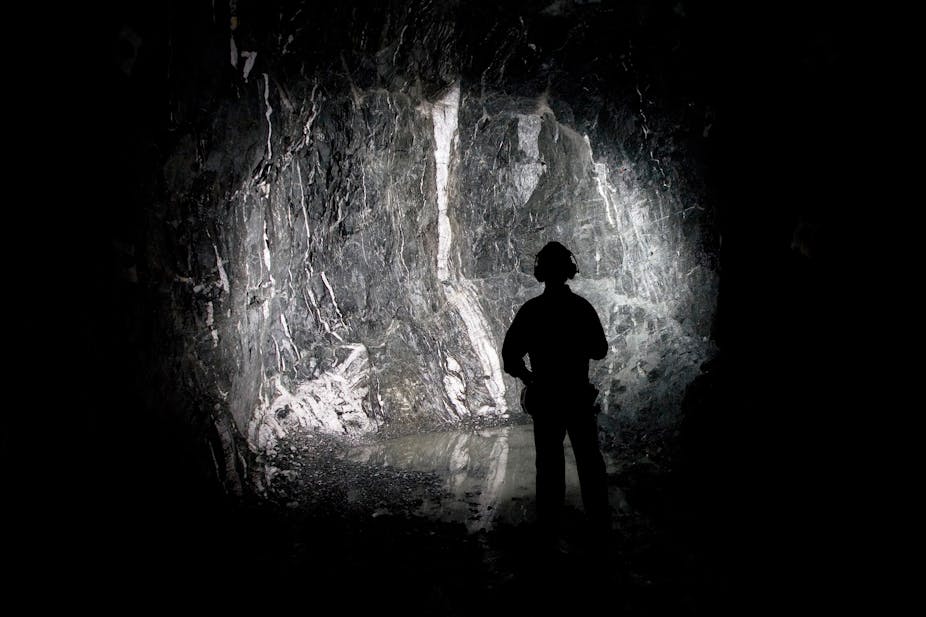
WHAT IS AUSTRALIA FOR? Australia is no longer small, remote or isolated. It’s time to ask What Is Australia For?, and to acknowledge the wealth of resources we have beyond mining. Over the next two weeks The Conversation, in conjunction with Griffith REVIEW, is publishing a series of provocations. Our authors are asking the big questions to encourage a robust national discussion about a new Australian identity that reflects our national, regional and global roles.
Is Australia really the “lucky country”? Not according to most Australians, who will tell you about the rising cost of living, the strain the new carbon tax will put on their household budgets, and the need to “Stop the Boats”. Not according to industry, who frequently complain to the media that such-and-such a new law will drive them into bankruptcy if the government doesn’t heed their demands. And certainly not according to any of our politicians, who instead focus their energy on short-term political manoeuvring calculated to gain a few Newspoll points against their opposition.
Australia’s current political discourse is characterised by a denial of the economic prosperity we now experience. This curious myopia in Australia’s social and political discourse, perhaps caused by an ingrained cultural refusal to acknowledge our achievements – the “tall poppy syndrome” – is fast becoming one of the biggest threats to Australia’s future. The longer we Australians refuse to see our country and our economy for what it really is, the more we risk forfeiting future opportunities. Instead of perpetuating the cultural myth that Australia is but a distant colonial outpost of Mother Britain, populated only by Steve Irwins and Baywatch babes, we need to face the reality of Australia’s economic prosperity and power that exists quite independently of nostalgic political alliances with the failing economies of the United States and Europe.
Consider the United Nations’ Human Development Index. Australia held the top spot from the 1980s, until we were knocked down to second place by Norway at the beginning of the 21st century. Consider the OECD’s latest economic outlook, which shows that, despite the debt crises in Europe and the United States, Australia’s economy remains one of the best performing in the developed world, with growth well above, and unemployment well below, the OECD average. Over the last 25 years, Australia experienced the highest growth in the developed world, and this growth predates the resources boom. Perhaps we should start seeing Australia for the global economic leader it really is, and not as the poor cousin of the Western world.
The good news for Australia doesn’t stop there. This economic prosperity has made Australians some of the wealthiest people in the world: we have the highest median income and the second highest average wealth in the world, second only to Switzerland. Our poorest 10% of households alone have experienced faster income growth than the income growth of the rich in almost any other country, while no other country has been able to top the income growth of our richest households. All of the above and we still have the third-lowest debt and the sixth-lowest taxes in the OECD. A low-tax nation with high quality, state-funded institutions, good infrastructure, and a welfare system that ensures a minimum standard of living and healthcare for all – sounds like a model economy.
Yet no recognition of our global economic leadership can be found in our politics. Instead we have introverted political leaders, media scaremongering, and a curious colonial paralysis that prevents us from taking leadership on international issues. Why, when Australia is an economic leader in the developed world, should it refuse for ten years to ratify the Kyoto Protocol – because the United States also refused? Why could Prime Minister Julia Gillard admit to having no interest in foreign affairs, just when the waning of the West and the rising of the East presents new opportunities for Australia, a country ideally situated between the two? Never before has a country been so ignorant of its own successes and so reluctant to build on them. Australia’s cultural and political myopia has birthed a lack of vision for the future.
It is vision, not luck, required to secure Australia’s future. Calling Australia the “lucky country” is a misnomer: it ignores that our prosperity predates the resources boom. Although digging minerals out of the ground and shipping them to India and China has certainly been great for the economy in the last few years, our prosperity can be traced to the policy reforms undertaken between 1983 and 2003 that saw Australia move away from protectionism to become one of the most flexible economies in the world. The Productivity Commission found that these policy reforms caused huge growth in Australia’s productivity, which is slowing again because of the very mining boom we seek to nurture.
What can be learned from Australia’s past experience is that far-sighted policy reforms are necessary for future prosperity. The Economist warns that Australians must now decide what sort of country we want our children to live in: we can enjoy our prosperity and squander our wealth, or actively set about creating the sort of society that other nations want to emulate. But vision and self-belief are something that current Australians, and their politicians, seem to lack.
This failure of vision was shown by one of Australia’s most shameful recent political events: the mining tax debacle, a missed opportunity if there ever was one. Australia has some of the richest natural resource deposits in the world, profiting from the historically high commodity prices and booming demand from China and India. The value of Australia’s commodity exports in 2011 hit $179 billion in 2011 (a 29% increase from 2010) and are forecast to reach a record $206 billion in 2012. Iron ore, coal and gold alone made up over a third of Australia’s total exports in 2011.
Booming commodity prices may benefit mining companies and their direct employees, but surrounding communities, businesses, and non-mining industries often suffer. Natural resource deposits won’t last forever, and one day Australia will have to rely on an industry other than mining to drive its economic growth. A far-sighted politician would keep back and invest some of the wealth from mining so that Australia will continue to grow when the mining boom ends. In 2010, Kevin Rudd and Ken Henry proposed to do just that, with their Resources Super Profits Tax (RSPT) that would place a 40% tax on the profits of mining companies above the 6% rate of return. The revenue from the tax was to be used to fund increased superannuation and cut company tax: this would provide for the ageing population and help other sectors that are hurt by mining.
The media hype created by the mining companies and Tony Abbott against the RSPT proposal should go down in Australia’s history as a period of national shame. Instead of reasoned political debate, a panicked maelstrom erupted. Fears that Australia’s mining industry would be halted and economic growth would cease were widespread . Advertising campaigns were launched, urging Australians to support the mining industry and, by extension, Australia’s future – Kevin Rudd was painted as threatening the core of Australia’s economy and countless jobs.
Calm was only restored when Rudd was knifed and a Prime Minister more accommodating to the mining companies was installed. The new watered-down Minerals Resource Rent Tax, negotiated between Julia Gillard and the three biggest mining companies (BHP Billiton, Rio Tinto and Xstrata), was criticised by economists as actually being more inefficient than the royalty charges it replaced. Keep in mind that BHP Billiton reported record profits of $23 billion in 2011. Keep in mind that the commodity price boom is likely to continue into the future, but natural resource deposits are finite and that other Australian industries are struggling because of the mining boom. How did we somehow end up confusing the interests of multinational mining companies with our own national interests?
Australia may be one of the luckiest countries in the world, but this came from good economic management and sound policies. Just as Rome wasn’t built in a day, the benefits we now reap from Australia’s current prosperity are the results of economic foresight decades ago. To ensure that future generations experience the same economic prosperity we do, we need to exercise the same economic foresight now. If Australia is to continue its prosperity, we need economically sound policies that focus on achieving long-run growth. The recent mining tax debacle shows how Australia’s political discourse has become dominated by self-seeking short-termism. We need to reverse this trend. The luckiest country in the world needs a government that can work out how to stay lucky in the long term. Political short-termism does nothing to secure a future for tomorrow’s Australia, nor the future of generations to come.
Economic prosperity does not happen by chance, but by design. We need to restore a vision for the future to our politics and political debate, and policies focused on securing Australia’s long-term economic prosperity. We need to focus on long-term productivity, not short-term profit, considering future generations by designing policies that secure the living standards of our children’s children,not just our own.
Mining is a cyclical industry, and to avoid irreversible harm to our natural environment and achieve sustainable economic growth we must implement policies that ensure Australia’s prosperity continues when our natural resource deposits have been exhausted. We need to secure Australia’s tomorrow through implementing sound, future-focused policies today.
Natural resources are becoming ever scarcer, and wise management of these resource deposits is an area of strategic interest around the world. Rather than using natural resource depletion simply to increase Australia’s export figures, we need to consider how to use this wealth to ensure the long-term prosperity of all Australians. Investment in human capital, long-term community development, and redistributing the benefits from mining to ensure inclusive development can alleviate the symptoms of “Dutch disease” in the manufacturing sector and combat the social exclusion, inequality and underdevelopment that often flows from resource extraction activities, to ensure Australia’s long-term economic future.
Australia is a world economic leader: the challenge now is to ensure that our economic policies reflect our economic reality, not deny it.
Read more provocations at Griffith REVIEW or at The Conversation.
Yuri Pannikin
Director
Well said, Mr Sarker. The dumping of Rudd and the Resources Super Profits Tax was the most shameful act of any government, let alone a Labor government, in recent memory.
They are still paying for it of course, and Labor face the most complete electoral annihilation at the next federal election in their history. Nice work guys!
And all because of the influence of a few mining related union leaders (you know who you are) sucking up to mining chiefs, who collectively have had their indecent way at the expense of the needs of decent Australians. You will pay . . . and you will pay big time you Labor traitors.
Yuri Pannikin
Director
. . . in the electoral sense of course. Thought I had better clarify that considering the "threat" lingo going around!
Ron Chinchen
Retired (ex Probation and Parole Officer)
Good article and spells out many of the myths that are being perpetrated by the wealthier elements of our country and are being accepted myopically by a public that remains beholden to the effective propaganda of a self interested media, big business, mining industry and reactive rather than proactive political structure.
Despite this I still beleive Austalia is Horne's 'Lucky Country' and that our recent success is primarily a consequence of mining, the new sheep's back in this country. We dont…
Read moreShane Bryan
logged in via Facebook
Well said and just further highlights how the mining industry and offshore interests are taking this country for a ride. China will not only own every ounce of every mineral that's pulled out of the ground, in the next 20 years they will own every piece of farm land as well.
One good example, why are kids in our schools still being taught European languages such as Spanish, French and German? We should be teaching Mandarin, Jin, Wu etc, Vietnamese or even Thai before irrelevent, almost dead languages from parts of the world that mean nothing to us economically. We may as well be teaching our kids Latin for all the good Spanish will do.
Abel Crawford
Mechanical Engineer
Teaching languages is not just about economics... Learning a language is important for cultural exchance and these languages open up a lot of cultures that are relevant to Australia's past (Germans).. Also Spanish is not an irrelevent almost dead language... It is actually the second most natively spoken language in the world after Mandarin.. The whole of Latin America use it.. it is far from irrelevant and dead... also there are many opportunities in Latin America for business.. it is time we started looking there too and not just to Asia.. Brasil is up and coming economically and yes they speak Portuguese (not an irrelevant language either there are 183 million Brasilians).. I always wonder why we almost ignore Latin America who have much more similar culture to us than Asia... we only see Asian opportunities... Why?
Kim Peart
Researcher & Writer
The clear need for Australia is a vision that all citizens and miners can share, which will then inform our political direction.
If we only gaze with blinkered eyes on holes in the ground, we will miss the real future.
A national vision must address the needs of income, sustainability and predicted Earth changes that could undermine all gains, locally and globally.
There is one simple direction for Australia that will address all needs and concerns.
We must invest our resource bonanza…
Read morePeter Ormonde
Peter Ormonde is a Friend of The Conversation.
Farmer
Ah yes the Lucky Country...
Here's the full quote: Australia is a lucky country, run mainly by second-rate people who share its luck.
There's something worth thinking about isn't it?
There has always been a tension between living by making stuff and living off what we've found here. When we were actually isolated we had to make our own stuff, invent it and make it ourselves and we were pretty good at it. Strangely we're still pretty good at inventing stuff and thanks to CSIRO and TAFE…
Read moreRussell Walton
Russell Walton is a Friend of The Conversation.
Retired
Yes, Mr Sarker's article summarises the national malaise very well, the cultural cringe hasn't disappeared.
Donald Horne made very similar observations about Australia more than 40 years ago, in his book "The Lucky Country". Essentially his thesis was that Australia was run by second rate people and that the nation had been lucky, so far, however, sooner or later our luck would run out. In the words of one economist--"an idiot that keeps winning the lottery". Typically, Australians no longer understand…
Read moreKim Peart
Researcher & Writer
What the country needs, Russell, is a vision driven by citizens that will deliver political direction. Any nation is only the sum of each individual. It is up to each of us, as citizens, to know what we want for Australia.
Dennis Alexander
logged in via LinkedIn
Vision or hallucination? How can one tell the difference? Some of our citizens are very smart, some very stupid, some drug-addled and some harking to some past or future "golden-age" which has never been or which will never come. As Tapan Sarker's article says, some national self-confidence and adventurousness, instead of jingoistic nationalism and the current political and media wolf-crying, would go a long way towards creating a productive and prosperous future.
And, I don't buy the "sum…
Read moreRussell Walton
Russell Walton is a Friend of The Conversation.
Retired
Kim,
Yes, of course, no arguments there, however the essential problem is to find the magic social/political algorithm that produces the required vision, isn't it? We have a foreign head of state, practically no film or TV industry, a middle class welfare industry, an obsession with spending taxpayers' funds on the production of useless and expensive elite athletes (rather like East Germany) and a "Great and Powerful Friend" mentality. I can't determine whether those are the symptoms or causes…
Read moreKim Peart
Researcher & Writer
I agree Russell, that human society is a complex creature and often the few determine the direction of the many. The Arab Spring, for instance, began with a suicide. That was one humiliated individual's choice and like the straw that broke the camel's back, had a rather huge impact.
My primary concern is to know the vision that I can live with. If this vision is shared with another, we may have an enlivened conversation. If it is shared with a hundred, we may form a political party and win a few…
Read moreRiddley Walker
.
I don't think you will ever see a "real Labor Party" in Australia again. They are too compromised by the progression from union leader, to MP to Minister to seats on the board of the industry for which they were minister or union leader.
In my view the only Party with real achievable long term vision for Australia is the Greens. Their economic policies resemble (and precede), the Henry Tax Review, and their education policies resemble (and precede) the Gonski Report. They are not afraid of the mining lobby or the media, or other corporate bullies, and have a vision for a more equitable Australia that looks after its own, be that people, resources or National treasures.
My fear is that by the time the Greens achieve government, it will be too late.
http://greens.org.au/policies
Kim Peart
Researcher & Writer
If personal experience counts, I have observed ruthless behaviour by Greens on the trail to power, where principles had no place in the matter. I was affected personally when daring to question the behaviour and took an active stand against it.
As long as we tolerate the play of power over principle, we will have trouble with politics, politicians and the media. When as individuals and as a community we demand principled behaviour, we will begin to find our feet.
Principles are built on honesty…
Read moreMark Harrigan
Dr
Great article - when will Australians wake up that we live in a great country that is the envy of the rest of the world? Unfortunately facts (such as our high growth rate, low unemployment and low tax levels) are simply ignored by those who just want to complain and deny the prosperity.
On the RSPT though - it should not be forgotten that Rudd and Swan comprehensively stuffed up the way they introduced it. They mugged the mining companies after assuring them it wouldn;t be bad - it was hardly a surprise the reaction that ensued. What was a good idea should have been carefully sold into the electorate. Instead Rudd, in characteristic "I'm smarter than everyone else and know best and don;t need to consult or bring anyone with me" style - tried to ram it through using a "lets tax the big evil mining companies" approach.
A lost opportunity to introduce a major piece of tax reform.
Robert Tony Brklje
retired
The selling of primary resources without any attempt to develop or sustain the ability to convert those resources into secondary or tertiary goods, is nothing more than allowing the greed of today's generation to steal from tomorrow's generation.
Europe was once rich in easily accessible resources and they were all frittered away. Global trade is an empty exercise in corporate greed, seeking cheapest materials and cheapest so as to provide products with the highest possible profit margin, serving no community not where the products are produced nor where they are sold, just accelerating the race to the bottom in terms of gutting the middle class.
Troy Barry
Postgraduate student
Dr Harrigan is right. If we identify our forunes too closely with mining companies' we do it in rejection of Swan and Rudd's ridiculous Us vs Them framing when introducing the RSPT. Few people disapprove of taxing successful mines - Western Australian royalty increases on iron ore fines were passed without a peep of political, popular or commercial protest - but not every tax announced is automatically so well designed that it should be accepted without objection.
Incidently I always enjoy seeing references to Dutch Disease. When I compare the current economic position of the Netherlands to its neighbours and European peers, I see evidence that the very best thing we could do for the next generation's economy is to contract a good dose of Dutch Disease.
Yuri Pannikin
Director
Harrigan wrote: "On the RSPT though - it should not be forgotten that Rudd and Swan comprehensively stuffed up the way they introduced it."
No, that's pretty much mythology, although as leader at the time Rudd probably has to accept some responsibility for Swan stuffing the whole thing up behind his back.
The Australian has it right for once: http://tinyurl.com/76xhmsu
Mark Harrigan
Dr
Yuri - I think it's nit picking as to whether or not Swan or Rudd was the major culprit. Both mispoke in the public arena (making it a them vs us matter) - and Rudd as the leader has to carry the ultimate responsibility.
The point, however, is that labor (under Rudd) comprehensively stuffed up a major opportunity to introduce a tax that would see a greater sharing of the wealth from the mining boom with the legal owners of the minerals - namely the "crown" representing the common weal of the people of Australia. That didn't show "vision".
Yuri Pannikin
Director
Mark, yes, you're probably correct.
Mark Harrigan
Dr
Thanks Yuri - in defence of the point you were making - I did find the article to which you linked (though I've sworn off ever buying the Australian ever since they adopted their hypocritcal approach to climate change reporting) very interesting. It shows Swan really stuffed it up but also just how disconnected Rudd was from his colleagues and the real world - which is why it amazes me that so many still think he should be prime minister.
I suppose we can all lament the lack of visionary leadership we have. Oh for a leader who could both celebrate our great strengths as a nation (and help us feel good about ourselves rather than promote the current mean spiritdness) but also use this to articulate an aspirational platform to insipre the nation to build on the strengths and do more for ourselves and the world rather than simply try and take credit for it (or beat up the problems and be negative).
I don't see anyone on the horizon even remotely like that though :(
Yuri Pannikin
Director
Yes, the irony of me quoting from The Australian has not escaped me!
I'd be willing to give Rudd another chance, if for no reason other than he might be able to turn the ALP's dismal electoral prospects around. The polling popularity numbers don't lie. I think we would see an immediate jump to close to 50/50 two party preferred.
I really can't bear to think of the loony tunes we would have to face with an Abbott government in tow with state conservative governments. Science in general would be the big loser, let alone climate science. But I guess I'm just one of those out-of-touch 'elites' -- like yourself of course ;-).
Mark Harrigan
Dr
We'll have to agree to disagree about Rudd - I though he was one of the worst leaders ever - with a borderline psychotic narcissism. I take your point about the polls but I suspect such a lead would soon evaporate when the electorate was reminded about just how bad he was.
I actually am (grudgingly) okay with Gillard - was willing to give Abbott a fair hearing but now would never vote for a party he leads.
What might actually give us mature politics and the chance to establish a dynamic discourse articulating a vision would be if Turnball took the helm again with the Libs and Bill Shorten took over labour. Unlikely though sadly
Yuri Pannikin
Director
Mark, Turnbull I like; but Shorten . . . never in a million years. I'd go for Combet, but that's not likely either. He needs to smile more :-).
And if Turnbull did manage a comeback, we'd likely see a 60/40 two-party preferred split and Labor would stand on the brink of absolute destruction (with the current leader) with only handful of seats in the federal house. I wonder if they have made plans for such an event. A Turnbull resurrection is not impossible, although unlikely at this time.
Mark Harrigan
Dr
Curious Yuri - what is your objection to Shorten? He presents and articulates well. Yes he's ambitious and knows how to turn a situation to advantage but I assess he's handled his policy portfolios rather well.
Ben Neilson
Marine Engineer / Farmer
Pity Turnbull can't seem to get the nod. With the right support he'd be one of a very few people who could truly improve the nature of politics from what we're currently enduring.
Peter Ormonde
Peter Ormonde is a Friend of The Conversation.
Farmer
Yes Turnbull is in the wrong party actually.
Trouble is though, unlike the American presidential system, the Australian system is a team sport ... leaders don't bring in their own administration, rather the administration brings the leader (ask Rudd).
So where would Turnbull put Barnaby Joyce - Education, Foreign Affairs, Trade???? Pyne? Joe Hockey? Abbott? They'd all be there. They - not Turnbull - would be making the decisions in Cabinet.
Yuri Pannikin
Director
Mark, what I can say is that for all of Rudd's alleged faults -- which have been over-emphasised by his opponents in my view -- it was a disgraceful act to dump him in his first term after he dragged them to government.
I looked up the polling stats and when he was dumped, and Labor was still ahead 52-48% two-party preferred. So that excuse was bull****.
This was a modern day coup, pure and simple, organised by some parliamentary members and union officials very close to mining company interests; and, I might add, that have traditionally fought the environment movement tooth and nail.
If this mob gain control (have control?) of the Labor Party I will not vote for them. Better to lose by 50 seats than 10. Greens 1, no preferences!
Mark Harrigan
Dr
Yuri - I'd have to disagree with you about Rudd - David Marr got it right I think. http://www.theage.com.au/national/recipe-for-ruin-lay-within-20100624-z3hz.html
"The public loved him.
Rudd looked different close up. So many who worked around him came to loathe him. His energy and resilience were phenomenal. So were his temper and self-belief. Caucus colleagues felt belittled. Ministers were frustrated. Staff fled"
and
"Part of the problem was Rudd's old ambition to find decent solutions…
Read moreYuri Pannikin
Director
When you consider Rudd at 35% and Gillard now at 26% primary, it's a stark contrast, and most experienced pundits agreed that Rudd would have won that election -- from Howard to Keating.
Naturally I am aware of the arguments against Rudd's personal style, but David Marr is the last person I would listen to . . . about anything. I would have thought that a Caucus committee warning that if he did not change his style, he risked being sacked would have been an honourable way to approach the matter. He was not given any chance, and the plotters acted before Rudd could summon his own supporters. Disgraceful, appalling, cowardly, treacherous. Never forgive; never forget.
And . . . knowledge of the main drivers of Rudd's evisceration is on the public record. No secret in that. Whether you accept the more clandestine implications is up to you, but it's somewhat plain to me, and many others I might add, who are closer to the action than I am.
Yes, we agree to disagree. Regards.
Suzy Gneist
logged in via Facebook
I can only agree that as a collective, Australia's future vision is lacking.
Read moreNone of our major parties represent the traditional support base any longer or even share their backgrounds to a large degree. They are divorced from people's lives, their trials, their challenges and their dreams by a glass ceiling that the "profession" has placed between politicians and the "ruled". We watch the drama and comedy played out on the floor and it has little relation to what happens outside the theatre…
Kim Peart
Researcher & Writer
By its nature Suzy, democracy is shaped by collective action and action by its nature is the sum of individual choice. It is easy to be told what to think and vote accordingly. It is more radical to do our own thinking and figure out what we should be striving for. We can risk isolation by stepping away from the mob, or we may find the freedom to speak our mind in a spirit of independence. When we find our liberty, then we can begin to create a more dynamic nation.
Australians are an amazing people and I suspect that we will begin to amaze the world; and not too far away.
Suzy Gneist
logged in via Facebook
I'm encourage by your hopeful outlook, as a futures thinking research student I share it on an intellectual level, yet often feel discourage by present day events on an emotional level.
Kim Peart
Researcher & Writer
I went through a long process, from 1987, of figuring out what the cause of our strife was. In the end I came face to face with the primary driver of evolution: expansion. For life, that does not mean remaining confined on a planet. I found it highly interesting that a conscious tool-maker emerges that can build spaceships and that the fossil fuel energy was there to use.
Did we drag our heels? Did we burn too much fossil fuel? Did we fail to start building solar power stations in space, to make…
Read moreDavid Nicholas
Freelance Journalist
Yes, Australia is very self-conscious about seeing its place in the world. Also, I find the negativity in any debate so extreme that the issue is rarely discussed beyond the personality advocating it.
The tall-poppy syndrome is one aspect, the practice of running down anybody who looks like they are succeeding above the norm. But there is something more to the cultural sense of us. I call it the Gallipoli Syndrome.
This is about goal orientation and achieving goals. The way the Gallipoli syndrome…
Read moreLiz Skelton Sla
logged in via Facebook
David, Im interested in your idea around the gallipoli syndrome. Im currently co-writing a book on changing leadership in australia exploring the paradoxes we hold in our story about leadership. This is an interesting idea, how can i discuss further?
Chris Skinner
logged in via LinkedIn
Frankly this and similar articles and recent books are no surprise. Australia is a timid and introspective country that displays its international immaturity in almost every way possible. But there is hope :)
In World War 2 Australia was saved from a terrible fate by the good offices of the USA in the form of General MacArthur and the land, sea, air and submarine offensives launched from Australia and Hawaii. Apart from the bombing of Darwin and other northern settlements, midget submarine attack…
Read moreRoxane Paczensky
Registered Nurse
I must say when I looked over the disclosure statement before reading I expected to be subjected to the usual neo-liberal rubbish we keep getting fed. What a great suprise to find it wasn't.
I agree completely with what the author is saying. I just hope the masses are listening too because this country is about to get plunged into the spending cuts, lower taxes, and deregulation mantra of our conservative politics judging by the way the state election results are going.
I'll be sharing this across the social media sites I belong to to help get the message across.
wilma western
logged in via email @bigpond.com
Many Australians would agree that we seem to be overdependent on quarrying and seem to be lagging in creating 21 century industries.But as others pointed out much of our well-being is due to social reform ,not digging up minerals. It's petty not to acknowledge that while Howard refused to sign up to Kyoto, that was one of Labor's first acts. , and while both ALP and Liberals seem overly subservient to the US, Labor under Crean and then Rudd was totally opposed to the Iraq invasion, It's also petty…
Read moreYuri Pannikin
Director
Well, Rudd only dumped the ETS after the Greens, stupidly, would not support it. As a Greens voter, I was appalled at the short-sightedness of that decision.
David Arthur
n/a
I applauded the farsightedness of the Greens' decision to NOT support the creation of yet another tradeable derivative.
MAke no mistake, ALL emission trading schemes have NOTHING to do with decreasing CO2 emissions, but everything to do with the transfer of obscene amounts of economic wealth to the financial sector.
The correct approach to eliminating fossil fuel use is to introduce, then steadily increase, fossil fuel consumption tax (FFCT).
1. Start cutting taxes.
Read more2. Make up the revenue…
Yuri Pannikin
Director
David, the Greens only knocked the ETS back because it did not go far enough, without acknowledging that getting something off the ground was the most important consideration.
And I would suggest it's easy to selectively quote literature to support a point. The fact is that:
"The departmental statistics (Climate Change and Energy Efficiency) show that from 2015, 35 countries were expected to have national emissions trading schemes, including the Republic of Korea and China while a further 11 sub-national jurisdictions in the US and Canada were also supposed to join. This would cover a total population of around 2 billion and account for about 45 per cent of global gross domestic product."
An ETS is the preferred approach.
Mark Harrigan
Dr
It's a little off topic but I do not think your opposition to an ETS (vs a Carbon tax) is supported by the devidence David.
Well explained here.
https://theconversation.edu.au/explainer-the-difference-between-a-carbon-tax-and-an-ets-1679
Pros and Cons to both. The downside of a tax is that is does NOT set a limit to emissions. The downside of an ETS is that opens up the risk of financially traded arbitrage - but that is NOT its designed purpose as you claim and is something that can be managed.
Most economists tend to prefer an ETS since it uses a market mechanism - and you can drive the price by limitting (and steadily reducing) the number of permits.
It's not as black and white as you suggest, sorry.
David Arthur
n/a
Thanks for that comment Mark.
You write that the downside to a tax is that it does not set a limit to emissions. In fact, a tax does set a limit to emissions. What you do is ramp up the tax, year by year, until the emissions decline to the level required.
Emission trading, on the other hand, transforms CO2 emissions from an environmentally damaging activity that must be priced out of the economy into a scarce commodity, just like recreational drugs when there's a big bust. Like recreational…
Read moreDavid Arthur
n/a
Thanks Yuri, an ETS may well be the preferred approach, but that doesn't mean it is the best possible approach. What I'm pointing out is that it is a lousy sub-optimal approach, devised by second-rate minds asnd spruikers with an interest in their own hip pockets.
Australia's tragedy is that, rather than accept the reality of climate change and argue for the optimal pricing structure to eliminate fossil fuel use, Mr Abbott has chosen to just say 'nyet'.
As ever, Australia is poorly served by its political class. One side argues for the sub-optimality of giving free rein to far-off tax-haven screen jockeys, the other side is hell-bent on environmental devastation. Great choice.
David Arthur
n/a
I might add that independent economic leadership is not to be found in craven adherence to other nations' economic orthodoxy, especially the demonstrably stupid ones eg ETS (see above).
Independent economic leadership may be found in prudent management of the nation's natural resources eg maximising the value and economic activity obtained from each tonne of mined resources in Australia, in enlightened nourishment of the talents of all the nation's citizens (universal health and education), in engagement with other nations while ensuring retention of national sovereignity (eg don't import pest species), and in being at the leading edge of technological progress (necessary to wean ourselves off fossil fuel use at the earliest).
Mark Harrigan
Dr
David - we are probably arguing about finer points - but again I don't think you are quite right.
We do, I think, both agree that what is needed is to put a price on emissions - so that the current "free" externalities associated with emssions carry a penalty to the emitter. The question is what is the optimal way to do this?
A Tax does NOT inherently set a limit to emissions - it simply makes them more expensive. Your argument ONLY holds if there is a price elasticity in relation to the…
Read moreKim Peart
Researcher & Writer
Concerning "the usual climate pseudo-skeptics" I have come to wonder if human society is plagued by a deeper level of denial that can come to threaten the survival of that society, leading to civilization collapse.
This is revealed in a nutshell on Easter Island, where they built a neat little civilization with a growth-industry in statue building, but in the process cut down all the trees. When they discovered that humans live by more than rock alone, they lost the lot in an orgy of civil war…
Read moreMark Harrigan
Dr
Interesting points Kim. My worry is that a fair amount of climate change that is deleterious is already locked in.
And by the time the situation becomes signficantly worse so that pseudo-skeptic deniers no longer have a public stage (well in excess of their actual numbers I suspect but amplified by short term special interests who can see their current wealth in fossil fuel burning under threat and will do anything to perpetuate it) it will be too late to arrest the problem.
One of the issues…
Read moreDavid Arthur
n/a
Thanks Mark. Weitzmann's 1971(?) paper "Prices v Quantities" was cited in the Henry Review as justification for preferring 'cap-and-trade' schemes over consumption taxation.
In fact, Weitzmann presented a solid argument in direct opposition; that is, Weitzmann found that decreasing emissions by imposing a price is the economically optimum technique.
You are right that a tax does not set an inherent limit on emissions. What a tax does is to get taxpayers looking for ways to minimise their…
Read moreMark Harrigan
Dr
Thanks David - I enjoyed this reply - good food for thought and i will refer to some of the references you have provided.
And please don't get wrong. I am not arguing in favour of an ETS vs a Carbon Tax. Only that I don't see an ETS is quite as bad as you say. Also - why is it the revenue from permits cannot be used to reduce taxes elsewhere (just as a carbon tax)?
I do like the notion of a carbon consumption tax - but see a problem cross border since it would price our goods and services to a point where they were uncompetitive - or do you see exports being exempt?
The other problem with a border adjustment tax is that it can act like a tariff (which is inefficient).
nevertheless I will read the links - appreciate them :)
David Arthur
n/a
Gday Mark,
As Geoff Carmody sets out, the treatment under a Fossil Fuel Consumption Tax (FFCT) of imports and exports could mimic their treatment under the GST - exports are 'zero rated' at the point of export, and imports have a border adjustment tax imposed. Carmody's criticisms of the CPRS (by implication, also of CPRS v2.0 aka Clean Energy Futures) are based on its (their) adverse trade implications.
Regarding fossil fuel consumption, a border adjustment tax as I outline is the direct…
Read moreRon Chinchen
Retired (ex Probation and Parole Officer)
Kim, I am taken by many of your arguments especially with an historical perspectine, though I have more of an alignment to the Greens perspective I suspect. Your vision has an almost H G Wells view of human nature and given his accuracy in predicting so much of our present world, who am I to dispute. My concerrn is that unlike Wells belief in a Things to Come style benevolent society also propogated in the Star Trek philosophy, that we as humans will not realise the folly of our actions any more than previous civilisations did that we now read about as extinct entities from past times.
Kim Peart
Researcher & Writer
I fear that we are in a race against the survival clock Ron, pure and simple. If the clock beats us, that will be the end of our game.
My key reason for concern is in the oceans, that acidification at its current rate could wipe out evolutionary capabilities to adjust and end in a repeat of the Great Dying of 252 million years ago, when most of life on the planet perished. Scientists like James Hansen see this, referring to the Venus syndrome ('Storms of My Grandchildren') and Lovelock has suggested…
Read moreKim Peart
Researcher & Writer
I wonder if the driving force within denial is a gut-felt awareness that without progress, we will not survive and progress demands energy, which for us comes from fossil fuel.
If our plan for survival delivers a dynamic progress beyond Earth, where the energy-well of our star is essentially unlimited, those in denial would not have a leg to stand on.
This is also the ultimate environmental plan, as it will enable us to deliver a sustainable human presence on Earth.
All current plans are…
Read moreRon Chinchen
Retired (ex Probation and Parole Officer)
Kim, I try to be a realist in these arguments despite my desire to chase the great dreams of what 'may' be achievable. Unfortunately we here in Australia have an opportunity for education and greater awareness of what is happening in the world around us. But probably 90% of the population of the World and probably the vast majority of people living here, are not in that position and are too tied up in just surviving, or are caught up myopically in their immediate world only or some belief system…
Read moreYuri Pannikin
Director
David, thanks for explaining. I learned a lot about potential alternatives to emissions trading schemes.
But can you discuss why ETS seem to be the favoured instrument worldwide? I don't understand why ETS seem to be first choice if FFCT are more effective. What are the barriers to a fossil fuel consumption tax -- beyond what Mark has provided?..
Mark Harrigan
Dr
Hi David,
I'm working through the CEDA papers and haven't finished yet - but thank you very much for pointing me at them. I recommend others read them too http://www.ceda.com.au/media/121695/a%20taxing%20debate%20-%20the%20forgotten%20issues%20of%20climate%20policy.pdf
I'm not yet entirely persuaded but I can see they make some very valid arguments about the benefits of carbon consumption tax vs a carbon production tax - and I do like the way a carbon consumption tax addresses the export/import problem and thus means australia's competitivness is not under any threat, alomost regardless of what the rest of the world might do.
I wonder about the political realities of it though - and if it IS a good idea (still exploring) how the public discourse might be periusaded to consider it as a better alternative
David Arthur
n/a
Good question Yuri,
The reasons for preference for of "cap-and-trade" (despite Weitzmann) are historical - cap-and-trade was applied to sulfur dioxide emissions to halt acid rain in the industrialised West in the 1980's, and all the people who matter did quite nicely out of it, thank you very much.
The reasons cap-and-trade was okay for sulfur control back then were that it didn't really require the engagement and participation of consumers and citizens. Coal is used by large industries, and…
Read moreDavid Arthur
n/a
Thanks Mark.
Elsewhere on this page, Yuri Pannikin asks for my opinion on how and why ETS came to be preferred to Pigovian consumption taxes. My reply, starting with "Thanks Yuri, an ETS may well be the preferred approach ..." points out that spruikers for emission trading got in the ears of "progressive" leaders such as Tony Blair and Kevin Rudd from the very start, so that the Stern and Garnaut Reports didn't even consider consumption taxes.
Garnaut's silence on the preferred carbon pricing…
Read moreMark Harrigan
Dr
Hi David, yes I read your reply to Yuri. I can see you are quite cyncical (justifiably perhaps?) about the politics of this issue and the finance sector.
Regardless as I work through the CEDA papers I am becoming more and more persuaded that a carbon consumption tax may well be the superior option. I guess we can only hope that the debate and public discourse about this topic matures both locallty and globally to enable this approach to be properly explored and understood. Cheers
Yuri Pannikin
Director
Thanks David. I admire your thoroughness and attention to detail on this matter.
Thanks for opening my eyes to this option.
David Arthur
n/a
Gday Mark, I've been following political and economic public debates for a third of a century now, and have worked in the finance and resource sectors long enough to form the view that those industries seem incapable of distinguishing between the national interest and their personal financial interests.
The same seems to hold for political parties attitudes' to their electoral prospects.
One has more hope of encountering objectivity in the webpages of 'The Conversation'.
Kim Peart
Researcher & Writer
If our amazing civilization Ron,
should slip and slide into the night of a Dark Age, or a New Stone Age, there is a very high probability that there will not be another Renaissance, let alone any future crack at securing a confident survival presence beyond Earth.
This is not just because we have already taken all the easily mined resources, or depleted key rare minerals, but because the Earth changes that we have brought on by burning carbon fossil fuel too long has filled the biosphere with…
Read moreRon Chinchen
Retired (ex Probation and Parole Officer)
I agree with much of what you say Kim, though I think with your mention of the Sun being 35% hotter than when Earth first formed and some of those other long term issues, I doubt that they will have much impact on humanity even in the long term because you are talking about processes that change very slowly and will take hundreds or millions if not one or two billions of years to seriously impact on Earths life ( given the average span of specific lifeform species on this planet, humans as we know…
Read moreKim Peart
Researcher & Writer
There are many disasters that can strike the planet Ron,
such as a mountain from space, or the collapse of a volcanic peak in the Canary Islands, or a solar blast from the Sun, or a super volcano erupting.
It is so pointless to put our civilization at risk unnecessarily, when with just a little effort we can assure our cosmic survival, the cost of which will be covered by energy from the Sun in space alone.
The concern with the warming Sun is not how slowly it is warming, but that our planet…
Read moreRon Chinchen
Retired (ex Probation and Parole Officer)
Good points and certainly rapid environmental change can bring about a negative cascade effect on the symbiotic relationship of many life forms. I've already stated that our grasses for example risk being totally decimated through environmental change not to forget the constant genetic manipulation and hyridisation of these plants (many of which have become floral mule species) which risk making them susceptable to species extinction through disease or other factors.
But as you well know such…
Read moreJohn Harland
bicycle technician
Perhaps the biggest problem is the negative thinking of the author and all the correspondents towards what is seen as Australian culture. When a people hears Its culture denigrated constantly, should it surprise us that that people find it hard to stand up for what is good?
Thr "tall poppy syndrome" is not about success ro achievement, but about the arrogance of " self-made" people who fail to acknowledge all those who have helped them to where they are.
The "good-enough" , "she'll be right…
Read moreRussell Walton
Russell Walton is a Friend of The Conversation.
Retired
The number of comments on this topic where sport is regarded as a significant national achievement is rather symptomatic of Australia's warped sense of priorities. How many gold medals have the S Koreans and Tawainese ever won at the Olympics or any other sporting circus?
John Harland
bicycle technician
The example I have given is a publicly documented one. I do not follow sport in general nor motor racing in particular.
My father ws involved at a similar level in team projects, but they were in the fields of radio and signals analysis, and computer programming. Hardly the stuff for public narrative.
I am far too close to any of the projects I am involved in to give any meaningful analysis.
Sport may not be meaningfull in yur mind, or mine, but it is readily available as example.
Chris Skinner
logged in via LinkedIn
To return to the main topic: what is my vision for Australia?
Simply it is as a benevolent but disciplined leader in our region, acting in concert with Indonesia and other regional powers for the good of all. Secondly I see Australia continuing to work with the great powers in the Indian-Pacific hemisphere for the peaceful and sustainabe advancement of all.
To China we render respect and fair and honest trade and dialogue as we learn about and come to appreciate an acient and diverse culture.and its people.
To the USA we render warm friendship and positive support for the maintenance of peace and harmony in the region, based on a close relationship forged in World War 2 and continued to this day through conflict and collaboration
To the other major powers in the region we offer collaboration and a will for mutual unerstanding and cooperation
Peter Ormonde
Peter Ormonde is a Friend of The Conversation.
Farmer
Yep, that'd be nice. But did you read here in the Conversation here the other day that Australia sits with the "Other European" grouping at the United Nations - not Asia. How shocking is that?... still flying that old White Australian flag ... a colonial outpost on the edge of "foreign parts".
I actually can't see us as playing anything other than a nagging aunt in Asia while we are off to one side like this... an Aunt twice removed.
We have to decide where we live, where our interests and futures lie - not just this nostalgic notion of a self-appointed "sophisticated" democratic bastion... fighting the good fight ...bringing light to our neighbours. It gets more wrong by the minute and was always, always an insult.
Mark Harrigan
Dr
I think it's a pity that this discourse is often framed as an either or choice. Not that you did that specifically Peter and I take your point about the signal that sends - but we need to resist the desire of others to put us in a "box" that neatly labels us.
We need to carve out our own indepdendent identity - perhaps as a model for what a world not divided by partisan ethnicity and nationality looks like (not that we have achieved that yet but there are some good points to celebrate)
Geographically…
Read moreJohn Harland
bicycle technician
It is worth pointing out, too, that nations such as Indonesia and India, despite their colonial past, are based strongly in their indigenous cultures. Australia, largely, is not.
If it were, it is important to understand that it would still not be an Asian culture, it would be Australian.
Certainly, Australia adjoins Asia, but so do Europe and Africa. That does not make Australia Asian. The US trades a lot with Asia but that does not make it Asian, either.
We need a lot less sentimental romanticism about our interactions with Asia. We are not an Asian nation and we look like clumsy clowns when we pretend to be so.
John Harland
bicycle technician
(aologies, I hit "send" accidentally)
The first esssential in dealing with any other culture meaningfully is to respect your own culture. Then we can respect the other person's culture without obsequience or pretence.
I see little evidence of that cultural self-respect amongst the contributors here.
Peter Ormonde
Peter Ormonde is a Friend of The Conversation.
Farmer
Geographically Asian... part of the region - but culturally, historically and politically apart. Or just different?
If we are so fragile in our identity that we must sit with, vote with and identify ourselves as a "European" country, then it is us who are isolating ourselves from our neighbours.
There has been some progress in overcoming the White Australia policy and the legacies this left us with in the neighbourhood. But as the kerfuffle with violence against Indian students showed recently - not to mention refugee policy, compulsory detention, detention without charge or trial, detention of children - there remain deep suspicions and memories of our recent past.
It will take another generation at least before we have the confidence to see ourselves as an Asian country with a European history ... no longer an outpost, but part of the neighbourhood. Different, but here.
John Harland
bicycle technician
Geographically, Australia is a separate continent.
We are neither culturally nor geographically part of Asia.
Peter Ormonde
Peter Ormonde is a Friend of The Conversation.
Farmer
Ah ... a European country then ... like Austria but with an extra syllable.
It's about where our future lies I reckon ... hooked into the fastest growing most dynamic and innovative region in the world - or bolted to a declining US empire and a fading European history - based on skin colour and some notion of a "shared" cultural heritage.
Twaddle I reckon. I'm Irish a few fathers and mothers back. I'm militantly disinterested in what passes for "European culture"... too much history - not enough future.
Anyway - not really worth an argument - history will decide it. Long as we stop trying to influence or lecture the locals while we maintain our none too discreet aloofness and implicit superiority.
John Harland
bicycle technician
A generation or two ago we aspired to independence. Is that too big a word for modern minds?
Australia is neither Asian nor European - nor American nor African, for that matter.
As to languages, there is generally more call for European languages than Asian in my work. Again, try not to get swept up in sentimental notions of what "should" be, or assumptions as to what the situation is.
Mark Harrigan
Dr
With due respect to both of you I think your either or identity/categoriation discussion is part of the problem
Australia is NOT asian, nor is it european (it isn't even english or american) - as any even casual observation will reveal if you spend time in europe (itself quite diverse from france to spain to italy to greece to the balkans to scandanavia) and asia (indonesia is decidedly NOT thailand, korea or Japan).
We are decidedly NOT like any of these alternatives. Though thanks to our…
Read morePeter Ormonde
Peter Ormonde is a Friend of The Conversation.
Farmer
Independence goes without saying John - let's just assume that's a given and that silly little business in the top corner of the flag is replaced by something more relevant.
But I don't see identifying ourselves as a country in Asia is any threat or diminution of our independence... just a statement of geographical and economic fact.
The point of my initial contribution on this issue is that by sitting and siting ourselves with "Other Europe" in the UN we seek to distinguish ourselves both culturally and politically from our neighbours - and while we do so we remain a little European outpost on the edge of the Asian hordes. And that is how they see us. And how we see ourselves, apparently. At least for the time being.
Kim Peart
Researcher & Writer
Perhaps we are an accidental nation, strangers in a strange land, looking about and wondering where in the hell we are. If this is Oceania, then there is a certain logic to embracing the old form of the continent during the last Ice Age, when New Guinea and Tasmania were part of the mainland and the people of West Papua shared cultural connections with the tribes of Van Diemen's Land. That part of this ancient cultural landscape is now invaded and occupied by the Javanese empire and even in the news…
Read moreDavid Arthur
n/a
Australia is a separate country to all other countries.
No-one else has responsibility for this country, we've got to look after this country by ourselves for ourselves.
If we choose to not husband its resources in a sustainable manner, then we're the victims of our own cupidity/stupidity.
Liz Skelton Sla
logged in via Facebook
What seems to be emerging right now and what is being questioned here is the need for Australia to have a broader vision of what kind of country it wants to be and what kind of country we want to create. We are in a stronger position than other countries globally to leverage the boom we're in. Unfortunately, we expect our political leaders to be the ones who will start that conversation and set the vision. Rather than continue being over-dependent on political leaders to fix our problems, there is an opportunity to start exercising leadership ourselves and develop a vision for the country which then shapes the kind of leadership we all can exercise to achieve that. Of course politicians are part of this process but the energy that is currently being consumed by whinging about the lack of leadership could be channelled into us starting to shape the national agenda ourselves. Or maybe its more comfortable for us to avoid this work and complain about who else isnt doing it?
Kim Peart
Researcher & Writer
Well argued Liz. It is perhaps our origins that shapes political contentions Down Under. I keep seeing a reflection of the governing and the convict classes in our national parliament. The Eureka rebellion might have blazed a different direction, but it did emblazon the Southern Cross on our flag.
Following our stand on the Kokoda Track, a new beginning emerged following the last war, but this was knocked off its wheels in 1962, when we buckled under Washington pressure to allow Indonesia to march…
Read moreDavid Arthur
n/a
The art of being a successful politician in Australia is to pick up on shifting attitudes, make a big statement and then pretend like you were leading it all along.
John Harland
bicycle technician
In general, politicians are led by the people, not the other way around.
Witness their craven obeisance to opinion polls.
As well, though, politicians will turn to an idea far faster if we present it as workable strategy and not merely as feelgood aspiration.
Mark Harrigan
Dr
Maybe John - probably true at the moment. But I did not perceive Whitlam, Fraser, Hawke, Keating and even (early years) Howard being afraid to go against the opinion polls and indeed even to articulate matters of principle they held and try and persuade the electorate.
They all had their faults but I think the current crop of politicians (perhaps Turnbull the possible exception) are alas not like that. I should add Bob Borwon as a man of principle and vision - i disagreed with a large number of his views and green policies - but I very much respect he had the principle and vision to articulate them
Liz Skelton Sla
logged in via Facebook
John, perhaps but what happens when we dont have workable strategies, when the challenge is one that our current logic isnt going to fix, like climate change, border protection. Instead of using the same thinking that created the problem in the first place, politicians and us may have to work differently to get some workable strategies. We dont like it when the strategy means we need to change our values and beliefs and yet progress may require that, theres not many politicians, particularly in a minority govt, willing to engage us in that kind of conversation where we may have to change our way of life for the greater good. So heres an opportunity for us , the chattering classes, to start that broader conversation rather than waste all our energy on complaint. What stops us?
David Arthur
n/a
Large areas of Australia were depopulated in the half centuries either side of 1900 in order to free up the country for agricultural exploitation.
A similar programme seems to now be underway for mineral exploitation.
John Harland
bicycle technician
David, I have never heard that story. Some refences, please?
David Elson
logged in via Facebook
Perhaps it never happened?
Ron Chinchen
Retired (ex Probation and Parole Officer)
Labor's best and brightest federally, the one with the most common sense approach and sharpest brain was Simon Crean. Unfortunately he looked like an undertakers clerk. But the man is well known in legal circles as one of the smartest operators and best imformed people around. Shame he couldnt capture the heart of the average Australian because I think he would have made a great prime minister
Tapan Sarker
Lecturer, Griffith Business School at Griffith University
Hi everyone,
I enjoyed reading your comments, thank you !
You may agree (or disagree !) with me that we now need to address some of the key intergenerational challenges that Australia is facing including (but are not limited to):
(1) preserving and benefiting from the mining wealth for future generations; (2) finding an appropriate response to climate change; and (3) responding to the aging population. Let’s work together to meet these challenges.
I have discussed these issues in my yesterday…
Read more