

Climate change and Victoria: high time to innovate, adapt, and cope

Victoria has entered a critical decade in the race to adapt for the stresses of climate change, according to a new report from the Climate Commission. Following the release of Victorian climate impacts and opportunities yesterday, the Commission’s Chief Commissioner, Professor Tim Flannery, writes here…

Czhmdbkc-1343018531
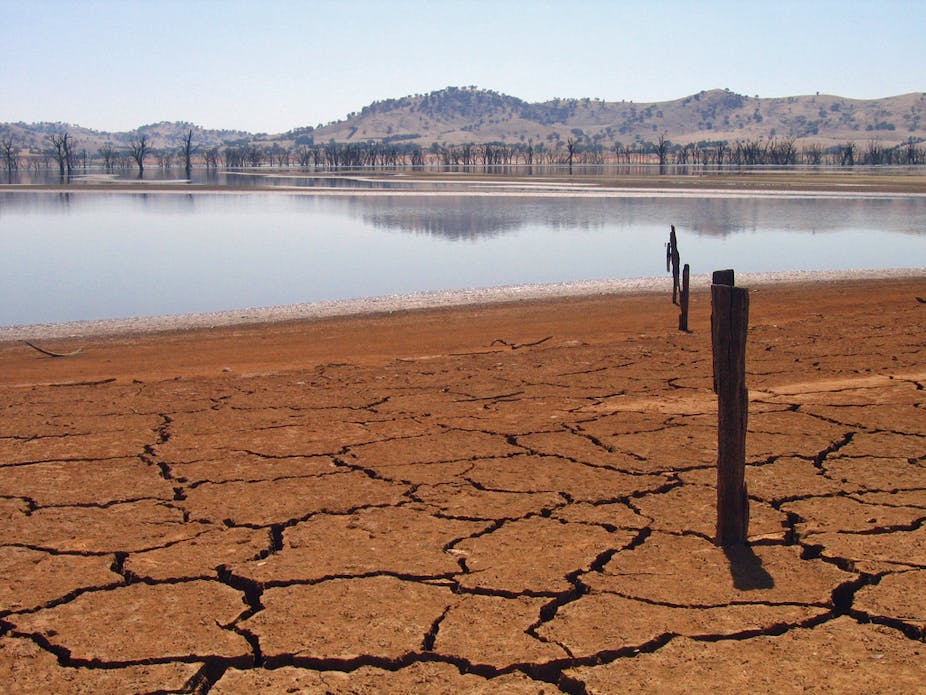
Sign of things to come: a depleted Lake Hume in 2007, when the big dry still had a couple years to run. Flickr/Tim J Keegan

Victoria has entered a critical decade in the race to adapt for the stresses of climate change, according to a new report from the Climate Commission.

Following the release of Victorian climate impacts and opportunities yesterday, the Commission’s Chief Commissioner, Professor Tim Flannery, writes here about Victoria and its state of play.


Victoria forms part of Australia’s southern fringe. Lying between the deserts to the northwest, and oceans to the south, it has seen dramatic shifts of climate in the geologically recent past. Relict patches of desert mallee on Melbourne’s western fringes, and even a few stranded snow gums in its eastern suburbs, tell of times dramatically colder and drier than the present, and should warn us that Victoria is vulnerable to large swings in climate. Now, because of the volume of coal, oil, and gas humans are burning, the state’s climate is changing again.

Victoria is already warmer, on average, than it was a century ago, and extremes of temperature are becoming even more extreme. The “big dry” of 1997 to 2009 was the worst drought in 100* years, and it culminated in a month-long heat wave that broke all records, damaging electricity and transport infrastructure and decimating wildlife. The “big wet” that followed provided some welcome relief by raising dam levels, but the relief may be short-lived. Victorians know water security is a long-term challenge that we must be prepared for. There are signs that el Niño may return later in 2012, bringing with it a return to drier conditions. The longer-term, rainfall is expected to be lower than the 20th century average, especially in the cooler months.

Climate change isn’t just about heat waves, droughts and rainfall. The state’s changing climate is likely to lead to less snowfall, more devastating bushfires, and the extinction of native species. And the warming of the oceans and the melting of glacial ice is causing sea levels to rise, possibly as much as a metre by the end of the century. This brings a significant risk of flooding in places like Hobsons Bay and the Gippsland Lakes. By the end of the century thousands of homes, as well as commercial buildings and iconic beaches may be threatened by rising seas.

The dangers of climate change have been known for decades, but as a society Australians have been slow to act. Victoria still draws more than 90% of its electricity from an ageing fleet of coal-fired power plants that include some of the most polluting in the world. Yet the state is blessed with excellent wind resources, as well as abundant sunshine.

We can’t expect that tackling a problem like climate change will have no costs. We will see it in our electricity bills, and in businesses and homes alike this should act as a spur to use resources more efficiently. In this, business and communities have been leading the way. Amcor, for example, has reduced its electricity use by 15% in its corrugated box plant, and its gas use by 30%, leading to an overall reduction in its greenhouse gas emissions of 20%. And the need to reduce emissions is also spurring innovation. At the One Steel, steel mill at Laverton, old car tyres are being substituted for coal in the steelmaking process, leading to less power demand, lowered greenhouse emissions, and less landfill. Wherever the Climate Commission has visited, but especially in regional Australia, we’ve met with individuals and businesses achieving similar innovation and greenhouse gas reductions.

Economic studies such as that by Lord Stern show that it’s worth paying the cost of reducing emissions now, for if we wait until our climate is changing even more rapidly, costs will escalate and the damage caused will be significant. The impact of the big dry gives us some idea of what climate change may bring in future. It lowered the inflow into Melbourne’s four major reservoirs by 40%, and caused an 80% reduction in crop yield, and a 40% reduction in livestock production in the state’s Wimmera-Southern Mallee region. Added to this must be the cost in human lives from the 2009 heat wave. Victoria experienced an eight-fold increase in hospital admissions for heat-related conditions, and a 62% increase in heat-related deaths. Without effective action on climate change, we can expect more such damaging weather and climate events in the future.

Climate scientists have designated this decade as “the critical decade” for action on climate change. That’s because unless we take significant steps to reduce our emissions by the end of the decade it will become increasingly difficult to keep global temperature rise at manageable levels.

Australia is playing a proud part in the global effort to reduce greenhouse gas pollution. As one of the top 20 largest emitting countries on Earth it’s vital that we do our bit, both in order to encourage others and to prepare our industries for the inevitable changes ahead.

* An earlier version of this article said 1000 years rather than 100. This has now been corrected.

Comments welcome below.

Articles also by This Author

Sign in to Favourite

Want to follow The Conversation?

Sign up to our free newsletter to get the day's top stories in your inbox each morning, with a special wrap on Saturday.

Spinner
Become a friend of The Conversation and donate

Join the conversation

62 Comments sorted by

    1. In reply to Mike Hansen

      Comment removed by moderator.

    2. In reply to Mike Hansen

      Comment removed by moderator.

    3. In reply to Ian Ashman

      Comment removed by moderator.

  1. John Newlands

    tree changer

    According to Environment Victoria the State gets 92% of its electricity from burning brown coal. Unless that is substantially reduced some of these other ideas are merely tinkering around the edges. An impressive emissions reduction could be achieved by replacing one of the big baseload stations (Yallourn, Loy Yang, Hazelwood) with nuclear or say two of them with combined cycle gas. However the south eastern gas price is rising steadily and may be too expensive a decade from now.

    A combination of wind and solar that could make a nontrivial dent in brown coal burning would also be expensive. Note the very high electricity prices in SA from using the wind and gas combination. To put it bluntly unless the brown coal stations are progressively replaced everything else is a feelgood exercise.

    report
    1. John Nicol

      logged in via Facebook

      In reply to John Newlands

      John Newlands,

      You write as if you actually believe the nonsense our "Chief Climate Commissioner" is trying to sell. His only basis for this rubbish is the output from untested models which in 2007 could NOT, according to the IPCC report, even correctly reproduce known climates of any of the years betwween 1950 and 2007! What has changed? Nothing.

      They are also typically hopeless at representing the "climates" for regional areas and one finds that this is consistent with the three month…

      Read more
    2. Alex Cannara

      logged in via Facebook

      In reply to John Nicol

      Ahhh, here's good ol' John pushing the "models are no good" straw man up to knock down!

      Unfortunately for John and other Fact Avoiders here, and us all, the realities of global effects of emissions have little to do with models, and John knows this, after our many discussions, right John?

      So rather than trot out the old, desperately misleading rhetoric on models, why not try some scientific observations? You know, the things anyone can measure -- sea rise, ocean acidification, average yearly…

      Read more
    3. Gillian King

      logged in via Facebook

      In reply to John Newlands

      South Australia has benefited from its wind and solar in the latest price rises.

      SA has announced 18% price rise for electricity. The South Australian Essential Services Commission broke it down like this:

      > carbon price 4.6% (half that of other states because SA has low carbon intensity generation)
      > network charges 4%
      > State Govt FIT for solar 7%
      > CPI adjustment 2.6% (whatever that is!)

      So, if you subtract the 4.6% avoided carbon price from the 7% FIT, you get the true additional cost of FIT - 2.4% or $38 a year. That's a good investment in the transition from high-carbon to low-carbon electricity that will deliver permanent benefits of reduced greenhouse gases for generations to come.

      report
    4. John Newlands

      tree changer

      In reply to Gillian King

      SA's 34c per kwh must be among the highest electricity prices in the world. I pay under 23c in Tasmania. Because wind requires gas backup the SA power price price seems likely to rise as east Australian gas gets more expensive, the same bugbear for replacing brown coal in Victoria. I think high SA power prices may have already killed off the State's biggest project, the Olympic Dam expansion.

      report
    5. Mike Hansen

      Mr

      In reply to John Newlands

      "South Australia has always had higher electricity prices than the rest of Australia, well before wind became prominent in the supply mix [due to lack of cheap coal or hydro]"

      "The high prevalence of wind power in South Australia’s electricity mix is actually depressing electricity prices in the state."

      "Critics of wind will suggest that wind requires huge amounts of expensive gas peaking power as back-up, and that’s where power prices will take a hit. But that hasn’t happened, as the chart below illustrates. South Australia has been using less electricity from gas peakers (open cycle gas turbines and thermal gas) over the period that wind power rose from 7 per cent to 21 per cent market share."

      http://www.climatespectator.com.au/commentary/australian-embarrasses-itself-again

      report
    6. John Nicol

      logged in via Facebook

      In reply to John Newlands

      John Newlands, for comparison, we pay 19c per kWhour in Queensland. I am not sure of the other states like NSW or WA.
      John Nicol

      report
    7. Ian Ashman

      Manager

      In reply to Alex Cannara

      Alex,

      John Nicol is Chairman of the advisory panel for The Australian Climate Science Coalition.

      According to sourcewatch, the Australian Climate Science Coalition (ACSC) is a climate change skeptics website created by the the Australian Environment Foundation (AEF), a spin-off group created by the the corporate funded think tank, the Institute of Public Affairs. In 2009-2010 the ACSC was almost exclusively funded by the Heartland Institute, via the American Climate Science Coalition.

      report
    8. markus fitzhenry

      logged in via LinkedIn

      In reply to Alex Cannara

      Ahhh, here's bad ol' Alex pushing the 'sky is falling' retoric for it to be knocked down

      Lets try some of that scientific measurement over the recent times, shall we?

      1. Aviso Envisat data show sea level rising in the eight years 2004-2012 at a rate equivalent to 1.3 inches (3 cm) per century. What is more, sea level in 2011-2012 was lower than in each of the previous seven years:

      2. Growth in Antarctic sea-ice extent almost matches the decline in the Arctic over the past 30 years, so…

      Read more
    9. Luke Weston

      Physicist / electronic engineer

      In reply to John Newlands

      I'll be quite saddened if as you say high energy costs in SA will really "kill off" the Olympic Dam expansion, since after that expansion the byproduct uranium produced per year as a byproduct from that one copper mine will represent an energy resource equal to the total of all the coal and fossil fuel production on Earth each year.

      report
    10. Alex Cannara

      logged in via Facebook

      In reply to Ian Ashman

      Thanks Ian. John asked me for direct email discussions over a year ago, when I first ran into his goofy comments on CO2 effects in air. It became clear he is no scientist, but a technician who did spectroscopic work at some time. It also appeared that he had no interest in full discussion, because when I presented him with the simple, AAAS, 2009, 4-parameter model that perfectly matches recent decades of world avg temps, he broke off.

      Like Monckton, with whom I had an earlier email exchange…

      Read more
    11. Alex Cannara

      logged in via Facebook

      In reply to markus fitzhenry

      Ahhh, there's ol' Markus following his handlers' lead...

      1) sea rise has been 8" since 1880. Go measure yourself, Markus (no, not that part of 'yourself' -- too disappointing). And your data interpretation shows you don't understand earth's seas, so how about a little self study, as you want of others? -- AAAS Science, 6 July 2012 "Editor's Choice", or Nat. Climate Change 2, 10.1038/NCLIMATE1597

      2) False, and since you refer to a 2005 doc., you know it;'s false. Plenty of satellite references…

      Read more
    12. Gerard Dean

      Managing Director

      In reply to Mike Hansen

      Ahha

      It's my old mate Mr Hansen. I haven't got time to read your comment, but I know it is wrong anyway.

      Regards

      Old JetA1
      (Actually, sometimes you get some things right, but I don't like admitting it)

      report
    13. Mike Hansen

      Mr

      In reply to Gerard Dean

      "I haven't got time to read your comment, but I know it is wrong anyway"

      That's OK Gerard. Being a troll, you never read the articles that you comment on either. Why change the habits of a lifetime?

      report
    14. Alex Cannara

      logged in via Facebook

      In reply to Gary Murphy

      Yes Gary, and the trend is much worse in recent years. Up north, just two weeks ago, we succeeded for the first time in turning the top layer of Greenland's ice to slush...
      http://tinyurl.com/cepkxag

      And, being no dummies, China has been contracting with Iceland, etc. to set up a logistics port for products shipped directly from China via the Arctic Ocean, for eastern US and Euro distribution, while Russia deploys shipborne 300MW reactors to power Siberian coastal industrial development.

      report
    15. Gerard Dean

      Managing Director

      In reply to Mike Hansen

      Mr Hansen

      Oh dear, irony isn't one of your strong points, my comments were a well natured rib. You know well that I argue with facts and don't stoop to name calling as others do on this site.

      - Professor Flannery is the Panasonic Chair of Environmental Sustainability. Virtually none of Panasonic's world wide production of electronic, audio visual or industrial equipment is made or powered sustainably.
      - Professor Flannery, by his own admission, flies around the world as part of his job, to…

      Read more
    16. Alex Cannara

      logged in via Facebook

      In reply to Gerard Dean

      "Oh dear, irony isn't one of your strong points," -- Gerard Dean

      "I argue with facts and don't stoop to name calling" -- Gerard Dean

      Hmmm, now what version of English thesaurus & semantics are you diddling with, Gerald?
      ;]

      report
  2. John Nicol

    logged in via Facebook

    Tim,

    A recent IPCC report which you appear to have missed, indicated that after a two year study of historical severe weather events, that there was a VERY LOW possibility that they were influenced by climate change. The history of floods in Queensland and fires in Victoria from the early 1800s (starting 1838 for Queensland) shows clearly that the severity of these recent events is much lower and fewer than in earlier times - like 150 years ago.

    This is totally consistent with the findings of this special IPCC report.

    Could you therefore carefully explain to your readers why you pick out the fires or "heat wave" deaths of 2009 as being caused by climate change? I believe deaths related to cold weather far out weigh those related to heat anyway.
    Thank you, John Nicol

    report
    1. Mike Hansen

      Mr

      In reply to John Nicol

      John Nicol is echoing the empathetic (not) views of Heartland Institute policy adviser John Dunn who stated at their last climate denial get together that

      “Warm is good for people, and it’s particularly good for people as they get older,” said Dunn. “The people that warm spells kill are already moribund.” He went on to say that only extreme cold caused extra deaths."

      http://grist.org/list/heartland-adviser-heat-waves-only-kill-people-who-were-basically-dead-already/

      report
    2. Ken Swanson

      Geologist

      In reply to John Nicol

      John
      You will not get a reply from this guy.
      He has no clue.
      His predictions to date have been laughable.
      Like Julia Gillard, every one has turned off Tim Flannery long ago.
      Commenting on his article here is a waste of time.
      Abbott will remove him and without his raft of government hand outs/ grants Tim will not be heard of again.

      report
    3. Alex Cannara

      logged in via Facebook

      In reply to Mike Hansen

      I guess we have to get the Glieck list of who's getting paid by us up here to lie down there again! And add The American Tradition Institute (only one tradition -- $), which also fronts bucks for BS.

      Nicol, Dunn & crew will likely be 1st in line when sea rise, climate or fish loss cause your govt to pay compensation.
      ;]
      I'd love to be on the rescue chopper, in charge of the rope hoist!

      report
    4. Ian Ashman

      Manager

      In reply to Mike Hansen

      You get the feeling that Ken is an old fashioned Jonesian Chaff Bagger?

      report
  3. Sean Lamb

    Science Denier

    I still want to know what became of the plan to clone the thylacine.

    report
  4. Philip Dowling

    IT teacher

    So "Victoria forms part of Australia’s southern fringe" according to Tim Flannery. I note that Victoria is not a promontory, a peninsula, a spit nor any other geographical term that I could recognise. Fearing that Victoria had merely become the result of a bad haircut, I checked out other possible meanings. At end of it I was not sure which meaning Tim had in mind. I trust that this was not just a subtle interstate put down.
    1. A decorative border or edging of hanging threads, cords, or strips…

    Read more
    1. Seamus Gardiner

      Citizen

      In reply to Philip Dowling

      That's one of the most amazing strawman/composition fallacy arguments I've seen for a loooong time... how long did it take to write that rebuff of nothing?

      report
    2. Philip Dowling

      IT teacher

      In reply to Seamus Gardiner

      Sean,
      I was merely asking a question.
      I tried to keep it simple for Tim. Nor did I wish to embarrass him by asking him what he considered Tasmania to be. In secondary school my atlas indicated that Tasmania is on the same tectonic plate as the REST of Australia.
      Is Tim proposing a different view of geology?
      Or does he not consider Tasmania significant?

      report
    3. Philip Dowling

      IT teacher

      In reply to Seamus Gardiner

      Actually Sean I was going to add the Macquarie definition as well.
      However Tim has so damaged the Macquarie University brand that I didn't bother.

      report
    4. Ian Ashman

      Manager

      In reply to Philip Dowling

      Ehrlinger, Joyce, Kerri Johnson, Matthew Banner, David Dunning, and Justin Kruger (2008),

      "Why the Unskilled are Unaware: Further Explorations of (Absent) Self-Insight Among the Incompetent." Organizational Behavior and Human Decision Processes, 105 (1), 98-121

      report
  5. Philip Dowling

    IT teacher

    Professor Tim Flannery asserts that Victoria lies "between the deserts to the northwest, and oceans to the south".
    I was wondering how it is that Victoria apparently has no Eastern boundary.
    Or did he mean to say "between the deserts to the northwest, and oceans to the south and east".
    Of course, to the south lies Bass Strait and Tasmania as well.
    Perhaps it would be more accurate to say "between the deserts to the northwest, and Bass strait and the Southern ocean to the south and the Tasman Sea to the east".
    Having driven a few years ago from Adelaide to Broken Hill when it was 41C, I will admit that this area was rather dry at the time. However it was also clear that there was still significant vegetation and grazing activities.
    It would be useful for Tim to clarify exactly which deserts he has in mind.

    report
    1. Ian Ashman

      Manager

      In reply to Philip Dowling

      Reduced to making silly, irrelevant comments because he has no valid argument. Welcome to the mind of a climate change denier.

      report
    2. Philip Dowling

      IT teacher

      In reply to Ian Ashman

      Ian,
      Welcome to the mind of a person who is concerned that a professor who is paid a large sum of money to spout nonsense that even person a with a junior secondary knowledge of geography can poke holes in.
      Ian, I am a person whose mind was trained in identifying errors in the syntax of assembly language programs, and the logic of theorems in pure mathematics proofs.
      If a person can't even get basic facts correct, what hope is there for the integrity of the rest of his argument.
      When I am wrong, stuff doesn't work.
      When Tim is wrong, he changes his predictions.

      report
    3. Ian Ashman

      Manager

      In reply to Philip Dowling

      Nothing wrong at all with being a TAFE teacher, very important role, one slip in the code and *POOF* you've detonated a thermonuclear device (sorry I meant you've scrambled the new automated menu in the subsidised lunch room).

      Let's have a look at your high quality syntax:

      "Welcome to the mind of a person who is concerned that [should be 'about' or 'with'] a professor who is paid a large sum of money to spout nonsense that even person a [should be 'a person'] with a junior secondary knowledge…

      Read more
    4. Philip Dowling

      IT teacher

      In reply to Ian Ashman

      Ian,
      Thank you for your comments.
      I think that you may find "The Mother Tongue - English And How It Got That Way." by Bill Bryson useful in broadening your knowledge.
      I must admit that I am used to utilising an automated grammar checker at work, so I apologize for any minor errors.

      report
    5. Mike Hansen

      Mr

      In reply to Philip Dowling

      Dowling says
      " I am a person whose mind was trained in identifying errors in the syntax of assembly language programs, and the logic of theorems in pure mathematics proofs."

      Why do climate science deniers spend so much time pumping up their own tyres. And the less they know the more they pump.

      I think I just answered my own question.

      report
    6. Alex Cannara

      logged in via Facebook

      In reply to Mike Hansen

      And, Mike, using as advertizement Assembly Language, with it's exceedingly narrow syntax, and theorem syntax, which can be automatically checked by simple programs, are Einsteinian achievements?

      Puffery, thy name is "climate science deniers".
      ;]

      report
    7. Ian Ashman

      Manager

      In reply to Philip Dowling

      I hear they run some good ESL courses at TAFE, maybe you can book yourself into one of them?

      Minor errors? But you say your mind is highly trained, much like a dancing bear I'm sure. How you could make sure errors? Surely if you are going to quibble over silly little points in Flannery's article then you must set a higher standard?

      report
    8. Ian Ashman

      Manager

      In reply to Mike Hansen

      Calling Professors Dunning and Kruger...

      Kruger, Justin; David Dunning (1999). "Unskilled and Unaware of It: How Difficulties in Recognizing One's Own Incompetence Lead to Inflated Self-Assessments". Journal of Personality and Social Psychology 77 (6): 1121–34.

      report
    9. John Nicol

      logged in via Facebook

      In reply to Ian Ashman

      Ian,

      I am often concerned "that" I might subject myself to the criticismn of others whenever I join The Converstaion. I think you have picked up a couple of typos at worst, not grammatical errors in your criticism of Philip's comment.

      You say "trained in identifying [ should be 'to identify'] errors in the syntax.". I think Philips use of "in identifying" is the more correct syntax in the context of what he is saying with regard to the general process rather than a specific error.

      Also "pure mathematics" is a subject - not a plural, but the logic of theorems applies to (plural = many) proofs.

      The rhetorical question "What hopoe is there for..." does not require a question mark - it is up to the choice of the author.

      I think when Tim Flannery is wrong, he forgets to admit that he was wrong and tries to pretend that his earlier prediction was somewhat different.
      John Nicol

      report
    10. Ian Ashman

      Manager

      In reply to John Nicol

      John, you poor old thing. Your corrections make no sense! Maybe English is your second language as well?

      The point being - when some smartarse tries to pick geographic holes in a climate change article, you know he is a sad loser, who needs 'correction'. Smugness and climate denial seem to go hand in hand.

      And how goes your climate denial hate group? Is the money still flowing in from the Heartland Institute? You remember them, the group in the US which equates climate science with terrorists. Your friends.

      report
    11. Alex Cannara

      logged in via Facebook

      In reply to John Nicol

      " I am often concerned "that" I might subject myself to the criticismn of others whenever I join The Converstaion. "

      Yes, John, when the going gets rough on the facts front, play victim!

      We have plenty of scurrilous folks in the combustion biz and politics who do that too. Too bad you choose that instead of honest study of fact. You're old enough to know better.

      In any case, here's the latest record event our laxity with the combustion industry has presented us and our descendents with...

      Snorkling on Greenland anyone?...
      www.guardian.co.uk/environment/2012/jul/24/greenland-ice-sheet-thaw-nasa?newsfeed=true

      The slush became about a foot deep in 5 days. An Olympic medal in ice-cap melting!

      report
  6. Philip Dowling

    IT teacher

    Tim is surprised that "Relict patches of desert mallee on Melbourne’s western fringes" still exist.
    "mallees are slow growing, tough trees which originate from arid and semi arid regions. But they're found from Tasmania to the Tropic" according to Sophie Thomson.
    http://www.abc.net.au/gardening/stories/s1763882.htm
    However even assuming that there has been rapid climate change as Tim asserts in Victoria, these trees indicate that rapid climate change is not simply a recent man-made phenomen but naturally occurring.
    Has anybody hiked from Melbourne to Launceston recently. It used to be possible.

    report
  7. Anthony Nolan

    Ruminant

    Short: Victoria will be uninhabitable within 50 years. Plan now.

    report
  8. Gerard Dean

    Managing Director

    PANASONIC Chair in Environmental Sustainability.

    Panasonic make audio-electronic equipment which is made from the following:

    - Aluminium. Mined, shipped and processed using electricity. Smelted, refined, formed, extruded, heat treated, anodised, pickled, machined, drilled, tapped using electricity.
    - Copper. Mined, shipped, smelted, refined, formed, extruded using
    - Plastics sourced from oil feedstock. 99% virgin feedstock. Recycled plastic cannot be used.
    - Rere earths. Essential for manufacture…

    Read more
    1. Mike Hansen

      Mr

      In reply to Gerard Dean

      All those red ticks Gerard - I guess people here assume that you are a troll.

      I on the other hand read your comment as a passionate plea for a carbon price to make all those unsustainable inputs more expensive.

      report
    2. Gerard Dean

      Managing Director

      In reply to Mike Hansen

      Mr Hansen

      Again we agree. Virtually all of Panasonic's inputs are unsustainable. Of the inputs, the carbon tax will only affect the power that runs the Pansonic plants, the rest have to pulled out of old mother earth, whether we like it or not.

      I really don't think people like knowing that the keyboard, computer and display in front of them is made from virgin earth resources and as such, is totally unsustainable.

      Funny things us humans.

      Gerard "The Troll" Dean
      Glen Iris

      report
  9. John McBride

    Associate Professor

    Tim Flannery has written a timely article on both the impacts and the adaptation opportunities for Victoria.
    In September this year, the Royal Society of Victoria in association with the Melbourne Sustainable Society Institute will be holding a 2 day Symposium on Climate Change Science: Impacts and Adaptation for Victoria. Speakers are from Australian Universities, CSIRO, and the Bureau of Meteorology. The program is structured such that there will be ample time for feedback and discussion.
    Information on the programme and form to register are at
    http://www.icms.com.au/climatechange/

    All readers of The Conversation are encouraged to register and attend.

    report
  10. David Nutzuki

    logged in via Twitter

    Do we WANT a President Romney and more Harper? No of course not so we have to stop driving votes away to Romney when we “threaten” our own voting base and their children with a death by climate change. Is this all worth it, really? In the voter’s eye we are now just the Big Green Fear Machine now. We goofed.
    -Occupywallstreet does not even mention CO2 in its list of demands because of the bank-funded carbon trading stock markets run by corporations.
    -Julian Assange is of course a climate change denier.
    -Obama has not mentioned the crisis in the last two State of the Unions addresses.
    -Canada killed Kyoto with a newly elected climate change denying prime minister and nobody cared, even the millions of scientists.

    report
    1. Alex Cannara

      logged in via Facebook

      In reply to David Nutzuki

      All true, but, we knew what we had to do >50 years ago, and started: http://tinyurl.com/6xgpkfa But got sidetracked by Cold War decisions: http://tinyurl.com/73p7ler by a non-scientist!

      We would have half the climate issues today, and likely not have seen this remarkable event...
      www.guardian.co.uk/environment/2012/jul/24/greenland-ice-sheet-thaw-nasa?newsfeed=true

      that testifies to our stupidity & cupidity, as just a harbinger of what's fast arriving that no one will like.
      .

      report
  11. John Nicol

    logged in via Facebook

    Those of yoiu who are waorried about bushfires and flooding as well as the recent comments about Greenland's Ic Sheet, may be able to draw comfort from the following.

    It appears that people who study these things know that the behaviour of significant Greenland melting is a cyclical thing which is well documented as having a roughly 150 year cycle. Sound a bit familiar? Enjoy.

    NASA’s claim that Greenland is experiencing “unprecedented” melting is nothing but a bunch of hot air, according…

    Read more
    1. Ian Ashman

      Manager

      In reply to John Nicol

      Fox News. Fox News John?

      Even for a supporter of a climate denial hate group this one takes the biscuit. May as well quote WUWT or other right wing climate change denier sites.

      "Tides come in, tides go out. You can't explain that." Bill O'Reilly. Fox Network.

      report
    2. Alex Cannara

      logged in via Facebook

      In reply to John Nicol

      Another uber-long comment designed to create much stir, yet signifying nothing. Keep at it John, your handlers may be proud, but getting nervous at the evident desperation.

      You're old enough to know better and you never had the nerve to continue our private email discussion. Why, John? Why?
      ;]

      report
  12. Glenys Liddell

    A Melbournian

    Climate Commission – Where is your Backbone?

    Many of us are well aware of the climate issues we face and acknowledge their seriousness.

    The informed public now looks to our Climate Commission not only as a resource but as a steering committee, expecting far greater impact than the content provided by the Commissioners at your public meeting on Tues (Melb RMIT 24/7).

    You cannot head your report “The Critical Decade” then tell us to go home and do what we can for ourselves and with our neighbours…

    Read more