Wrestling some science off of Mars: How clays became sexy.

This side-by-side comparison shows the X-ray diffraction patterns of two different samples collected from the Martian surface by NASA’s Curiosity rover. NASA/JPL-Caltech/Ames

With this picture, clays just became the new sexy science, in mineralogical terms at least (well having said that if you’re into mud wrestling then I suppose clays have long been sexy). Here is the long-sought confirmation, from NASA’s Curiosity rover, that there are indeed clays on Mars. But what’s all the fuss about? We’ve loads of clay here on Earth, both on and off the mud wrestling arenas of the world, why has finding them on Mars got everybody so excited?

Well first it’s a nice bit of proof that geological processes have happened on the Martian surface, it’s not just red and dead. Clays only form as alterations products when a liquid (usually that is slightly acidic) has long-term contact with a rock. Over time this liquid eats into the rock and changes its crystal structure. This is what the picture that the CheMin team put out is showing; along with the parent rock (mainly basalt) they are finding this other pattern from something very different.The alteration processes that make clays are great markers on what sort of temperatures and climate conditions were around at the time. So by closely examining the end product, the clay, we can get an idea of what sort of weather was about earlier in Martian history.

Unlike the rocks they are altered from, clays are really light and mobile. On Earth we see that they can be picked up by wind and water and transported many thousands of miles. Has this been the case on Mars? Very early days, but if the Mars rover can show that the clays are not quite where they used to be, then that begins to paint a pretty dynamic picture of the Martian surface. This is not pure speculation, in fact one of the reasons that the Spirit and Opportunity rovers lasted as long as they did was because their solar panels regularly got swept clean by the winds of Mars.

Dust devils on Mars as captured by the HIRISE orbiter

But all of this raises the excellent point, where are all these liquids now? Looking over abstracts for the on-going Lunar and Planetary Science conference over in Huston, this is very much an ongoing research area. Data from the Curiosity rover’s suite of instruments has already provided a number of clues to this. But it how the data these instruments collect will change as the rover progresses up Mt Sharp that will help the most.

A mosaic of images from the Mast Camera (Mastcam) on NASA’s Mars rover Curiosity, which shows Mount Sharp in a white-balanced color adjustment that makes the sky look overly blue but shows the terrain as if under Earth-like lighting. NASA/JPL-Caltech/MSSS

Curiosity is currently sitting at the bottom of this imposing feature, which is thought to be a giant layer cake built upof material deposited over time. As the rover it trundles up its slopes it will travel forward in time and see the changes in the materials. If one layer does not have clays, but the next one above it does, that will start to paint a picture of how Mars may have changed back and forth from being warm and wet to being cold and dry. If however there’s a big change with no clays above a certain point, then we’ll have a clue that Mars’s climate in the past would have just changed the once from being warm and wet, to how we know it today.

As with every good bit of science, the discovery of clays on the Martian surfaces raises more questions that it answers. But if you examine the building blocks that make up clays, there may be a further surprise in store.

Clay minerals are made up from layers of silicate (silicon and oxygen) and layers of metal oxide, which are sandwiched together with water. They are part of a group of layered silicate minerals, called phyllosilicates, which now I think of it must be where the term filo or phyllo pastry comes from. These layers can swell up and take in many things from their surroundings.

Clays in a more terrestrial use Flickr/alli http://www.flickr.com/photos/allialli/5279353472/

That’s why we (well us ladies at least) put clays on our faces as face masks. The clay grabs the moisture from our skin and sucks it in, along with all the grub and grime on our skin. The layers within clays also make them very soft and slippery, which is why they are nice to put on your skin and are the main type of ‘mud’ used in mud wrestling.

This ability to suck up moisture and other bits make clays a super place to live if you’re a small microbe. You’ve access to water, food and a snug place to live. It’s an intriguing prospect, and sadly Curiosity doesn’t have the instruments to tell us if this is happening.

Have I achieved the impossible? Have I convinced you all that clays are really quite sexy, and that there’s a ton of science to be done with them, both on and off Earth? Whatever the effect, I reckon that you’ll never think of mud wrestling in quite the same way again.

Is the sky falling on our heads?

This was my week.

Head buried in grant writing looks up
“Oh, the Pope has resigned.”
Goes back to writing, looks up a few days later
“Oh dear, it seems that everyone has been eating horse.”
Goes back to writing, looks up a couple of days later

“A FIREBALL OVER RUSSIA!”

Ok world, you’ve got my attention.

One piece of amazinf footage

Courtesy of the smart-phone generation, the pictures and videos that captured the falling meteor are stunning and scary at the same time. Now, with over a thousand people known to have been hurt from the shockwave that proceeded, it’s perhaps a wake up call to all of us that we are vulnerable to objects from space.

Russia hasn’t been a stranger to meteoroids. One of last big meteoroids was the Tunguska event in 1908. Falling in a sparsely inhabited region of Siberia it still is the only entry of a large meteoroid we have in the modern era with first-hand accounts.

Like Friday’s meteor, most of it didn’t make landfall, exploding with a force big enough to fell 80 million trees.

Trees knocked over by the Tunguska blast. Photograph from the Soviet Academy of Science 1927 expedition led by Leonid Kulik Wikipedia/CYD

The meteor that fell on Friday is thought to have been 7,000 tonnes before it plunged towards Earth.

The assessment of its size may change if any of the object survived and are recovered. Bits of meteoroids that survive the treacherous journey through our atmosphere to make landfall are known as meteorites.

Scientists have picked up many thousands of meteorites over the years, and found that their origins are many and varied.

From being the former interiors of ill-fated planets to containing the primordial stardust of which we are all made of.

Meteorites aren’t just rock – some are mostly metal, mixtures of iron and nickel. These are the class of meteorites that would have once been a planet core.

A very beautiful affect you get in these iron and nickel meteorites are Widmanstätten patterns. These patterns form over millions of years of cooling and are an effect of different crystal structures of two iron and nickle alloys separating out.

The beautiful Widmanstaetten patterns in the Staunton meteorite.

So it seems Asterix and Obelix were right to worry, but don’t let it keep you up at night.

There’s still more chance of winning the lottery than being hit by something from space.

Inflatable space modules: NASA’s exciting expansion plan

Jerry Downs/Flickr

I was sat in the garden over the weekend looking up at the cloudless blue sky and noticed what looked like a bright star moving steadily across the sky. My first thought was that I had spotted the International Space Station (ISS), which has been making a number of passes over Australia in recent weeks (have a look a Canadian astronaut Chris Hadfield’s twitter feed).

But closer inspection (with hastily grabbed binoculars) revealed that the object was in fact a group of four balloons floating to obscurity, probably with an ex-owner howling on the ground a few miles from me.

There’s going to be a few more balloons in the space above our heads in the near future, with NASA announcing last week that it had commissioned a new “expandable” space module from Bigelow Aerospace. It’s an exciting venture that will attach to the ISS and be tested by the astronauts on board as early as 2014.

How the Bigelow module will look attached to the ISS NASA/Bigelow Aerospace

The use of inflatables in space is not a particularly new concept. Massive weather balloons that float to the edge of space are easy to pilot; even a chicken can fly one. And the plans for an expandable space module have been on the agenda for quite a while – in fact the original designs for the ISS incorporated one until it soared over budget.

It’s a stupendously good idea, given that every gram you send into space costs thousands. The more space you can pressurise for less money brings the ideas of inter-planetary travel and even habitats on Mars a step closer.

But in space there is nothing to slow you down, and the most microscopic of dust particles can become bullet-like in their impact on a structure. Any blow-up module needs to be strong enough to withstand this, almost constant, bombardment.

Creating a material that is both strong and light has been a grand challenge for scientists. Metals have been a staple in this search, with clever control of the microstructure producing some pretty amazing results. From the jet-engine alloys that get stronger with temperature to the memory metals, the understanding of their microscopic properties has been key to unlocking these properties.

Using microscopes to make metals strong and light, the winner of the 2012 ‘Dance your PhD’ competition from University of Sydney

But metals are still too heavy, and are not flexible enough to make up most of the strength of the new space module’s skin. The plan is instead to have a number of layers, 6 inches thick, with the chief strength coming from a polymer material.

Similar to the material used in bullet-proof vests it’s hoped that the combination of layers will, once expanded, be like concrete in their strength. These (heavily patented) polymer materials also have an added bonus in that they provide better radiation protection for the astronauts, in that they avoid the secondary scattering that the current (metal based) space station induces.

2012 was the year that commercial space developments became a reality. The flight of the Dragon X spacecraft delivering to the ISS and now the news of Bigelow Aerospace’s “expansion” into the sector shows that private investment in space is fast becoming real and tangible.

I know I’ve expressed squeamishness before at the idea of private companies mining asteroids, but I’m rapidly coming around to these new developments in commercial space travel. If they need anyone to test the expandable spacecraft I’d be the first to put my hand up.

Need to chill your beer? I’ve got the solution

After a long, hot day, would could be better than an ice-cold beer? jimflix!/Flickr

It’s now my second summer in Australia. The first wasn’t too bad but this year the frequency of days in the high-30s is a little too high for this English girl. Today’s going to hit 39°C in Melbourne, and the cooling at my place is broken. I think I’ll stay in the lab today and take advantage of the synchrotron’s steady 23°C and wait for things to chill off this evening.

But the one thing that would take the edge off this evening is one of the beers I’ve got, ah, not in the fridge. Well that puts a dampener on things.

Putting beer on ice is a good option … but we can do better. Speed Light

But perhaps there is a way to speed up the cooling of my after-work-on-a-39-degree-day beer.

I could put in the freezer, but the rule of thumb for temperature control is that you want to maximise contact between your sample (the beer) and the coolant. I think I could do a little better than a few cold air molecules bumping into the sample every so often.

The standard tool of an ice bath is a super idea. Floating enough ice in water will mean that the whole thing will equilibrate for a good long while (until all the ice melts) at the melting point of the ice, 0°C. But things would speed up if you could equilibrate the mixture of ice at a lower temperature.

The trick is to make the water into a solution by dissolving something into it. It doesn’t even really matter what you dissolve into the water – though table salt is what you’re most likely to have – the effect will get stronger with the more materials added and dissolved into it. This effect is known as freezing point depression.

Try it later if you like: take 1 cup of table salt and dissolve in 3 cups of water. Add lots of ice and you should get a cooling bath for your stubbies that’s below -10°C. Hey, by the end of today you might even fancy a dunk in it yourself!

Here’s the beer cooling effect demoed. (And of course you know that it’s thermodynamics rather than chemistry at play now!)

But it doesn’t have to be table salt to cause this effect (though I would only recommend using table salt at home); anything that dissolves into water will have this effect. It’s the freezing point depression effect that is thought to have formed much of the super-varied landforms we see on the icy moons of the solar system, worlds like Saturn’s Enceladus and Jupiter’s Europa.

There’s not much sunlight that reaches out to Jupiter and Saturn and the daily temperature at Europa, for instance, is a chilly -150°C. If these moons were only made of pure ice, chances are we’d not see half the weird landforms we do. So something is mixing with the ice to allow it to melt sometimes, to form the strange alien landscapes that we see on this moon.

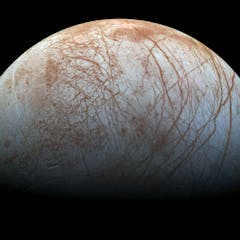
This mosaic of the Conamara Chaos region on Jupiter’s moon, Europa, clearly indicates relatively recent resurfacing on Europa’s surface. Irregularly shaped blocks of water ice were formed by the break up and movement of the existing crust. The blocks were shifted, rotated, and even tipped and partially submerged within a mobile material that was either liquid water, warm mobile ice, or an ice and water slush. NASA/JPL

One of the things I’ve been investigating at the synchrotron has been mixtures of sulfuric acid and water. When frozen these mixtures form a variety of solids, made up of sulfate (a sulfur atom bonded to four oxygen atoms) and water molecules.

Each of these solids form with different numbers of water molecules, and in a variety of crystal structures. These sulfate and water solids, known as hydrates, are thought to be all over the surface of Jupiter’s moon Europa, with the sulfate being spewed from Europa’s sister moon Io.

Adding sulphuric acid to water has quite a large freezing point depression effect. In fact, in the correct proportions the solution will not freeze to -73°C. This stronger effect is probably due to the sulfate molecules interacting a bit more strongly than table salt would with the water molecules. -73°C is a bit of an overkill (not to mention dangerous with high-concentrations of acid) to cool your beer but temperatures just below the surface of Europa could easily reach this point, probably higher, allowing for melting and possible volcano-like activity.

I’m taking the fact that I can only consider drinking beer ice cold as sign I’m rapidly adopting the Australian way of life. And, in future, I will endeavour to get my beers in the fridge early when hot days are forecast.

NASA crashes GRAIL into the moon after productive mission

In space, no one can hear you scream… Dr. Ian O'Neill @astroengine

It’s been a short but productive life for the two satellites that made up the NASA’s latest successful moon mission. Named Ebb and Flow both were each about the size of a washing machine and have been flying together round the moon since the January 1 this year, making up the Gravity Recovery and Interior Laboratory (GRAIL).

Now, after a stupendously successful end to their science work, they have been crashed into the moon.

Flying in tandem (with Flow forever chasing Ebb) they have been in a very tight polar orbit, as near circular as the NASA flight engineers could manoeuvre them into. This high precision in their tandem orbit allowed NASA to see when they moved slightly towards or away from each other. This small change would then be because of gravity changes over the lunar surface.

Detecting these gravity changes is essentially about measuring the distribution of mass about the moon or planet. If you sync a detailed gravity map up with one of topography, you can understand the tie-in between say, a large mountain giving a bit more mass and hence a bit more gravity.

This gets really interesting when the gravity field departs from what is expected from the terrain. This then reveals what is going on beneath the surface, providing a sort of CAT scan of the inner moon.

But on the whole it would seem that the moon, unlike a lot of other bodies in the solar system, “wears its gravity on its sleeve” with the highs and lows of gravity being as expected from the terrain.

When you look at the variation of the moon’s gravity you can see that some of the craters are low in the gravity field … which you would expect for them being a big hole in the ground.

But you’ll also see that some of them are red, indicating they are higher in gravity. These are the older craters that have been filled with dense rock that has flowed from under the surface of the moon very early in its history.

One of the chief findings that Ebb and Flow have given us was that the density of the moon’s highland crust (the brighter stuff you see when you look up at it) is quite a bit lower than was thought before. Using this new information, models of how the moon formed can be brought up to date.

That this new lowering of the highland crust density only serves to support the idea that the moon was born from a violent impact involving the early Earth.

Once they entered their orbit Ebb and Flow were always locked into a course of doom, inevitably to end in a new impact crater of their making. Much lobbying of the NASA mission control led to today’s controlled impact, preserving the moons heritage sites and also providing the engineers with much loved data.

It was a glorious – if sudden – ending to a mission with big impacts … now quite literally on the moon.

GRAIL Spacecraft Over the Moon NASA/JPL-Caltech/MIT

Could a synchrotron help bring peace to the Middle East?

The beautiful SESAME building in Jordan http://www.sesame.org.jo/sesame/

It has been a terrible couple of weeks with renewed conflict between Palestinian and Israeli factions. A fragile cease fire is holding (so far), but has come too late for those who lost their lives in the latest bout of fighting.

In the midst of the fighting, Israeli and Palestinian scientists and policymakers are collaborating, through the building of the first synchrotron in the Middle East. Synchrotron-light for Experimental Science and Applications in the Middle East, or SESAME for short, is fast becoming a beacon of co-operation with a number of partners who have the most fractious of political relations.

The first video in this super in-depth article on the BBC, captures some of the views of the scientists who are working on this incredible project.

This video really captures why I love working in science, and more specifically working within a synchrotron. Even in Australia, it is hard to finance these machines as one nation (in fact it’s often over looked that the Australian Synchrotron is funded by both Australian and New Zealand), and they really are a hot-bed of international co-operation and collaboration.

This construction of SESAME has had to be resourceful as they are working with a very tight budget. There’s a good precedent for this – the first x-ray synchrotrons were converted from pre-runners of the Large Hadrons collider.

These first generation machines would have first been used by particle physicists to smash particles, but became too small as the energies of particle physics increased. That’s when the next group of scientists move in, converting a particle smasher into a source of high-intensity radiation that could be used by a massive range of sciences.

SESAME is part of the new generation of synchrotron recycling and is being constructed from the now-closed Berlin Electron Storage Ring Society for Synchrotron Radiation(BESSY) ring. Having been de-commissioned in Germany a few years ago, it is now being transported piece by piece to Jordan. There it’s now being reconstructed to become SESAME, along with magnets recycled from the first similar synchrotron (originally named Synchrotron Radiation Source or SRS) which closed in the UK in 2008.

The SESAME project has already weathered rocky times, after deciding to upgrade the instrument left a $35 million hole in their funding. But with recent contributions from new partners, such as $5 million in kind from Pakistan, this has improved. Even through the recent conflict, goodwill for the project has increased and hopefully the last $10 million to improve the experimental beamlines will be found soon.

SESAME is housed in a beautiful (and confusingly square for a round machine) building, shown in the image at the top. It’s within these walls that Palestinian, Israeli, Cypriot and Turkish (to name a few of the countries involved) scientists have been working to a common goal. It is hoped that the incredible sense of peaceful ambition this project inspires will extend into the communities at large.

Once operational – which is currently planned for 2015 – SESAME will allow scientists to tackle some of the challenges faces humanity. Who knows, they might even help foster peace between nations.

Curiosity bites the dust … and spits out some history

About a week or so ago the Mars Science Laboratory, Curiosity, literally swallowed some dust. Scooped from the soil about the rover, its robotic arm manoeuvred to a hole and tipped the dust into the belly of the rover.

‘Down the hatch’ Where the martian dust was tipped for delivery to the ChemMin instrument. NASA/JPL

There’s a very particular groups of scientists that were very excited about this development. You won’t see them at mission control, sporting outrageous hair do’s and jumping wildly (which is a shame) but the people behind ChemMin were probably very happy and relieved to see this scoop of dust being swallowed and sent to their instrument in Curiosity’s belly.

They’d had to wait since the 6th of August to verify it their instrument was even working after its long trip to Mars and eventful landing, a long three months. On top of that what they wanted to do was pretty audacious, carrying out the first crystallography on another planet.

Crystallographers are perhaps not the most well known group of scientists. The title has people wondering if they are, in fact, professors at Hogwarts. But crystallography is the ‘science of the arrangement of atoms in solids’, and is spectacularly useful for a massive range of sciences.

And now, on the eve of its centenary the field has taken another giant leap into the future.

It’s coming up to a century since, on November 11th 1912 a young man presented the first crystal structure solution to the Cambridge Philosophical Society. In the proceedings that were published after this event William Lawrence Bragg described how he used a set up of an x-ray tube and an image plate, similar to that carried on Curiosity, to work out the arrangement of atoms in the material zinc blende.

His “Eureka” moment in this discovery was to think of the x-rays travelling through the zinc blende as waves, allowing him to interpret the spots he got in the images plate as reflections.

When you throw two stones into a pond, the ripples from each stone interact with each other. What Bragg was observing on the image plate was the result of ripples from the layers of atoms in the zinc blende structure. These realisations allow him to interpret the spots he observed, and work out where the each atom within zinc blende was.

Adelaide born Bragg was, along with his Father William Henry Bragg, awarded the Nobel Prize for physics in 1915 for this work. At 25 he was, and still is, the youngest recipient of the award. He didn’t stop there, and went on to establish and put down much of the groundwork of the science and practise of crystallography.

You only have to look at subsequent Nobel prizes to see the impact this has had. Crystallography has been instrumental in another 25 Nobel prizes, including the last four chemistry prizes.

The first x-ray diffraction pattern from another planet! NASA/JPL-Caltech/Ames

So somewhere out there a lucky crystallographer is examining the first of these reflection patterns taken on another planet.

The raw data has just been released; it’s beautiful but without detailed analysis is impossible to make direct conclusions from these data.

Unlike ChemCam, where the raw data peaks will correspond to a particular bond between a couple of atoms, these images of the reflections (more often called diffraction patterns) are more devilish to interpret.

As Bragg discovered a hundred years ago, the peaks in a diffraction pattern (which are often called Bragg peaks) correspond to the spacing between atoms in crystals. To know if a particular material is present needs all the peaks to be there, and then to fit a model of your crystal structure to the data.

So it’s tricky, and you have to be careful to check that all the information you want is there.

In yesterday’s press release, the ChemMin scientists revealed that they are pretty sure the sample contains olivine, making the dust similar to the weathered dust that you can find on a Hawaiian beach, product from a volcano.

So far the scientists have commented that the results are supporting their original idea that Curiosity’s landing site, Gale Crater, has changed from a wet to a dry environment in Mars’s history. But much remains to be picked out of the patterns, with each material they find capturing a little of Mars’s geological history.

Like Bragg 100 years ago, the interesting thing will be when these, now Martian crystallographers, succeed in putting all the pieces together.

Time to set sail to Titan?

After the success of the audacious Entry Descent and Landing (EDL) in delivering the Curiosity rover to Mars, the space engineers of this world are no doubt looking for the next challenge. How about something further away than Mars? And how about landing on terrain that we’ve not explored before – say a liquid? Maybe we could sail about? Seems unlikely, but there’s a place that has all these challenges, the lakes of Saturn’s moon Titan.

Titan has long been one of the most interesting planetary targets in our solar system, though a moon of Saturn it is actually larger (at least by volume) than the planet Mercury. It puzzled us more after it was discovered that it has quite a dense hazy atmosphere. Titan’s atmosphere is pretty similar to ours on Earth; it’s dominated by nitrogen gas and generates a surface pressure of about 1 atmosphere. If you were on the outside of our solar system looking in (like we are currently are for the Alpha Centauri system) it would look a pretty intrigued possibility for life.

The Cassini mission, currently touring about the Saturnian system, revealed the icy moon Titan to be a complex and unique place. Shrouded in its hazy atmosphere, we could only guess at what lay beneath this before Cassini could dispatch its Huygens lander and use the on-board radar to reveal the surface below. It was worth the wait, with Huygens making a squelchy landing into an alien terrain dominated by hydrocarbons and water. Measurements by Cassini spacecraft itself have revealed a ‘methane cycle’ like the water cycle we have on Earth. It really is hydrological, but not as we know it!

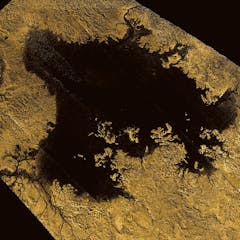
A false-color mosaic shows synthetic-aperture radar imagery of Titan’s north polar region, featuing Ligeia Mare the intended desintation for the TiME mission. NASA / Jet Propulsion Lab / USGS

Aside from discoveries of volcanoes, weather and complex organic molecules, one of the most exciting developments in the Cassini mission was the observations of lakes across the Titan surface. Dotted all over the surface and in many shape and sizes, some are big enough to have been name seas – or Maria. Being so far from the sun the average surface temperature of Titan is a chilly -194°C. So rather than water these lakes and seas are thought to be made up of mixtures of methane and ethane, making them a crucial part of the moon’s methane cycle.

But exploring the chemistry, depth and (probably most excitingly) possibility for biology on these hydrocarbon lakes will be impossible before we land an interplanetary boat on these seas. Added to this would be the potential for this probe to paddle about, sampling the atmosphere and mapping the shores, without all the issues that the Mars rovers have had getting their wheels stuck.

An artist’s impression of the Titan Mare Explorer (TiME) probe. Jet Propulsion Laboratory/Corby Waste

How soon will a ‘nautical’ mission take off? There’s nothing planned as yet. Sadly, NASA already have passed once on an opportunity to send a boat to Titan. Named the Titan Mare Explorer (TiME) it was proposed as part of the latest round of Discovery missions, and lost out to theInSight mission which will head to explore the Martian interior in 2016. More recently a Spanish engineering firm revealed concept plans for another mission Titian Lake In-situ Sample Propelled Explorer (TALISE). More ambitions than TiME, this design does incorporate a way of propelling it across the seas , either with wheels or an screw.

Even if a mission to send a boat to Titan gets approved tomorrow, there would still be a seven years or so travel to this frozen world. So until then, I suppose you’ll have to content yourselves with this written view from ‘The Shores of Titan’.

Methane hydrates – evil under the Antarctic or a force for good in the lab?

A study last week suggested that there could be up to 400 billion metric tonnes of methane under the Antarctic ice sheet.

The concern this study flagged up was the effect on the climate such a large amount of methane could have should it begin to leach out. Though the catastrophic outpouring of the methane in the near future seems unlikely, the study pointed out that that even small fluctuations in temperature and pressure of the ice sheet could cause an outpouring that current climate models don’t take account of.

And that’s where my interest (aside from the stability of the climate!) comes in. Methane hydrates are sometimes known as ‘fire ice’. When you pressurise methane and water and cool it down, the water forms a cage which traps the methane molecules, known as a clathrate structure.

This is a host-guest structure, with the water ‘host’ molecules containing the methane ‘guest’ molecules. To contain methane with water in this, delicate, structure requires temperatures to be below 25°C and the molecules to be buried by about 300m of sediment or ice.

This is why they are a continuing concern for deep sea hydrocarbon exploration. Moving the methane hydrates out of this setting, either by warming them up or taking them out of their buried environment, causes the water cage to destabilise and the methane to be released as a gas.

Methane hydrate, is often known as ‘fire ice’

This latest study isn’t the first to warn of the effect that the release of methane from methane hydrates can have on our climate. There’s some evidence that a warming of the ocean in the geological past caused a massive release of methane into the atmosphere.

This, affectionately termed an ‘ocean fart’, caused a large scale change in the carbon chemistry in the atmosphere and could have accelerated the warming in ancient times.

Humphry Davy (a rather interesting character who wrote romantic poetry aside from being a leading chemist) discovered clathrate materials in 1810, when he pressurised water with chlorine gas. Since then we have discovered that these structures form in a number of gases: Nitrogen, Argon even hydrogen to name a few.

There are also a number of ways that the water forms a cage about the gas molecule it’s hosting. These differ in the size and variety of cages that they contain. The research into these has opened up a number of intriguing possibilities of how we can engineer and store a lot of gas in a small amount of space.

Humphry Davy, a man of many talents. Engraving from about 1830, based on a portrait by Sir Thomas Lawrence (1769 - 1830)

But the problem remains that you need quite a bit of pressure or very cold temperatures to form these materials, and that’s not too possible for long term storage. There’s much work underway trying to understand how we can form these materials at surface pressure and room temperature.

Last year’s work at the European Synchrotron suspended droplets of a solution in a stream of air and used natural cooling from evaporation, adding a little bit of water to form their clathrate structures. Using the beam from the synchrotron, the researchers could monitor how the materials formed from the atomic scale.

A high speed video of the clathrate forming from a droplet, taken for the European Synchrotron study. Sarfraz et. al. Chemical Communications (2011)

My big hope, and that of many other scientists, is that really understanding how this super simple and elegant material forms may help efforts towards gas storage. Hopefully methane hydrates can be part of the solution, and not just part of the problem.

Curiosity gets to know its neighbours

The innocent victim, N165, now known as ‘Coronation’ rock NASA/JPL

There’s a rock on the surface of Mars that now has a very strange life story. N165’s life started out normally enough. Like the basalt rocks on Earth it would have erupted molten, and solidified when exposed to the cold atmosphere of Mars.

There it has sat, probably for a few billion years, only being bothered by a violent dust storm every few decades – each time shaving off a small piece. Until the present day, where N165 finds itself only about 8cm in size, slowly crumbling into its surroundings.

N165’s neighbourhood, until things changed on the 6th August. NASA/JPL

N165 wouldn’t have had very much warning of its impending difficulties. The atmosphere on Mars is very thin – sound cannot travel all that far. The first clue our plucky rock would have had of something being amiss was when the ground shook and a car-sized alien object, otherwise known a NASA’s Curiostiy rover, thumped down next to it in a cloud of dust.

Once the dust had settled, N165 got a better look at its new neighbour. Sat about one and a half metres away, it seemed passive enough. For the next few Sols Curiosity sat on the surface, giving the odd quiet whirl and click.

Could you out-stare this robot? Bear in mind, he has a laser! NASA/JPL

But then a great head sprung out from the body (I’m sure everything is quick relative to a rock), and N165 started to get a feeling that something was up. After a Sol or so there was no getting away from it, Curiosity was looking straight at it.

After trying to politely to ignore it, N165 thought that enough was enough and locked itself into a staring competition. Not blinking they sat there, the alien creature and the plucky Martian rock staring each other out. Then, in a spectacular cheating move, the alien creature zapped poor N165 with a 10,000 Watt laser.

The damage to N165 NASA/JPL

Reeling from this new development N165 really wanted to hide, run away or even try and fight back. Little did the rock realise that on Earth it had some new-found fame, and a grand title of ‘Coronation’ rock. By hitting the rock with that 10 second pulse of power a piece of it was vaporised, allowing us to detect the chemical make up of N165.

All this was not in the pursit of rock-torture, but a vital test of Curiostity’s ChemCam instrument. Coronation rock wasn’t picked for its uniqueness, but because it was a nearby object and identified to be a “typical” Mars basalt. So successful was ChemCam, it picked up traces of the scant Martian atmosphere while performing the test.

Just when N165 thought it was safe again, the robot unfurled this monstrosity. NASA/JPL

I’m sure N165 got nervous again when Curiosity’s robotic arm unfolded itself. This can extend over 2 meters and is armed with the percussive drill, able to do a lot of rock bothering. But Coronation rock can now breath again, with yesterday’s test drive Curiosity will soon be on its way. More science to be done, and rocks to terrorise….

The Dish #2: This time it’s Mars

‘The Dish’ is one of my favourite movies of all time, telling the story of the Australian and American crew who operated the dish to pick up the television pictures from the first moon landing. I was thinking the other day that, after the upcoming events in August, would a sequel be on the cards?

24 days to go now, and the nerves at NASA are showing. At 3.30pm on 6th August (AEST) they are attempting to land the Mars Science Laboratory, named ‘Curiosity’ on the surface of Mars. The engineers who designed the landing of this rover, the size of a small car, are calling it Curiosity’s ‘7 minutes of terror’.

Why put themselves though all this? Well Curiosity is a lot bigger than the previous rovers that have successfully landed. The last two rovers that landed on Mars, Spirit and Opportunity, bounced onto the surface encased in large air bags that deflated once they had come to a halt. Not only is Curiosity too big to do this with, but the planetary scientist that designed the mission are now being more picky on where they want her to land. The ‘sky crane’ is designed to land Curiosity in a prime interesting spot on the Martian surface, Gale crater.

The three types of rovers that NASA has landed on Mars. Right in front is the now-tiny ‘Sorjourner’ rover and behind that is a replica of the ‘Spirit’ and ‘Opportunity’ rovers. On the right is a replica of Curiosity. NASA/JPL

Curiosity is carrying a super package of instruments; the one I’m most excited about is called ChemMin. This small package uses x-ray diffraction and fluorescence and it’s hoped with identify minerals on the surface of Mars. It seems fantastic achievement that, 100 years since the discovery of x-ray diffraction from crystals, we’re now on the brink of doing this on another planet. It’s hoped that this little instrument (it’s about the size of a suitcase, where the powder diffraction instrument at Australian Synchrotron is as big as a bus) we be able to tell between minerals with water in them and those that don’t. This would allow us to map the progress of water on the surface, and under it – looking for nooks for the potential for life.

One group of minerals many scientist are particularly excited about finding are clays. It’s funny how boring old clays have suddenly become, well, rather sexy. From measurements from space it’s though clays are sporadic across the surface of Mars, suggesting that water only hung about on the surface for short periods of time. Opportunity, one of the rovers that landed in 2004 and is still trundling across the Martian surface, has found hints of many water-bearing minerals but is yet to detect the illusive clays.

And where does Australia play in all this? Well the success (or otherwise) of Curiosity’s 7 minutes of terror will be monitored by Canberra’s Deep Space Communication Complex. Managed by CSIRO, this complex will be one of the posts listening out for Curiosity as it sits on the surface of Mars. They are opening their doors on the 6th, so I’d encourage anyone in the Canberra area to head along, feel gripped by the tension and (all being well) marvel at Curiosity’s first pictures from Mars.

Nanomaterials on the Moon

Admit it, you probably think about soil very little? What about the soil on the moon? Well it’s a shame because, as I’ve come to realise in the last few days, moon soil is pretty nifty.

For one thing it would be a good place to keep your beers cool. If you could collect a bucket of it, your beer would keep cool for hours, as the lunar soil has very bad thermal conductivity. You could pour boiling water on the surface of the moon, and because of the soil the layers underneath would stay at frosty temperatures.

Though its soil will help you keep your beer cold you can’t have a party on the moon, there’s no atmosphere. Another Pint Please, on Flickr

It’s also seen to levitate. This was noticed by the Apollo astronauts, who saw that when they kicked up the dusty soil, it took longer to settle than the lack of atmosphere and low gravity of the moon should allow. It also stuck to everything, coating and damaging equipment in a way that had not been anticipated.

We now think this is because the lunar soil gets electrostatically charge. On the side facing the sun, the rays of sunlight (which aren’t hindered by any atmosphere) knock electrons off the material in the soil, leaving it positivity charged and able to repel other soil particles.

Now, an Australian scientist thinks he may have a clue as to why the lunar soil has these strange properties. Marek Zbik, based at the Queensland University of Technology used tomographic (3D x-ray images) to closely examine the bubbles within small glass beads found on the moon.

Funded by the Australian Synchrotron, Zbik took samples loaned from the Russian space program to the National Synchrotron Radiation Research centre (NSRRC) in Taiwan. The samples were part of the very first material robotically returned from the Moon, from the Luna 16 mission. As these are extremely rare samples, it was important that the analysis didn’t damage them. The super benefit of the synchrotron beam in this case was that Zbik could image the inside of the bubbles within the glass without breaking them.

“We were really surprised at what we found,” Dr Zbik has noted “Instead of gas or vapour inside the bubbles, which we would expect to find in such bubbles on Earth, the lunar glass bubbles were filled with a highly porous network of alien-looking glassy particles that span the bubbles' interior.’

Get your 3D glasses out, a movie of one of the nano particles found in the lunar soil

These particles, which are in the order of a billionth of a metre in size (nanometres), could explain some of the bizarre behaviour of the lunar soil. It’s because at this scale the ‘normal’ rules of physics don’t seem to apply. The forces that dominate our world, like gravity, have very little effect at this scale. Instead its tiny packets of electric charge that dominates, which can lead to some very strange behaviour.

It is thought that the nanomaterials are be being formed by the millions of tiny ‘micro’ meteorites that the moon gets pelted by on a daily basis. If, as Dr Zbik’s results indicate, nanomaterials are abundant in the lunar soil then there could be yet more bizarre things to be found in the lunar soil. Size, it would seem, really does matter.

Dr Zbik’s published article on this work is open access and can be read here.

Last chance to see the transit of Venus

Update 5pm Tales of the Transit

So that’s it for another 105 years, I hope that even if the clouds didn’t part you saw it on some of the live web feeds Ian Musgrave was keeping us well informed on.

There’s been some great tales (some of woe) surrounding the transit. I really feel for all in Perth, where the clouds only parted briefly. Also those planing to watch a stream of the even from Centralian Middle School, Alice Springs; where a cable was cut by mistake..

When I got into work I found a few people gathered round a telescope, looking for a breaks in the cloud.

What do you call a gathering of scientists? Nicola Scarlett

A particularly ingenious adaption of the telescope there, with a funnel over the eyepiece with some tracing paper stretched over the end. This made for some great images.

A super image Helen Brand

This wasn’t the only tale of genius adaptation. I heard of an Melbourne office worker (albeit with a PhD in optics) who angled one of his windows so that a reflection was bouncing between the outer and inner panes. Moving the inner pane enabled a image to be seen on the third bounce.

Lastly, one of my friends from undergraduate had perhaps the most spectacular trip, being sent to Spitsbergen to observe the transit for the European Space Agency (ESA). Emily, who’s a Space Science Editor for ESA recorded her experience on a live blog.

It’s been a super day, I really didn’t expect to be as excited as I was by it all. But seeing that first contact, and the small disk creep onto the sun was pretty magical. I’ll probably not make it to the next Venus transit in 2117, but thenext Mercury transit in five years time is firmly in my diary.

11 am Tranist in Progress

The transit of Venus! Helen Maynard-Casely

Wow, what an amazing morning. I can’t quite contain my joy at the clear skies here in Melbourne this morning. We haven’t seen the sun for three days but at the vital break of dawn on Venus transit day, a few fluffy clouds graced the horizon instead of a carpet of greyness.

So instead of dejectedly heading into work, my partner and I set up our telescope in front of the house, and projected the sun on to a hastily constructed white piece of paper taped to a bit of card.

We had a bit of a shaky start, after getting a fleeting glimpse of the first contact (when the small disk of Venus first crosses the giant disk of the sun) when one of the fluffy clouds floated in the way.

Worrying start, with a cloud floating across first contact. Helen Maynard-Casely

But luck was with us, and soon the cloud drifted off and allowed us to see the beginning of this historic event.

Phew, there it is! Helen Maynard-Casely

We had a lot of visitors, kids on their way to school and people out walking dogs. The most rewarding thing about showing them the transit, is the look on their faces when you explain this won’t happen again for 105 years.

Live streaming of the transit of Venus courtesy of the University of Queensland.

How to safely view the transit, but you need to be VERY careful near the eyepiece of this setup. Helen Maynard-Casely

A happy Helen! I’ve now seen the Transit of Venus in the Northern and Southern Hemisphere. Helen Maynard-Casely

Coming up to second contact, where the disk of Venus leaves the edge of the sun. Helen Maynard-Casely

A hint of the ‘black drop’ effect, which caused confusion of the timing for astronomers years ago. Helen Maynard-Casely

And off the disk! Ready to trundle it’s merry way across the sun. Helen Maynard-Casely

An upcoming transit

It’s not every day that a once-in-a-lifetime opportunity comes up, but on Wednesday you have the opportunity to see the silhouette of the planet of Venus move across the disk of the sun. To see this happen again you would have to live another 105 years.

I should correct myself, as for me it’s going to be a twice-in-a-lifetime event as I was lucky enough to see the last transit in 2004 from London. And, by lucky chance, I’ve gone and plonked myself right in the corridor that sees the whole transit once again.

Where on Earth the 2012 transit of Venus can be view from. Melbourne right in the full-transit area! PD-USGOV-NASA

If you are planning to try and see this great event, which will start in Melbourne on June 6 at 8.15am, PLEASE DO NOT LOOK DIRECTLY AT THE SUN. There are plenty of websites that explain how you can view the transit safely.

There’s been a lot of overview about the science history behind previous Venus transits. Transits currently occur in pairs about 120 years apart, so the transit before the last one in 2004 was in 1882. The 1769 transit which saw James Cook journey to Tahiti, has been touted as the first global scientific event, with international scientists collaborating to find the distance between the earth and the sun.

But here we are in the 21st century and we know the distance between the earth and the Sun quite well enough now (it’s, on average, 149.6 million kilometres should you need to know). But there is a group of scientists using the upcoming transit of Venus to further our understanding of the universe. Can it help us learn more about exoplanets?

The transit on June 6 will be old-hat for the Kepler spacecraft. Orbiting alongside Earth since 2009, Kepler is monitoring hundreds of thousands of stars looking for similar events – small planets passing in front of their stars. In reality, all Kepler sees is a slight dimming of the light from the host star, but this has enabled it to find to date 61 exoplanets orbiting other stars, even identifying other solar systems.

Diagram of the planetary systems found by the Kepler spacecraft. NASA Ames/Dan Fabrycky, UC Santa Cruz

So knowing that there are planets out there is one thing, but what are these planets made up of? Do they have atmospheres? For this researchers are now turning to spectroscopy, where the light that has travelled past a transiting planet holds signatures of chemicals on the planet itself.

The method, called transmission spectroscopy, has already been shown to see chemicals in the atmospheres of exoplanets. In 2008 NASA’s Hubble telescope detected methane in the atmosphere of an exoplanet 63 light years away, catchily called HD 189733b. Though this planet is too close to its star to support life, and probably a gas giant like Jupiter, it was an important step forward for exploring the universe.

Kepler has a harder task; it’s looking for smaller, Earth-like planets, which would have much smaller atmospheres. If we are going to be able to filter out chemical signals from such small bodies we need to have a good idea of what to look for.

This is when the potential of Wednesday’s transit comes in. We have a transit of a planet that, thanks to the work of the Venus Express and Magellan missions, we know a lot about. Venus has quite a dense atmosphere, dominated by carbon dioxide. A group have calculated what they expect the transmission signal from Venus to be, and hopefully will be able to couple this with accurate observations to be taken on Wednesday.

From the (perhaps not so) humble start discovering the distance between our earth and the sun, to helping us explore planets light years away, the transit of Venus continues to help build scientific collaborations across the globe.

Now all we need is for the clouds to stay away.

The chemical bond is stronger than we could have imagined

There are at present a number of ‘grand questions’ in physics. From the search for the Higgs boson to the unbalance of matter and anti-matter in the observable universe, but the one that most interest me is the search for metallic hydrogen.

Hugo90 on Flickr

Why? It’s the planetary implications. The planet Jupiter is very big and in the centre of it are extremes of conditions in terms of temperature and pressures that we cannot re-create here on Earth (yet). We’ve got a pretty good idea that the centre of Jupiter is going to be mostly hydrogen, as that is what most of the solar system is made of anyway. We know from gravity measurements that the centre of the planet is very dense. Jupiter also has a really interesting magnetic field. It’s massive and if we could see it’s whole effect, it would be bigger than the sun in our sky.

So we know something strange is going on in the centre of Jupiter (and indeed all the other gas giants). And we even can observe the effect of this strangeness in the massive magnetic field. Is this all because at massive pressures hydrogen, which we are all more familiar with as a gas, becomes a metal?

The theory goes that under extremely compressed conditions the hydrogen molecule breaks down and the electrons that orbit its nucleus will ‘delocalise’ and the material will become a metal. The first of these calculations, in 1935, predicted that this would occur at 250,000 atmospheres of pressure (equivalent to about 10 fully grown African elephants on one stiletto heel) but some of the first high-pressure experiments to get to those pressures soon found that this was not the case. Metallic hydrogen remained illusive.

In the last couple of months there have been two major finding reported in the search for metallic hydrogen. The first was from a group in Edinburgh, UK, who collected data from hydrogen at 3.15 million atmospheres. Using spectroscopy they found a distinct change in the behaviour of the material, indicating that the atoms within had changed their arrangement.

The possible structure of hydrogen at 3.15 million atmospheres.

The structure of graphite

Looking to theory they noted the similarity of their measurements to those predicted by a graphite-like structure for solid hydrogen.

Then a group in Washington DC, USA reported that they believe the hydrogen molecule is still intact and not metallic at 3.6 million atmopheres. They believe even at these pressures at least part of the structure is still made up of the H2 molecules that make up the hydrogen gas we are more used to. So now experimenters are at an impasse, it would seem the higher they go in pressure the more the hydrogen impresses them with the strength of its bond.

It all begins to beg the question what if hydrogen doesn’t become metallic? Do the theoretical results need to be revised? Is there another way to describe Jupiter’s magnetic field?

Hydrogen has long been used as a model system, because of its simplicity containing only one proton and one electron. The higher in pressure scientists observe hydrogen, the more complicated it would seem to become. So if even the simplest of things can be so perplexing, the mind boggles about what anything else in the universe will do!

Australians! British Science is not dead

On Tuesday a funeral cortege pulled up outside the UK’s Westminster parliament and the mourners pulled out a wreath depicting ‘Science’. Some 100 protesters observed this as part of their protest against the ‘Death of British Science’.

The protest saw the launch of the group ‘Science for the future’ who used this event to highlight what they see as the injustice of the UK’s Engineering and Physical Research Council’s new policy for distributing funding.

But was this a good move? Looking from 14,000 miles away I’m having my doubts.

In 2010 I, with a thousand other scientists, marched on Westminster as part of the ‘Science is Vital’ campaign. We had been motivated by the prospect of devastating cuts to the science budget and spurred into action by cries of ‘No more Dr nice guy’. The Science is Vital team delivered a petition signed by 30,000 scientists and engineers to the treasury.

It was the politest rally ever, a very enjoyable day out; I even took Jupiter for a walk. What I loved about the ‘Science is Vital’ rally was that it didn’t matter if you were a biologist, an astronomer or even an organic chemist; we were there to point out that Britain needs science.

And it worked. Instead of cutting science the UK government froze the budget. OK, not ideal but far better than what had been touted.

My unease about Tuesday’s protest was that it was it was a specific gripe at the way some physicists and chemists receive their funding. As valid as this gripe may be, to tout it as the ‘Death of British Science’ seemed unnecessary and potentially damaging hyperbole. I’m sure those who spent Tuesday working an 18 or so hour day in the lab would agree with me.

Organisations like ‘Science is Vital’ and the Australian group ‘Discoveries need Dollars’ show that grassroot campaigns can effectively mobilise the scientific community, with great effect.

The message that I think Australia science should take out of this all is we should not be complacent. It was a bit of a mixed picture from the science budget, and if the recent uncertainty over the funding for the synchrotron has anything to go by, scientists cannot rest on their laurels.

Governments are facing many more pressures from an ever-more-squeezed pot of money. We need to be telling the public and politicians alike why we are important and not just taking it for granted they know this.

The anticipation of some freshly squeezed results

The chink of light in the few weeks of madness I’ve had was news that European Space Agency (ESA) have decided to commission a mission to Jupiter. A catchy name too, JUICE from JUpiter ICy moons Explorer. The mission will focus on three of Jupiter’s Galilean moons, Ganymede, Callisto and Europa as well as making new observations of the gas giant itself.

JUICE will be following in the footsteps of a highly successful NASA mission, the Galileo spacecraft. Big shoes to fill as Galileo, amongst many other things, discovered that Europa has an internal ocean, making it a prime candidate for life away from Earth.

Ganymede, taken from the New Horizons spacecraft as it passed by on it’s way to the outer solar system. It’s hoped that ESA’s JUICE spacecraft will find answers to some of the mysteries this moon posesses. NASA/Johns Hopkins University Applied Physics Laboratory/Southwest Research Institute

However, whilst Galileo focused on the smaller moon Europa, JUICE firmly has the largest of Jupiter’s moons Ganymede in its sights. The satellite is due to enter orbit of the icy moon in 2032, it will circle Ganymede investigating the moon’s surface and magnetic field.

Ganymede is unique within the solar system, as it is the only moon that generates its own magnetic field. This is particularly weird as the moon was originally thought to be too small and cold to generate such a strong field. Though some have thought of a few ways this could happen, the phenomenon that creates the magnetic field will remain a mystery until JUICE gets there.

Similar features on Ganymede (left) and Europa (right). Where it is thought that the feature on Europa has been formed from the spreading of the icy crust, it’s not so clear if the same process can happen on the older terrain of Ganymede NASA/JPL/Brown University

Paradoxes from the magnetic field aside, the similarity of features between Europa and Ganymede makes this moon also a tantalising prospect for life. JUICE will carry two cameras, one with filters so that extra details can be picked up on the surface.

So it’s quite a wait, and I don’t know where on Earth I’ll be by 2032. But I’ll be mostly looking forward to the results of the spectrometers that JUICE will carry. Though we know the surfaces of these moons are partly made of water ice, there is thought to be a significant amount of other material. These instruments will discover what these extra materials are, which would be super if they tied up with the experiments I’m doing at the synchrotron!

The world is not enough: why we shouldn’t mine asteroids

With an enormous fanfare, pomp and ceremony, a consortium of billionaires released their newest space plans: to mine an asteroid. These guys have a history of game changing when it comes to space, having been part of the pioneering of space tourism. Despite the grand expense, the far-fetched nature of the beast and the fact that we’re not even sure what asteroids are actually made of, you kind of think they might actually do it.

Asteroid Vesta from NASA’s Dawn spacecraft. A marvel for science or the future source of our rare metals. NASA/JPL-Caltech/UCLA/MPS/DLR/IDA

The idea of mining other bodies in the solar system for their mineral wealth is not particularly new. The Earth is currently in the grips of a shortage of Helium (yes party balloons may soon be a thing of the past). The moon has itself been touted as a possible source for mining this light gas, in order to keep MRI scanners and the hope of fusion reactors alive.

Putting the ethics of extra terrestrial mining aside for the moment, at the recent 43rd Lunar and Planetary Science meeting I was struck about how little we actually know about asteroids. ‘Asteroid’ is quite a broad-brush term, but describes an object in orbit around the Sun, which isn’t a planet. It now usually refers to bodies, which are circling within the orbit of Jupiter. There are hundreds of thousands of them, with a massive range of compositions – from metal to rocks and carbon rich organics.

Many of these bodies inhabit the Asteroid belt, a collection of about 90,000 asteroids that live in the space between Mars and Jupiter. NASA’s Dawn mission is currently probing the two biggest asteroids belt objects, Ceres and Vesta. It’s swooping about Vesta has blown apart the fuzzy images we first had from Hubble and revealed the potential for finding water ice as well as rich variety of geological features. It is due to reach Ceres, the biggest asteroid of them all, in 2015.

Mining is one thing but bringing the material back to Earth is, perhaps, the most underestimated challenge. Only very few space missions have achieved this robotically, most relevant was the valiant Japanese Hayabusa mission. It returned dust from the asteroid Itokawa after having trouble picking the stuff up. It plunged back to Earth in June 2010, with the landing guided to the South Australian outback.

One of the main reasons to study these desolate rocks is that many asteroids are protoplanets, leftover mini planets from the throng that came together to form Earth, Venus, Mercury and Mars. They are super old, and detailed knowledge of what they are made of and what they have been through, could reveal much about the formation of our solar system. Will they shown fingerprints from comets passing millions of years ago? How did they survive shattering impacts, and can we learn from these?

Ceres and Vesta, like their many smaller cousins, are yet another marvel of the solar system. They are beautiful and could reveal much about how the Earth was formed, are they really the answer to our resource problems?

So I’d like to throw this open to the floor, am I being too squeamish about the whole idea? Would this drive to space for profit throw us into a new space age?

Or am I right to be a little suspicious, at least uneasy about the feeling that we need to head to space solely to exploit resources because we’re using up those here on Earth?

Rubber chicken in space!

As the world braced itself for the large solar storm last month, one fearless rubber chicken looked danger in the eye and went to meet it head on. Armed with only a knitted space suit, Camilla took to the skies and reached the edge of space at 120,000 feet.

As she ascended to above 99% of the Earth’s atmosphere, her badge allowed the school students who launched her to get measurements of one of the strongest proton storms in years. An expert in such matters, Camilla is the mascot of NASA’s solar dynamic observatory, and the figurehead of the centre’s outreach program.

It was all in a day’s work for Camilla who is now, unlike most chickens, a seasoned aviator having flow in a T-38 training jet as well as a previous flight on a helium balloon. She even kept a cool head during the drama of the balloon exploding, sending her hurtling back to Earth.

Camilla the rubber chicken is only one of a number of unlikely space travellers of late, from Lego men to cans of beer. Part of this increase in orbital visitors has been encouraged by projects such as last year’s Hackerspace in Space. Laying down strict rules on cost and explaining the regulations, many teams took on the challenge to launch a payload to the edge of space, take a picture, and get it back down safely.

But why? I suppose the phrase ‘because we can’ springs to mind. But it should never be underestimated how inspiring projects such as these are. Be it launching a space balloon, building a basic computer, or learning to extract DNA for yourself. In an ever technological society, we need as many people as possible, from 5 to 105, to be engaged and excited about scientific achievements.

And as a final note, an Austrian man plans to take a leaf out of Camilla’s book and is using a space balloon to make the highest ever free-fall jump. Aiming to jump from the edge of space, Felix Baumgartner needs to wear a specially designed spacesuit to survive the low pressure and cold. Now that’s taking science to the extremes!

Shedding new light on an old rock

When thinking about what to kick off this column with, it seemed appropriate to give an insight into a project we’re looking into at the synchrotron.

At coffee a few months ago a fellow researcher Simon, who works on the X-ray fluorescence microscopy beamline, mentioned he was despairing at finding sample to test a new technique to map elements inside a sample on.

Simon’s a brain guy, and mainly works with biological samples which, because they are mainly made of light elements (carbon, oxygen and hydrogen), do not fluoresce all that well under the X-ray beams we use at the synchrotron.

Fluorescence happens when a material absorbs some electromagnetic radiation (such as X-rays from the synchcrotron) and then gives off the excess energy in the form of light. This is easier when a material has more electrons to begin with, for instance is made up of bigger elements than the relatively simple carbon, oxygen and hydrogen.

Hence Simon needed a sample that was made of heavier stuff – silicon, iron and the like – to be able to hone the new technique. If it was interesting, that would be a bonus.

I’ve had in my rock collection (you can’t go through a geology degree without ending up with a bit of a rock collection) a small piece of the Allende meteorite that I picked up from a museum shop in Germany.

After hearing Simon’s plight, I realised this would be a really good sample for him, it has lots of the heavier elements in it, and it is a very interesting piece of rock. I broke off a small chunk (about 3 mm by 3 mm) and handed it over.

A false colour image of fluorescence from a small piece of the Allende meteorite. Red show the presence of calcium, green shows iron and blue is where chromium is. X-ray fluorescence beamline, Australian Synchrotron

Beautiful isn’t it. What the X-ray fluorescence microscopy (XFM) beamline is very very good at is mapping where particular elements are with fantastic detail. In the image I’ve put in here Simon has picked out the positions of three elements: calcium, iron and chromium.

Thousands of tonnes of rock fall from space every year, but why is the Allende meteorite is so special?

It’s often referred to as “the most studied meteorite in history” and came to Earth as a fireball, breaking up on entry over Mexico in 1969. Landing as it did, right in the Apollo era, nearly 3 tonnes of material from the fireball were strewn over a small village, Pueblito de Allende.

As US laboratories were preparing for the first moon rocks to be returned, many were happy to have such an interesting specimen land almost on their doorstep.

It was soon realised that the Allende was the largest carbonaceous chondrite to be found on Earth. This is a particularly rare meteorite type, making up only 4% of the meteorites we have found. Carbonaceous chondrites are especially interesting because they contain some of the oldest and most primitive material in the solar system.

A slice of the Allende meteorite. The lighter grey round patches are known as chondrules and are thought to have formed at the beginning our our solar system. Shiny Things, Flickr

Much of the scientific interest in the Allende meteorite has fallen on the tiny specs of carbon in the form of diamond that has been found within it. These diamonds have a very strange chemical signature, which point to their origins being from outside our own solar system.

With the XFM beamline we unfortunately can’t trace these tiny diamonds. We can, however, accurately map how the heavier elements are spread about this ancient rock.

Hopefully this work, as well as developing a great new technique, could provide clues as to how this amazing rock came together. Who knows what this could tell us about how our solar system came into being?

A short introduction

James Whitesmith, Flickr

A young researcher is wandering about the newly planted forest of eminent columns on The Conversation and notices the door to one has been left open …

*Looks about the inside of the column*

It’s nice and roomy in here; white space with lots of potential. Has that nice, new car smell to it. Let’s see how this goes then.

So where did I pop up from? I’m currently a postdoctoral researcher at the Australian Synchrotron and have come on a bizarre science route, through geology, physics and chemistry and jelly balloons to get here. Most of it did make sense at the time.

I’ve very much an experimentalist, just as likely to be found in the lab covered in mineral oil as in front of my computer pouring over data. The main drivers of my science are very small molecules, how their crystal structures affect their overall physical properties and the worlds about them.

One of the main tools I use for this is X-ray powder diffraction, where I’m able to study the structure of my materials while changing the environment about them. I like diamonds, but not for the same reason as most girls.

What will I write about? Well I’m interested in opening up physical science: why did the researchers look at that? Why did they do it that way? What are the unresolved issues? Why is this interesting? Will these findings help me to make a better cup of tea?

So, let’s get started then.