
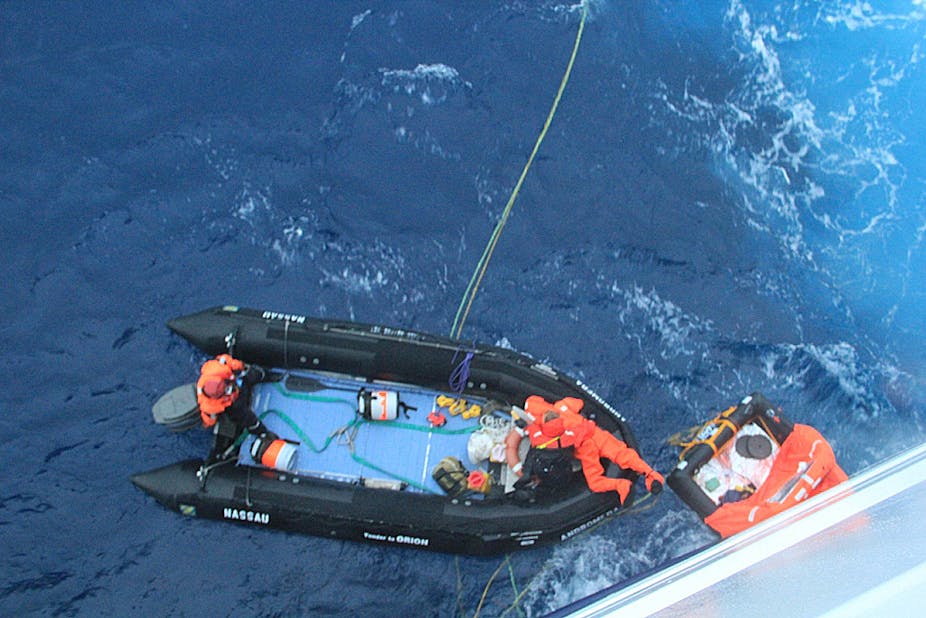
Passengers aboard the cruise ship Orion, which recently rescued French sailor Alain Delord in the seas southwest of Hobart, were at first upset that they had to detour from their planned route. They were on course for Macquarie Island and the diversion to attempt to rescue the stricken sailor was going to take them more than 50 hours off course.
But finding they had the chance to save someone’s life put their situation in perspective, and many passengers later spoke of being compelled to help when faced with the opportunity to save someone’s life. Indeed the Orion’s Captain, Mike Taylor, reported cheers throughout the ship when Alain Delord was eventually pulled on board.
So close to Australia Day it is great to witness such an example of the national spirit on display. A tiny capsized boat holding one person who has been adrift for days in open waters, brings out the best of our ability to go out of our way to help someone in distress. It’s the same spirit we see nightly on our news as many communities face bush fires. Irrespective of language, nationality and inconvenience, the chance to do something good prevails. Mr Delord described his rescue as a “miracle”; one that gave him “a second chance at life”.
Contrast this recent scene of rescue at sea with the hostility displayed last year towards asylum seekers arriving by boat . As asylum seekers arrived by boat seeking safety, politicians competed to seem tougher on border security and harsh detention regimes were re-established on Nauru and Manus Island.
As the issue of boat arrivals reached fever pitch with an Expert Panel inquiry announced (and The Conversation’s own expert panel launched), it became harder and harder to convey the story of asylum seekers as people seeking a miracle as they boarded boats in the hope that Australia would provide them with their own second chance at life.
So what is the difference between Alain Delord’s story and the story of so many asylum seekers?
For me, it the personalisation of the story – the fact that we can attach a face and name to Delord, when asylum seekers largely remain nameless and faceless. Part of this is due to efforts of the Department of Immigration and Citizenship to deliberately de-humanise asylum seekers. Why else do we call the boats “SIEV” (Suspected Irregular Entry Vessel) and the people on them “IMAs” (Irregular Maritime Arrival)? In a sea of legal labels and confusing acronyms, individual stories and personal details are obscured.
For too long, we’ve been led by politicians telling us how to think about the issue of asylum seekers. Cameras are not allowed into detention centres and once released from detention, many refugees fear that telling their stories might harm the situation of their families in their countries of origin. Confidentiality and anonymity can safeguard their life.
Many asylum seekers do want to tell their stories. For example the Voiceless Journeys photo project, Refugees' Australian Stories, Amnesty International’s Re-think refugees campaign and the Between the Devil and the Deep Blue Sea film each present different sides and faces of this very complex tale. And if you are in need of more summer reading, Ali Al-Jenabi’s harrowing tale of exile and displacement is told in Robin de Crespigny’s award-winning book “The People Smuggler”.
Some asylum seekers' stories go on to become stories that we celebrate on Australia Day. Take for instance one of the finalists for Young Australian of the Year, Akram Azimi. Akram arrived as a refugee from Afghanistan as a teenager and he has used his second chance in Australia to support and mentor Indigenous communities in Western Australia. These stories are out there waiting to be heard.
As we approach the Australia Day long weekend at the end of January, I’m not sure if it is too late for new year’s resolutions. One possible resolution for 2013, an election year where asylum seekers are undoubtedly going to generate more political debate, is to start making up our own minds about asylum seekers.
Beyond IMAs, “illegals” and “boat people” are men, women and children who have faced arduous journeys. Asylum seekers are in need of rescue and we can help them. Wouldn’t it be nice if just once we could read a quote from the Australian Maritime Safety Authority, having found asylum seekers at sea, that says, “It was a challenging rescue operation, but Mohammed and his family needed our assistance and we can give them a chance at a better life”?
Marilyn Shepherd
pensioner
We care more about sheep and cows than we do asylum seekers, this is a shameful country.
I wish SBS would replay the Man Who Jumped this year to show what really happens when DIAC are wrong.
All people at sea deserve rescue, asylum seekers though have to wait until enough people are drowned to act as a deterrent to others.
Robert Attila
Business Analyst
"shameful country"? You have no idea. My parents were immigrants escaping persecution from E.Europe but they always told me to be grateful to be born in Aus.
Aus is now predominantly O/S born or children of O/S parents.
Those asylum seekers have plenty of $ to pay to get here, so obviously they r not as poor as many believe, ie $10,000 per person. They r simply queue jumping which denigrates our laws & those waiting to emigrate in far more desperate conditions such as Africa than those in the…
Read moreJohn Bryan
Retired
Personalization is the key. The reader, the spectator becomes involved.
With asylum seekers it's more difficult. How to control disease? How to guard against criminals? What are the standards and policies we, the people, should demand from our government?
Every situation is different; every situation demands its special solutions. Are we prepared for that? I don't think so.
Phil Dolan
Viticulturist
Why is it more difficult with asylum seekers? They are just people and we have doctors and police.
The article hits the nail on the head with the depersonalization though. It's so easy to lead a population. I feel for the people in the navy who have to deal with it. It gets pretty personal for them.
And what aren't we prepared for? Treating people with respect?
We are being led by politicians who are playing to our fear of boat people. When the numbers get as high as in the rest of the world, what will we do? Tens of thousands. Who knows, we might start to feel as the original inhabitants did 200 years ago.
Felix MacNeill
Environmental Manager
Do the French never experience disease or commit crimes?
Sue Ieraci
Public hospital clinician
Perhaps we just assume that yacht owners must be healthy and honest, while asylum seekers must be disease-ridden potential terrorists.
Did this yachtie have correct papers on him?
James Jenkin
EFL Teacher Trainer
Isn't this article comparing apples and oranges?
It would make sense if it showed we only rescue rich sailors - but not refugees - when they're in danger at sea.
Instead it says while we're willing to rescue someone from a capsized boat, we won't give refugees 'a chance at a better life'.
How are they comparable? The only thing in common seems to be there are boats involved. It would be like saying 'We're willing to spend millions on the America's cup, yet we won't spend money on refugees'.
Incidentally I personally support Phillips' position on refugees. I just don't think the article presents a very sound argument.
David Clerke
Teacher
Why should we show more "compassion" for people who can arrange passage to Australia in search for a better life than those who may spend decades in refugee camps. How many refugees are in the world at the moment, twenty million? I remember a professional refugee from Somalia who appeared on the SBS reality TV "Go back where you came from". He had bought forged papers in Germany and had previously been in Rumania he then flew to Australia. On the reality show he went back to Somalia to visit relative who were hale and hearty including a grandmother who was around a hundred. What persecution had he fled from in Somalia and what in Germany>
Janet Congues
logged in via Facebook
Thank you for a wonderful presentation of this whole debate! People are people, no matter what the race, ethnicity, religion, socio-economic status in this world. Showing compassion to people in need is something we, in Australia pride ourselves on - yet we seem very picky as to who we choose to show compassion to. There are always people who buck the system, but they are generally the minority. I wish we could focus on the majority. Point well made, Melissa.
Robert Attila
Business Analyst
All boat people r bucking the system Janet, not just a few. Your logic is flawed. You dont find legal immigrants coming on boats with legal immigrants.
Basically, they r merely jumping the queue, & have paid on average $10,000 per person to do so. I guarantee you most REAL refugees dont have $10 let alone 10 thousand.
Send them to the back of the queue at the nearest refugee camp.
That is fair on our resources, but mostly fair on those waiting in refugee camps following our procedures.
PS My parents emigrated form persecution as well, but legally.
The boat people r telling you they care nothing about our laws.
The only exception to these requirements would be in emergency cases such as all out war with no alternatives.
Leonie Moore
logged in via Facebook
Actually I get a bit annoyed with these adventurers that put themselves at risk and then have to be rescued at the cost and inconvenience of others. If the Orion has to pay compensation to its passengers who missed out on a big part of their tour (which they paid a lot of money for), I hope they can recoup this from Mr Delord. These people should have to take out large insurance policies before they set off on these dangerous lone voyages. He was out there with full knowledge of the conditions, for his own adventure, unlike an asylum seeker who is trying to get a better life.
Paul Fourie
RF Technology Leader
The asylum seekers also choose to put themselves in harms-way just like Mr Delord, so if they get rescued must they also pay for it?. Their motivations is different but that is not the argument. Both parties should be treated the same. Border control is in place to deal with people coming into a foreign country regardless of the means of transport. The argument here is whether one agrees with the rules and restrictions in place for the regulation of border control. The article does not compare apples with apples and plays the "emotion" card instead of just dealing with facts. It also hints at the flawed "diversity is beneficial" idea.
Felix MacNeill
Environmental Manager
Paul, there's a bit of a difference between 'putting yourself in harm's way' to escape persecution and doing so for personal adventure.
David Clerke
Teacher
Even if they are escaping persecution and not simply economic refugees there is a requirement in international law that you apply for refugee status in or from the first country of safe haven. You do not have the right to swan around the world looking for the best deal anymore than a shipwrecked mariner can demand to be picked up by a luxury cruise ship rather than the first vessel available.
Anneliese Ford
Senior Consultant
It is not Delord vs us, or asylum seekers vs us. We are all part of the one human family, simply seeking to meet Maslow's hierarchy of needs. For those of us in the incredibly lucky position of living in Australia at this time, how can we so limit our compassion, our humanity and our capacity to show kindness to those in need? My guess is that if the asylum seekers were English or American, we would not dare demonstrate such moral deficit. For every person who decries asylum seekers, put yourself in their place, and then dare to judge.
Melissa Phillips
Doctoral Candidate at University of Melbourne
Thanks for the responses. Another resource I forgot to mention is this site http://www.africamediaaustralia.com/
Robert Attila
Business Analyst
I dare to judge. My parents emigrated from persecution in E.Europe but they did it legally & told me to be loyal & grateful to Aus.
Its irrelevant to me where they come from, the laws apply to everyone. They r not 'special'. Boat people raise $10,000 to pay a smuggler to take them to a rich country. Obviously they r predominantly economic not political refugees.
I wonder if people with those attitudes will go straight on the dole, breed more & prosper at tax payer expense. From the documentaries…
Read moreRobert Attila
Business Analyst
Melissa, your lone boatman example is irrelevant to the debate, & some of your comments are emotive & again irrelevant.
But i agree that anyone on land or water that needs rescuing should be forced to pay a hefty fee. They may think twice before gallivanting around the world for excitement, in single personnel craft. Tax dollars r not infinite nor theirs to waste.
My parents emigrated from persecution in E.Europe but they did it legally & told me to be loyal & grateful to Aus.
Its irrelevant…
Read moreAnthony Nolan
Ruminant
Melissa writes about the rescue of Delord:
"So close to Australia Day it is great to witness such an example of the national spirit on display."
Exactly. We rescue wealthy sailors and let refugees drown. That's our genuine national spirit right there: flint hearted, hypocritical, cowardly. Roll on Australia Day becuase I so enjoy the spectacle of crowds of staggering, drunken oafs showing their Aussie patriotism by wearing the flag on their arses.
Felix MacNeill
Environmental Manager
Anthony, is it just me or do others also experience a visceral revulsion nowadays whenever they se an Australian flag displayed.
I should note that both mu grandfathers fought under that flag and i am deeply proud of their sacrifice. Until a few years ago, I was also reasonably proud to be Australian - it wasn't that I thought we were better than anyone else or perfect, just that, on the whole, I thought we were reasonably decent, open-minded and honourable. I was never a great one for flag-waving, but I certainly wasn't offended by our flag.
But these days, I'm beginning to experience a gut reaction to seeing it displayed that is frighteningly close to what I experience when I see a swastika.
I expect a set of hysterical 'if you don't love it, then leave it' kinds of reactions. I can only say that the very reason I say this is precisely because I do (or certainly did) love it and don't want to see it turned into (or is that back into?) a small-minded, mean-spirited backwater.
Abbie Noiraude
logged in via Facebook
I avidly agree with you Felix.
My grandfather and father fought under the red ensign, not the blue flag ( popular AFTER 1952) and both would be disgusted at the flag waving, even though they both were conservatives.
Anthony Nolan
Ruminant
I have a rule of thumb regarding the display of the Aussie flag anywhere except official buildings and during official ceremonies which is that the bigger the flag or the greater the number then the greater the degree of marginalization experienced by the flag waver. Remember Boswell's comment that "patriotism is the last refuge of the scoundrel". Well, we always have been a nation of scoundrels!
Hopefully, The Conversation will launch a series of columns on this subject to mark Australia Day…
Read moreFelix MacNeill
Environmental Manager
Maybe we should start a loyalty oath movement, as in Catch 22.
Abbie Noiraude
logged in via Facebook
Until the fear and hatred drummed up by Howard via American President Bush jnr we never saw asylum seekers anything but desperate people taking desperate measures to try for a better life.
Why do we decry those who want a better life, the life we have?
Why do we judge before having heard their stories or understanding their plight and their intent. Rather like days of yore when my parents and grandparents judged and decried our Aboriginal brothers and sisters without having ever heard their story let alone without having even met them.
Don't we encourage our children and our immigrants to aim high, to battle the odds to do better, to achieve more? Why then denounce those who dare to do the same under extenuating circumstances, under excruciating backgrounds, under painful motivational necessities.
Let's find the Leadership who will say; Enough! Welcome to Australia.
David Clerke
Teacher
There are over twenty million refugees in the world today. Are you advocating open borders and if not how many do we take and which ones?
James Hodgkinson
logged in via Facebook
"So what is the difference between Alain Delord’s story and the story of so many asylum seekers?"
The biggest difference to me is that he wasn't intending to gain access to our country illegally, he came upon rough seas and encountered an emergency situation.
Abbie Noiraude
logged in via Facebook
Seeking asylum is NOT ILLEGAL. Sigh* How many times does it have to be said!!!!
Sue Ieraci
Public hospital clinician
Capsized asylum seekers were intending to seek asylum legally, they just came across junky boats that sank.
John Phillip
John Phillip is a Friend of The Conversation.
Grumpy Old Man
So attempting to enter a country without papers and by avoiding detection is not illegal?
Phil Dolan
Viticulturist
The ones who avoid detection are the ones who come by plane.
John Phillip
John Phillip is a Friend of The Conversation.
Grumpy Old Man
That doesnt answer the question
Phil Dolan
Viticulturist
It is not illegal to arrive in Australia and ask for asylum. However, if you arrive by plane and ask for asylum while you are still in the airport, you will be sent back to where you came from. Boat people want to be found. They do not hide unlike many folk who overstay their visas.
From the immigration website; In the 2009–10 financial year, it was estimated that approximately 15 800 people overstayed their visa.
We don't see that on the front page of the Australian.
John Phillip
John Phillip is a Friend of The Conversation.
Grumpy Old Man
Thanks Phil. I would hazard a guess that the reason we dont see that on the fron page of the Austrlalian is that people who fly in and overstay a) come with documentation and b) dont put their lives and the lives of their rescuers at risk. I do like your consequence though: "you will be sent back to where you came from". Makes a lot of sense for any nation attempting to have control over its borders. Any response that leads to an increase in boat arrivals automatically leads to an increase in deaths by drownng. Cheers
Jim KABLE
teacher
Thank-you for writing with such fellow-feeling for our brothers and sisters from western Asia coming to Australia seeking refuge.
Colin MacGillivray
Retired architect
Good article
There are a lot of Australian who think "asylum seekers" is the wrong description and they are "Illegal immigrants". Whatever they are, I think anyone who pays a lot of cash to risk death to reach Australia should be welcomed as a plucky and committed future citizen and tax payer.
Wasn't so long ago that no hopers could get here for 10 pounds.
Felix MacNeill
Environmental Manager
It's an interesting thought, isn't it, Colin?
I think Hugh MacKay once observed that, at the risk of sounding flippant, the kind of gumption, energy, commitment and desire demonstrated by people who got on leaky boats to get here wasn't such a bad test for citizenship.
It's not entirely serous, and I'm well aware things aren't that simple, but it does represent a counter-view to the belligerent 'queue-jumper' rhetoric...
David Clerke
Teacher
Unfortunately four years after being granted asylum 85 per cent of Hazaris are still on social welfare. Hardly model citizens.
Melissa Phillips
Doctoral Candidate at University of Melbourne
Thanks Felix and others for your thoughtful comments. The issues aren't easily solved (as we saw when a Panel of Experts tried their hardest to reach a workable solution) but it's great to see a counter-view being discussed. That's just what The Conversation is for!
Sue Ieraci
Public hospital clinician
"Unfortunately four years after being granted asylum 85 per cent of Hazaris are still on social welfare. Hardly model citizens."
Four years is a very short time in the life of a migrant. Let's watch a bit longer and see their children contributing enthusiastically to our society, without risking their lives just for being Hazari.
Robert Attila
Business Analyst
Well said Mel.
Few debates r ever black & white, no matter how emotive them seem..
Robert Attila
Business Analyst
Sue, incorrect.
4 yrs is plenty of time to find work, or for making excuses.
My parents escaped persecution in the 60's, emigrated LEGALLY here, & found work within days of arriving in Geelong. They had no $, no english, no family/friends & no help from the govt. The friends they met on the ship did the same. Even the ship fare was repaid to the govt. They were put into tin sheds, no air con, etc.
Compare that to the luxurious accommodation & all the freebees etc of the illegals these days…
Read moreMindi Kua
logged in via Facebook
I agree with James. There is a vast difference between asylum seekers and Alain Delford. Asylum seekers make passage to Australia for the sole purpose of making application to stay here, often at great expense in terms of legal representation, accommodation and allowances. They have no intention of returning from where they came. Mr Delford was not even attempting to come to Australia, and will go home without being sent. We must ensure our borders are protected and we do not provide an incentive for people to jump the queue.
Felix MacNeill
Environmental Manager
What bloody 'queue' would that be? one that is currently running at something like 76 years?
John Phillip
John Phillip is a Friend of The Conversation.
Grumpy Old Man
Why do you think there might be such 'queue', Felix? How many people are you prepared to support?
Steve Hindle
logged in via email @bigpond.com
"So what is the difference between Alain Delord’s story and the story of so many asylum seekers"?
Well "personalisation of the story" may be an important difference, but another difference you have missed is that of numbers.
Alain is a single story whereas the stories of Asylum seekers number in the tens of thousands.
Jim KABLE
teacher
I don't understand where it comes from but whenever there is a conversation on matters relating to cultural difference or immigration/refugee/asylum-seekers/Indigenous Australia - the selfish me-first-ism rises up and with cynical cleverness and hyperbole hi-jacks a more generous and humanitarian exploration of whatever are the issues/difficulties first outlined in the headlining essay. What is it that has turned a once (in some respects) more open-hearted and socially-caring people into this cold-faced glare at "the other"! Re the flag - I noticed to-day that Prof. BLAXLAND at ANU has designed an "inclusive" flag - beyond discussion of the corner which represents Britain - or fighting kangaroos - but includes aspects in symbolic form of both - plus other aspects of Indigenous cultures, our ethnically diverse society - stunning!
Mindi Kua
logged in via Facebook
Who really wants to live in Jim's world. A place where anyone can come and live at our expense. Let them come by their millions, Jim will put food in your mouth and a roof over your head.
Alain's story is different because he is not going to apply for asylum. These left wing purists are unable to see that argument. And I bet Alain said thank you, and has not gone on a hunger strike!
Felix MacNeill
Environmental Manager
Then again, oh person not using their real name, Alain wasn't locked away indefinitely behind razor wire...nor were his children.
Tony Simons
Accountant
We need to have more stories and a film. History will judge Howard, Gillard, Abbott and Morrison harshly.
Dalit Prawasi
Auditor, Accountant, Trade Teacher
“As asylum seekers arrived by boat seeking safety”. You are right and wrong as Delord, I am sure wanted to be rescued and has not yet asked for asylum here. “So what is the difference between Alain Delord’s story and the story of so many asylum seekers?” You should have rephrased your question: So what is the difference between Alain Delord’s story and the story of so many asylum seekers and the 40 million (See UNHCR reports etc) or so refugees around the world? Why do we discriminate between…
Read morePaul Fourie
RF Technology Leader
Agree, white refugees from Europe, South Africa etc. has a much better chance to assimilate into the Australian society.
Felix MacNeill
Environmental Manager
Just heading off to vomit quietly in the corner, Paul
Roni Taylor
logged in via Twitter
"So what is the difference between Alain Delord’s story and the story of so many asylum seekers?"
The answer is within your question: "so many."
Compassion is born of empathetic distress. We 'feel' for those we rescue.
We can as easily sympathise with the distress of a single asylum seeker as we do for an adventurer, we can as easily rally a rescue mission, shout 'hurrah' and then go back to our regular lives satisfied in a job well done.
But when there's always another asylum seeker to rescue, and a daily gauntlet of charity collectors to run, and the ongoing compassion demands of our friends and families, we begin running out of spaces to recover from our empathised distress.
It's called 'compassion fatigue' and it cannot be resolved by expecting people to care more. Anyone who works in a 'caring profession' can tell you:
there's only so much we can take.